

Why did Trump pardon Changpeng Zhao?
The White House's public explanation, the $2 billion settlement arrangement involving USD1, and the questions that remain to be confirmed and answered.
In 2025, Trump pardoned Binance founder Changpeng Zhao; prior to this, MGX announced a settlement of its $2 billion minority stake investment in Binance at USD1. Pardons, lobbying, stablecoin reserves, and federal banking regulation converged on a simultaneous timeline. This article examines the boundaries of known facts and evidence based on publicly available documents: currently, there is no evidence to prove an exchange relationship between the transaction and the pardon, but the transparency of the decision-making process and potential conflicts of interest still require verifiable explanations from the relevant parties.
Editor's Note: Why start with Trump pardoning Changpeng Zhao?
In October 2025, President Trump pardoned Binance founder Changpeng Zhao. Ten months later, the U.S. Office of the Comptroller of the Currency granted preliminary conditional approval to the World Liberty Trust Company, National Association, bringing this trust bank application related to USD1 to the doorstep of the federal banking regulatory system.
The two issues are legally independent: the former concerns a natural person's federal conviction and the president's power of pardon; the latter concerns stablecoin issuance, reserve assets, custody, and bank supervision. But between them lies a $2 billion deal that cannot be ignored: Abu Dhabi-based investment firm MGX made a minority stake in Binance and publicly chose USD1 as its settlement stablecoin.
When reviewing pardon records, legal documents, lobbying filings, company announcements, and USD1 data, my primary concern wasn't presupposing charges against any party, but rather why several paths originally belonging to the White House, capital markets, and financial regulation intersected at the same time. When public power, private business interests, massive cross-border transactions, and financial regulation all appear in the same institutional context, what should the public know? And what questions remain unanswered?
This is precisely why GFM.News launched the "Institutional Deconstruction: Changpeng Zhao, He Yi, and Binance" research series, using this article as the entry point. This is not an exposé, nor is it intended to create a legend for any individual; we hope to put individuals, companies, laws, capital, technology, and user assets back onto the same institutional map, ensuring that every power corresponds to responsibility and that every claim can withstand the test of evidence.
Jeff Morgan
Editor-in-Chief of GFM.News
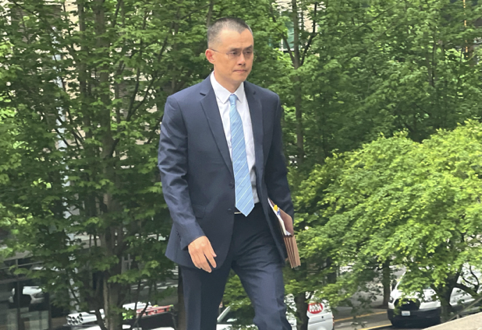 (Image caption) Changpeng Zhao (CZ), former founder of Binance. His pardon by President Trump has become a significant event in the global discussion on crypto finance and public power.
Evidence and Conclusions in this Article
The existing public records are sufficient to confirm the following facts:
In March 2025, MGX announced a $2 billion minority stake investment in Binance. Subsequently, Zach Witkoff, co-founder of World Liberty Financial, publicly stated that USD1 had been chosen as the settlement stablecoin for the investment. Changpeng Zhao and Binance also separately hired lobbyists to engage with the US administration regarding "administrative remedies" and digital asset policies. Changpeng Zhao was subsequently pardoned by President Trump in October 2025.
These facts constitute a business, political, and institutional intersection that deserves serious examination.
However, as of the data cutoff date, GFM.News has not found any publicly available documents sufficient to prove that the use of USD1 in this investment was a transaction, a directive, or a causal relationship with Trump's pardon of Changpeng Zhao. This article does not presume anyone to have acted illegally; what this article seeks to investigate is whether the decision-making process was sufficiently transparent when interests may have clashed, and what verifiable answers the public has the right to demand.
Scene 1: The White House Pardon
On October 21, 2025, the U.S. federal government exercised one of its most personal and difficult-to-reproduce powers through external processes. According to U.S. Department of Justice pardon records, President Trump pardoned Changpeng Zhao, the founder of Binance, commonly known as CZ.
Two days later, White House Press Secretary Karoline Leavitt stated at a press conference that the pardon application would undergo a full review by the White House Office of Legal Counsel. The White House placed this decision within a broader policy narrative: the Trump administration believed the Biden administration's enforcement approach towards the cryptocurrency industry was overly hostile; Changpeng Zhao was seen as an isolated case of excessive prosecution.
Trump later told the media that he did not know Changpeng Zhao and did not believe the two had ever met; he said that many people had suggested he grant a pardon and that some had told him that Zhao had been persecuted by the Biden administration.
These are the policy and procedural reasons publicly given by the White House and President Trump. They are sufficient to explain the position of pardons in the political narrative, but still insufficient to fully reconstruct the decision-making process in individual cases.
Who made the recommendations? What legal, sentencing, policy, and ethical materials were submitted? What standards did the White House Office of Legal Counsel use to assess administrative remedies? Did the White House conduct a conflict of interest assessment regarding issues involving the Trump family's business interests? Currently, public records do not provide complete answers.
The U.S. Constitution grants the president broad powers of pardon for federal crimes. The Justice Department's pardon process can offer advice, but it cannot limit the president's constitutional power. The source of this pardon power is clear; whether its exercise is sufficiently transparent is another question that the system must answer.
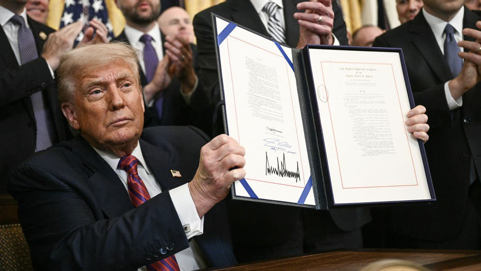 (Image caption) On July 18, 2025, Trump displayed the signed GENIUS Act at the White House. The image shows the federal legislation on stablecoins, not the signing ceremony of the amnesty, and is used to illustrate the digital asset policy direction of this amnesty.
What did Changpeng Zhao admit to, and what did Binance admit to?
When discussing pardons, accuracy is paramount.
On November 21, 2023, Changpeng Zhao pleaded guilty in a U.S. federal court to violating the Bank Secrecy Act. According to the U.S. Department of Justice case record, criminal complaint, and plea agreement, he admitted that he caused Binance to fail to establish and maintain an effective anti-money laundering program.
On April 30, 2024, the U.S. District Court for the Western District of Washington sentenced Changpeng Zhao to four months in prison and a $50 million fine. Zhao has since served his full sentence. Therefore, the pardon did not shorten his actual time in prison; its more likely impact is the ongoing eligibility restrictions, reputational damage, and future business opportunities resulting from the federal conviction.
Binance's legal liability is broader. According to the agreement released by the U.S. Department of Justice, Binance admits to crimes including: conspiracy to violate the Bank Secrecy Act and failure to register as a money transfer operator, as well as violation of the International Emergency Economic Powers Act.
Binance agreed to forfeit $2,510,650,588 and pay a criminal fine of $1,805,475,575, for a total economic penalty of $4,316,126,163; the company also agreed to make compliance reforms and accept independent compliance oversight.
This distinction cannot be ambiguous. Changpeng Zhao personally admitted to causing Binance's failure to maintain an effective anti-money laundering system; Binance, on the other hand, admitted to a broader range of corporate criminal liability. Attributing all of Binance's corporate penalties to Changpeng Zhao personally is inaccurate; describing him as being convicted for personally carrying out specific money laundering transactions also exceeds the scope supported by legal documents.
The pardon does not erase this history. The Department of Justice's general guidelines on pardons state that a pardon is an executive branch act of leniency and does not equate to an acquittal; the original federal conviction and subsequent pardons remain in the relevant records. More importantly, the pardon for Changpeng Zhao personally does not overturn Binance's guilty plea, financial penalties, or compliance obligations.
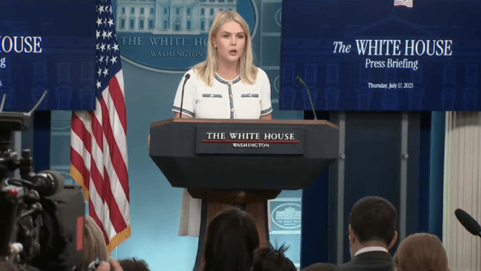 (Image caption) Former White House Press Secretary Karoline Leavitt speaks in the White House press briefing room. The White House has explained the pardon of Changpeng Zhao as a correction to the previous administration's approach to cryptocurrency enforcement.
Scenario 2: A stablecoin enters a $2 billion investment pool.
On March 12, 2025, MGX and Binance announced a $2 billion minority equity investment. Both parties stated at the time that the investment would be paid in stablecoins; the announcement did not specify which stablecoin would be used.
On May 1, Zach Witkoff publicly stated at an industry event in Dubai that USD1 had been selected as the settlement stablecoin for this investment. USD1 was launched in March of the same year; Reuters, citing CoinMarketCap data, reported that as of April 30, its circulating supply had reached approximately $2.1 billion.
The significance of this arrangement goes beyond just "the use of cryptocurrency for payments".
In typical dollar-backed stablecoin structures, issuers usually hold cash, short-term U.S. Treasury securities, or other eligible assets as reserves. The returns generated from these reserve assets, after deducting custody, compliance, liquidity, technology, and operating costs, can become a significant source of revenue for the issuance and servicing structure; ordinary token holders typically do not directly receive these returns.
Therefore, when USD1 is used as a settlement instrument for a $2 billion transaction, the market is naturally concerned not only with whether a payment has been completed, but also with how reserve assets are managed, how the returns are distributed, which legal entities have economic interests, and whether these interests are kept sufficiently separate from public decision-making.
In October 2025, Reuters estimated under specific market conditions that the reserve assets associated with the transaction could generate approximately $80 million in annual revenue. This is a media estimate, not an audited actual return, and should not be presumed to be revenue earned by any specific individual, member of the Trump family, or affiliated entity. Interest rates, reserve size, redemption activities, servicing costs, and revenue distribution arrangements will all alter the final outcome.
A lawyer for World Liberty Financial objected to Reuters' broader analysis of valuation and revenue, arguing that the analysis was inaccurate and misleading. MGX stated that it evaluated various stablecoins before making its selection, considering commercial suitability, the jurisdiction where the reserve assets are located, the currency, and compliance records. MGX also stated that using USD1 does not constitute an investment in World Liberty, and that the seller required settlement in cryptocurrency.
Binance and Zhao Changpeng's lawyers also stated that neither client controlled MGX's choice of settlement instruments, and linking the use of USD1 to Zhao Changpeng's pardon application lacked factual basis.
These are all publicly stated positions of the relevant parties. GFM.News has not yet been able to independently obtain the complete transaction agreement, settlement instrument selection procedure, list of decision-makers, reserve service agreement, and revenue distribution arrangements. Therefore, this article cannot portray the commercial overlap as an exchange of benefits, nor can it interpret the temporal proximity as a causal relationship.
However, the proximity in time, the enormous scale of the funds involved, and the inclusion of stablecoin settlements and family-related business interests within the same institutional environment are enough to subject this pardon to a higher degree of scrutiny regarding public interest and conflicts of interest.
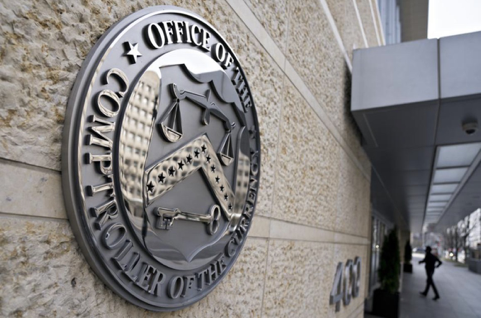 (Image caption) U.S. Treasury Department building. Binance and Changpeng Zhao's lobbying filings both involve digital asset policy and administrative remedies; FinCEN and OFAC, under the Treasury Department, are also important regulatory bodies for Binance's 2023 settlement and ongoing compliance oversight.
Lobbying does not provide the complete answer.
Federal lobbying filings provide another verifiable lead on this issue.
Changpeng Zhao has hired Baker & Hostetler to lobby on his behalf. The registration was filed on March 24, 2025, and will take effect on February 10; the registered lobbyist is Teresa Goody Guillén, and the subject of the application is "administrative remedies".
Binance Holdings Ltd. also hired the same law firm and the same registered lobbyist, effective February 10, 2025. Their filings included financial services policies related to digital assets and cryptocurrencies, as well as "administrative remedies." Binance subsequently hired Checkmate Government Relations; the firm reported in its Q3 2025 LD-2 filing that it received $450,000 in lobbying fees from Binance, also concerning digital asset policies and administrative remedies, with contacts including the White House and the U.S. Treasury Department.
These documents demonstrate that administrative remedies and cryptocurrency policies have indeed become targets of organized lobbying.
However, the filing itself did not disclose, item by item, the forms of legal remedies sought, the materials submitted, the content of the actual meetings, the instructions from the parties, or who ultimately influenced the president's decision. Changpeng Zhao and Binance Holdings Ltd. are two different clients in the filing; without further evidence, their legal responsibilities, costs, instructions, and political objectives cannot be conflated.
Furthermore, both parties used the same law firm and the same registered lobbyist, initiated engagements on the same date, and both filed for "administrative remedies." This is not evidence of coordination, but it does raise a fact-checking question that should be addressed: Did the two engagements share personnel, documents, government meetings, funding, strategies, or specific objectives?
The American political and legal system allows for the hiring of lawyers and lobbyists. What truly needs transparency is not the legality of the contact itself, but rather the content, procedures, impact on decisions, and how conflicts of interest are handled.
The third scenario: USD1 arrives at the doorstep of the Federal Banking System.
On August 14, 2026, the Office of the Comptroller of the Currency (OCC) issued Corporate Decision No. 1385, granting preliminary conditional approval to the application to establish the World Liberty Trust Company, National Association.
According to the decision, the proposed institution will be located in the Bay Harbor Islands, Florida; after meeting conditions such as capital, management, independent audit, Bank Secrecy Act, anti-money laundering, information security and pre-opening inspection, it plans to issue and redeem USD1, manage its reserve assets, provide digital asset custody services, and provide certain exchange services to custody clients.
The OCC filing indicates that the proposed trust bank plans to take over the issuance and custody functions of USD1 currently handled by BitGo Bank & Trust, National Association, and subsequently acquire and assume the reserve assets and related liabilities of USD1 from BitGo. Existing public documents do not fully clarify whether BitGo will continue to provide technology, custody, liquidity, exchange, or other services if the transfer of functions is completed, and how these services will be divided.
It must be emphasized that this is a preliminary, conditional approval, not a final authorization to open for business immediately. The OCC will only issue final approval after all pre-opening conditions are met; until then, the OCC retains the regulatory power to process this preliminary approval in accordance with the law.
USD1 is a blockchain-based payment stablecoin, not a bank deposit insured by the Federal Deposit Insurance Corporation (FDIC). Progress in the application for a national trust bank license will not automatically grant USD1 holders FDIC protection.
This section is not the same as the pardon of Zhao Changpeng, but it illustrates a larger institutional context: when a stablecoin that was once used to settle $2 billion in cross-border equity transactions moves further into the federal trust bank structure, the public needs to ask not only whether it can circulate, but also who manages the reserves, how the redemption right is executed, how the custody responsibility is allocated, and who is truly responsible to users in the event of stress or failure.
 (Image caption) Binance corporate logo. The personal pardon granted to Changpeng Zhao does not alter Binance's acknowledged corporate responsibilities, financial penalties, and compliance obligations.
Policy direction can explain the background, but it cannot replace case-by-case review.
Changpeng Zhao is not the only defendant in the digital asset ecosystem to be pardoned during Trump's second term. Trump also pardoned Ross Ulbricht, founder of Silk Road, as well as Arthur Hayes, Benjamin Delo, Samuel Reed, Gregory Dwyer, and HDR Global Trading Limited, all associated with BitMEX.
These cases differ in their acts, charges, penalties, and factual backgrounds, and should not be substituted for one another. However, they collectively constitute part of the Trump administration's relatively supportive political signal regarding the digital asset industry.
On January 23, 2025, Trump signed an executive order to readjust the U.S. federal government's digital asset policy; on March 6, he established the Strategic Bitcoin Reserve and the U.S. Digital Asset Reserve; and on July 18, he signed the GENIUS Act, establishing a federal regulatory framework for payment-based stablecoins. The White House has repeatedly stated its desire for the United States to become a global center for cryptocurrency and digital financial innovation.
Against this policy backdrop, Zhao Changpeng's pardon is indeed consistent with the Trump administration's overall direction of reassessing the previous administration's approach to cryptocurrency enforcement and attracting digital asset companies and capital.
However, policy consistency cannot replace case-by-case review. It can explain "why such a pardon might be politically possible," but it cannot answer alone "why this decision was made at this time and for this person."
Confirmed transaction links versus decision-making links that are still pending verification.
Currently, the number of confirmed personal relationships is quite limited.
Trump stated that he does not know Changpeng Zhao and does not believe the two have ever met; Zhao has also publicly stated that the two have never met. GFM.News could not find any verifiable public information to prove that the two have a direct personal relationship or have had a substantive meeting.
On April 27, 2025, Changpeng Zhao met with Zach Witkoff and other co-founders of World Liberty in Abu Dhabi, referring to them as friends on social media. Public records indicate that the meeting concerned the global adoption of cryptocurrency and industry standards. This proves that Zhao had contact with executives of companies associated with the Trump family; however, it does not prove that the meeting involved pardons, MGX investments, or USD1 settlement arrangements.
The business relationships are more specific: MGX has made a minority stake in Binance; USD1 has been publicly selected as the settlement instrument for transactions; stablecoin reserves may generate revenue; and there are economic interests involving entities related to the Trump family in the World Liberty project that need further clarification.
Government processes are also observable: the Trump administration adjusted its cryptocurrency policy, Changpeng Zhao's legal status changed due to the pardon, and Binance and Changpeng Zhao sought administrative relief and policy access through formally registered lobbying channels.
These three relationships must be described separately. The absence of evidence of a direct personal relationship does not mean that a conflict of interest does not exist; the existence of business connections does not mean that the pardon has been sold, exchanged, or unjustly influenced.
To elevate a reasonable review to the level of establishing an exchange relationship, at a minimum, communication records of decision-makers or intermediaries, meeting documents, complete transaction terms, payment arrangements, witness testimonies, or other mutually corroborating evidence are required. Currently available public records do not form such a chain of evidence.
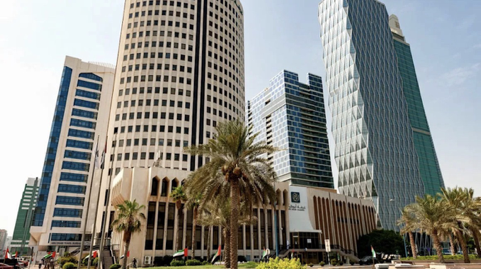 (Image caption) Abu Dhabi-based investment firm MGX. The USD1 settlement arrangement used by MGX for its $2 billion minority stake in Binance has raised concerns about the intersection of related economic interests and public power.
The public still has not received the answer.
The most responsible answer to the title of this article at this stage is:
President Trump and the White House publicly acknowledged that Changpeng Zhao was excessively prosecuted by the Biden administration; the pardon aligns with the Trump administration's support for digital assets, adjustments to previous cryptocurrency enforcement policies, and efforts to maintain America's competitiveness in fintech. Zhao's lobbying efforts with Binance established a formal channel for communication regarding administrative remedies and policy positions.
On the other hand, the settlement role of USD1 in MGX's $2 billion investment in Binance, and the potential reserve gains and economic benefits behind it, make this amnesty subject to a higher degree of conflict of interest scrutiny.
However, the existing public evidence is still insufficient to prove that the transaction constitutes an exchange with the pardon.
Unsolved problems are not abstract, and they can be answered.
The White House can explain the categories of individuals involved in advising on and reviewing the pardon, the review standards used by the White House Counsel's Office, and how conflict of interest assessments are conducted when there may be financial interests related to the president's family.
Can Changpeng Zhao and Binance explain whether their respective commissions to Baker & Hostetler share personnel, documents, meetings, funds, or strategies? What is their relationship with Checkmate Government Relations? What is the complete timeline of their contacts with government officials? And could the pardon affect Changpeng Zhao's future role in Binance's governance?
MGX, Binance, and World Liberty can also disclose the USD1 selection process, the decision-making authority of each party, key service agreements, reserve arrangements, and revenue distribution principles.
The law may not require all business documents to be made public, but public trust depends on whether the relevant interpretations can withstand the test of evidence.
I cannot conclude from existing public documents that "a deal was made in exchange for a pardon"; but precisely because I cannot conclude, the system needs to ask questions that can be answered, rather than asking the public to fill the gaps in transparency with speculation.
This article does not announce a conspiracy for its readers, nor does it offer any innocence to either side. It simply connects a few lines that are already in the public record: a presidential pardon, a $2 billion investment settled in USD1, two sets of administrative relief lobbying, and a stablecoin issuance plan that is moving toward a federal trust bank structure. These may not constitute an exchange, but they are enough to constitute a public interest issue that cannot be dealt with simply by "belief."
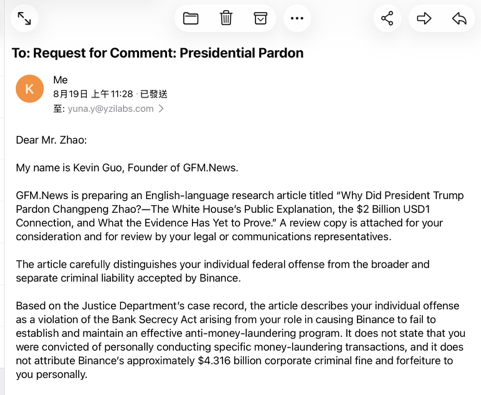 (Image caption) On August 19, 2026, GFM.News sent emails to Changpeng Zhao, He Yi, Binance, and the White House Press Office, requesting responses with a draft for review; apart from Binance's automatic reply, no substantive responses were received before the deadline.
Invitation for further research and response
GFM.News previously published "How the Trump Family's USD1 Entered the US Federal Banking System," examining the licensing, reserve assets, redemption rights, and regulatory independence issues surrounding the World Liberty Trust. This article, following the $2 billion settlement arrangement, further delves into the institutional boundaries of presidential pardons, conflicts of interest, and public transparency.
GFM.News's "Web4 & RWA" column will launch a series of studies titled "Institutional Deconstruction: Changpeng Zhao, He Yi, and Binance." The first article in the series, "Changpeng Zhao and He Yi: How Binance Was Created," will return to the market environment of 2017 and examine how the two founders combined their capabilities in trading systems, user organization, branding, and market expansion. Subsequent articles will continue to explore platform business and responsibility, dual-CEO governance, YZi Labs capital allocation, startup incubation, the RWA power chain, and governance issues arising from the integration of AI agents into the financial system.
GFM.News welcomes documents, data, corrections, and supplementary responses from the White House, Changpeng Zhao, Binance, MGX, World Liberty Financial, YZi Labs, and other relevant parties. Any significant new information that can be independently verified will be included in this article in accordance with GFM.News' established correction and update procedures.
Disclaimer
This article provides institutional and financial analysis based on publicly available information and does not constitute investment, legal, tax, business, or transaction advice. All allegations, estimates, company positions, and media reports cited in this article do not constitute an independent determination by GFM.News of any illegal activity. Digital assets carry high risks; readers should verify relevant information independently and make decisions prudently.