

Robots are not yet ready, but the capital market has already begun pricing in their future.
—After Unitree Robotics' surge on its first day of trading, how far away is the "ChatGPT moment" for humanoid robots?
Yushu's stock price surged on its first day of trading, indicating that the capital market has already priced in the future of humanoid robots. However, the maturity of the technology, commercialization, data ownership, employment impact, and safety regulations still need to be verified. The real "ChatGPT moment" may have to wait until robots can consistently create quantifiable corporate value.
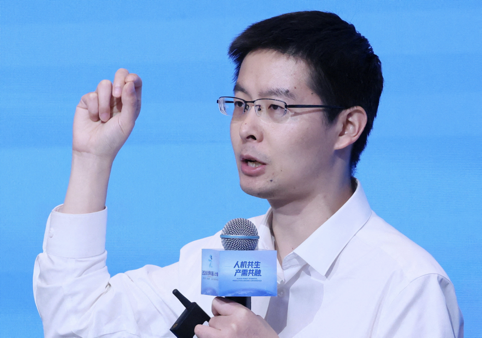 (Image caption) Wang Xingxing, founder of Unitree Robotics, delivered a speech at the main forum of the 2026 World Robot Conference, pointing out with a cautious attitude that the "ChatGPT moment" of embodied intelligence will take at least two to three years, and at most five to ten years.
The market arrived in the future before robots.
On the morning of August 19th, Unitree Robotics officially listed on the Shanghai Stock Exchange's STAR Market. The opening price was 1,100 yuan, 629% higher than the offering price of 150.8 yuan. The closing price fell back to 845 yuan, still a 460% increase, with the company's market capitalization settling at approximately US$50 billion. This was a first-day performance far exceeding the average for Chinese IPOs this year—the average first-day gain for Chinese IPOs this year has already reached a staggering 279%. Unitree's retail subscription was oversubscribed by more than 8,000 times, with a winning rate of only about 0.018%, meaning that the vast majority of the nearly ten million retail investors who participated in the subscription ultimately failed to receive an allocation.
A day later, on the stage of the World Robot Conference in Beijing, Wang Xingxing, the 36-year-old founder of Unitree Robotics, gave a prediction that was completely out of sync with the stock price. He said that the robotics industry was approaching its "ChatGPT moment"—future robots would be able to rely on more mature embodied intelligence to understand natural language instructions in unfamiliar environments and complete tasks that had not been pre-programmed. But he immediately added: if progress goes smoothly, this breakthrough will still take two to three years; if it is slower, it may take five to ten years. He did not hide the reality: today, the efficiency of most humanoid robots in real-world work scenarios is still not as good as that of an ordinary worker.
These two scenes, separated by only one day, represent the most intriguing contrast in the current state of the humanoid robot industry. The capital market has already priced robots based on a grand future, while the founders of robot companies stand on stage reminding investors that the future of truly versatile robots is yet to come.
Yushu's listing thus provides a rare window of observation: for the first time, the market can use daily fluctuating public stock prices to measure an asset of "machine labor" that is still in the early stages of commercialization.
Unitree Robotics is not a company that only tells stories without generating revenue. According to its prospectus disclosed by the Shanghai Stock Exchange, Unitree Robotics' revenue in 2025 was approximately RMB 1.699 billion, with a net profit after deducting non-recurring gains and losses of approximately RMB 591 million, a gross profit margin of 60.13%, and net cash flow from operating activities of RMB 670 million. Among many humanoid robot companies that are still burning through cash, such profitability is a rare commodity.
The company's revenue structure has changed rapidly in the past two years. In 2023, humanoid robots accounted for only 1.88% of Unitree's revenue; by 2025, this proportion had risen to approximately 51.78%, with humanoid robots surpassing quadruped robots for the first time to become the company's largest source of revenue. The prospectus discloses that Unitree will ship more than 5,500 humanoid robots in 2025, making it the world's number one; as of the end of July this year, the cumulative production and delivery of bipedal humanoid robots has reached approximately 18,000 units.
These figures explain why the market is willing to pay a high premium for Unisoc, but they don't answer a more crucial question: how many of these robots have truly become production tools that companies are willing to pay for long-term use, rather than one-time showcase purchases? Shipment volume is an important metric, but for machine labor, the future may require another measure closer to asset efficiency: where is a machine actually deployed, how many hours does it effectively work each day, how frequently is it maintained, what is the cost of completing a task, and is the company willing to continue purchasing them? Only at this stage will shipment volume truly begin to translate into sustainable production capacity.
Unitree Robotics' own wording in its prospectus was quite cautious—the company acknowledges that the global humanoid robot industry is still in the early stages of technological exploration and has not yet achieved large-scale application; current application scenarios are concentrated in scientific research, education, application development, cultural performances, and intelligent services. Industrial manufacturing and warehousing logistics are generally considered to be the directions that are likely to be scaled up first, while service scenarios such as medical care and education still face a series of issues such as technological maturity, cost-effectiveness, privacy, and user acceptance. A robot that can run, jump, and perform a beautiful set of boxing moves proves its motion control capabilities; whether it can work continuously for eight hours a day in a factory at a total cost lower than that of a worker is a completely different business proposition. The demonstration that wins applause at the World Robot Conference today does not equate to labor productivity in a factory tomorrow.
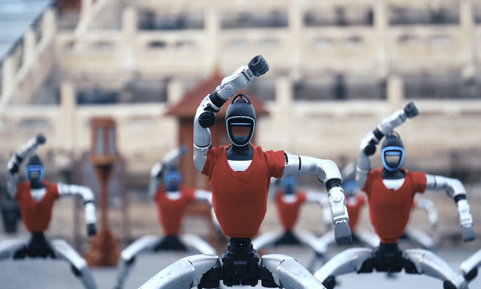 (Image caption) Yushu humanoid robots performed synchronized martial arts at the Temple of Heaven in Beijing, demonstrating excellent motion control and coordination. Such demonstrations often generate buzz in the market, but they are not yet equivalent to factory production efficiency.
What exactly did the $50 billion buy?
When Unitree Robotics priced its IPO, the company was valued at approximately 61 billion yuan, equivalent to about 9 billion US dollars. CITIC Securities previously estimated that the valuation range six to twelve months after listing would be approximately 50.6 billion to 55.9 billion yuan, equivalent to 20 times the projected 2026 sales and 80 times the projected profits. The market completely overturned this valuation within just a few hours—the company's valuation surged to approximately 67 billion US dollars at the opening, equivalent to about 857 times the projected 2026 profits, according to Reuters Breakingviews; even after closing at around 50 billion US dollars, it was still far higher than the IPO valuation.
It's difficult to find a reasonable explanation for this price using today's profits. The market is essentially buying into something that hasn't been realized yet: the future market share of robots in manufacturing, logistics, and services; the vast amounts of real-world data accumulated during robot operation; the continuous improvement of embodied intelligence models; the economies of scale formed by hardware platforms; and the potentially huge productivity dividend that could emerge once machine labor costs fall below human labor costs. This is why the valuation of humanoid robots cannot be simply based on the price-to-earnings ratio of an ordinary equipment manufacturer—the price paid by investors includes not only hardware, but also software, data, and the unproven value of a general-purpose robotic platform.
Taking this logic a step further, humanoid robots may be forming a new type of priced asset: Machine Labor. Today, the capital market is buying Unitree's stock, but what truly needs to be priced in the long run is how many effective working hours a machine can provide, how much cost one hour of machine labor will incur, how much productivity it can bring to the company, and ultimately, how much sustainable cash flow it can generate. Decades ago, the market learned to value rail transport capacity, electricity production capacity, and later, cloud computing power; if general-purpose robots gradually mature, "Machine Hours" may also become the next production factor continuously calculated by corporate finance departments and capital markets.
However, Unitree's own prospectus has already given the market a heads-up. The company's revenue CAGR from 2023 to 2025 reached a staggering 226.78%, but in the first quarter of 2026, revenue growth had already slowed to 68.49%. Affected by rising R&D and sales expenses, non-GAAP net profit decreased by 52.55% year-on-year. The company expects revenue to still grow by 35.62% to 45.41% in the first half of this year, but non-GAAP net profit may decrease by 6.43% to 21.97% compared to the same period last year. It's not surprising that a rapidly growing technology company would increase its R&D investment. What these figures truly remind the market is that from explosive early growth to larger-scale commercialization, revenue, expenses, and profits will not always follow the same upward curve.
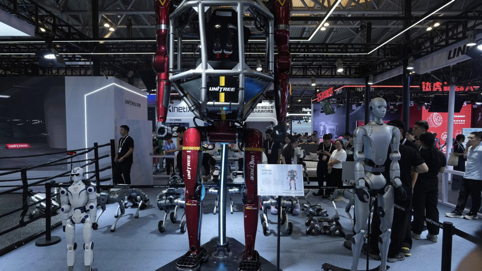 (Image caption) At the Unitree Robotics booth at the World Robot Conference, multiple humanoid and quadruped robots were displayed side by side, attracting a large number of visitors and industry professionals, reflecting the industry's transition from laboratory to open commercialization.
The robot's body also reflects China's manufacturing capabilities.
Humanoid robots are often seen as the next battleground in the US-China AI competition, and there's some truth to that. However, focusing solely on whose model is smarter easily overlooks the fundamental difference between robots and pure software AI: robots need a body. They require motors, reducers, servo systems, batteries, controllers, a stable supply chain, and factories capable of mass-producing them at sufficiently low costs. China possesses a significant industrial foundation in this area—Reuters, citing industry data, reported that Chinese companies delivered over 40,000 humanoid robots in the first half of this year, accounting for approximately 97% of global deliveries. Since the definition and shipment statistics for humanoid robots haven't yet reached a mature and unified global standard like the automotive industry, this percentage still needs to be observed as the industry develops, but China's current advantage in delivery scale is already very clear.
Yushu is a typical example of this industrial structure, and its technological origins are not actually mysterious. A recent Reuters investigation into the quadruped robot industry pointed out that some key early research initially came from publicly funded research projects funded by the US military and institutions such as MIT. Chinese companies did not secretly obtain these results, but rather rapidly transformed publicly available research findings into engineering, supply chain integration, and large-scale low-cost manufacturing capabilities. This case is particularly worth considering for the United States: leading in basic research does not equate to leading in manufacturing; inventing a technology does not mean controlling the market that develops from it. The United States still has a clear advantage in AI models, semiconductors, and basic research. Tesla has already begun installing the first-generation Optimus production line, and companies such as Boston Dynamics have also developed their own technological roadmaps. However, if the competition in general-purpose robots ultimately depends on model capabilities, cost control, parts supply, and large-scale factory deployment, the outcome will not be decided solely in the laboratory. It will be closer to the competition in the automotive or semiconductor industries—technology, manufacturing scale, and capital capabilities are all indispensable.
What will be the first job to be changed?
Humanoid robots attract so much attention for a straightforward reason: they resemble humans and are designed to perform tasks traditionally done by humans. China's aging population and declining working-age population have created a very real economic impetus for automation, and Beijing also sees robots as one of the technologies to fill future labor shortages. Many of the products showcased at the World Robot Conference have clearly defined applications in manufacturing, logistics, police assistance, healthcare, elderly care, and public services.
For the average person, the question "Will robots take my job?" is a natural one, but it might be a misdirected question. A more relevant question is: Which jobs will be changed first? Over the past few decades, industrial automation has rarely eliminated an entire profession overnight. Tasks like welding, handling, sorting, and repetitive assembly have been initially offloaded to machines, while humans have shifted to monitoring, maintenance, quality inspection, programming, and jobs requiring more complex judgment. Humanoid robots will likely follow a similar path—if they cannot reliably understand their environment in an unfamiliar factory, companies are unlikely to entrust an entire position to them; but if they can consistently move boxes, retrieve materials, conduct inspections, or complete dangerous tasks within a fixed area, it will already be enough to change the content of some jobs.
Public policy therefore needs to answer another, more difficult question: when robots begin to increase corporate productivity, who ultimately reaps the benefits? It may first be reflected in corporate profits and shareholder returns, or it may flow to consumers through price reductions; if workers are able to enter new maintenance, management, programming, and operation positions, they may also share in some of the benefits. Historical automation has not provided an automatically established answer to this distribution, and the robot era will similarly require advance preparation in education, vocational training, and labor systems.
Has the education system begun training technical personnel to maintain and manage robots? How are the productivity gains generated by companies using robots distributed? In elderly care, healthcare, and home settings, who owns the vast amounts of image and behavioral data collected by machines? In the event of an accident, who bears the responsibility: the manufacturer, the software supplier, or the company using the robot? These institutional preparations are currently far behind the pace of pricing in the capital market.
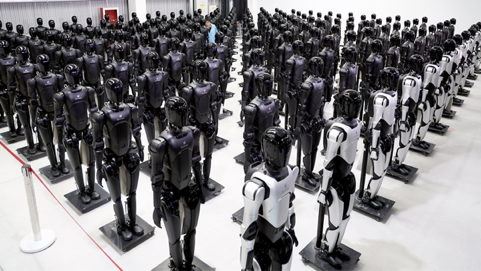 (Image caption) The neatly arranged array of robots inside the Chinese humanoid robot mass production factory highlights China's clear advantages in hardware manufacturing, supply chain integration, and large-scale delivery.
A mobile data terminal
There's another crucial difference between robots and purely software AI. When robots enter the real world, they typically carry cameras, microphones, spatial maps, LiDAR, motion logs, and data about the factory or home environment. Some of this data may involve personal privacy, some may be corporate trade secrets, and some may become invaluable real-world data for training next-generation models. In the future, a robotics company's competitiveness will likely increasingly depend on its ability to continuously acquire high-quality real-world data within the bounds of law and contract, and to transform this data into model capabilities.
Beyond technology, another competition has escalated to the security level. On July 28th of this year, the U.S. Federal Communications Commission (FCC) added advanced foreign-made robotic equipment to its Covered List. New foreign-made humanoid, quadrupedal, and some other mobile robots will be unable to obtain the necessary FCC equipment authorization to enter the U.S. market without obtaining the appropriate conditional approvals; existing authorized models are not automatically invalidated. The FCC's inclusion of such equipment within its national security regulatory framework demonstrates that the communication, remote control, and data capabilities of connected robots are beginning to be subject to different regulatory scrutiny than those of ordinary industrial equipment.
Publicly available security research also provides a real-world context. In September 2025, researchers disclosed that some Unitree robots had security vulnerabilities that could be exploited via Bluetooth and Wi-Fi. After gaining control of one device, an attacker could scan and infect other nearby robots, forming a self-propagating robot botnet. While this type of risk doesn't prove malicious design by a particular robotics company, it illustrates that a networked robot equipped with cameras, sensors, wireless communication, and remote upgrade capabilities, when deployed on a large scale in factories, hospitals, warehouses, and homes, becomes itself a mobile data terminal and a network security node. Unitree also listed changes in US regulations as one of the risk factors for its overseas business in its prospectus.
This endows humanoid robots with unique asset attributes. Firstly, it's a hardware device with costs, depreciation, and production capacity; secondly, software and embodied models can allow the same hardware to acquire new capabilities with updates; thirdly, real-world data generated during operation can become training and service assets; and fourthly, if enterprise customers use it through leasing, subscriptions, Robot-as-a-Service, or long-term maintenance, it can generate continuous contractual cash flow. Because of this, the global robotics market is likely to gradually encounter institutional fragmentation similar to that experienced by 5G, drones, and some semiconductor devices: technical standards, safety certifications, data rules, and national security reviews will all affect a company's entry into a market, not just the performance and price of the product itself. This is another reality that Unitree Robotics, with its $50 billion market capitalization, needs to face—it can build scale in China, but globalization is not a path without institutional boundaries.
Does anyone know how much a futuristic robot should be worth?
Yushu's IPO also exposed a significant gap between new technology assets and traditional IPO pricing mechanisms. The offering price of 150.8 yuan, corresponding to approximately 219 times its 2025 earnings, was already not cheap, yet nearly ten million retail investors still flocked to subscribe, with the retail portion oversubscribed by more than 8,000 times. On the first day of trading, the market pushed the price up several times further. Reuters Breakingviews raised a pointed question: if a company's opening valuation is seven times higher than its IPO valuation, did the underwriters set the price too low? However, in China's current IPO system, the answer is not so simple—new share supply is affected by the approval process, funds are highly concentrated in the policy-encouraged technology sector, and with real estate losing its past investment appeal, a large amount of household capital is also seeking new high-growth assets. When the supply of "good companies" is limited and demand is extremely high, the probability of a huge price discrepancy on the first day of trading naturally increases.
Yushu's stock price thus carries two uncertainties: one stemming from whether robots can truly become mass production tools, and the other from whether today's price in the capital market reflects a rational expectation of future cash flows or a premium created by scarcity, policy direction, and short-term capital. Neither question has an answer now, but this is precisely the significance of the public market—private market prices are often only reaffirmed during new rounds of financing or equity transfers; after listing, new transaction prices emerge every day, and every financial report re-examines the story. Years later, the market will know whether today's $50 billion was a premature and overpriced purchase, or whether it still underestimated the market that machine labor could truly create.
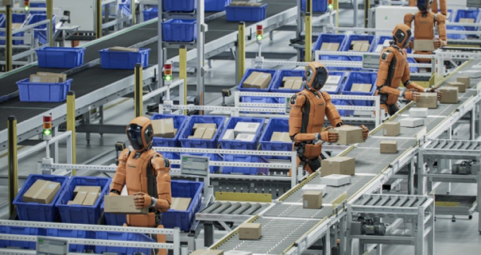 (Image caption) Humanoid robots in a warehousing and logistics scenario are moving and sorting goods, indicating that if "machine labor" can operate continuously and stably in a fixed area, it will truly enter the enterprise's capital expenditure return model.
The real "ChatGPT moment" might happen in the factory.
When ChatGPT emerged at the end of 2022, ordinary people were able to directly experience the power of a large language model within seconds for the first time. The "ChatGPT moment" for humanoid robots will likely be much more difficult to achieve. If a language model answers a question incorrectly, the user can simply ask again; however, a robot weighing tens of kilograms making a mistake in a factory could damage equipment or even injure people. While software products can be updated in the cloud at any time, each iteration of a robot involves hardware, batteries, joints, components, and safety certifications.
Therefore, the real breakthrough in robotics is unlikely to be a stunning demonstration video that suddenly appears one day. More likely, it will occur in a much more ordinary place—a factory's finance manager discovers that a robot has been working continuously for six months, requiring no daily adjustments by engineers, experiencing no frequent downtime, handling unexpected situations, and achieving the same task at a lower total cost than hiring a human. Only then will robots truly move from an experimental technology budget into the company's normal capital expenditure return model.
Yushu's listing brought the capital market to the doorstep of that factory many years ahead of schedule.
Technology has its own rhythm; factory production line debugging takes time, and changes in human work methods are slower. The capital market operates on a different rhythm—its greatest strength lies in converting potential value several years from now into today's price. This ability has driven countless technological revolutions and also created numerous bubbles. $50 billion itself neither proves that the future of humanoid robots has arrived, nor that the market is necessarily wrong; it simply indicates that a large amount of capital is already willing to bet on this future in advance.
In the coming years, what's more worth tracking than stock prices might be some much simpler figures: how many robots have actually entered the factory, how many hours they work each day, what the failure rate is, what the cost is to complete a task, how much money each machine can save the company, and what changes have occurred to the work that was originally done by humans. If these figures ultimately hold true, today's seemingly extreme valuations may find a new interpretation; if they fail to materialize, the capital market will recalculate the price.
The era of humanoid robots may be approaching, but before a machine can be truly trusted and can work continuously, it must first prove not how fast it can run or how high it can jump, but whether it can create enough value to make a company willing to keep it around every day.
Disclaimer
This article is based on publicly available information as of the time of writing and is intended for news research and institutional analysis only. It does not constitute investment, legal, or trading advice. Relevant technical, regulatory, and market data may continue to change.