

DataStory submits application to Hong Kong Stock Exchange: Enterprise AI begins to face the test of on-site operations.
Whether an enterprise AI company can transform customized delivery into reusable capabilities will determine its valuation boundaries in the Hong Kong stock market.
Hong Kong stocks don't lack AI stories, but they lack AI businesses that can survive on financial statements.
On June 18, 2026, AI remained one of the few buzzwords in the Hong Kong stock market capable of igniting imagination. That day, the share price of Zhipu, a domestic large-scale model company, surged over 26% to HK$2094; based on its IPO price of HK$116.2, the share price had increased nearly 18 times in less than six months, representing a cumulative increase of over 1700%. In a market that has long sought a high-growth narrative, AI, like a beam of light, illuminated investors' expectations and amplified all the debates about valuation, bubbles, and genuine business capabilities.
 (Image caption) The exterior of the Hong Kong Stock Exchange and the digital market data display reflect the attention and valuation expectations of AI companies filing for IPOs in Hong Kong and the capital market regarding the narrative of enterprise-level artificial intelligence.
At this very moment, DataStory AI Technology Co., Ltd. submitted its listing application to the main board of the Hong Kong Stock Exchange, with CITIC Securities International acting as the sole sponsor.
A prospectus for an enterprise AI company won't immediately excite you like a product launch. It lacks a dazzling stage and instantly shareable demonstrations. Instead, it presents revenue, gross margin, customers, accounts receivable, share-based payments, cash flow, and lines of risk warnings. But precisely because of this, it's more worthy of careful reading than many AI stories presented on stage. Ultimately, the capital market's test isn't whether a company is riding a wave of hype, but whether it can turn that hype into real business.
The application version disclosed by the Hong Kong Stock Exchange shows that DataStory positions itself as a native AI technology company, helping enterprises transform market data and business variables into decisions and growth plans through application products and solutions based on enterprise-level large models. This positioning is not difficult to understand. What is truly worth asking is another more fundamental question: as the capabilities of general-purpose large models become stronger and the cost of calling them gradually decreases, what exactly are enterprises willing to continue paying for?
The answer is likely not in the model parameters themselves.
For most businesses, the hardest place for AI to penetrate is not on desks with Q&As, copywriting, summaries, or reports, but in the operational environment that impacts revenue, inventory, channels, brand reputation, and customer relationships every day. Market information is scattered across social media, e-commerce platforms, content platforms, and offline channels; the brand, marketing, product, and sales teams each possess a portion of the facts; by the time management needs to make a judgment, the information is often outdated, but responsibility cannot lag behind.
DataStory's recent IPO filing brings the "Agentic Enterprise" narrative to the Hong Kong stock market. An Agentic Enterprise isn't simply about buying more AI assistants; it's about integrating intelligent agents into the company's business chain, assuming analytical, collaborative, and execution functions among real data, industry rules, and human decision-making. The challenge isn't whether the model is intelligent, but whether the company can effectively integrate AI into its operational processes.
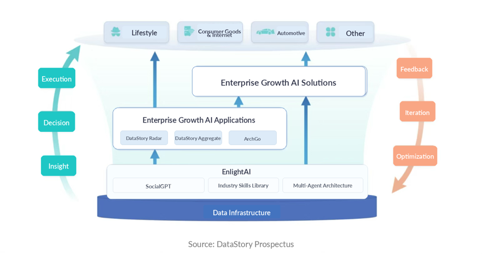 (Image caption) DataStory uses EnlightAI and data infrastructure as its foundation to extend enterprise growth AI application products and solutions to scenarios such as lifestyle, durable consumer goods, the Internet, and automobiles, and forms a closed loop of enterprise growth through insight, decision-making, execution, and feedback iteration.
AI Enters the Business Environment
Over the past two years, the excitement of enterprises towards AI has primarily stemmed from the leap in capabilities brought about by general-purpose big data models. Applications such as copywriting generation, customer service Q&A, meeting minutes, knowledge retrieval, and program assistance have been quickly adopted by enterprises because they are intuitive and easy to use. They have reduced the workload for many people and allowed enterprises to realize for the first time that AI is not a distant technology, but a tool that can be used in daily work.
But real business operations are far more complex than a simple dialog box.
Taking the growth scenario of consumer brands as an example, companies need to determine where market sentiment is shifting, what new moves competitors have made, how consumers react differently to price, efficacy, design, and brand tone, and which types of content can be converted into sales leads. If these judgments remain at the reporting level, they will have limited help to operations; they must be further translated into concrete actions in product, content, channels, and sales.
For frontline teams, AI isn't an abstract productivity revolution; it's the real pressure of deciding whether to revise a campaign ad tomorrow morning, adjust new product selling points next week, and deliver growth results by the end of the month. If enterprise AI can't address these concrete pressures, it will remain just a demo system.
Running a business is never a clean flowchart. The brand department focuses on brand awareness, the sales department on conversion rates, the product team on features and iterations, and management ultimately faces revenue and cash flow. Each department has its own data, language, responsibilities, and pressures. If an AI agent only performs well in a single task, it will still be difficult to change how a business operates. It must understand the friction between these departments and find its place among real data, business semantics, and decision-making rhythm.
In the past, most enterprise information systems recorded events that had already occurred. With the introduction of AI agents into the operational field, enterprises are beginning to allow the system to participate in judging events that have not yet happened. Whose data is trusted, whose judgments are amplified by the system, which actions can be automated, and which responsibilities still need to be borne by humans—these questions ultimately return to the core of enterprise governance.
This is where the real challenge of enterprise AI lies. Getting a machine to write a polished report is no longer the hardest part; the real challenge is enabling it to understand which conclusions can be generated automatically, which judgments require human verification, which data is merely noise, and which signals are sufficient to influence product, channel, and sales decisions. This is what makes companies willing to pay for long-term solutions.
The prospectus reveals that DataStory's underlying capabilities include data infrastructure, SocialGPT vertical large model, industry skills library and multi-agent architecture, and EnlightAI as the multi-agent system to serve enterprise growth scenarios such as insights, marketing and sales.
The term "Agentic Enterprise" itself isn't important. What matters is its potential to change the way enterprises buy AI. In the past, enterprises mostly bought software features; if they want to integrate AI into their operations, they're no longer just buying a single feature, but a suite of capabilities that can be embedded in their business processes. These capabilities include data governance, industry semantics, task decomposition, cross-departmental collaboration, results validation, and continuous optimization. Models are just one part of this.
Intelligence derived from data accumulation
The entrepreneurial path of DataStory differs from that of many current AI-native companies. It didn't seek application scenarios after the big model craze emerged; instead, it built its success from long-term accumulation in enterprise data analysis and business growth services.
As of March 31, 2026, the company has served more than 65 Fortune Global 500 companies and 135 Global 500 consumer goods companies. Based on 2025 revenue, DataStory ranks third in China's enterprise-level large-scale model-driven business growth market.
These customer figures have special significance for an enterprise AI company.
Enterprise-level AI doesn't spread rapidly like consumer-facing applications can through traffic. It needs to enter the procurement systems of large enterprises and undergo repeated scrutiny regarding compliance, delivery, effectiveness verification, and customer trust. Gaining access to leading consumer companies is a hurdle in itself. More importantly, this service experience can be distilled into industry knowledge.
How to identify target audience pain points before launching a new product, how to integrate content marketing with channel conversion, and how to convert brand awareness into traceable sales leads—these kinds of judgments come more from repeated business problems encountered in years of projects than simply from model training data. For enterprise AI companies, valuable assets are often hidden in the structured experience accumulated after project delivery.
 (Image caption) Xu Yabo, founder and CEO of DataStory. As one of the leading figures in AI solutions for enterprise growth, his company DataStory focuses on data insights, AI applications, and enterprise growth services, showcasing a new generation of entrepreneurial power in China's AI marketing and business intelligence field.
Founder Xu Yabo received early training in computer science and data mining, and taught at a university before leaving academia to found DataStory. This shift from algorithm research to on-the-ground business operations has shaped the company's approach to some extent: understand the data first, then understand the scenario, and only then talk about intelligent agents.
The prospectus reveals that DataStory has developed a technological system comprised of data infrastructure, the SocialGPT vertical enterprise big data model, an industry skills library, and a multi-agent architecture. The EnlightAI multi-agent system is used by the company to understand complex business scenarios in specific domains and to execute complex business tasks at scale.
The key to this path lies not in having a name for a vertical model, but in the ability to encapsulate long-accumulated data, project experience, industry semantics, and task processes into reusable capabilities. If this can be achieved, industry skills and intelligent agents will not merely be product packaging, but could potentially become the most important asset layer for enterprise AI companies.
The capital market will ultimately test this in a very practical way. Customer numbers, average order value, delivery costs, gross margin, cash flow, renewals, and expansion will be more honest than any technological concept. The technological narratives of AI companies will ultimately be examined in terms of financial statements.
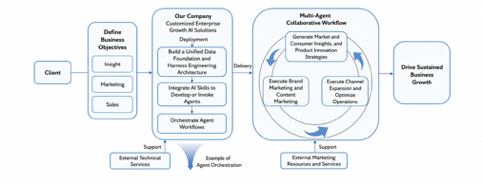 (Image caption) This image illustrates how enterprises can achieve continuous business growth through multi-agent collaboration processes, from setting business goals and deploying AI solutions to market insights, brand marketing, and channel optimization.
After a valuation of 5 billion: software assets or human resources projects?
Two days before filing its IPO prospectus, on June 16, DataStory completed a pre-IPO strategic financing round worth over 100 million yuan, valuing the company at over 5 billion yuan post-investment. This served as a pricing benchmark for the company before its listing, adding another layer of capital logic to the prospectus.
A valuation of 5 billion yuan represents both confidence and pressure. Confidence comes from the market's belief that the company's AI still has significant growth potential; pressure comes from another reality: after listing, the valuation is no longer supported by a single round of financing or an industry story, but will be subject to continuous scrutiny in the public market.
The prospectus shows that the company's revenue increased from RMB 235 million in 2023 to RMB 283 million in 2024, and further to RMB 503 million in 2025, with a compound annual growth rate of approximately 46.4%. Revenue in the first quarter of 2026 was RMB 79.65 million, representing a year-on-year increase of 53.8%. For an enterprise-level AI company, maintaining a high growth rate after exceeding RMB 500 million in revenue indicates that its products and solutions have a certain commercialization foundation.
The revenue structure is also changing. The contribution of enterprise growth AI solutions to total revenue increased from 50.1% in 2023 to 62.1% in 2024, and further to 77.5% in 2025; it reached 70.6% in the first quarter of 2026. This indicates that customer demand is shifting from relatively standardized AI application products to integrated solutions that are more deeply integrated into business processes.
This change brings the company closer to the core processes of its customers and also puts delivery costs in a more prominent position.
On the positive side, solutions that are more aligned with core business processes may lead to stronger customer loyalty and potential for increased revenue per customer. The prospectus shows that the company's number of major clients increased from 45 in 2023 to 83 in 2025; the average revenue per major client rose from RMB 3.7 million in 2023 to RMB 4.9 million in 2025. In 2025, revenue from major clients reached RMB 408 million, accounting for 81.1% of total revenue.
However, another set of figures also needs to be considered. The company's overall gross profit margin decreased from 57.2% in 2023 to 52.2% in 2024, further to 42.1% in 2025, and then further to 39.9% in the first quarter of 2026. The company explained that the decline in gross profit margin was mainly related to the increased proportion of revenue from solutions and higher related fulfillment costs.
This is a very real hurdle in the commercialization of enterprise AI. The deeper an AI company delves into a customer's business, the easier it is to create value, and the more likely it is to become a service business with high delivery, high customization, and high human resource investment. Whether an AI company's valuation is justifiable depends on its ability to distill common tasks in customized delivery into standardized modules, thereby reducing delivery costs for the next customer.
If standardization capabilities don't keep up, growth is likely just the accumulation of more projects; only when common tasks can be continuously accumulated can intelligent agents, skill libraries, and industry data become reusable operational levers.
For Hong Kong stock investors, the valuation disagreement of such companies often lies not in whether they possess AI, but in which category the market ultimately categorizes them as. If revenue can scale up with productization and standardization, and gross margins gradually improve, it is closer to the pricing logic of software and AI platform companies; if growth mainly relies on project delivery, human resource investment, and customized deployment, the market is likely to revalue it according to the standards of technology service companies.
For DataStory, the most important issue after listing is not whether it can continue to clearly explain Agentic Enterprise, but whether it can prove that it is transforming human resources projects into software assets. This dividing line will determine whether it can obtain a higher valuation tolerance in the Hong Kong stock market.
The challenges of enterprise AI are hidden in cash flow.
The improved profitability is a positive sign in the prospectus. The company's net losses were RMB 115 million, RMB 86.91 million, and RMB 51.73 million in 2023, 2024, and 2025, respectively, narrowing year by year. Measured according to non-Hong Kong Financial Reporting Standards, the adjusted net profit in 2025 was RMB 7.28 million, marking the first positive year.
However, the operational quality of an enterprise AI company cannot be judged solely by its adjusted profitability.
The company's net cash flow from operating activities was RMB 28.79 million, RMB 41.19 million, and RMB 72.76 million in 2023, 2024, and 2025, respectively; it further reached RMB 44.27 million in the first quarter of 2026. Trade receivables and notes receivable also increased from RMB 68.42 million at the end of 2023 to RMB 193 million at the end of March 2026.
These figures reveal another side of enterprise-level AI. Larger clients bring higher revenue, but also often longer sales cycles, more stringent acceptance processes, and more complex payment collection schedules. Any delay in any stage, from contract to delivery, from acceptance to payment, will be reflected in cash flow. For a rapidly growing AI company, revenue growth and cash flow pressure often occur simultaneously; the key is whether this pressure can be gradually alleviated as productization and delivery efficiency improve.
There is another easily overlooked detail. In the first quarter of 2026, the company's administrative expenses rose to RMB 87.595 million, exceeding the quarterly revenue; during the same period, share-based payments amounted to RMB 104.068 million, of which share-based payment expenses in the compensation of key management personnel were RMB 66.158 million. These types of share-based payments are mainly non-cash in nature and will amplify current losses, but cannot be simply equated with a deterioration in operating cash flow.
Even excluding this factor, the company's operating cash flow remains under pressure; however, the reasons for the amplified losses in the first quarter need to be addressed more accurately. This is a financial variable that requires rigorous analysis, as it can influence the reader's judgment of the company's operational quality.
A high-growth market can provide room for imagination in a company's valuation, but it cannot replace the company's own operational proof. The prospectus cites data from Frost & Sullivan, stating that the market size of large-scale business growth driven by enterprise-level models in China will reach RMB 8.6 billion in 2025 and is projected to reach RMB 150.1 billion in 2030, with a compound annual growth rate of 77.2%. This is a sufficiently large market, but a large market does not guarantee that every company can successfully productize and scale its products.
DataStory currently occupies a position somewhere between an AI platform, data services, and growth solutions company. This position offers both potential and valuation ambiguity. Its advantage lies in its early entry into industries such as consumer goods, lifestyle, durable goods, internet, and automobiles, accumulating leading enterprise clients and a suite of data, models, and intelligent agent capabilities related to business growth. Its challenge also lies here: if the proportion of revenue from solutions continues to increase, it must offset rising delivery costs with stronger standardization capabilities; otherwise, the faster the growth, the more pronounced the pressure on gross margin and cash flow.
Among the major shareholders disclosed in the prospectus before the IPO, in addition to the shareholding platform controlled by founder Xu Yabo, there are institutional shareholders such as Yipu Data, Shunwei Capital's Golden Growth III, Guangzhou Shengmu, and Hanxing Venture Capital. Yipu Data is related to Ipsos (China), while Hanxing Venture Capital is wholly owned by Xiaomi Technology. This indicates that the company had already received support from industrial and financial capital, and also means that after the IPO, the market will pay more attention to whether it can translate its past financing narrative into sustainable operating performance that can be verified in the public market.
 (Image caption) The technological scenario of transforming customized project experience into reusable modules and standardized intelligent agent platforms echoes the core proposition that enterprise AI can transform human delivery into software assets and determine the valuation boundaries of Hong Kong stocks.
Hong Kong stocks have no shortage of AI stories
The Hong Kong stock market has shown considerable interest in AI companies in recent years, but this interest is becoming increasingly discerning. Initially, the market was willing to pay for the AI concept, but later it began to focus on revenue, and will now look at gross margin, cash flow, customer retention, and valuation justification. For AI application companies, the biggest challenge is not clearly explaining the technology story before listing, but rather demonstrating through quarterly reports after listing that the technology can be repeatedly sold, sustainably delivered, and that the cost structure can be gradually improved.
DataStory's submission provides a sample for observing the commercialization of enterprise AI. It is neither a simple model company nor a traditional marketing service provider. It attempts to integrate data, models, industry knowledge, and multi-agent systems into the enterprise growth process. If this path works, enterprise AI will penetrate deeper into the operational level; if it doesn't, the market may reclassify it as a highly customized, high-delivery-cost technology service company.
For GFM, this type of company is worth continued monitoring, not only because it has the potential to become a representative enterprise with agentic enterprise characteristics in the Hong Kong stock market, but more importantly, because it represents a shift in the AI industry: AI is beginning to address the institutional issues of how enterprises organize information, processes, decision-making, and growth.
Every technological wave entering the capital market follows a similar process: first, the concept is chased; then, revenue is validated; and finally, cost structure and cash flow determine valuation. AI will be no exception. Model capabilities can ignite imagination, but operational capabilities will determine its value.
The competition in enterprise AI will likely not end with whose model can answer questions better, but will return to an older business question: who can help enterprises make judgments and take actions at a lower cost, higher efficiency, and more sustainably.
The presentation of data at the Hong Kong Stock Exchange provides a market-tested model for this proposition. Revenue, gross margin, cash flow, receivables collection, and customer retention will be more convincing than any new concept.
Hong Kong stocks have no shortage of AI stories, but what they lack are AI businesses that can be repeatedly proven successful in the field.
Disclaimer
This article is based solely on publicly available information and the IPO prospectus application version and does not constitute any investment advice. Relevant data may be updated with the final prospectus; investors should make their own prudent judgments and seek professional advice.