

QC Quant: The Financial Discipline Behind Algorithms
IPO System Deconstruction | On the Eve of Institutionalization: Unraveling the Institutionalization Ambitions of an Emerging Quantitative Platform
Editor's Note:
QC Quant is not yet listed and has no history of public offerings. GFM includes it in its "IPO System Deconstruction" column for one reason only: it is an earlier and therefore more worthy case study.
The real test of the capital market never begins on the day the bell is rung.
Whether a company has the foundation for institutionalization is often answered before its IPO—it is reflected in how it explains its business model, how it defines its revenue sources, how it sets risk boundaries, how it establishes traceable data standards, and how it makes its governance structure and compliance arrangements understandable to external capital.
For quantitative trading platforms, this requirement is particularly stringent.
Impressive returns can generate attention, but attention does not equal trust. What institutional investors truly care about is not just "whether you have ever made money," but rather: can these returns be explained, verified, and tracked? Over a longer period, can they withstand the test of risk, drawdowns, liquidity pressures, and extreme market scenarios?
This is precisely the starting point for our observations.
If an emerging quantitative platform with an Asian background wants to enter the field of vision of global institutional capital, it needs to ask itself a more fundamental question: Do I already have the institutional foundation to be understood, investigated, and trusted in the long term?
This article doesn't analyze an IPO event, but rather the preparatory stage of a company on the eve of institutionalization. At this stage, returns are merely the externally visible result; what truly needs to be observed is the system behind those returns—how the model generates signals, how transactions are executed, how risks are controlled, how performance is truthfully disclosed, and how the founder's narrative is transformed into institutional trust.
GFM's focus on QC Quant is neither an investment endorsement nor a prediction of its capital market trajectory. We view it as an observational case on the "eve of institutionalization": how an emerging quantitative technology platform can move from strategic capabilities to systemic capabilities, from a profit narrative to a governance narrative, and from trading technology to verifiable market trust.
Going public is the result; institutionalization is the starting point.
Companies that can truly pass the scrutiny of the capital market often don't start preparing from the day they ring the bell, but rather have already established their own data, governance, risk control, compliance, and trust structures much earlier.
Therefore, this article is not a traditional IPO report, but rather an observation about the system "before the IPO"—attempting to answer a most fundamental question:
Before an emerging fintech company can truly be recognized by the capital market, what kind of institution does it need to become?


⸻
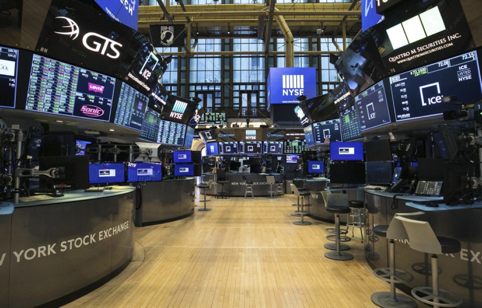
(Image caption) Inside the New York Stock Exchange trading floor, trading terminals and market data screens operate simultaneously. Financial markets are not static tables, but dynamic systems comprised of prices, volumes, volatility, capital flows, and trading behavior. Quantitative finance attempts to capture precisely the observable, calculable, and verifiable order behind these complex market signals.
The market is never a quiet table.
It has emotions, noise, panic, greed, and also some order hidden deep within prices, transactions, volatility, and capital flows.
What the human eye sees are rises and falls, but what the system tries to capture are the patterns that can be observed, calculated, verified, and repeatedly executed.
This is the most fundamental, and also the most easily misunderstood, aspect of financial digitization. It is not some mysterious financial magic, nor is it a machine that guarantees profits. True financial digitization uses mathematical models, statistical methods, and engineering systems to address financial market problems—it cares about trading signals, and also about whether those signals can be executed, monitored, and interpreted once they enter the real market.
In the eyes of institutional investors, the value of a chemical company never depends solely on its ability to capture market trends, but rather on its ability to transform research, order placement, risk control, drawdown management, and external due diligence into a stable process.
According to information on QC Quant's publicly available website, the company positions itself as a technology platform for institutional clients, covering areas such as stocks, ETFs, commodities, and digital assets. It aims to integrate signal research, portfolio intelligence, execution systems, and monitoring infrastructure into a single production-grade technology stack. The website also explicitly states that the content is intended for a professional audience and is for informational purposes only, not constituting investment advice, a solicitation, or an offer.
These statements deserve analysis. Why should an emerging platform focus on architecture rather than just revenue; governance rather than just strategy; and a systematic language that institutional capital can understand and scrutinize, rather than simply showcasing trading capabilities?
This is the starting point for GFM's observation of QC Quant.
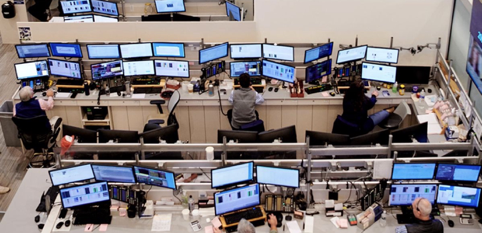
(Image caption) Traders monitor real-time market data and trading status in front of multi-screen terminals. For mature quantitative platforms, the model is just the starting point; the real test is whether the trading intent can be executed accurately, stably, and at low cost after the model enters the market. Execution, monitoring, slippage control, and trade consistency determine whether a quantitative strategy can move from research to a production system.
⸻
Only after the model leaves the paper does it begin to undergo true testing.
The part of a model that is most easily romanticized by the outside world is the model itself.
The model appears calm, precise, and objective, as if it can compress market uncertainties into a set of formulas. But truly experienced market participants know that the model's weakest point is often not its logic on paper, but the friction it encounters when it enters the real market.
Real-world trading involves slippage, impact costs, execution delays, and liquidity gaps. A strategy that performs well in historical data does not guarantee its effectiveness in future markets. More complexly, as more and more funds identify the same type of signal, the market itself can alter the validity of that signal.
This is why a mature platform cannot only have research capabilities; it must also possess complete engineering capabilities. The concepts of execution system, slippage diagnosis, trade consistency analysis, and execution governance mentioned in QC Quant's public materials point to a real-world problem: whether the model's trading intent can be accurately, stably, and cost-effectively realized in the market.
This is often underestimated by outsiders.
Building an airplane requires design blueprints, but once the airplane is actually flying, engines, instrument panels, control systems, and emergency mechanisms are equally important. Flight theory alone is not enough for aerospace engineering; a model without execution and monitoring is not enough for a mature platform.
QC Quant emphasizes the "production-grade technology stack," which refers to this: it's not just a model in the research department, but a production system that can withstand the pressure of the real market.
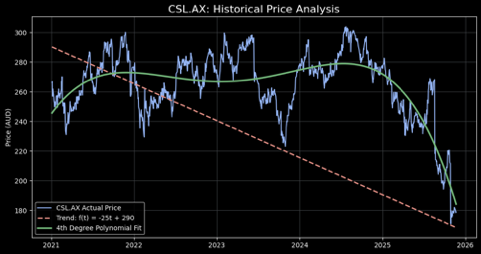
(Image caption) Quantitative models are often used to capture hidden statistical patterns in the market. The image shows trend fitting and multinomial analysis based on historical price data, which is a typical visual representation of how quantitative platforms apply mathematical models to real market data. True quantitative finance emphasizes the process of moving a model from theory to an executable system, rather than simply leaving it as a paper formula.
⸻
Risk is a boundary that exists before a trade, not a summary after the trade.
The cheapest thing in the financial markets is optimism when things are going well.
In every bull market, there are people who believe they understand the market; in every high-yield story, there are often people who mistake luck for ability. What truly distinguishes financial companies is often not how much they earn when things are going well, but whether they have boundaries when things are going badly.
One noteworthy statement in QC Quant's public materials is that risk limits, monitoring, observability, and operational discipline are embedded in the system design from the outset.
This statement alone on a webpage is not unusual. The key lies in whether a professional institution can truly implement it as a daily practice. The so-called risk embedding system does not mean reviewing losses after they occur, but rather clarifying before trading: how much risk a single strategy will bear, how much position will be exposed to a certain asset class, whether to automatically reduce positions when volatility increases, and whether to pause operations when drawdowns reach a certain threshold.
Mature companies don't treat risk as an appendix in promotional materials. It's the backbone of the entire system. Returns may fluctuate, but the system cannot function without brakes; strategies may have failure cycles, but the platform must be aware of where the failures lie.
For institutional investors, the real question isn't "Can you make money?", but rather "How do you make money, what risks do you take, how do you handle extreme market conditions, and is your process traceable?" These questions may sound cold and impersonal, but they form the foundation of financial trust.
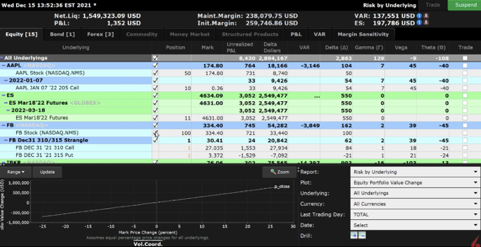
(Image caption) The risk monitoring interface of a professional trading platform displays real-time exposure to various assets, VaR (Value at Risk), margin, and Greeks risk indicators. QC Quant 's emphasis on "risk-embedded system design" embodies this type of production-grade infrastructure: risk is not a post-trade summary, but a hard boundary and observable mechanism set before trading.
⸻
Impressive profits should be displayed in a glass case.
The most prominent content in public reports about QC Quant is his performance figures.
Media reports indicate that QC Quant's strategies achieved significant returns in the first half of 2025, including S&P 500 ETF-related strategies and multi-strategy portfolios. Similar reports have also appeared on Chinese financial platforms, mentioning the performance of Venucia's systematic strategies.
These figures certainly have news value, giving QC Quant a reason to be included on the industry watchlist. But they must be viewed behind a glass case—they can be observed and discussed, but cannot be directly used as investment conclusions.
The reasons are very specific. Behind a "rate of return" may lie a single strategy or a combination of strategies, a live trading account or a representative model, whether fees are deducted or not, whether leverage is included or not, whether there is third-party auditing or it is just the company's external statement. These differences will greatly affect the meaning of the numbers.
Genuine institutional capital is not afraid of high returns; it is afraid of inexplicable high returns. It does not reject emerging platforms; it rejects platforms without a proven path.
Until standardized audit documents or complete fund-level disclosures are available, relevant performance data is more suitable as a signal for public reporting than as an audited investment record. This restraint is not a denial of QC Quant, but rather a basic respect for financial reporting.
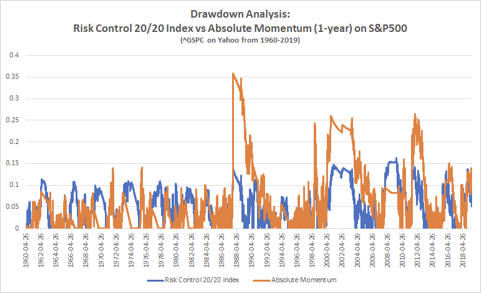
(Image caption) Long-term drawdown analysis chart, comparing the maximum loss control capabilities of different strategies under market pressure. The chart clearly shows the performance differences between the risk control index and the absolute momentum strategy across multiple market cycles. This is precisely the core indicator that institutional investors care about most: returns may fluctuate, but the system must have the ability to protect capital in bad weather.
⸻
Technology cannot automatically become trust.
The QC Quant case touches on a larger issue: how can emerging platforms with Asian or cross-border backgrounds enter the trust system of global capital markets?
The Asian market has no shortage of smart people, trading experience, or technical skills. The real challenge lies in translating these skills into institutional language that international institutional capital can understand.
In global capital markets, trust isn't built on passion or impressive numbers. It comes from a long track record, clear boundaries, third-party verification, a compliant structure, risk transparency, and disciplined communication. A professionally designed English website can attract attention; but the real question is: can this company withstand scrutiny from professional investors?
The so-called review is not just about providing a few pages of introductory documents, but about letting external investors see a complete and verifiable structure: the company entity, regulatory status, fund custody, transaction records, risk control processes, drawdown handling and compliance arrangements.
For emerging platforms, technological capabilities are only the first step. The second step is to translate technological capabilities into institutional capabilities, and the third step is to solidify these institutional capabilities into trust assets that can be repeatedly verified in the capital market. There are no shortcuts in this process, nor can it be accomplished with a well-written official website introduction.

(Image caption) A modern quantitative hedge fund trading floor showcases a multi-screen data monitoring and team collaboration environment. The image illustrates the infrastructure and governance structure required for emerging quantitative platforms to transition from "individual strategies" to "institutionalized production systems," which is also the foundation of trust that Asian-based quantitative firms must establish when entering global capital markets.
⸻
Bad weather is the real test for quantitative trading platforms.
The financial markets are not short of smart people. In every market cycle, someone discovers patterns, and in every market cycle, someone believes those patterns will always hold true. But the truly cruel thing about the market is that it always changes the environment, forcing models, systems, and human nature to be put to the test.
When the wind is favorable, the model is like poetry. When the wind is unfavorable, risk control is like law.
QC Quant presents itself to the outside world with a restrained, professional, and institutionalized approach: multi-asset coverage, production-grade technology stack, risk embedding, execution governance, and observability and due diligence interfaces. These elements make it less like an ordinary trading story and more like an emerging platform attempting to enter the international capital market.
However, the words on the website and the revenue figures in media reports are not the final answer. What truly determines its value is whether it can prove over a longer period that: the research can be reproduced, the execution can be controlled, the risks can be explained, the drawdowns can be tolerated, the governance can be audited, and trust can be built.
If QC Quant can supplement its future offerings with clearer performance metrics, long-term real-money trading data, drawdown indicators, third-party custody or audit information, and regulatory and compliance structure explanations, it will have the opportunity to further transform today's institutional narrative into institutional trust that can be recognized by the capital market.
Before that, it remains an emerging platform worth watching, but one that needs further validation.
What the financial world truly lacks is never stories, but systems that can withstand bad weather.
(Image caption) The S&P 500's cumulative returns over long-term bull and bear market cycles demonstrate the market's dramatic fluctuations and long-term recovery capabilities at different stages: in favorable conditions, models are like poetry; in adverse conditions, risk control is the law. The true value of a quantitative platform needs to be tested across multiple complete market cycles, rather than focusing solely on outstanding returns in a single phase.
⸻
Disclaimer
This article is based on financial research and industry observations from information on the QC Quant website, public media reports, and other publicly available materials. It does not constitute investment advice, investment solicitation, securities issuance recommendation, or any form of return guarantee. Performance data mentioned in this article comes from publicly reported sources. Due to differences in disclosure standards, strategy scope, fee handling, leverage levels, fund size, drawdowns, and third-party verification methods, it should not be considered a standardized return ranking, audited performance record, or basis for investment decisions. Readers should conduct their own independent due diligence and consult qualified professional institutions before making any investment, cooperation, or fund allocation decisions.