

Hengsheng AI Financial Platform Breakdown: How Far is the Gap Between Selling Insurance Policies and Building a System?
In pre-IPO observation, we examine how insurance cash flow, AI tools, and trust infrastructure are being restructured.
Disclaimer: This article provides observations on business models and systems and does not constitute investment advice, insurance advice, legal advice, or tax advice. 
(Image caption) In a calm and professional meeting space, the core of insurance consultation is not selling products, but building long-term trust and understanding of risks.
Starting with a question: What is the hardest thing to sell in the insurance industry?
It's not an insurance policy.
The hardest thing to sell in the insurance industry is a feeling.
It's a feeling of believing that someone will keep their promise, even when the family is at its most vulnerable, life is in chaos, risks suddenly arise, and customers are unsure of whom to trust.
This feeling cannot be standardized, mass-produced, or directly replicated by any AI tool. It can only be built, slowly accumulated into trust through repeated contact, attention to detail, and genuine follow-up.
This is the core institutional tension in the insurance industry: its products can be standardized, but its purchasing decisions are highly personalized; its terms are legal documents, but its transactions are often based on emotional judgments; its cash flow can be calculated, but its brand equity is difficult to quantify.
When a customer buys insurance, on the surface they are comparing premiums, coverage amounts, terms, returns, and policy terms; but in reality, they are asking a deeper question:
If something really happens to me, will this system be on my side?
Hengsheng is trying to change a certain aspect of this industry.
It uses AI tools to help insurance brokers generate content faster, answer questions more accurately, and follow up with clients more effectively. It attempts to reorganize an industry that heavily relies on individual skills, network building, and the experience of veteran brokers into a trainable, replicable, and data-driven system.
This experiment is not merely a business choice by one company. It is a manifestation of an institutional question: when AI technology enters the trust-dependent financial services industry, will efficiency and trust reinforce each other or deplete each other?
This is the starting point for this article's observation of Hengsheng. 
(Image caption) The logo of Hengsheng Financial Group shows its brand positioning as a financial service provider that extends to an AI insurance platform and a comprehensive financial technology architecture.
The real task of pre-IPO observation
Hengsheng has not yet submitted any prospectus, nor has it entered any formal listing process. This article makes no judgment on its listing timeline, valuation, financing capabilities, or business prospects.
GFM established the "Pre-IPO Observation" perspective because going public is not just a financing event. It is a moment when a company's institutional maturity is scrutinized by the public market. And this scrutiny often begins quietly among capital, regulators, partners, and the industry community before the IPO.
For a company attempting to transition from a traditional insurance agency to an AI-powered insurance fintech platform, what truly matters is not when it files for an IPO, but whether it has established the institutional conditions to support its platform narrative.
These institutional conditions do not depend on whether it uses AI, whether it has an app, or how elegant its marketing language is. They depend on several harder issues:
Can data be stored away?
Is the process replicable?
Is revenue auditable?
Is compliance traceable?
Can brokers be empowered by the system?
Can the entire platform continue to operate stably without the strong impetus of a few key figures?
This is the fundamental distinction the capital market makes between a "platform" and a "sales company".
Hengsheng's case stands precisely on the edge of this watershed. It possesses some platform elements, but also has some unanswered questions. The task of pre-IPO observation is not to endorse it, but to present the true situation truthfully, allowing readers, investors, and industry professionals to make independent judgments.
In today's world where AI is widely used to repackage traditional industries, this ability to make judgments is itself a scarce public asset. 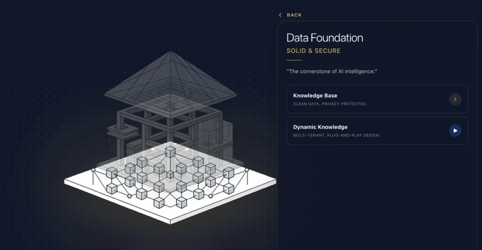
(Image caption) Hengsheng regards the knowledge base as the foundation of its AI insurance platform, attempting to distill product information, customer dialogues, and compliance requirements into an iterative data foundation.
⸻
The Capital Market Dilemma for Insurance Agents: With Cash Flow, Why Isn't It Enough?
Traditional insurance agency businesses have no shortage of cash flow, which is both their advantage and their ceiling.
The business logic of insurance agents is clear: licensed agents sell insurance products in compliance with regulations and receive commissions from insurance companies. They do not need to underwrite insurance themselves or directly assume the insurance company's claims liability. As long as they maintain customer relationships and comply with sales procedures, they can generate relatively clear income.
This model does not require a large amount of inventory or heavy investment from the outset, making it a relatively clean business in the early stages.
However, once this model enters the capital market narrative, it will encounter a fundamental valuation dilemma.
The valuation logic of the capital market for "high-tech platforms" is based on several core assumptions: the number of users and the frequency of use can grow at scale; marginal costs continue to decrease as the scale expands; data accumulation forms competitive barriers; and core capabilities do not depend on a few irreplaceable individuals.
Traditional insurance agents are the exact opposite.
Its income is highly dependent on the agent's personal ability and network; customer acquisition mainly relies on acquaintance networks; each new customer usually requires a corresponding investment of manpower; core assets are often scattered in each agent's mobile phone address book, WeChat groups, Moments and personal trust relationships, rather than being accumulated in the company's data system.
This model can generate revenue, but it is not easily understood by the capital market as a technology company with a platform premium.
The capital market's sober assessment is brutal:
If your growth relies primarily on recruiting more people rather than making existing people more efficient, you're more like a traditional distribution company than a platform company.
If your core data is in the hands of an individual rather than in the company's system, losing a core broker could mean losing a group of clients.
If your sales process cannot be tracked, audited, or replicated, no matter how high your income is, it will be difficult to obtain the valuation logic of a technology platform.
This is an institutional hurdle that Hengsheng must overcome:
Transform the ability to rely on people into the ability to rely on the system.
This is also the institutional motivation behind its introduction of AI tools. 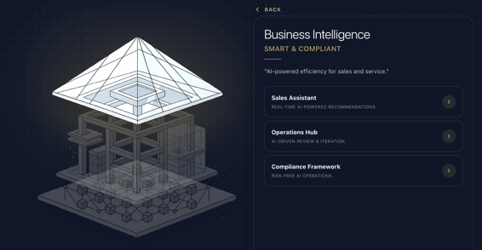
(Image caption) Hengsheng platform lists sales support, operational iteration and compliance framework side by side, showing that it not only pursues transaction efficiency, but also tries to establish process control capabilities.
⸻
The Real Role of AI in the Insurance Process
There are too many companies on the market claiming to be "transforming industries with AI". But if you ask where the AI is specifically used, the answer is often just: generating some copy, connecting to a chat model, or creating an automated customer service response.
These are all AI, but none of them are a moat.
Based on the information currently available, Hengsheng's AI tools are mainly focused on several core aspects of the insurance broker sales process.
First, there is the generation of personal IP content.
This tool helps brokers consistently post content on social media about family protection, wealth security, immigration, children's education, and risk planning. It aims to build trust with clients before they have a clear need for insurance, rather than waiting until they need it to face a stranger for the first time.
This design is very interesting.
It attempts to extend the trust-building cycle in insurance sales from "a few meetings after the customer has a need" to "months or even years of daily content interaction." This is an attempt to move from a transactional relationship to a content-based relationship.
Second, there's the AI insurance coach.
It provides new brokers with product Q&A, sales script frameworks, training content, and compliance reminders. This tool attempts to solve the most common dilemma faced by newcomers in the insurance industry: it's not that they can't pass the licensing exam, but that after passing the exam, they don't know how to start a conversation, how to answer customer questions, how to handle objections, or how to determine which words are appropriate and which should be avoided.
These skills have traditionally been passed down through mentorship and oral instruction from experienced agents to new hires, requiring a long period of accumulation. If AI coaches can compress this learning cycle, it will substantially help the large-scale expansion of agent networks.
Third, there are automated quotation tools.
Quickly generate premium calculations based on parameters such as the customer's age, gender, coverage amount, and term. This may seem simple, but in insurance sales scenarios, the ability to provide a fast and relatively accurate quote is often the first step in making customers feel that "this person knows their stuff."
Fourth, there is the CRM and WeChat Work integration system.
It manages the allocation of customer leads, follow-up reminders, conversation records, and conversion processes. If this layer is done well, the company can gradually transfer customer relationships from personal mobile phones to the company system, which is one of the most important infrastructures for insurance agents to move towards platformization.
These tools, taken together, point to a clear institutional intention: to reduce the growth costs for new agents, enabling those with insufficient connections and experience to quickly enter an effective sales state.
But there is a problem we must honestly face:
Do these tools enable newcomers to provide professional services more quickly, or do they enable them to create potential compliance risks more quickly?
Efficiency improvement and compliance risks are never independent variables in the insurance industry. 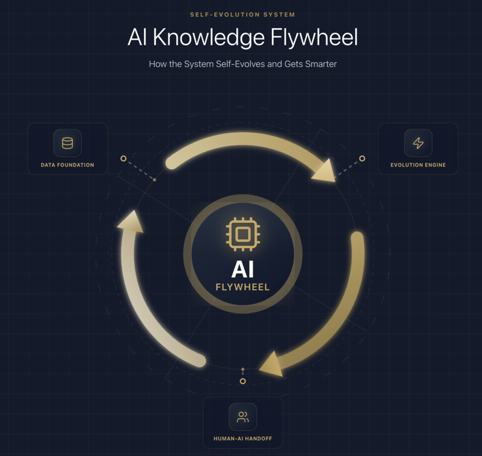
(Image caption) The knowledge flywheel diagram presents Hengsheng's vision for data accumulation, model iteration, and human-machine interaction, which are key issues for the platform to form a moat.
⸻
Data Flywheel: The True Shape of the Moat
AI tools are a means; data is the asset.
Any AI tool, without industry-specific data accumulation, can be quickly copied by competitors with more resources. What truly creates a barrier to entry is the structured data with industry-specific characteristics accumulated during the tool's use.
What should the shape of this data be for an AI insurance platform?
It's not about "how many policies were sold." That's just financial data.
What truly creates a competitive advantage is the behavioral data from the insurance sales process: which types of customers respond to which sales pitches in which situations; which product combinations have the highest success rate for which types of families; which questions, once raised, indicate that the customer is seriously considering the matter; which objections can be explained, and which are genuine rejection signals; which compliance reminders are most effective at which sales stage; and which dialogue patterns often initiate policy cancellations, complaints, and disputes.
If Hengsheng's knowledge base and data system can structurally accumulate these behavioral patterns and continuously feed back into the iteration of AI models, then it will not only establish a tool, but also an institutional knowledge base for insurance sales.
This knowledge base is something that no newcomer can replicate in the short term.
However, there is a core question that remains unclear: Has Hengsheng's data closed loop truly been formed?
A true data flywheel needs to meet several conditions:
Customer conversations must be systematically recorded, rather than scattered across personal phones and WeChat groups;
The results of completed and uncompleted transactions must be tracked by the system;
AI's answers must be traceable and have feedback on their effectiveness after use;
The knowledge base must be continuously updated based on real business data, rather than relying on a static question-and-answer database maintained manually.
Brokers must be willing to put their client interactions into the platform, rather than just using it as a toolbox.
Each of these conditions requires extensive system building and organizational management capabilities, as well as the genuine cooperation of brokers, not just verbal agreements.
The current size of Hengsheng's knowledge base, the number of real dialogues entered into the database, the accuracy of AI responses, the compliance review mechanism, and the degree of structuring of transaction data are key indicators for assessing whether this flywheel has truly formed.
Until this data is fully disclosed and verified, the "data flywheel" remains a compelling direction, not a completed fact.
This distinction is crucial during pre-market observation. 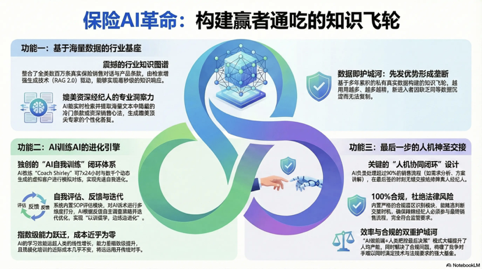
(Image caption) This internal concept diagram summarizes Hengsheng's design for the data base, AI self-training, and human-machine collaboration, but its actual effectiveness still needs to be verified by business data.
⸻
Compliance is the lifeline, not an option.
Compliance in the insurance industry is not a bonus for ordinary sales; it is a prerequisite for the legal existence of the business.
If a restaurant waiter says the wrong thing, the worst outcome might just be a dissatisfied customer; if an insurance broker says the wrong thing, the worst outcome might be that the customer buys the wrong product, faces incorrect claims expectations, and discovers at their most vulnerable moment that the coverage is not what they thought it was at all.
The consequences could be more than just complaints; they could also include lawsuits, regulatory investigations, revocation of broker qualifications, and even impact on the platform's continued operation.
Therefore, the compliance capabilities of an AI insurance platform are not icing on the cake, but the foundation for the continued existence of the entire system.
A mature AI insurance compliance framework requires at least four layers of design.
The first layer is that the source of knowledge can be traced.
Any answer provided by AI should be traceable to specific policy terms, regulatory documents, or official materials, rather than being a "reasonable inference" generated by the model itself. Every number, every condition, and every exception in insurance may have legal consequences. "That's roughly it" is not safe in this industry.
The second layer is automatic identification of sensitive boundaries.
When conversations involve areas such as profit guarantees, investment return protections, cross-border funding arrangements, tax planning, and legal advice, the AI must immediately flag these issues and prompt a referral to a licensed person or professional advisor. These are not questions of the AI's capabilities, but rather areas where advice from unlicensed parties is legally prohibited.
The third layer requires manual review, which cannot be bypassed.
In certain critical stages, such as pre-policy confirmation, demand analysis for complex products, and when customers express clear confusion or uncertainty, the human intervention of licensed professionals cannot be replaced by AI automation. Improvements in platform efficiency should not come at the expense of bypassing licensed professionals.
The fourth layer ensures that all key conversations are fully documented.
Every suggestion, every quote, and every product description should be systematically recorded for easy review and dispute resolution. This layer protects not only customers but also the platform and brokers.
Whether Hengsheng has established these four layers of compliance mechanisms is a question that this article cannot fully confirm at present.
However, this confirmation is a necessary step for Hengsheng before its IPO. Regulatory agencies will not believe a company simply because it claims to be compliant; nor will the capital market give it a premium just because its white paper outlines a compliance framework.
What can truly be trusted are institutional arrangements that can be audited, tracked, and do not collapse under pressure.
This is the final hurdle for Hengsheng to transition from a sales platform to a system platform. 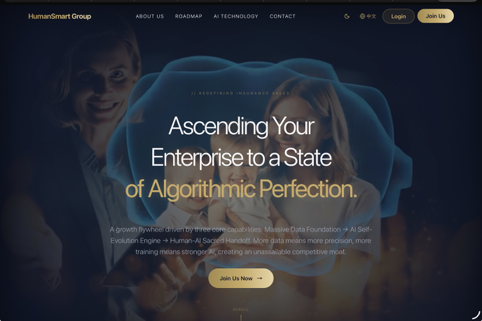
(Image caption) The HumanSmart Group website homepage features a core visual theme of family protection and AI-driven sales restructuring, showcasing Hengsheng's direction in building a platform-based brand.
⸻
Global Chinese Wealth Security: The Real Market and the Need for Restrained Language
If AI tools represent Hengsheng's technological direction, then the wealth security needs of Chinese families worldwide represent the market space it has chosen.
This market space is real, the demand is real, and the scale is considerable.
Chinese immigrant families in the United States face a completely new insurance system context: the design of American insurance products, tax structures, and claims logic are entirely different from the insurance systems they were familiar with in mainland China or Hong Kong. Many families still haven't established a protection structure suitable for their local needs even several years after immigrating.
The needs of entrepreneurial families are more complex: the separation of company assets from personal assets, life and critical illness protection for founders, risk exposure for cross-border families after businesses go global, and how to achieve intergenerational wealth transfer through compliant insurance and trust arrangements. These needs cannot be met by a standardized insurance policy; they require collaborative work from licensed individuals, lawyers, and tax advisors.
High-net-worth individuals are most sensitive to cross-border needs: USD asset allocation, offshore insurance structures, trust arrangements, and tax residence design—each aspect involves the regulatory frameworks of different jurisdictions, and each decision requires advice from licensed professionals based on the specific circumstances of each case.
Hengsheng's attempt to serve this market is understandable.
But language must be used with extreme restraint.
The phrase "capital outflow" is a highly sensitive and compliance-risk statement in any public context targeting mainland Chinese clients. "Insurance for capital preservation and appreciation" is easily misinterpreted as a guarantee of returns, potentially conflicting with the essence of insurance products. If "dollar asset allocation" is presented as a solution for "where the money is," rather than a tool for "protecting family risk exposure," it may cross the legal boundary between insurance advice and capital operations.
For Hengsheng, this means a specific institutional requirement:
Transforming market language into compliance language is part of platform building, not a patch job after sales.
If the AI coach's advice treads a tightrope between compliance and actual compliance, then the coach will not only fail to help, but may actually be planting the seeds of future regulatory risks.
For any institutional media, this market can be studied and dissected, allowing readers to understand the complexity of demand, but it cannot become the operational entry point for any specific financial arrangement.
The boundary between education and sales is the fundamental red line in this discussion. 
(Image caption) The team discussed data and technology, and the real competitiveness of the AI insurance platform is shifting from tools to data accumulation.
⸻
Eight questions about the platform: questions that must be answered before listing.
Transforming a traditional insurance agency into an AI-powered insurance and financial technology platform is not as simple as just saying it.
When reviewing IPO candidates, the capital market uses a very specific framework of questions to determine whether the "platform story" meets the institutional requirements.
For Hengsheng, the following eight questions are lessons that must be answered honestly before listing.
First, is the revenue auditable?
Is the structure of insurance commission income clear? Is the legal basis for the profit sharing at each level complete? Can the income of different product lines be categorized and tracked? If income cannot be cleanly audited, the requirement for financial transparency after listing will become a systemic pressure.
Second, is the conversion data clear?
From lead generation to quote completion, from quote to policy submission, and from submission to transaction, what are the conversion rates at each stage? These figures are not only core indicators of business health but also direct evidence of whether AI tools are truly effective.
Third, is the broker network manageable?
What are the current number of brokers, activity rate, retention rate, average productivity, and training completion rate? A network that relies excessively on a few top brokers and where most brokers have almost no transactions is fragile and not a platform asset.
Fourth, is AI truly effective?
Before and after introducing AI tools, did the time for new customers to close deals shorten, customer acquisition costs decrease, and customer service satisfaction improve? Results must be proven by data, not by mere direction and feelings.
Fifth, does the data truly become an asset?
Have customer conversations, quotes, transactions, complaints, and policy cancellations been structured and integrated into the system and actually used for model iteration? Or is this data still scattered across personal devices and social media?
Sixth, are the compliance processes genuine and complete?
Are there written regulations governing the compliance boundaries of AI systems, mechanisms for human intervention in sensitive issues, and systems for recording key conversations, and are these regulations actually implemented in daily operations, rather than just existing in planning documents?
Seventh, is the income sufficiently diversified?
Currently, if a company relies entirely on insurance commissions, is it possible to develop diversified revenue streams such as SaaS platform fees, data service fees, training service fees, or consulting fees in the future? Companies with a single revenue structure will find it difficult to achieve platform multiples under the valuation framework of the capital market.
Eighth, is the company's governance clear?
Are the legal relationships between the insurance business entity, the AI technology entity, the data management entity, the licensed service entity, and the future listing entity clearly defined? For businesses operating across jurisdictions, are there corresponding compliance structures? Is the equity structure clear, and are there any nominee shareholders, undisclosed shareholders, or unresolved ownership disputes?
These eight questions are not challenging, but rather questions that any company seriously considering entering the capital market needs to proactively answer.
Answering questions in advance is a sign of a mature system; waiting for investors to ask follow-up questions is the beginning of passive defense. 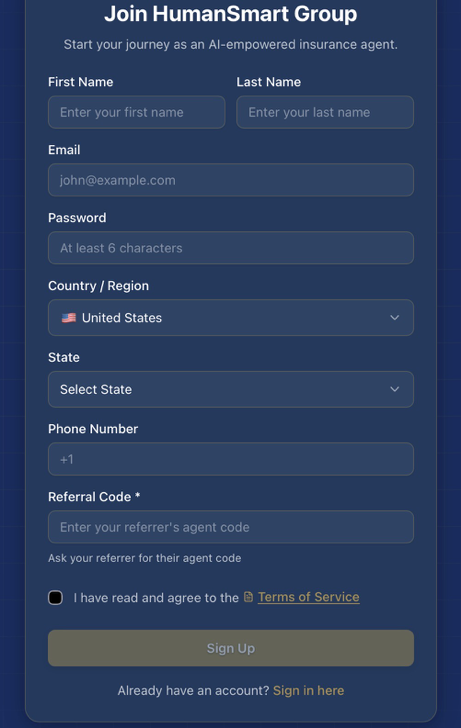
(Image caption) The registration page shows that the platform manages new members using referral codes and regional information, reflecting that the expansion of the broker network still requires a clear compliance and governance mechanism.
⸻
From sales companies to trust infrastructure: How far is it?
What Hengsheng currently possesses deserves to be taken seriously.
It has real insurance cash flow, not a concept company that relies on financing to survive; it has a sense of direction in AI tools, and knows clearly which problems in the insurance sales chain it is trying to solve; it has a market entry point to Chinese families around the world, and the demand in this market has existed for a long time; it has an institutional awareness of knowledge bases and data flywheels, and knows that data is the real barrier.
But it is not yet finished, and that is equally clear.
Whether the data loop has truly been formed cannot be confirmed at present; whether the compliance mechanism is actually implemented in daily operations and not just a written design requires more verifiable evidence; the health of the broker network requires more detailed tiered data; the diversification of revenue paths is currently mainly at the direction level rather than the implementation level; the clarity of corporate governance, especially in the legal entity arrangements for cross-border business, requires written documents confirmed by lawyers.
This distance cannot be crossed in a single step.
Reorganizing a traditional industry that is highly dependent on people into a platform that relies on systems requires more than just technological investment; it also requires organizational capabilities, management discipline, data culture, compliance awareness, and patience for long-term development.
Many companies have chosen shortcuts in this process: replacing the arduous task of building a robust system with a compelling narrative. Shortcuts may work in the short term, but they will be exposed one by one under the public scrutiny of the capital market.
The real pre-IPO challenge for Hengsheng that deserves our attention should not be "how to package an insurance agency as an AI company," but rather:
How to truly transform an early-stage company that already has cash flow, a market, and a clear direction into a trustworthy, traceable, auditable, and replicable system of rules and regulations.
The ultimate goal of the insurance industry is never to sell more policies more efficiently.
Its ultimate goal is to ensure that customers receive what they expect to receive, even in their most vulnerable moments.
Hengsheng's pre-IPO observations should start from this endpoint and go back to ask whether every current system construction decision is truly moving in that direction.
⸻
Disclaimer: This article is part of GFM's "IPO System Deconstruction" pre-IPO observation series. It is written based on publicly available information and business model research and does not constitute investment advice, insurance advice, legal advice, or tax advice. This article makes no commitment regarding any company's listing timeline, valuation, or business prospects.