

GFM IPO System Breakdown | Cerebras
Is the market buying AI chip performance, or the credit and credentials behind the OpenAI contract?
This is not an IPO, but a public test of pricing logic.
Cerebras' move to the public market is not essentially a case of one company seeking funding, but rather the first time the entire AI infrastructure narrative has been held accountable by the public market.
Cerebras Systems is once again attempting an IPO, ostensibly an AI chip company trying to enter the public market. But GFM's institutional assessment is that this is more like a test—in the capital markets of 2026, whether investors are pricing in the technology itself, or paying a premium for credit, supply capacity, and entry into the AI era.
This question is far more crucial than whether it can challenge Nvidia. It determines not only whether Cerebras' valuation is justified, but also the extent to which the entire AI infrastructure narrative can be sustained in the public market. This is a historic moment when AI infrastructure assets are truly held accountable by the public market for the first time.
Cerebras is an extreme but typical example. It compressed several elements that should have been priced separately—hyperscale chip architecture, cloud computing services, large customer partnerships, and the macro narrative of the AI era—into a single IPO filing. This compression itself means that its valuation does not come from a single dimension, but rather from a synthetic pricing. GFM's task is to break down this composite. 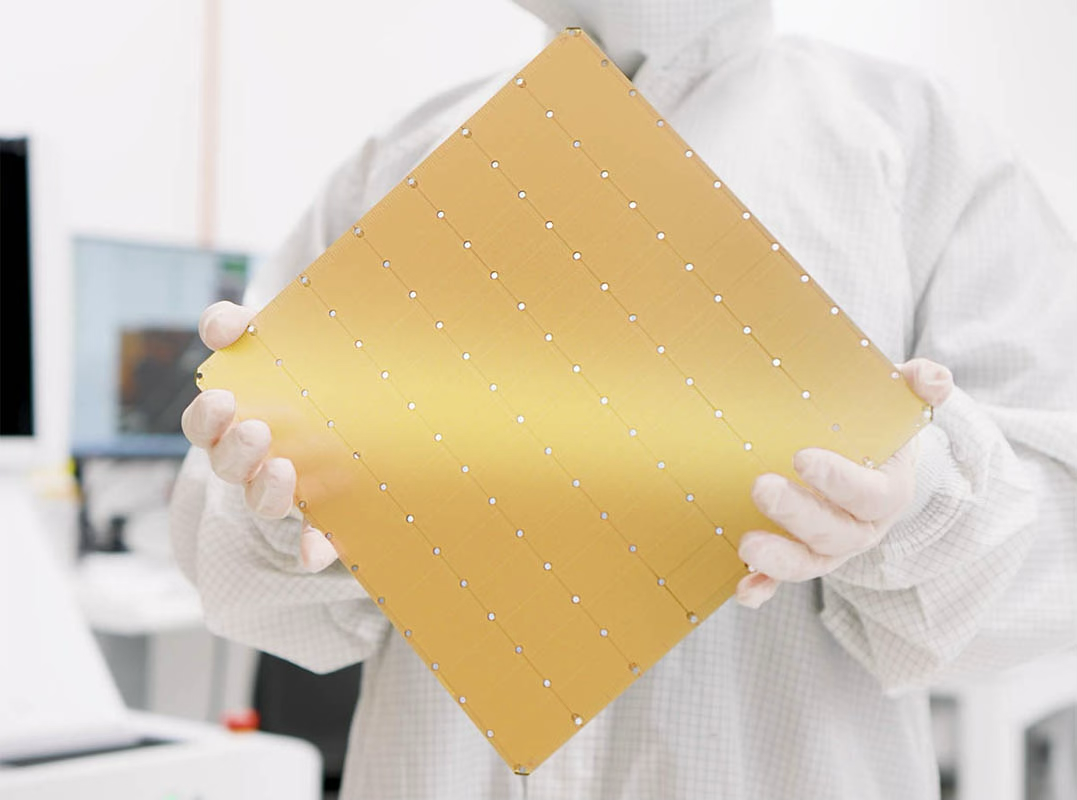 (Image caption) A physical display of the Cerebras Wafer-Scale Engine (WSE-3) chip, which is the world's largest single AI processor, far exceeding the size of traditional GPUs, and contains several megatransistors and millions of AI cores.
Identity Deconstruction – Counterintuitive Naming: This is not an AI Chip Company. To understand Cerebras, one must first reject the market's most intuitive label for it – "AI chip company." This classification is too narrow because it obscures what the company is truly trying to build: a complete infrastructure location that extends from chips to computing power supply, and then to large-scale model training and inference services.
Wafer-level processors are just the beginning. The real ambition is to transform hardware uniqueness into a higher-level market identity—providing computing power, embedding it into customers' model training processes, and ultimately becoming part of the AI system itself.
Cerebras' true identity is that of a composite entity attempting to transform chip barriers into computing infrastructure locations, rather than a traditional semiconductor company.
This design, in theory, possesses both technological barriers in hardware and revenue stickiness in services. However, it also faces multiple pressures: high-intensity R&D investment, complex infrastructure delivery, customer concentration risk, and the capital market's continued demand for a high-growth narrative. These four pressures do not act separately, but rather overlap.  (Image caption) The abstract visual combination of AI and the stock market represents the historic moment of Cerebras' IPO as "accepting public market accountability for the AI infrastructure narrative," and a triple pricing test of technology, credit, and narrative.
Financial Perspective – Structural Realization: Is Revenue Driven by Real Demand or Contractual Concentration?
When a company's narrative spans both hardware and services, its financial structure is no longer just about "how fast it grows," but a more fundamental question: Does this revenue come from broad market demand, or is it driven by a concentrated pull from a few key customers? Is this structure replicable, or is it essentially closer to a contractual revenue model?
This is why OpenAI plays a dual role in Cerebras' narrative: both amplifying and vulnerable—roles that cannot be separated.
Verified: OpenAI adoption has reduced the cost for investors to independently assess the feasibility of a technology, jumping directly from "potentially effective" to "already adopted by top users." This endorsement itself is part of the valuation and has a real market impact.
To be verified: When the rationality of valuations highly depends on a few iconic clients, what the market is actually buying is no longer a diversified and stable business foundation, but a highly concentrated credit narrative. This structure amplifies valuations during uptrends, but may accelerate contraction in a non-linear manner during downtrends. GFM cannot independently verify whether current contracts have the potential for renewal and diversified expansion. 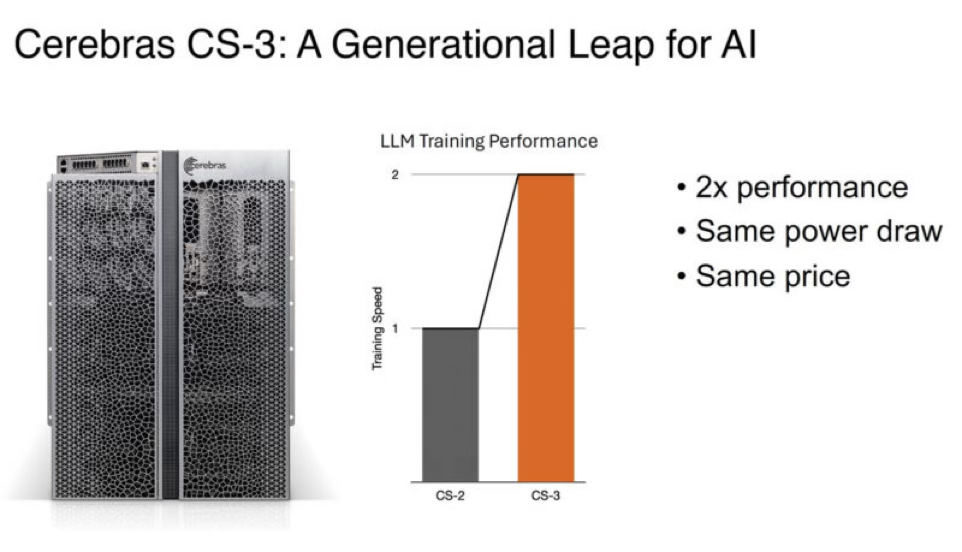 (Image caption) Cerebras CS-3 system and performance comparison chart, showcasing its advantages in large-scale model training and emphasizing its complete positioning from hardware to computing services.
The core contradiction—the moat, or vulnerability—is the same thing: the greatest advantage and the greatest risk.
OpenAI is the most powerful amplifier of Cerebras' valuation, but also its most uncontrollable systemic risk—the two cannot be calculated or priced separately.
This structure has a very clear but often overlooked characteristic in capital markets: a credit-concentrated narrative that enjoys an excess premium during upward cycles and contracts at an excess rate during downward cycles. This is not linear risk, but rather a structural asymmetric exposure.
For Cerebras, this means that any negative news regarding its OpenAI partnership—whether it's changes in contract terms, reduced procurement, or a shift in OpenAI's own strategy—wouldn't just be a customer churn, but a direct impact on its entire valuation logic. This structure cannot be resolved in the short term through business diversification. 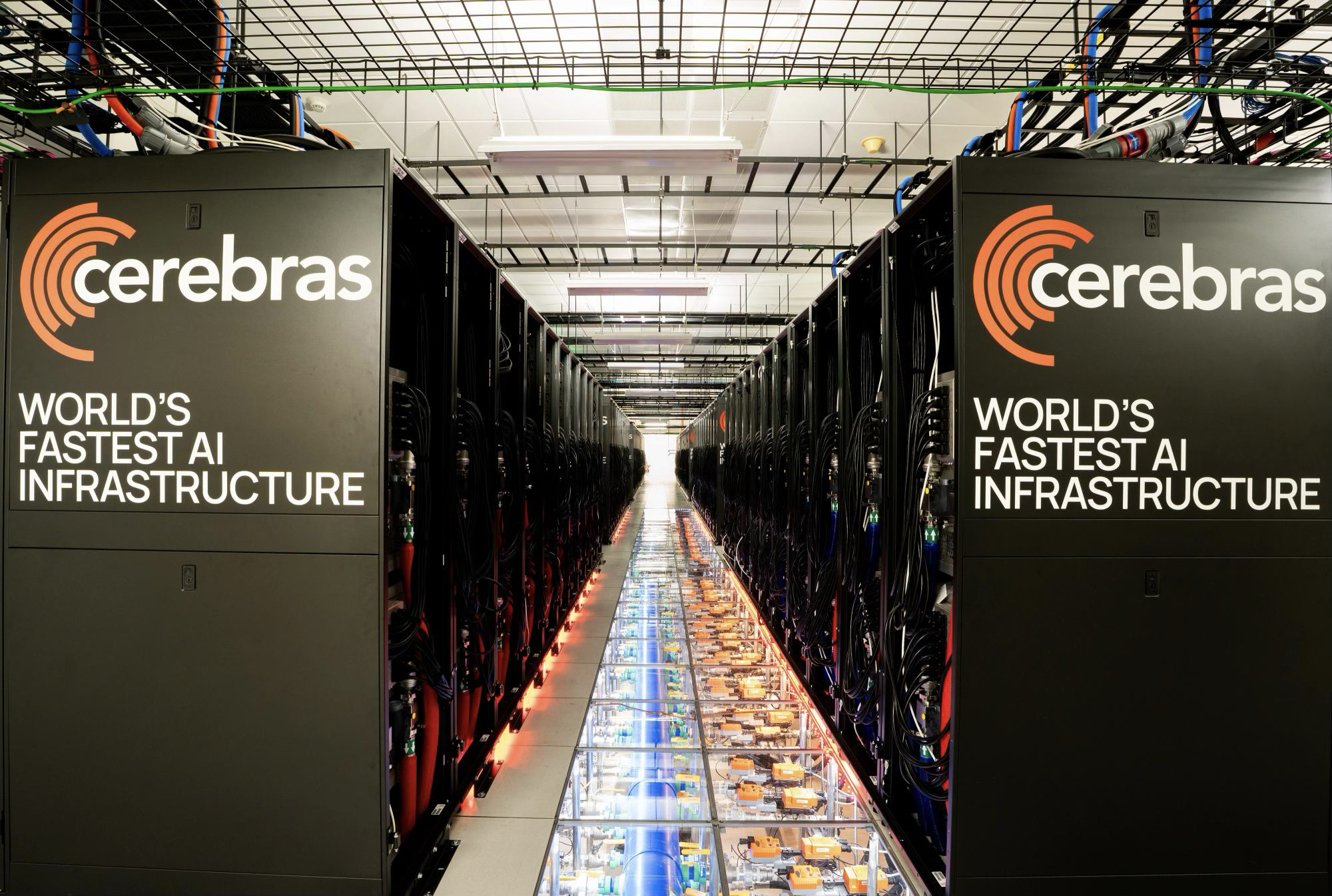 (Image caption) Inside the Cerebras AI Data Center, rows of CS systems are neatly deployed, symbolizing the company's ambition to transform chip barriers into cloud computing services.
Transformation Verification – The Completion of Technology into Business: Technological feasibility and commercial viability are two different criteria. The chip industry has never been a market that can be established simply by demonstrating technology. What truly determines long-term value is not just the ability to produce larger chips, but the ability to achieve stable production, stable deployment, continuous integration, and serve large customers over a long timescale.
As computing power transforms from a product into a service, delivery capabilities, supply chain resilience, and capital expenditure discipline begin to replace single performance metrics and become more critical competitive dimensions.
Stable delivery capability – There are existing large customer cases, but large-scale validation is not yet sufficient. GFM ruling: Partial validation.
Supply chain resilience—The wafer-level manufacturing process is highly dependent on TSMC, and there has been no public disclosure of diversified backup plans. GFM ruling: To be verified.
Capital expenditure discipline—high R&D spending rate, unclear profit path before IPO. GFM ruling: To be verified.
GFM's institutional ruling on the technology-to-business transformation is currently only partially validated, not fully established.  (Image caption) A scene of OpenAI-related figures and media attention, representing the dual role of the "OpenAI contract" as a valuation amplifier and systemic risk in the article.
Timing Analysis – Why Now? Because the window for listing is still open, but it's narrowing.
April 2026 presents a crucial window of opportunity. AI infrastructure and computing power assets are once again being pursued by the capital market, but at the same time, the market's demand for long-term profitability is gradually returning. Choosing to relaunch the IPO at this time is not only a strategically precise move, but also reveals a deeper judgment: the market is still willing to pay for "alternative AI infrastructure"—but this willingness has a clear expiration date.
The capital market is not fully embracing technology again, but selectively repricing assets that can be described as "scarce and irreplaceable infrastructure." Chips, computing power, energy, and manufacturing capabilities—these originally fragmented links are being pulled into a tighter valuation chain by the demand for AI.
Cerebras is right at the intersection of this valuation chain—technological leadership, key customer endorsement, scalability potential, and a window of market sentiment—all four conditions are present simultaneously, but none of them are permanent.
The success or failure of this IPO depends not only on the company's fundamentals but also heavily on whether the market's tolerance for the AI capitalization narrative remains. When sentiment becomes part of the pricing, the risk is no longer merely financial but structural. The window of opportunity is narrowing, which is the most honest institutional reason why Cerebras chose to go public at this time.  (Image caption) The futuristic AI data center corridor symbolizes the high level of R&D investment, the complexity of delivery, and the pricing test of AI infrastructure assets by the capital market.
The ruling concludes – the answers to three questions plus the two-way scenario market will not belong solely to Cerebras.
The most noteworthy aspect of this IPO has never been whether Cerebras is advanced enough. GFM has only three systemic problems:
Can advanced technology be translated into a sustainable market position?
Can collaboration transform individual cases into replicable demand structures?
Can the narrative ultimately be sustained by a stable income?
If the market ultimately chooses to buy in: This means that capital in the AI era is still willing to pay a high premium for alternative infrastructure, the credit-centric narrative still has pricing power in the public market, and the narrative window remains open. This will provide an important sentiment and valuation anchor for the subsequent listing of similar AI infrastructure assets.
If the market hesitates or even rejects the idea, it indicates that relying solely on technological imagination and collaborations with a few star companies is no longer sufficient to support pricing logic over a longer period. The public market is demanding: a replicable customer structure, a predictable profit path, and a business foundation that doesn't depend on a single credit anchor. This will be the starting point, not the end point, for the entire AI infrastructure narrative to be held accountable.
Cerebras' move to the public market is a test of how technology, credibility, and narrative can be priced together. The market's final answer will not only belong to Cerebras, but also to the entire AI infrastructure era.
This article is a GFM institutional observation and does not constitute any investment advice. GFM focuses on the institutional logic, narrative structure, and valuation language behind IPOs, recording market judgment samples that can be cited and tracked over the long term.
GFM's "IPO" column | Institutional Research × Decoding Valuation Language × Market Narrative Analysis
Global Finance Media Group — gfm.news