

GFM IPO System Breakdown | Fervo Energy
Is the market buying geothermal electricity, or stable power supply capabilities that will be repriced in the AI era?
This is not the first time an energy company has gone public; rather, it is the first time the public market has openly offered prices for electricity scarcity.
On the Friday evening that Fervo Energy filed its S-1 application, it wasn't just submitting a prospectus, but rather a question: When AI makes electricity a scarce asset again, are public markets willing to pay real capital upfront for a power supply capacity that doesn't yet fully exist?
For the past few years, the valuation language for AI has been almost one-dimensional—chips, models, computing power, cloud services. This language has its clarity: it describes quantifiable computing power, benchmarkable performance, and platform scale measurable by subscription revenue. But this language has a systemic omission: it assumes that electricity is readily available, a background condition, and a premise that does not need to be priced. 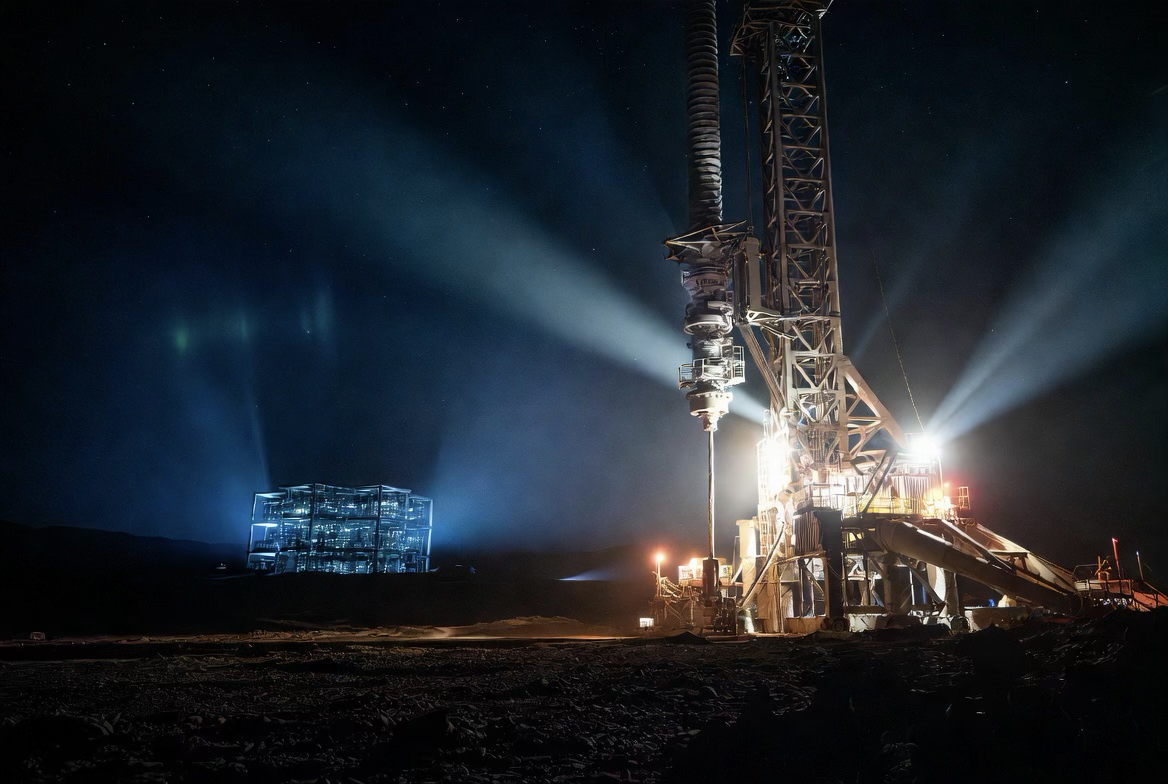 (Image caption) Fervo Energy stands at the intersection of AI's electricity scarcity and geothermal engineering. This is not an ordinary energy IPO, but the first time the public market has publicly offered a price for "stable power supply capacity that does not yet fully exist but has already been priced in."
This oversight only became apparent when large-scale computing power deployments were truly implemented. The electricity required to train a large model is not an engineering problem that can be optimized away by software, but an infrastructure problem that needs to be solved in the physical world. Data center site selection began to revolve around grid capacity, and hyperscalers began to lock in ten-year power agreements in advance. Power carrying capacity has quietly moved from an issue in the energy sector into the core of technology capital decision-making.
Fervo stands at this crossroads. It hasn't become an AI company; it's simply been re-emphasized by the market's growing understanding of it. But what this IPO truly tests isn't Fervo's commercial viability as a geothermal company, but a larger institutional question: is the valuation language of the AI era ready to incorporate stable power generation capacity into its asset pricing framework?
It's not an AI company, but it's no longer just an ordinary energy developer—a position that makes pricing more difficult than either. To understand Fervo, you have to resist both interpretations, because both will come at a price.
The first interpretation is an overemphasis on narrative. Fervo doesn't build models, manufacture chips, or provide cloud services. Its core business is enhanced geothermal systems—directional drilling, hydraulic fracturing, underground engineering, geological assessment, power generation facility construction, and grid connection. This is a business that requires precise engineering delivery under uncertain conditions thousands of meters underground; its difficulty lies not in algorithms, but in the rock strata. Pricing Fervo using the framework of an AI company is like measuring something on the wrong scale—you'll get a number, but that number doesn't describe Fervo. 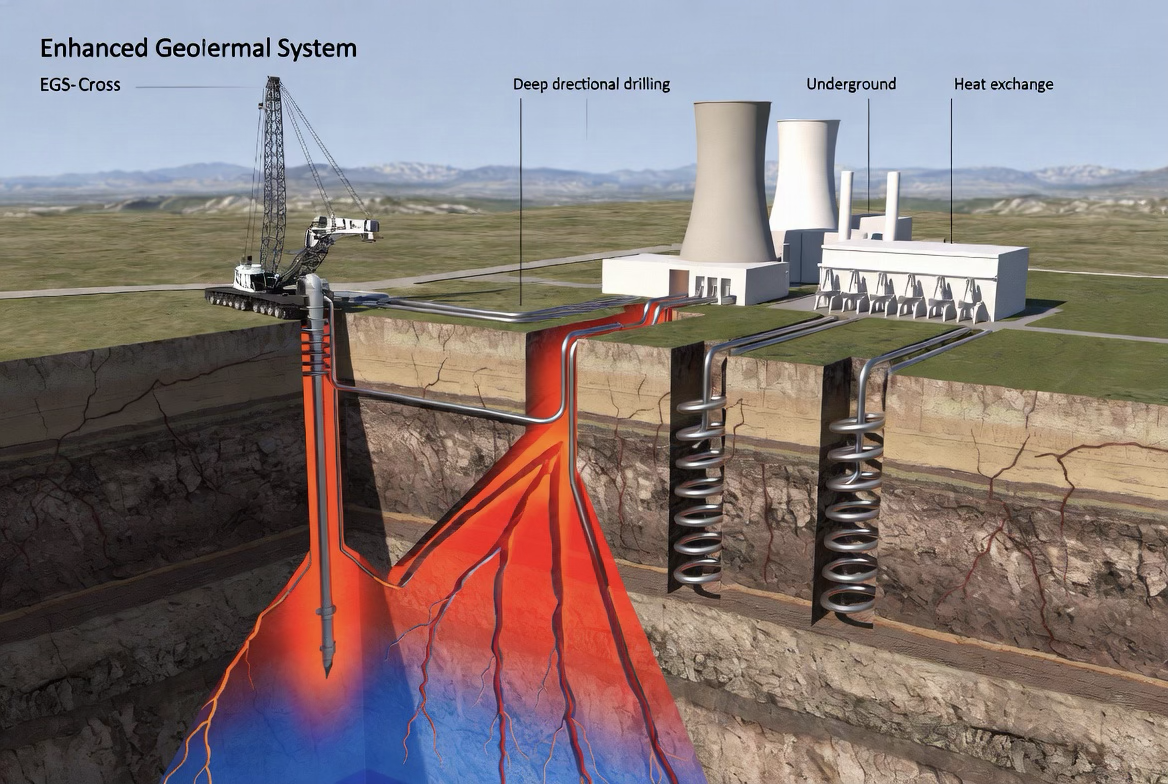 (Image caption) Fervo's core technology—Enhanced Geothermal System (EGS). It leverages drilling technology from the oil and gas industry to unlock new geothermal resources, transforming geothermal energy from a geographically dependent, niche energy source into a readily replicable, industrially scalable baseload power source. This learning curve is the core assumption behind market pricing.
The second interpretation is one of over-conservatism. In the traditional energy analysis context, geothermal energy has long been in an awkward position: safer than nuclear power and more stable than wind and solar power, but its expansion is naturally limited by geological conditions, making it difficult to be narratived by the general public. Fervo is attempting to change this limitation—using drilling technology from the oil and gas industry to unlock new geothermal resources, transforming geothermal energy from a geographically dependent, niche energy source into a base-load power source that can be industrially developed in more locations. If this path succeeds, the asset class attributes of geothermal energy will be fundamentally rewritten.
Fervo's true identity lies somewhere between these two interpretations, which is why it's more difficult to accurately price than any single label. It's a geothermal infrastructure company redefined by the structural shift in AI's electricity demand. Its valuation isn't based on AI technology itself, but on AI's unavoidable reliance on stable electricity. This position is both its value and the fundamental reason its valuation is difficult to anchor—because the market hasn't yet established a mature language for pricing this kind of "physical industrial node redefined by demand."
It has almost no mature revenue today, but that's not the real issue—the real issue is whether the market is paying for the right thing.
Fervo's financial structure is clear, but clarity doesn't equate to optimism. Its net loss for 2025 was $70.5 million, more than 70% larger than the previous year. Its only revenue source is the incidental cost of Project Red powering Google in Nevada, a negligible amount. The company acknowledges in its prospectus that losses will continue for years to come because construction costs far exceed any potential early operating revenue.
This is not an unusual infrastructure financing structure in itself. The revenue logic for geothermal projects has always been deferred: construction first, then production, and then gradually covering the cost of capital with electricity sales revenue. Fervo has not tried to hide this fact.
But that's not the problem with GFM. The problem lies in: which layer of reality is being priced in by the market?
Fervo's S-1 contains three distinct tiers of "revenue" that must be clearly distinguished. The first tier is Project Red, already operational at 3 megawatts, supplying electricity to Google; this is the only truly delivered commercial capability. The second tier is a binding power purchase agreement for 658 megawatts, corresponding to potential revenue of approximately $7.2 billion. This is a contract-backed expectation, but its realization depends entirely on the timely commissioning of the core project. The third tier is the 3-gigawatt framework agreement signed with Google, which appears 36 times in the prospectus. However, it is essentially a structured roadmap, not a binding PPA for specific projects—it gives Google considerable flexibility but not Fervo equivalent protection.
These three layers are not the same thing, but they are easily confused and read together using the same narrative language.
If the market is pricing in the first tier, Fervo is a geothermal infrastructure company that has just completed its proof-of-concept and is building its first large-scale project, with a valuation logic similar to early-stage infrastructure finance. If the market is pricing in the second tier, it is a predictable power asset backed by large contracts, with a valuation logic similar to long-term infrastructure stocks. If the market is pricing in the third tier—treating the framework agreement as a confirmed future revenue stream—then the market is paying a cash flow premium for an engineering commitment. Between these two things lies not just time, but all the uncertainties of drilling, geology, construction, financing, and project management.
GFM's institutional stance is: contractual potential is real, but contractual language cannot replace the facts of cash flow. Framework agreements are not revenue; they are direction.  (Image caption) In the past, AI valuation language almost completely ignored the "background condition" of electricity. Today, the large-scale deployment of computing power has transformed electricity from a prerequisite into a scarce asset. Fervo stands at this juncture of extended understanding.
Fervo's competitive advantage is real, but it stems from a time lag in engineering accumulation, not a permanent structural monopoly. The first-mover advantage in the geothermal industry does exist. Fervo's engineering expertise in enhanced geothermal technology, geological data, drilling efficiency, land resources, and customer trust are not capabilities that can be replicated overnight. At a time when geothermal commercialization is still in its early stages, this time lag is a genuine competitive advantage.
But time difference is not a monopoly.
If AI's demand for stable electricity continues to surge, capital will continue to flow into the stable energy supply sector. Geothermal, nuclear, small modular reactors, long-term energy storage, natural gas power plants, and large-scale grid upgrades are all competing for the same customers within the same demand pool. Fervo's current premium is based on the market's belief that it is one of the few early players capable of providing stable, clean electricity. However, this premise is time-dependent—as more solutions enter the market, relative scarcity will change, and valuation language will change accordingly.
There is a deeper institutional risk here that needs to be named.
The most common mistake the market makes is not overestimating a particular company, but rather perpetuating a temporary supply-demand bottleneck as a structural scarcity. Electricity capacity is indeed a real bottleneck for the current expansion of AI, a point that cannot be disputed. However, bottlenecks are dynamic; capital chases bottlenecks, supply expands under the impetus of capital, and the bottleneck will eventually be alleviated at some point—but the market often pays too much of a premium for scarcity before that happens.
Once this misjudgment is corrected, Fervo's valuation language will need to be switched. It will shift from being seen as an "indispensable stable power node in the AI era" to a "capital-intensive, long-cycle energy infrastructure developer." The former can command a narrative premium, while the latter must undergo rigorous scrutiny regarding discount rates, capital costs, construction cycles, and cash flow structures. The difference between these two sets of language can be substantial.  (Image caption) This isn't just an energy company going public; it's the first time the public market has openly put a price on the scarcity of electricity. What reality is the market actually paying for? The already operational 3MW Project Red? The potential $7.2 billion contract? Or the narrative premium of the 3GW framework agreement?
While engineering capabilities have been partially proven, the entire valuation is centered on a cost curve that has not yet been validated on an industrial scale.
Fervo is not an empty narrative. The production of Project Red provides real evidence of its technical feasibility, and collaboration with major clients provides a fundamental anchor for its commercial credibility. These are what distinguish it from purely conceptual targets, and GFM will not easily erase these facts.
However, the IPO market is never just about "whether a project can be successfully completed," but rather "whether this model can be replicated on a large scale and continuously reduce costs during the replication process." That is the core of the issue.
Fervo's S-1 disclosure states that the construction cost of the first phase of Cape Station was approximately $7,000 per kilowatt. The company's long-term goal is to reduce costs to $3,000 per kilowatt, at which point its power generation costs will be directly competitive with natural gas. The jump from $7,000 to $3,000 represents a cost reduction of more than half—this is not a minor efficiency improvement, but a learning curve requiring multiple complete project cycles, a mature supply chain, and a systemic improvement in drilling efficiency.
Geothermal development borrows heavily from the technological tools of the oil and gas industry, but it faces more heterogeneous underground conditions than oil and gas, with each new project potentially introducing new geological variables. This means its learning curve is closer to that of heavy infrastructure than to software platforms. It can improve, but not at a rate where marginal costs approach zero.
This cost curve is the core assumption of Fervo's entire investment argument. If it works, Fervo has the potential to truly transform from a technology-driven geothermal startup into a power infrastructure asset with long-term cash flow attributes, building an unassailable scale barrier in the process. If it doesn't work, or progresses much slower than expected, then the premium the market is paying for it today is pricing in an engineering commitment, not pricing in a proven business model.
GFM's ruling was that Fervo's engineering capabilities had been partially validated, but the scale-based cost reduction capabilities upon which its valuation relied had not been fully tested over any complete project cycle. This was an open engineering problem, not a financial problem that could be solved with a narrative.
Fervo chose to go public at this time not because its business model was mature, but because it was a time when the market was willing to listen.
The timing of Fervo's IPO is itself a systemic signal that deserves separate interpretation.
The first phase of AI capital market pricing revolved around core computing power: GPU shortages, model competitions, cloud service expansion, and declining inference costs. In the second phase, market attention shifted to the prerequisites for computing power: data center location, grid capacity, cooling energy, and energy infrastructure. Fervo's IPO occurred precisely at a point on this extended line; it didn't need to actively reshape its business model, and the market's perception naturally extended to its current position.
The precision of this timing is supported by its engineering logic. Cape Station Phase 1 is expected to generate its first electricity by the end of 2026, reaching a capacity of 100 megawatts by early 2027. This timeline design maintains a market-acceptable space for imagination between the IPO narrative and the first real cash flow milestone—far enough to allow the growth story to unfold, and close enough to provide the market with a concrete anchor. The intersection of the engineering verification window and the capital market narrative window is not accidental, but rather the result of a deliberate choice.
But opening a window never equates to certainty of opportunity. It is merely a temporary alignment of conditions.
Fervo's IPO window opened up, relying on sustained high-intensity capital expenditure on data centers, a fundamental shift in market pricing intentions regarding stable power scarcity, and a macroeconomic financing environment that doesn't systematically compress long-term, asset-heavy projects. All three conditions are met today. However, none of these are variables Fervo can control. Choosing to go public now is management's shrewd gamble that the window remains open, not a declaration that their business model is mature. Confusing these two things is the easiest mistake the market to make when interpreting this IPO. 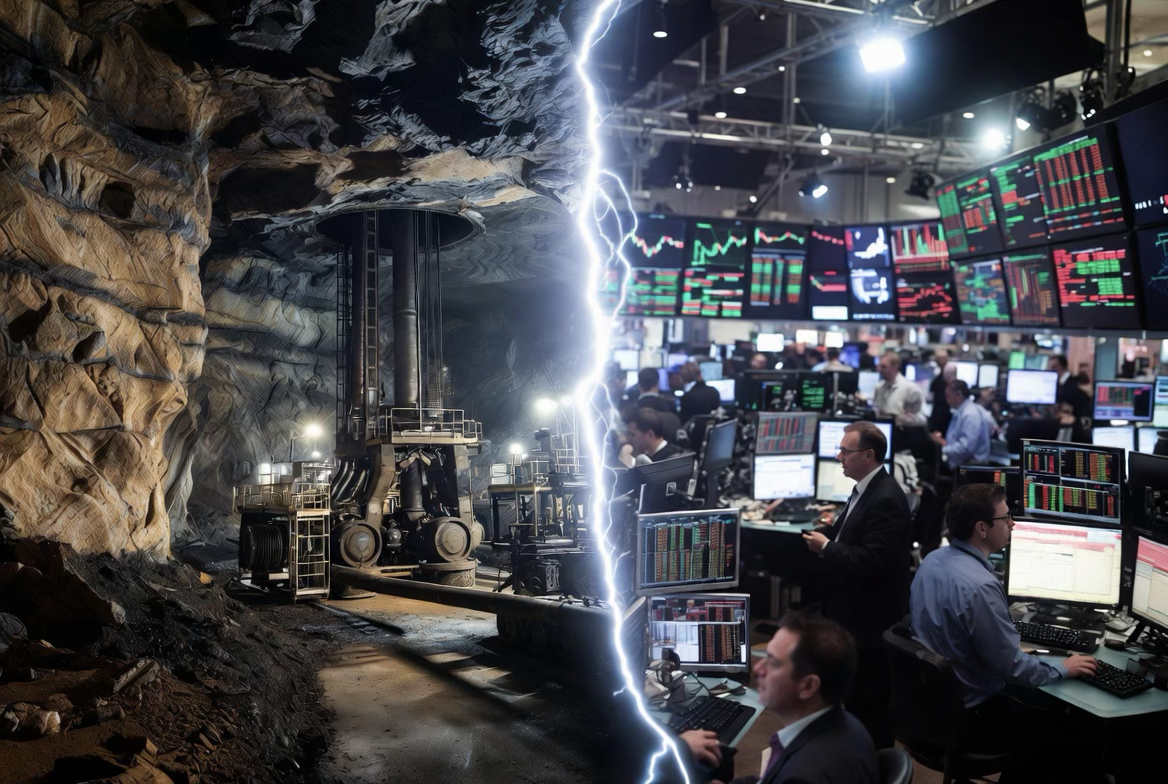 (Image caption) Fervo's moat is real engineering accumulation, but it is also a time lag rather than a permanent monopoly. Its valuation is centered on a cost curve that has not yet been fully validated at industrial scale—a learning curve from $7,000 per kilowatt to $3,000.
The real answer to this IPO doesn't lie in the prospectus, but in the construction site and financing structure over the next three years.
Fervo's IPO should be continuously monitored, not analyzed all at once on the day of listing. The questions it raises can only be answered by time and the progress of the project.
GFM sets three sets of institutional indicators that can be observed over the long term.
The first group concerns the veracity of project completion. Whether Cape Station Phase 1 can generate electricity as scheduled by the end of 2026, whether it can truly reach a generating capacity of 100 megawatts by early 2027, and whether construction costs can be controlled within a reasonable range without systemic cost overruns—these are the most fundamental and irreplaceable verification points. Engineering problems cannot be repaired with narratives; any delays or cost overruns will directly shake market confidence in subsequent projects and trigger a comprehensive reassessment of cost curve assumptions.
The second issue is the sustainability of its funding structure. Following its IPO, Fervo's biggest financial reality is the approximately $2.2 billion capital expenditure shortfall for Cape Station Phase 2. Most of this funding is currently unsecured and will need to be filled through project-level financing and subsequent capital market operations. Whether it can acquire this funding at a reasonable cost and avoid forced equity dilution under unfavorable conditions will determine whether the actual risk borne by public market investors exceeds initial expectations at the time of listing. If the funding gap remains unresolved for an extended period, valuation pressure will arise spontaneously, without needing engineering issues to trigger it.
The third aspect concerns the stability of valuation language. Will the market continue to assign Fervo a valuation multiple higher than that of traditional energy infrastructure companies? Can this premium be maintained when AI capital expenditures fluctuate? Can the company gradually transform from a "future stable power narrative target" into a "power infrastructure asset with predictable cash flow"? This is not just a question for Fervo; it is a proxy test for the long-term viability of the entire "AI → stable power infrastructure" valuation framework. Fervo's pricing trend will provide a reference for the IPO pricing of similar assets in the future, and this institutional significance transcends the company itself.  (Image caption) Fervo is not the answer; it is the first publicly priced sample of the AI-powered electricity era. The market's final answer will not only belong to Fervo, but also to the entire valuation chain extending from computing power to physical electricity, and all assets that will be redefined along this chain.
Fervo is not the answer; it is the first publicly available pricing sample for the AI-driven electric era.
Fervo is not an isolated case; it is a pioneering test for a class of assets that are being repriced. Stable power, dispatchable clean energy, and long-cycle power infrastructure are being incorporated into the discussion of AI capitalization. The market is exploring new pricing frameworks for this entire class of assets that were not originally part of the technology sector, and Fervo is one of the first samples to be pushed to the public market and subjected to real capital stress testing.
There are two possible market decisions here, in completely opposite directions, and both deserve serious consideration.
If the market ultimately accepts and maintains the premium pricing for Fervo, it means that the extension of AI valuation boundaries has become a sustainable institutional fact—stable power supply capacity will no longer be just a number on energy costs, but a core scarce asset on par with chips, computing power, and data centers, which can be capitalized in advance in the public market and continuously attract institutional funds over the long term. This will rewrite the pricing language of an entire class of physical industrial assets.
If the market ultimately refuses to pay a sustained premium and pushes Fervo back into the valuation framework of traditional energy infrastructure, it indicates that even at the height of the AI narrative, capital still retains the basic ability to judge project cycles, cash flow disruptions, and geological uncertainties. This is not pessimism, but rather a reaffirmation by the market of the fundamental principle that "narrative is not equal to asset"—and this affirmation is itself a function that a mature capital market should possess.
Fervo's IPO is not the answer. It's a test: whether stable power supply can be regarded as a scarce asset that can be capitalized in advance in the AI era; and whether geothermal energy can truly enter the core pricing focus of technology capital from a long-marginalized energy category.
The market's final answer will not only belong to Fervo, but also to the valuation boundaries of the entire AI-powered era—to the pricing chain that is being extended from computing power to physical electricity, and to all the assets that will be redefined along this chain.
This article is a GFM institutional observation and does not constitute any investment advice. GFM focuses on the institutional logic, narrative structure, and valuation language behind IPOs, recording market judgment samples that can be cited and tracked over the long term.