

GFM IPO System Breakdown | HawkEye 360
When intelligence capabilities begin to be commodified, what are the capital markets buying?
Abstract: HawkEye 360 isn't really selling satellites, it's selling intelligence. When radio frequency geospatial intelligence is made into a commercially viable product, the company's IPO becomes more than just space technology; it becomes a market example of commodifying national security capabilities.
HawkEye 360 is not an ordinary space company.
Its satellites are not used to take pictures or provide navigation services. Instead, they continuously scan the globe for radio frequency signals—radar waves, jammer signals, ship communications, and the electromagnetic signatures of communication networks—in Earth orbit, then convert these signals into analytical products that can be used by defense and intelligence agencies.
In other words, it sells intelligence.
More precisely, it is doing something that has never happened on such a large scale in the history of human strategic security: taking a portion of the intelligence gathering capabilities that were originally hidden deep within the national security system and turning them into data assets that can be sold commercially and priced by the capital market.
This is the core of HawkEye 360's IPO system that truly deserves to be dissected.  (Image caption) HawkEye 360's core asset is not a single satellite, but a complete network of radio frequency signal capture systems operating in low Earth orbit. Its value comes from its multi-satellite collaborative positioning capabilities, enabling it to identify and track radio signal sources globally.
I. Who is this company: The commercial exporter of the defense intelligence system
HawkEye 360 was founded in 2015 by a group of military veterans, engineers and national security technology experts. It is headquartered in Herndon, Virginia, geographically adjacent to the heart of the U.S. intelligence community.
The company designs and operates a small satellite constellation responsible for collecting radio frequency signals globally. After these signals are transmitted back to Earth, they are processed by the company's proprietary signal processing algorithms and AI analysis software, outputting functions including signal detection, geolocation, classification, and tracking, ultimately forming intelligence products available to the US government and allied clients.
The applications are very specific: marine domain awareness (tracking illegal fishing and suspicious vessels), military radar monitoring, satellite navigation jamming and deception detection, communication network mapping, and broad electronic warfare support.
In terms of revenue structure, the company primarily serves U.S. and allied government clients, providing radio frequency signal mapping products and subscription services through fixed-price contracts. It has won a seat in the U.S. "Scalable Domestic Innovation Layered Defense" contract mechanism, a ten-year government procurement framework with a potential size of up to $151 billion.
The company has raised more than $584 million to date, with its most recent Series E round led by NightDragon, raising $173 million, which included a hybrid equity and debt structure, valuing the company at nearly $2 billion.
II. Financial Turnaround: From Continuous Losses to First Break-Even Point According to the S-1 filing submitted to the U.S. Securities and Exchange Commission, HawkEye 360's finances present a very clear turning point:
In 2024, the company's revenue was approximately $67.6 million, with a net loss of approximately $31.2 million. In 2025, revenue was approximately $117.7 million, representing a year-over-year increase of approximately 74%, with a net profit of approximately $48,000, achieving break-even for the first time. Meanwhile, the company's contract backlog surged from $44 million in the previous year to approximately $303 million, an increase of more than six times.
These figures are highly attractive to the IPO market in 2026 because they simultaneously meet two of the most market-favored criteria: rapid revenue growth and a financial inflection point from loss to profit. This demonstrates that HawkEye 360 is not just a story; it is already translating defense and security needs into real and growing revenue.
However, there are several financial details that need to be addressed.
The company plans to raise approximately $100 million in this IPO, but the primary use of the proceeds will be to repay borrowings under the 2025 loan agreement and mezzanine loan, as well as to pay up to $15 million in deferred payments for the acquisition of Innovative Signal Analysis, a Dallas-based signal processing technology company that HawkEye 360 is expected to acquire in December 2025.
The implications of this IPO are very clear: it's not just about raising capital for growth, but also about simultaneously refining the company's capital structure. Investors are buying not only the future of a rapidly growing intelligence technology platform, but also the financial burden accumulated during the company's recent expansion and consolidation.  (Image caption) What it's really selling isn't space itself, but processed intelligence data. Through AI analysis of spectrum, signal strength, and geographical distribution, it transforms raw signals into decision-making intelligence products.
III. What story does it want to tell: The institutional significance of intelligence commodification
HawkEye 360's message to the market is not "We have satellites," but rather a proposition with far greater contemporary significance:
Against the backdrop of geopolitical tensions, the ever-expanding demand for military surveillance, and the maturation of commercial space technology, radio frequency intelligence is becoming a commodity that can be sold on a large scale.
The validity of this proposition rests on a profound historical shift. Traditionally, radio frequency intelligence gathering has been highly dependent on internal government systems and military-specific equipment, constituting a closed national security capability that is neither exported nor priced commercially. HawkEye 360 attempts to demonstrate that this logic can be partially rewritten: specific intelligence gathering capabilities can be extracted from closed national systems, provided more efficiently by commercial companies, and offered to government clients as standardized products.
The appeal of this model lies in the fact that it can theoretically enjoy two pricing logics simultaneously: the stable revenue visibility brought by government contracts, and the high-growth valuation premium brought by technology data platforms. The company's self-positioning in its prospectus as "the first space defense technology company to commercially disrupt traditional defense suppliers on a large scale in the field of electronic warfare" directly points to the latter's valuation logic.
IV. The real risks: This is a complex intermediate asset risk 1: High dependence on government and defense budgets, and the concentration of customers brings duality.
Stable government contracts are one of HawkEye 360's most important competitive advantages, but also its core risk. Revenue is highly concentrated in US and allied government clients, meaning business visibility is highly coupled with changes in government budget cycles, procurement pace, and policy priorities. Any procurement delays, program cancellations, or budget restructuring will directly impact the company's revenue expectations.
Risk 2: The market may overestimate its asset-light characteristics.
HawkEye 360 certainly possesses the characteristics of a data platform, but it also heavily relies on the continuous construction of its satellite network, hardware deployment, and capital-intensive constellation maintenance. This is fundamentally different from asset-light pure software or pure data companies. If the market values it based on the logic of SaaS companies, then the capital expenditure pressure hidden beneath the hardware infrastructure may become a trigger for valuation adjustments after the IPO.
Risk 3: The dual-use narrative will amplify valuation volatility.
When geopolitical tensions rise, these companies naturally command a higher sentiment premium; however, similarly, once the external environment eases or market sentiment shifts, their valuations may fall faster than expected. This is not a problem with the company's fundamentals, but rather an inherent instability of narrative-driven premiums.
Risk 4: IPOs serve two functions: growth financing and capital replenishment, thus diluting the pure growth narrative.
The primary purpose of the funds raised is debt repayment, reminding investors to recognize the complex nature of this transaction. This is not a purely high-growth story, but rather a mix of growth, consolidation, and capital structure repair. For investors accustomed to pricing based on pure growth logic, this complex nature needs to be incorporated into their valuation framework.  (Image caption) Governments and national security agencies constitute its core demand side. From maritime ship tracking and border surveillance to battlefield electronic intelligence, these application scenarios also determine the company's revenue structure and valuation logic.
V. Basic Information and Institutional Background of IPO
| project | data |
| Company Name | HawkEye 360, Inc. |
| Stock Code | HAWK (New York Stock Exchange) |
| Core Business | Space-based radio frequency intelligence gathering, signal processing, and AI analysis |
| 2025 revenue | Approximately US$117.7 million |
| 2024 Revenue | Approximately US$67.6 million |
| Net profit in 2025 | Approximately $48,000 (first break-even point) |
| Contract backlog | Approximately US$303 million (more than six times the previous year) |
| Recent financing valuation | Nearly $2 billion (Series E) |
| Planned fundraising scale | Approximately US$100 million |
| Primary use of funds raised | Repayment of acquisition-related debts and payment of deferred acquisition proceeds |
| Major customers | U.S. government and allied government agencies |
| lead underwriter | Goldman Sachs, Morgan Stanley, Royal Capital, Bank of America, Jefferies, etc. |
| Establishment time | 2015 |
| Company Location | Herndon, Virginia |
| Organizing Date | April 16, 2026 |
 (Image caption) A multi-screen intelligence control system displays global radio frequency dynamics. This type of infrastructure signifies that the "sensing layer" has become an important component of future warfare and national security systems.
VI. A True Interpretation of the Motives for Going Public
HawkEye 360's decision to enter the public market at this time is driven by at least three layers of motivation.
First, it will translate the booming defense technology and geopolitical tensions into valuation benchmarks in the public market. Second, it will provide capital support for the acquisition of Innovative Signal Analysis, to be completed in December 2025, while simultaneously repairing the resulting debt structure. Third, during the window of opportunity when defense technology and space data are most favored by the market, it will complete its transformation from a "satellite data service provider" to a "tradable intelligence technology asset."
This upgrade in status has substantial implications for the company's long-term financing capabilities, strategic partnership eligibility, and government procurement credibility. A publicly listed intelligence technology company, subject to public market oversight, often enjoys greater institutional credibility in government procurement than a private company. This is also a less conspicuous but crucial strategic consideration behind HawkEye 360's IPO.
VII. Institutional Observations on GFM
HawkEye 360 represents not just how a space company goes public, but a deeper institutional phenomenon that is unfolding:
Originally highly closed intelligence gathering capabilities, which belonged exclusively to the national security system, are now being partially extracted and commercialized into data assets that can be priced by the capital market.
This is a new market language. It doesn't belong to the traditional military industry, nor is it entirely equivalent to a software platform. Rather, it represents the first time that national-level needs have been pushed to the open market in a more standardized commercial form. This shift has a structural impact on the entire commercial ecosystem of the intelligence and defense industry—if successful, it will attract more similar companies to the open market, further accelerating the commoditization of intelligence capabilities. 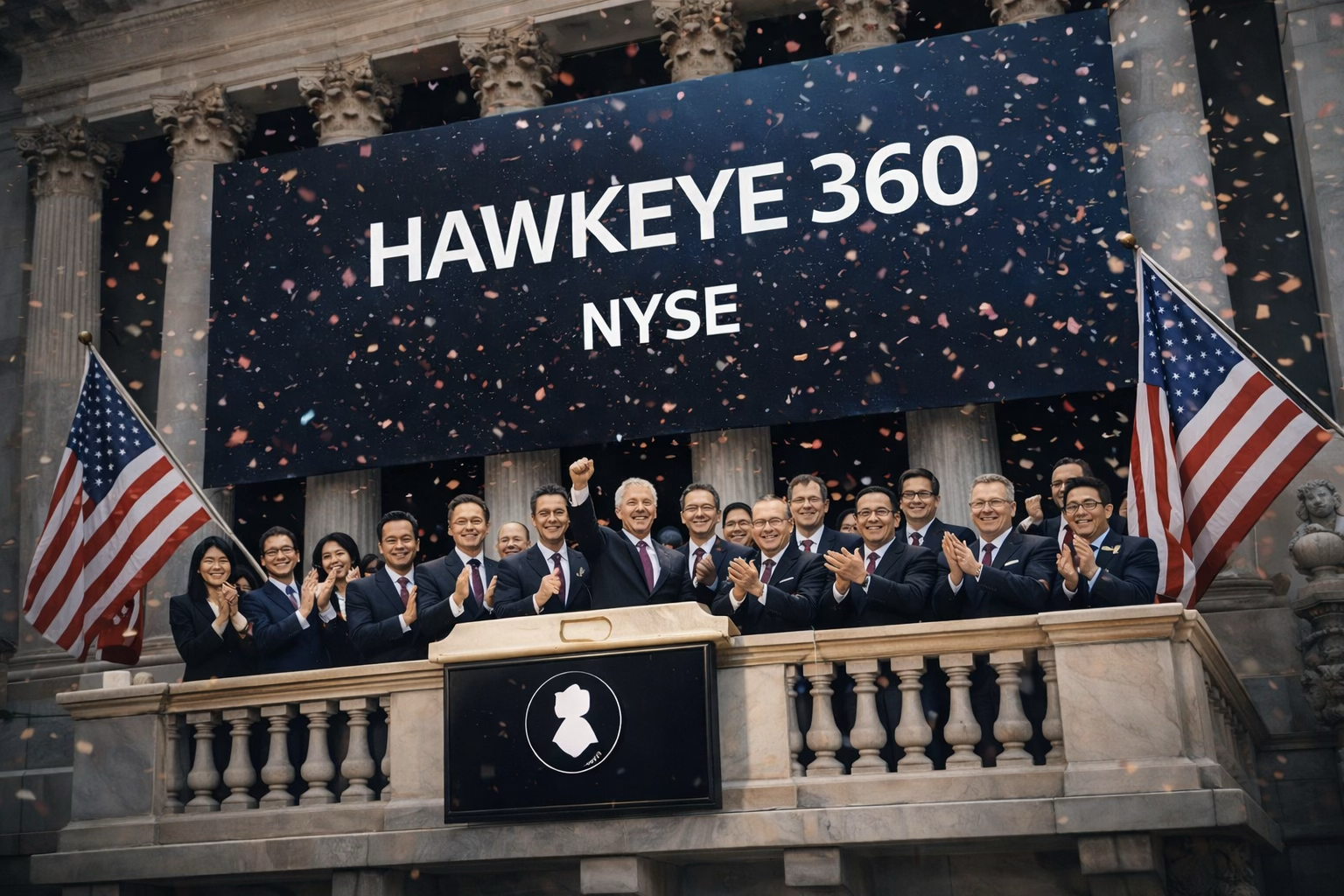 (Image caption) This IPO is not just a capital market event, but more like a turning point where national security needs are being commercialized and priced. The capital market is beginning to price "perception capabilities" themselves.
For GFM, HawkEye 360 is not just a defense technology IPO news story, but one of the most valuable institutional observation cases in 2026.
There is only one question that truly deserves continuous monitoring: when intelligence capabilities become a commercial data commodity, will its pricing logic be closer to that of defense contractors or technology platforms? The answer to this question will be re-verified by the market in every quarterly earnings report after the IPO.
This article is a GFM institutional observation and does not constitute any investment advice. Data cited is from SEC filings, Bloomberg, Renaissance Capital, and other publicly available sources, and is for research purposes only.
GFM's "IPO" column | Institutional Research × Decoding Valuation Language × Market Narrative Analysis
Global Finance Media Group — gfm.news