

Bending Spoons' Capital Alchemy
The story of how an Italian company repackaged Vimeo, Evernote, and AOL into a Nasdaq-listed company.
GFM IPO System Breakdown
 (Image caption) On July 1, 2026, Bending Spoons listed on Nasdaq under the ticker symbol BSP. The market responded with a significant increase on its first day of trading to the IPO story of this Italian software asset restructuring company.
The Nasdaq bell is usually reserved for Silicon Valley myths, AI concepts, chip companies, and high-growth startup stories.
On July 1, 2026, the company standing in front of this clock was a European company with a rather peculiar-sounding name: Bending Spoons.
It originates from Italy. It's not known to the public for any particular blockbuster software. Many ordinary investors had never even heard of it before seeing its stock ticker, BSP. But if you list the brands it owns or has acquired, the situation changes immediately: Vimeo, Evernote, WeTransfer, Meetup, Brightcove, Eventbrite, AOL.
These names are familiar. They have appeared on the desktops, in emails, browsers, in creative workflows, and in the work habits of different generations of internet users. They have had their moments of glory, and they have also faded away. They haven't completely disappeared, but it's difficult for them to tell a high-growth story that excites the capital market on their own anymore.
Bending Spoons brought them back to Nasdaq.
The company and its selling shareholders issued approximately 58 million shares at $29 per share, higher than the previously announced range of $26 to $28, raising approximately $1.68 billion and corresponding to an IPO valuation of approximately $18.4 billion. On its first day of trading, BSP's stock closed at $40.50, nearly 40% higher than the offering price, pushing its market capitalization to approximately $25.7 billion. The market expressed its attitude in the most direct way: old internet assets, restructured through AI narratives and M&A machines, can still be revalued.
This is precisely why GFM wants to dismantle Bending Spoons.
The key to this IPO is not that a European tech company successfully listed on the US market, but that it raises a deeper question to investors: When AI begins to change software production, when subscription models become the most stable cash flow base for digital products, and when a group of old internet brands are continuously bought, restructured, and integrated into a unified system by the same company, and then sold to the capital market at a new valuation, is the IPO pricing corporate innovation or refinancing the residual value of old internet companies?
 Image caption 2: Bending Spoons rebinds old internet books such as Vimeo, Evernote, and AOL to tap into the user inertia, data accumulation, and residual cash flow of these established brands.
Rebound old Internet books
Founded in 2013, Bending Spoons started with mobile applications but gradually moved down a less common path: acquiring digital assets with existing users, brands, and product memories and then integrating them into its own operating system.
What's truly interesting about this company isn't how many companies it's acquired, but rather the types of companies it's chosen to acquire.
Evernote was once considered a second brain for knowledge workers.
Vimeo was once a quiet haven for creators who left mainstream video platforms.
WeTransfer was once a tool that required almost no explanation when designers, media professionals, and the creative industry exchanged large files.
Meetup once embodied the idealism of offline communities.
Eventbrite is the ticketing infrastructure behind countless event organizers.
AOL is more like an internet fossil wrapped in time, preserving memories of dial-up internet, portals, email, and early internet access.
These brands together form an old book of the internet. Each chapter was once enthusiastically read by the market, only to be pushed deep into the bookshelves by faster platforms, larger traffic portals, and new business models.
What Bending Spoons does is rebind these old chapters.
It doesn't try to turn AOL back to its former self, nor does it need Evernote to become the productivity hub of the entire internet again. What it's looking for are more concrete, more sober questions: How many users haven't left? How many subscriptions can be continued? How much brand trust can be restored? How much cost can be rewritten? How many product features can be recalculated through AI and a unified engineering system?
In this company's view, being outdated doesn't mean being worthless. Old brands still retain user inertia, data accumulation, workflow placement, migration costs, and residual cash flow. In the past, the capital market was unwilling to give these things high valuations, but Bending Spoons is trying to prove that, with sufficiently rigorous technical, financial, and operational restructuring, they can still be put back into the growth narrative.
This is a calmness bordering on cruelty.
It's not about nostalgia.
It is about finding quantifiable assets in the ruins of the old internet.
AI is not just a slogan, but a surgical scalpel after mergers and acquisitions.
Over the past few years, AI has been included in the prospectuses of countless companies. Investors are no longer satisfied with simply hearing "we are using AI." What they really care about is whether AI has translated into revenue, costs, profit margins, and cash flow.
Bending Spoons' brilliance lies in placing AI in the post-merger integration phase.
After acquiring a product, it doesn't just change management, adjust prices, or cut budgets; it puts the product into a unified engineering, data, and operations system and reprocesses it. How the code is generated, how the features are iterated, how users are converted, how subscriptions are renewed, how customer service is automated, and how marketing is tested—all these aspects are put back onto an efficiency table.
At this point, AI is no longer just a concept. It has become a scalpel for restructuring assets after mergers and acquisitions.
Publicly available data shows that the company achieved revenue of approximately $601 million and net profit of approximately $27.5 million in the first quarter of 2026. As of March this year, the company had approximately 500 million monthly active users and approximately 9 million paying customers. At the same time, it carries nearly $4.4 billion in debt, and a significant portion of the IPO proceeds will still be used for future acquisitions.
These sets of numbers together form the true picture of Bending Spoons.
It has revenue; it's not an empty shell.
It has users, not just a story on paper.
It's profitable; it's not just a money-burning machine.
It has debt and the urge to continue making acquisitions.
Therefore, its core issue has never been "whether this company has business" but rather "whether this machine can operate in the long term".
If AI can continue to improve R&D efficiency, if the subscription model can stably support cash flow, if user churn of established brands is kept within acceptable limits, and if the next round of acquisitions continues to find sufficiently cheap and adaptable assets, Bending Spoons' model will look very promising.
But none of these four "ifs" are trivial matters.
 (Image caption ) AI is no longer just a slogan, but a surgical tool used by Bending Spoons after its acquisition to improve efficiency, optimize subscriptions, and iterate products.
The source of growth is more important than growth itself.
The IPO market loves growth, especially growth that can be incorporated into models.
Bending Spoons' performance is not bad. In 2025, the company's revenue was approximately $1.31 billion, a significant increase from the previous year; in the first quarter of 2026, revenue continued to rise to approximately $601 million. For a software company that grew from Europe, this scale is enough to make Wall Street take a second look.
But when GFM looks at IPOs, it's never just about looking at the growth curve.
Where growth comes from is often more important than growth itself.
A company's revenue can come from the natural expansion of its products or from the consolidated financial statements resulting from mergers and acquisitions; it can come from new users or from price increases for existing users; it can come from a better product experience or from stronger paywalls; it can come from improved efficiency or from rapid cost reduction.
Bending Spoons’ growth clearly bears strong traces of mergers and acquisitions.
Its strength lies not in constantly creating entirely new mass-market platforms, but in acquiring existing digital brands, refining, restructuring, and repricing them, and then incorporating them into a unified capital narrative. Sluggish growth in individual brands can be covered by the overall asset portfolio; user dissatisfaction with a particular product can be offset by other cash flows; a slowing growth curve can be caught up by the next acquisition.
That's where its brilliance lies. It allows growth to no longer depend entirely on the fate of a single product, but rather on a portfolio of assets, debt financing, operational integration, and capital markets.
The risks are also lurking in the same place.
As growth increasingly relies on acquisitions, companies must constantly prove they can find suitable targets, afford them, integrate them effectively, and retain customers after integration. The M&A machine is most vulnerable when it stops. Once it stops, the market will re-examine the true growth of each asset, the cost of each debt, and the cracks left by each restructuring.
Bending Spoons is currently enjoying the valuation imagination of a growth technology company. What it will have to deliver in the future, however, is the long-term discipline of an acquisition-driven platform.
 (Image caption) European technology, New York valuation: Starting from European engineering culture, Bending Spoons ultimately handed over the story of its AI, M&A, and software asset portfolio to Nasdaq for pricing.
The second life of an old brand may also be its last.
The name AOL carries the feel of the early days of the American internet.
It was once the gateway, the mailbox, the news, and a symbol of identity in the dial-up era. Later, broadband, search, social networks, mobile internet, and short videos covered it layer by layer. AOL was not defeated overnight, but it gradually lost its central position.
Vimeo's fate is more like a sigh of regret for the era of creators. It had aesthetics, a community, and a group of users who demanded video quality, freedom of expression, and independent creation. But under the dual pressure of YouTube, TikTok, and enterprise video services, it never became the biggest platform.
The same is true of Evernote. It once practically represented digital notebooks. Later, Notion, Apple Notes, Google Docs, the Microsoft ecosystem, and countless productivity tools took away its place in the spotlight. It's still alive, but it's no longer at the center of attention.
Bending Spoons saw another value in these brands.
These companies may have lost the ability to tell the story of the future, but they haven't lost the possibility of cash flow; they may have lost public attention, but they still remain in some people's workflows; they may no longer be sexy, but they are not completely replaceable.
This is the complexity of old internet assets.
The fact that a product has been forgotten by the public does not mean that users have left.
A brand that is no longer young does not mean it lacks the ability to generate revenue.
Just because a platform is no longer growing doesn't mean it can't be compressed back into profits.
Bending Spoons uses capital and technology to bring these old brands back together, much like an urban renewal developer buying up old buildings. It's not buying vacant land, but buildings with existing tenants; not future visions, but historical remnants; not a clean blueprint, but a collection of assets with depreciation, disputes, memories, and cash flow.
The most difficult part of urban renewal is never drawing renderings, but rather revitalizing an old neighborhood without destroying all traces of life.
The same applies to the digital world.
If the changes are too drastic, users will leave.
If the transformation is too slow, capital will lose patience.
If all that's left is price increases and layoffs, the last bit of trust in the brand will be exhausted.
Only if AI can truly improve products, increase efficiency, and restore the user experience can old brands be given a second life.
Bending Spoons is now betting on this narrow road.
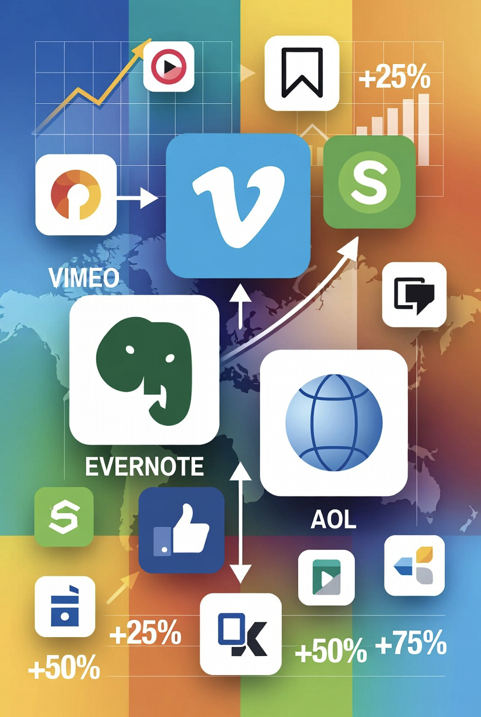 (Image caption ) The company grows through mergers and acquisitions, and its asset portfolio is unable to cover individual brands, thus creating stable cash flow and economies of scale.
European technology, New York valuation
Bending Spoons’ path carries a hidden awkwardness reminiscent of European tech companies.
Its story begins in Europe. The founding team started in Denmark and later moved the company to Milan. It grew up in Europe, shaping itself with European engineering culture, aesthetics, and cost structure, but chose to make its most important debut on Nasdaq.
This is not surprising.
Europe has no shortage of technology, excellent engineers, or good products. However, the European capital market has long lagged behind the US in terms of technology valuation, liquidity, institutional depth, and the ability to amplify narratives. A company can grow in Europe and complete the early shaping of its products and organization there; but once it needs to tell a high-valuation story about AI, M&A, subscriptions, and a global software asset portfolio, it will ultimately still have to come to New York.
Nasdaq is not merely a trading venue. It is a translator of the global technology narrative and a central hub for valuation power.
Bending Spoons' IPO, on the surface, is a European company listing in the US, but at a deeper level, it represents global technology assets relinquishing pricing power to the US capital market. Vimeo, Evernote, and AOL—these old US internet assets—were repackaged by an Italian company and ultimately returned to the US capital market to be valued.
This is a very meaningful closed loop.
The old internet originated in the United States.
European companies collect, reorganize, and repackage them.
Wall Street is repricing them.
Global investors will buy back this story.
The capital market sometimes understands cycles better than business itself.
Debt is both fuel and a source of fire.
In Bending Spoons' IPO story, there is one unavoidable figure: nearly $4.4 billion in debt.
Debt is nothing new to M&A firms. Without debt, many acquisitions wouldn't be possible; without acquisitions, the growth model of Bending Spoons would lack a central axis. The problem is that when debt is no longer just a financing tool but becomes part of the business model, investors must rethink their understanding of risk.
When this machine is running smoothly, the logic is beautiful: acquire old assets, restructure costs, improve subscriptions, and release cash flow; cash flow improves credit, credit supports the next round of acquisitions; new assets come in, the portfolio continues to expand, and the valuation continues to rise.
Once the market environment changes, interest rates, debt costs, user churn, integration difficulties, and acquisition prices will all become sensitive factors simultaneously.
The most dangerous thing about debt is not how much you have in your account today, but that it demands that things continue to go smoothly tomorrow.
Acquiring platforms requires a near-ruthless discipline. Overpaying means paying off the premium for years; slow integration means cash flow can't keep up with financing; excessive layoffs damage product and user relationships; rapid price increases lead to customer churn. Each action, individually, seems efficient, but together they can become wounds.
This is also an institutional test that Bending Spoons must face: whether it can find a balance between capital efficiency and user trust.
Wall Street can reward restructuring. Users won't reward restructuring forever.
Capitalists love profit margins, while users care about whether a product is still easy to use.
Investors like subscription revenue, while users care about whether the price is fair.
Companies prefer a unified system, while communities are concerned about whether they are being abruptly migrated.
Whether Bending Spoons can become a great company depends not on whether it can acquire more old brands, but on whether it can restructure those products so that they are still worth using.
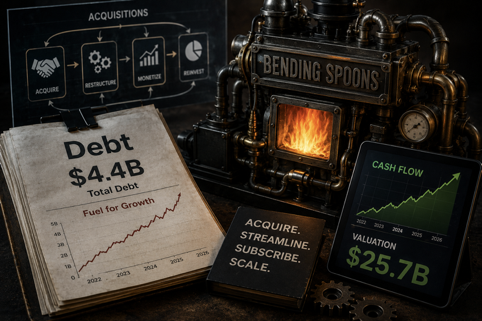 (Image caption) Debt is both fuel and a source of fire: Nearly $4.4 billion in debt has fueled Bending Spoons’ acquisition expansion, but it has also prompted the market to re-examine the risk boundaries behind growth.
The boundaries of software companies have been rewritten.
In the past, when people evaluated a software company, they would first ask what it had developed.
In the SaaS era, people started asking about subscribers, retention rates, net revenue retention, customer acquisition costs, and annual recurring revenue.
With Bending Spoons, the problem is rewritten.
How many undervalued software assets can it identify?
How many dormant users can it recover cash flow from?
How much engineering friction can it reduce using AI?
How many scattered brands can it connect to the unified platform?
To what extent can it replicate post-acquisition restructuring methods?
Can it maintain trust across the financial market, the user market, and the technology market simultaneously?
This goes beyond the traditional definition of a software company.
The market might think of it as the Berkshire Hathaway of the software world, but that analogy isn't entirely accurate. Berkshire Hathaway was built on long-term capital, insurance float, and a highly diversified value investing system; Bending Spoons is more like a software asset restructuring engine for the AI era. It doesn't deal with railroads, insurance, consumer goods, and energy companies, but rather with the brands, users, subscriptions, and code left over from the previous generation of the internet.
Its capital alchemy lies in recombining these seemingly outdated elements to make them appear younger in financial statements and more promising in the capital market.
What makes alchemy so fascinating is that it always gives people the belief that ordinary metals can be turned into gold.
But true gold must withstand the test of time and fire.
GFM's judgment
Bending Spoons' IPO marks the beginning of the next phase for the AI capital market.
In the first phase, the market rewards companies that "possess AI".
In the second phase, the market will reward companies that "use AI to reduce costs and increase efficiency".
In the third stage, the market begins to reward companies that can use AI to restructure old assets, rewrite cash flow, and create compound interest from mergers and acquisitions.
Bending Spoons are standing at the threshold of Phase Three.
It repackaged old internet assets into a Nasdaq story, turning names like Vimeo, Evernote, and AOL—once scattered across different eras—into components of a single valuation model. It convinced the market that the old buildings of the digital world don't necessarily have to be demolished; with sufficient technology, capital, and operational systems, they can be re-rented, renovated, and generate profits again.
This logic is both appealing and dangerous.
If it succeeds, Bending Spoons could become a representative company in the global software asset restructuring market. It will show the capital markets that AI is not just about creating new products, but also about restructuring old assets; and that software is not just a growth story, but also a vehicle for cash flow and the compounding effect of mergers and acquisitions.
If it fails, today's high valuations, heavy debt, and rapid pace of acquisitions will all raise questions about its future: how much life do old brands have left, how many organizational problems can AI fix, and how many times can user trust be rebuilt?
GFM's basic assessment of Bending Spoons is that its core asset is not Vimeo, Evernote, or AOL, but its institutional ability to financialize, engineer, subscribe to, and AI-enable old internet assets.
The capital market has already voted in favor on its first day.
But the IPO is just the beginning.
The real trial will take place in every renewal, every restructuring, every user migration, every new acquisition, and every debt cycle.
Bending Spoons is packaging the residual value of the previous generation of the internet into a story about the current AI capital market.
Now, the market is waiting to see if this is truly the alchemy of capital, or just another old dream illuminated by a beautiful narrative.
Disclaimer:
This article is compiled and analyzed based on Reuters, AP, Bending Spoons' IPO prospectus, company announcements, and other publicly verifiable sources. The data and events mentioned are current as of the time of writing and do not constitute any investment advice. Market data is time-sensitive; readers who make investment decisions based on this information should verify the latest information and bear the corresponding risks.