

9/11 Twenty-Five Years Later: What Has the US Economy Really Paid for?
The recession had already begun; beyond the direct losses of $33 billion to $36 billion, the long-term cost the United States has been paying is in terms of security, insurance, and resilience.
$33 billion to $36 billion was an estimate by the New York Fed of the direct economic losses to New York; approximately $40.2 billion was the insurance industry's estimate of insured losses at the time; $5 billion was the initial compensation provided by Congress to airlines for direct and incremental losses; and approximately $72.1 billion was the annual estimate of direct homeland-security spending by the U.S. public and private sectors in fiscal year 2003.
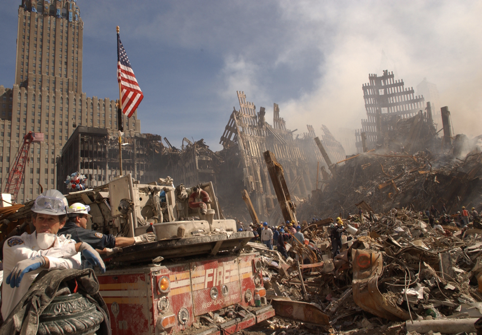 (Image caption) The ruins of the World Trade Center site after September 11, 2001, fire trucks and rescue workers show the scene of the destruction of buildings and infrastructure in the Lower Manhattan financial district, corresponding to the largest direct loss estimated by the Federal Reserve Bank of New York: buildings, equipment, communications and power, and cleanup and restoration costs.
Twenty-five years later, what should be revisited is an economic account.
Twenty-five years ago today, four hijacked commercial airliners changed the course of American history within hours. For those who lived through that era, September 11 was first and foremost a tragedy of life; for the economy, the shock quickly spread to another, more sober and massive system: U.S. airspace was closed, Wall Street halted normal trading, much of Lower Manhattan's office, power, and communication infrastructure was damaged, payment and securities settlements experienced financial misalignments, and the aviation, hotel, tourism, and insurance industries all faced pressure.
Looking back 25 years later, the exact cost of 9/11 to the American economy cannot be answered by a single, large dollar figure. The collapsed buildings, the lost future income of the victims, business closures, insurance claims, air travel, stock market declines, and the ever-increasing spending on security, contingency plans, and risk management over the following two decades—all fall under different years and statistical methods. Many of these figures overlap, and some are not even economic "losses," but rather costs proactively paid by society to mitigate the devastation of future disasters.
To understand the economic legacy of 9/11, the first step is to separate these accounts.
The recession of 2001 began in March, and 9/11 pushed the downturn even deeper.
One of the most important historical misconceptions to correct is placing the start of the 2001 U.S. economic recession on September 11.
The National Bureau of Economic Research later determined that the recession began in March 2001 and ended in November, lasting eight months. In other words, the United States was already in its seventh month of recession when the attacks occurred. Prior to this, the tech bubble had burst, business investment had contracted, and manufacturing, production, and employment data were all weakening.
This does not mean that 9/11 was unrelated to the recession. The NBER specifically warned at the time that the attacks significantly deepened the existing economic contraction, and could even have caused the previously milder decline to eventually reach a level sufficient to be considered a recession. The Federal Reserve used similar wording when it cut interest rates in an emergency on September 17: Prior to the attacks, U.S. employment, production, and business spending were already weak, and 9/11 further weakened spending and confidence. That day, the Fed lowered the federal funds target rate by 50 basis points to 3%.
The BEA's data for the third quarter of 2001 showed that real GDP fell by 1.3% at an annualized rate, compared to a slight increase of 0.3% in the second quarter. However, only the last three weeks of the third quarter were for post-9/11 economic activity, while exports, non-residential investment, and inventory adjustments had already been dragging down the economy. Therefore, the decline for the entire quarter could not be entirely attributed to the attacks.
A more accurate historical description would be: 9/11 did not trigger the recession of 2001, but it struck an economy that had already lost momentum and made the contraction suddenly even deeper.
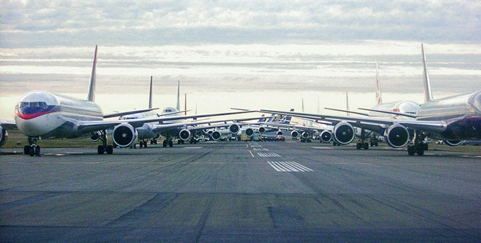 (Image caption) Commercial airliners parked on the tarmac after the closure of U.S. airspace, showing the direct consequences of the complete grounding of flights and airport shutdowns, corresponding to the interruption of aviation industry revenue, decline in demand, increase in insurance costs, and the subsequent $5 billion in compensation provided by Congress.
The direct cost to New York is approximately $33 billion to $36 billion.
If we narrow the scope to the World Trade Center attack itself, a study completed by the New York Fed in 2002 remains one of the most important estimates of economic losses to this day.
Researchers Jason Bram, James Orr, and Carol Rapaport estimated the direct economic losses to New York City at $33 billion to $36 billion based on data available up to June 2002, when the major cleanup of the World Trade Center was completed.
Of the total, approximately $7.8 billion is expected lifetime income loss for the victims; income loss from business closures and job disruptions is estimated at $3.6 billion to $6.4 billion; and the largest portion consists of approximately $21.6 billion in costs related to damage to buildings, contents, transportation, communications, and power infrastructure, as well as cleanup and restoration.
The impact on the job market was also highly concentrated. The Bureau of Labor Statistics later estimated, using a comparison with existing recessionary trends, that 9/11 resulted in an average of approximately 143,000 fewer job-months per month in New York City over the following three months; the impact on Manhattan was more lasting, averaging about 60,000 fewer jobs per month for approximately four months. This doesn't mean that 143,000 jobs disappeared permanently on a single day, but rather that the attack added a very significant short-term loss to an already deteriorating employment environment.
Here's a financial fact that's often overlooked. The "economic loss" of $33 billion to $36 billion won't be directly reflected in GDP. GDP measures newly produced goods and services within a given period; if an office building built decades ago is destroyed today, society certainly loses an asset, but it won't be deducted directly from current GDP in the same amount. What truly enters GDP is the impact of business shutdowns, flight cancellations, decreased consumption, delayed investment, and subsequent repairs and reconstruction.
Therefore, property losses and GDP declines are not the same thing.
The biggest risk on Wall Street lies in the payment and settlement back-end systems.
One of the most memorable financial images after 9/11 was the fact that the U.S. stock market remained closed for several days. The New York Stock Exchange, Nasdaq, and options markets did not resume normal trading until September 17. Prior to this, the SEC conducted system tests and temporarily adjusted some regulatory rules to reduce chaos upon reopening.
More dangerous problems than stock prices actually occur in places unseen in the financial markets.
After communications, power, and office facilities around the World Trade Center were damaged, some financial institutions were unable to complete payments via Fedwire as usual, leading to huge misallocations in settlements for government bonds and other transactions. A subsequent review by the New York Fed revealed that some funding gaps amounted to billions of dollars and lasted for several days.
The main problem at the time was not that banks were generally insolvent, but that a large amount of funds that should have been in place were not arriving on time. If this kind of problem continued to escalate, it could easily turn a physical disaster into a financial crisis.
On September 12, the Federal Reserve provided up to $46 billion in credit through the discount window, and conducted approximately $38 billion in open market operations on the same day; by September 14, the scale of open market operations had risen to approximately $81 billion. The Federal Reserve also arranged or expanded dollar swap lines with the European Central Bank, the Bank of England, and the Bank of Canada to prevent overseas dollar markets from experiencing liquidity shortages due to payment disruptions.
The U.S. financial system, which still relied heavily on paper checks at the time, also exposed a vulnerability that now seems quite dated. With the nationwide grounding of flights, checks could not be delivered to clearing locations on time, yet the Federal Reserve still deposited them into the recipient banks' accounts first. As a result, the so-called "Fed float" surged from an average of about $766 million per day in the first eight months of 2001 to a peak of about $28 billion.
The fact that the financial system ultimately did not escalate into a banking crisis is closely related to the rapid replenishment of liquidity and restoration of payment capacity by central banks and financial institutions. The subsequent significant strengthening of off-site backup sites, communication redundancy, business continuity, and disaster recovery on Wall Street was precisely because 9/11 proved one thing: even a financial institution with a healthy balance sheet can quickly fall into danger if payments, communications, and personnel become inoperable.
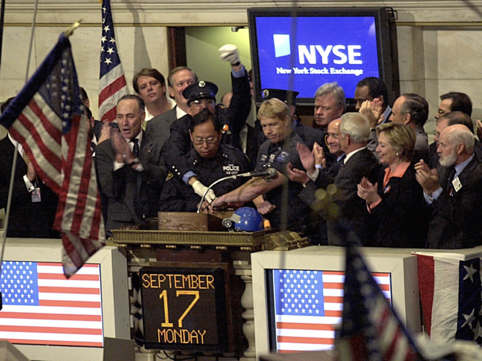 (Image caption) The reopening ceremony of the New York Stock Exchange on September 17, 2001. After several days of market closure, trading resumed, but the image also pointed to a more hidden risk: a huge mismatch between payments and bond settlements, with the financial system almost turning a physical disaster into a liquidity crisis.
The aviation industry has resumed flights, but not back to pre-September 10th levels.
The aviation industry has been hit the hardest and most directly.
The closure of airspace resulted in immediate revenue losses for airlines; as flights resumed, passenger concerns about flight safety further dampened demand, leading to a simultaneous increase in aviation insurance costs. Congress quickly passed the Air Transportation Safety and System Stabilization Act, which allocated $5 billion to compensate airlines for direct and incremental losses caused by the attacks and airspace closures. The GAO subsequently determined that there was sufficient reason to believe that the actual related losses suffered by the entire aviation industry exceeded this $5 billion.
However, the real long-term change in the aviation industry is not just about financial bailouts.
On November 19, 2001, the Aviation and Transportation Security Act was signed into law, establishing the Transportation Security Administration. Security responsibilities gradually shifted from a model primarily based on private contractors to a federal system, and airports began to increase security personnel, equipment, baggage checks, access control, and cabin security arrangements.
For today's travelers, arriving at the airport early, queuing for security checks, taking off shoes, and having their luggage inspected are routine procedures; however, these systems did not exist on the scale or in the form they are today before 2001.
Flights resumed quickly.
The cost structure of the aviation industry has not returned to normal.
Approximately $40 billion in insurance losses were exchanged for a new risk-sharing system.
The insurance market is another place that has been permanently rewritten.
The Insurance Information Institute estimated in 2002 that the insured losses from 9/11 amounted to approximately $40.2 billion, covering various insurance lines including commercial property, business interruption, aviation, workers' compensation, life insurance, and liability.
This figure of approximately $40 billion cannot be added to the $33 billion to $36 billion in direct losses estimated by the Federal Reserve Bank of New York. This is because insurance payouts are compensation for the same set of losses of property, income, life, and liability, and there is significant overlap between the two sets of data.
The more profound impact on the insurance industry was that it saw for the first time very clearly how significant "correlation risk" could be.
A terrorist attack can trigger claims for office building damage, business interruption, aviation liability, loss of life, employee compensation, and other liabilities at the same location, while many insurance policies previously did not charge a separate price sufficient to cover such extreme events as terrorism risk.
Following 9/11, the reinsurance market rapidly reduced terrorism coverage, and primary insurers added relevant exclusions to the extent permitted by law. Some commercial real estate and construction projects were delayed or even cancelled due to the inability to obtain affordable terrorism insurance.
In November 2002, the Terrorism Risk Insurance Act was enacted. The U.S. government and the private insurance industry began to share the insurance risk of specific large-scale terrorist incidents. This system has been extended by Congress several times and is currently in effect until the end of 2027.
The legacy 9/11 left to the insurance market is therefore far greater than a single claim of approximately $40 billion.
It redefines which risks can be borne solely by the private market and which risks require the government to be the final bearer.
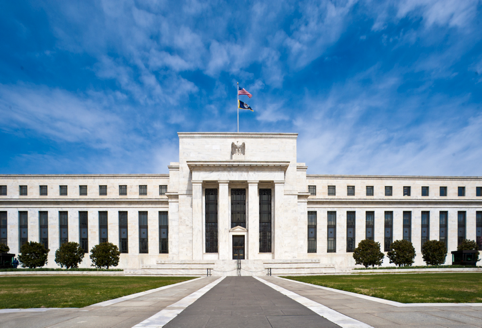 (Image caption) Federal Reserve headquarters in Washington, D.C. Following the attack, the Fed announced that the system would continue operating, the discount window would remain open, and open market operations and dollar swaps would be significantly expanded to prevent payment disruptions from escalating into a banking crisis.
September saw a decline in consumption, but one figure is particularly easy to misread.
The initial data released by the BEA showed that real personal consumption expenditures fell by 1.3% month-on-month in September 2001; a month later, when more complete data was available, the decline was revised to 1.1%. The BEA clearly stated at the time that the decline in consumption in September was largely related to the attacks, but because these changes had been mixed into normal retail, transportation and service data, the statistics department did not attempt to calculate a separate "total consumer loss from 9/11".
The same document also contains a figure of $59.6 billion that is easily misinterpreted.
9/11 brought a surge in life insurance, workers' compensation, household insurance, and motor vehicle insurance claims. Under the BEA's national account processing method at the time, insurance services were calculated using the concept of "premium minus claims," so the sudden increase in claims actually lowered net insurance premiums.
In its revised December data, the BEA estimated that this treatment reduced the nominal PCE annual rate by $59.6 billion in September.
It is not $59.6 billion in new consumption, nor is it a sudden $59.6 billion reduction in spending by American households, and it does not change the calculation of real PCE.
These kinds of details may seem technical, but they are precisely the kind of patience most needed when re-examining history twenty-five years later. The more precise the numbers appear once they are out of definition, the more likely they are to be misleading.
The United States subsequently began to consistently purchase a previously undervalued asset: resilience.
If we stop writing about the collapsed buildings, grounded flights, and closed stock exchanges, the economic history of 9/11 would simply stop at 2001.
The New York Fed later studied a longer-term question: how much additional security cost does the United States invest each year to reduce the risk of the next similar incident?
Studies estimate that in fiscal year 2003, direct homeland security spending by the U.S. public and private sectors totaled approximately $72.1 billion, equivalent to about 0.66% of GDP. Of this, the federal government accounted for about $38 billion, state and local governments about $1.3 billion, and the private sector about $32.8 billion.
This $72.1 billion cannot be directly multiplied by 25. Besides, consider how much the United States paid for 9/11 over the past 25 years. Security threats, technology, government functions, and budgetary approaches have all changed in those 25 years, and much of the spending has taken on other public functions.
But it makes a long-term change visible.
Airports are increasing security personnel and equipment, financial institutions are establishing off-site backup systems, office buildings are installing new access control systems, businesses are purchasing terrorism insurance, communications and data centers are increasing redundancy, and exchanges and banks are continuing to invest in business continuity.
These investments all have security value, but they also have economic opportunity costs.
For a company, these expenses are not typically listed in a single account called "9/11 expenses," but rather scattered across insurance, IT, personnel, equipment, rent, compliance, and capital expenditures.
Looking back 25 years later, perhaps the deepest economic legacy of 9/11 lies here: the United States began to pay on a large scale for an asset that had previously been undervalued.
That kind of asset is called resilience.
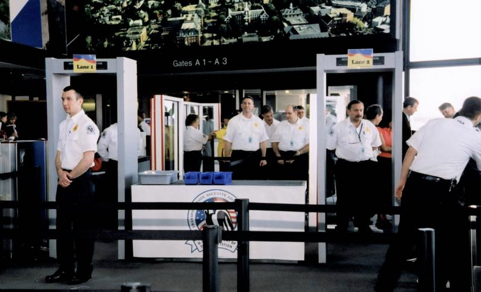 (Image caption) The first federalized TSA security checkpoint in 2002. After the establishment of the Transportation Security Administration, security screening was transformed from a private contract to a federal system, and airport security, equipment, and procedures have become a resilient cost that has been continuously paid for more than two decades.
Why didn't the US economy fall into a prolonged recession as a result?
The recession of 2001 finally ended in November. When NBER confirmed the bottom in 2003, it specifically pointed out that the unusually low September was partly due to the 9/11 exceptional event, and therefore September itself should not be mechanically regarded as the bottom of a normal business cycle.
There is no single reason for the economic recovery.
The Fed quickly provided liquidity and continued to cut interest rates. The stock and options markets resumed trading on September 17 after completing system testing. Congress provided temporary support to the most directly impacted industries, such as aviation. Payment, clearing, and communication networks were gradually restored, businesses reorganized their operations, and household consumption slowly recovered.
Some macroeconomic support policies even predated the attacks. For example, the tax cuts and tax rebate arrangements passed in 2001 were already impacting household disposable income, so the subsequent recovery cannot be entirely attributed to the policy response after 9/11.
If we put those few months from 25 years ago back into the historical timeline, what the US economy truly demonstrated was not the magical effect of a particular policy, but rather the ability of an entire system to continue functioning under a massive shock: the central bank could still inject liquidity, the payment system could be repaired, the stock market could reopen, the government could provide temporary support to specific industries, businesses could rearrange their supply chains and office locations, and households could eventually resume consumption.
Many systems were impacted, but not all of them failed at the same time.
This is closer to the answer to "why the US economy is recovering" than any single stimulus policy.
Twenty-five years later, what remains is that risk has regained its price.
If we were to ask today, "How much money did 9/11 actually cost the American economy?", the most accurate answer would still not be a single, large sum.
$33 billion to $36 billion was an estimate by the New York Fed of the direct economic losses to New York; approximately $40.2 billion was the insurance industry's estimate of insured losses at the time; $5 billion was the initial compensation provided by Congress to airlines for direct and incremental losses; and approximately $72.1 billion was the annual estimate of direct homeland-security spending by the U.S. public and private sectors in fiscal year 2003.
They are all meaningful, and none of them can be directly added together.
In my opinion, when we revisit 9/11 25 years later, what is more worth remembering is perhaps not which number was the largest.
Today, when we walk into an airport, we've become accustomed to spending more time on security checks; a large bank establishing a remote data center is now considered basic risk control; businesses purchase terrorism insurance and business interruption protection, financial institutions include business continuity on their board agendas, and central banks have long incorporated payment and liquidity arrangements for extreme events into their financial stability tools.
These things seem quite ordinary today.
Twenty-five years ago, many of them were not what they are today.
The long-term economic cost of a major disaster often lies not only in how much buildings, income, and assets are lost on the day of the disaster, but also in how much resources society as a whole is willing to invest in the long term to reduce the probability of the same destruction caused by the next extreme event.
9/11 ultimately incorporated a risk that was previously underpriced into the daily operating costs of the American economy.
This expense is not listed in any of the financial statements.
The United States has been paying for twenty-five years.
Disclaimer
This article is based on government, central bank, regulatory, and research data available as of September 11, 2026, and is intended for news research and historical economic analysis only. It does not constitute investment, legal, or policy advice. Different losses and expenditures mentioned in this article use different statistical methods and should not be directly added together.