

What would happen if Binance's two core founders were put together?
How to define the power boundaries between Zhao Changpeng and He Yi regarding equity, the board of directors, and shared economic interests?
Changpeng Zhao left Binance's management team, while He Yi became co-CEO and joined the board. Their long-standing collaboration and shared family responsibilities make the lines between equity, voting rights, investment interests, and company positions more worthy of close examination. While private trust can support entrepreneurship, for a trading platform serving global users, trust requires traceable authorization, disclosure of interests, and independent review. This article examines how these rights meet, and who can raise objections when necessary, by following company announcements, court documents, and securities filings.
 (Image caption) On June 4, 2022, Changpeng Zhao spoke at the Vietnam NFT Summit, when he was still the CEO of Binance. This file photo documents his public activities before leaving management.
The boundary between shareholders and management
On December 3, 2025, Binance announced at Binance Blockchain Week in Dubai that co-founder He Yi would serve as co-CEO, jointly leading the company with Richard Teng, who took over as CEO in November 2023. As of October 8, 2026, the group's board of directors list published on Binance's official website included He Yi but not Changpeng Zhao. In an interview with WIRED in early 2025, Richard Teng stated that Changpeng Zhao remained the company's largest shareholder and retained shareholder rights.
These documents reveal two distinct formal positions: He Yi participates in management and board decision-making, while Zhao Changpeng retains his shareholder status. Their long-standing collaboration, coupled with shared family responsibilities, has drawn attention to how their interests and influence intersect. To understand the impact of this combination on company decisions, it's essential to first identify who holds each right, how it is exercised, and what limitations it faces.
For platform users, the questions will fall into specific details: Why is a token approved for listing? Which legal entity holds a certain asset? Who approves an arrangement that involves the founder's interests? The identities of shareholder, director, manager, and related party of investment vehicle may appear in the same person, but each has different powers and responsibilities.
Binance's official website lists Changpeng Zhao and He Yi as co-founders, but Heina Chen, who is responsible for clearing, settlement, and fund management, is also a co-founder. This article focuses on the two core founders to examine the relationship between shareholder rights, management positions, and shared economic interests, and does not attribute the company's founding and operation to the two individuals.
Post-retirement restrictions
In November 2023, Binance Holdings Limited pleaded guilty to anti-money laundering, unregistered money transfer business, and sanctions-related violations, agreeing to pay approximately $4.316 billion in fines and forfeitures. Changpeng Zhao himself admitted to failing to maintain an effective anti-money laundering program, resigned as CEO, and was subsequently sentenced to four months in prison.
The plea agreement submitted by the U.S. government at the time included a commitment to accept Changpeng Zhao's resignation, prohibit him from participating in the company's management, and list him as a Binance executive. The original arrangement described in the document began upon the court's acceptance of the guilty plea and ended three years after the appointment of the independent monitor. This corporate commitment should be read separately from Changpeng Zhao's personal criminal punishment.
The pardon signed by US President Trump on October 21, 2025, granted a full and unconditional pardon to Changpeng Zhao in his personal case. The document did not address Binance's plea agreement; therefore, the pardon alone cannot be used to conclude that the company's management restrictions have been lifted. In a civil lawsuit in 2026, Zhao's side still argued in court that Binance was bound by the company's plea agreement, preventing him from participating in its operations or management. This is their position in the lawsuit, not a final ruling on the full legal effects of the pardon.
The board of directors has its own institutional basis. In a case with the U.S. Commodity Futures Trading Commission (CFTC), a court order issued on December 14, 2023, required Binance to establish a governance structure that includes at least three independent directors, a compliance committee, and an audit committee, and stipulated that Changpeng Zhao could not be a member of the board of directors.
Shareholder status, director qualifications, and day-to-day management rights are therefore subject to different constraints. A change in an individual's legal status does not directly answer whether other rights within the company will change accordingly.
 (Image caption) On November 21, 2023, then-U.S. Treasury Secretary Janet Yellen spoke at a press conference in Washington, D.C., with Attorney General Merrick Garland and other officials in attendance. The plea bargaining arrangements announced that day formed a significant backdrop to Binance's governance restructuring and Changpeng Zhao's departure from his position.
Family interests and evidence
The long-term collaboration, personal relationship, and shared children of Zhao Changpeng and He Yi have been documented in public interviews and media reports. From a corporate governance perspective, this background is relevant to identifying potential conflicts of interest; however, how the two live their lives is not essential information for determining the compliance of platform decisions.
Joint family responsibilities may link the economic interests of two individuals, but whether assets are jointly held, whether shares are voted on in unison, and whether one party can issue company instructions on behalf of the other are distinct issues. Shareholding or trust structures, voting agreements, powers of attorney, and detailed decision-making records are the basis for identifying these rights. Personal relationships can guide researchers in asking specific questions, but they cannot provide the answers.
The U.S. District Court for the Southern District of New York addressed a similar issue in the case of Raanan et al. v. Binance Holdings Limited et al. The plaintiffs argued that after He Yi became co-CEO, Changpeng Zhao could obtain Binance documents through their relationship and should therefore be required to submit these documents. Changpeng Zhao's side objected to using a personal relationship as evidence of control over the documents.
The court did not find that the plaintiff had proven that Changpeng Zhao had control over the relevant company documents as defined in Rule 34 of the Federal Rules of Civil Procedure, but still required him to submit relevant documents in his or his lawyer's possession that met the requirements of the ruling. This ruling, concerning the disclosure obligation, did not comprehensively determine whether Changpeng Zhao had commercial influence over Binance.
A founder's influence is not necessarily fully stated in their job description. Years of accumulated reputation, organizational experience, and interpersonal trust may influence how others understand or respond to their opinions; however, determining whether someone can control assets, obtain information, or direct decisions requires identifying specific rights and actions. The challenge of corporate governance lies in preserving experience and trust while ensuring that influence from different sources is accessible through processes that allow for identification, review, and accountability.
Equity and voting rights
Richard Teng's statement in early 2025 regarding the "largest shareholder" provides important information, but it does not provide the full shareholding percentage, share class, or voting arrangements. This interview also occurred before the MGX investment and cannot be directly taken as evidence of the shareholding structure at every subsequent point in time.
On March 12, 2025, Abu Dhabi-based investment firm MGX and Binance announced a $2 billion minority stake investment paid in stablecoins, which they called Binance's first institutional investment. Reuters reported at the time that a Binance spokesperson declined to disclose MGX's shareholding percentage or the governance rights agreed upon by both parties.
The public announcement did not provide complete information sufficient to restructure the shareholding structure before and after the transaction, including the proportion of capital increase and transfer of existing shares, share classes, and whether the voting arrangements had changed. Early wealth estimates or market-circulated proportions are therefore unsuitable for direct allocation of the equity of the two founders today; He Yi's management position also cannot be used to deduce how many shares she holds.
The amount of profit distribution and risk a shareholder receives depends on their shareholding percentage and shareholding conditions; the ability to nominate directors, approve major matters, or veto arrangements requires reviewing the articles of association, shareholder agreement, and other rights documents. Holding a large number of shares and having the ability to make unilateral decisions are not always the same issue.
The legal entity hierarchy is equally important. Which company's shares a group's shareholders hold, and how that company holds or influences the actual operating entity responsible for trading, clearing, custody, and brokerage businesses, will all alter the distribution of rights and responsibilities. Users may use services under the same brand and interface, but legal liabilities may be borne by different companies.
Therefore, understanding the positions of the two founders requires a power diagram that can be read layer by layer along the legal relationships: where is the capital, where is the voting, who appoints the directors, and who ultimately approves the operating decisions? Simply knowing that someone is the largest shareholder or that someone is at the top of management is not enough to answer these questions.
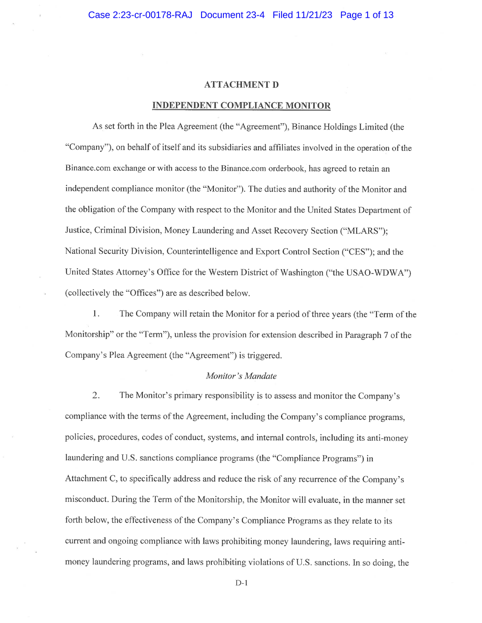 (Image caption) Page 1 of Annex D to Binance's plea agreement filed with the court on November 21, 2023, outlines the appointment of an independent compliance monitor and the responsibilities of overseeing the company's compliance program and internal controls. These written obligations constitute a legal arrangement at the company level.
Seven Boards of Directors
Binance's official website describes He Yi's responsibilities as covering business, marketing and brand strategy, as well as human resources, global communications, customer service, and businesses such as Binance Earn, Binance Square, and Binance Academy. These formal responsibilities should be the starting point for evaluating her role in the company.
The group's board of directors, as listed on the official website, currently consists of seven members. Gabriel Abed serves as chairman and is listed as an independent director along with Xin Wang and Max Yang; the other four are Richard Teng, He Yi, Roger Wang, and Heina Chen. Changpeng Zhao is listed under the founders section, with the title of co-founder and former CEO.
The three independent directors did not constitute a majority of the seven seats, but this proportion alone is insufficient to determine the effectiveness or ineffectiveness of oversight. When the issue involves the founder or their investment interests, it is even more important to know whether directors with conflicts of interest recused themselves, what rules the remaining members followed in making their decisions, and whether the independent directors were able to obtain sufficient information, seek external opinions, or request a reassessment.
Board members familiar with the business can help the company assess product and operational risks; independent oversight ensures that different considerations have the opportunity to be discussed. When the founder's experience, business goals, and user interests are not entirely aligned, whether other directors have sufficient information and authority to raise objections is a better indicator of the system's effectiveness than the identities listed on the board.
He Yi's title of co-CEO cannot answer all authorization questions alone. Who proposes personnel appointments and dismissals, major investments, risk limits, and related arrangements, who can approve them, and who handles disputes in case of disagreement, still need to be defined through an authorization matrix and the powers of the committee.
To interpret He Yi's decisions solely as Zhao Changpeng's will would overlook her own managerial responsibilities and establish a proxy relationship in the absence of evidence. She should be responsible for the judgments made within the scope of her authority, and these judgments should be evaluated according to the same standards, without being pre-interpreted due to personal relationships.
The group's board of directors and the boards of directors of each licensed legal entity need to be considered separately. How legal entities that bear contractual responsibilities to users should take over the group's strategy, fulfill their own regulatory obligations, and maintain their responsibilities when interests conflict cannot be answered solely by the titles at the group level.
YZi's capital relations
In January 2025, Binance Labs changed its name to YZi Labs. YZi describes itself as an independent investment vehicle, investing in Web3, artificial intelligence, and biotechnology; Bloomberg reports that the new name combines the names of its two founders.
The nature of this organization has been subject to differing public interpretations. Bloomberg, citing its head Ella Zhang, described it as a family office investment vehicle and reported that it would manage He Yi's wealth. Following the report, YZi told Bloomberg that the company is a venture capital and incubation firm, not a family office, and that He Yi is not involved in its day-to-day operations. Ella Zhang also told WIRED that YZi's funds primarily come from the personal assets of Binance's founder.
These statements provide clues about the source of capital and the division of labor in operations, but they do not present a complete picture of the distribution of benefits. Those who have the right to the profits are not necessarily responsible for day-to-day management; and not participating in day-to-day management does not mean that there are no economic interests that need to be identified.
U.S. securities filings have made some of these rights concrete. In November 2025, YZILabs Management Ltd. and Changpeng Zhao filed Schedule 13D regarding their holdings in CEA Industries. The filing states that the investment entity is a British Virgin Islands company, and Changpeng Zhao is its sole director.
The revised filing dated September 21, 2026, shows that YZILabs Management Ltd. beneficially owns 9,749,745 CEA ordinary shares, representing approximately 19.99% on the basis listed in the filing; Zhao Changpeng, as the sole director, may be considered to beneficially own the same batch of shares. These two sets of filing figures cannot be added together, nor do they represent two distinct investments.
This document discloses the rights of a specific investment entity to a specific listed security, and cannot be used to conclude that all assets under the YZi brand belong to Zhao Changpeng personally. Whether He Yi has contributed capital in different investment vehicles, how the profits are distributed, and whether she enjoys voting or information rights also require supporting documentation from the respective rights documents.
Governance issues become concrete when investment interests intersect with platform decisions. For example, if an investment vehicle with an economic interest in a founder holds a token that is undergoing listing or product configuration evaluation on Binance, the platform needs to identify this interest, define who has access to undisclosed information, and when relevant managers should recuse themselves.
This is a scenario used to examine the process, not an accusation of interference in a particular transaction. Even if the investment team and the platform team operate separately, someone still needs to be able to explain: when the interests of both sides clash, who participates in the decision-making process, who withdraws, and what criteria the final approver uses to make their judgment.
 (Image caption) A waterfront view of Al Maryah Island, Abu Dhabi, taken on May 12, 2021. The island is located within the jurisdiction of Abu Dhabi Global Market (ADGM), providing geographical context for this article's discussion of licensed legal entities and regulatory responsibilities.
BNB and Company Equity
BNB on the BNB Smart Chain is used for purposes such as paying transaction fees and staking. Official governance documents link voting rights to staked credits and allow delegation of governance to others. These rights are part of the blockchain network's operational structure and belong to a different system from Binance's shareholder voting, director appointments and removals, and management authorization.
Holding BNB does not grant you shareholder rights on Binance; holding Binance shares does not prove how much on-chain voting power you possess. Proposals, voting, and execution must comply with network rules, and the concepts of simply holding BNB, participating in staking, and obtaining governance privileges need to be understood separately.
Exchange custody offers another perspective. Binance's Terms of Use, Article 20.5, reserves the discretion to exercise voting rights for specific tokens within an account and requires users who wish to exercise such rights themselves to withdraw their tokens in advance. This clause suggests that custody services and on-chain governance may overlap, but it does not prove that Binance has exercised such rights for BNB, nor can it be presumed that the two founders control the corresponding number of votes.
From an economic perspective, platform businesses, BNB usage demand, portfolio valuations, and publicly traded companies holding BNB may all be affected by the same market shift. Whether their interests align and the extent of the impact depends on the assets and contractual arrangements of each party.
CEA Industries, which adopts the BNB treasury strategy, provides a documented example. After a governance dispute with YZi, the company reached a cooperation agreement on June 23, 2026, at which time it expanded its board of directors to six seats, appointed Ella Zhang, Alex Odagiu, and Matthew Roszak as directors, and appointed Odagiu as interim president.
YZi agreed to terminate the solicitation of written shareholder consent, accept the agreed voting obligations, and the provisions restricting shareholding increases, director nominations, and other shareholder actions. The agreement also stipulates that both parties jointly select another independent director. These arrangements were made at the time of the agreement's formation and should not be taken as evidence that the composition of the board of directors has remained unchanged thereafter.
A more specific disclosure appeared in the financial statement notes for the quarter ended July 31, 2026: the company stated that it considered YZi a related party because YZi held the right to appoint and substitute directors. The company subsequently changed its name to BNB Standard Corporation on September 29, while retaining the common stock ticker BNC.
This disclosure provides a meaningful contrast to the court's handling of private relationships. The court did not determine control of the documents solely based on private connections; the listed company, on the other hand, explained the basis for identifying related parties based on specific board rights. While the applicable laws and standards differ, both serve as a reminder to outside observers that relationships need to be translated into verifiable rights to support further conclusions.
This case can be used to study the connection between the founders' capital and the BNB ecosystem, but it cannot prove that Binance provided any improper benefits to the investment. Furthermore, the criteria for identifying related parties between listed companies and YZi cannot be directly applied to the relationship between Binance and YZi.
The same standard of evidence applies to the interests of the two founders in BNB. Assets held by the exchange on behalf of users, company-owned assets, investment vehicle holdings, and private holdings need to be identified separately. On-chain records can show asset movements, but they are not necessarily sufficient to identify the ultimate beneficiary; wallet tags, wealth rankings, and historical token allocations cannot constitute a complete list of private holdings on their own.
Who approves the conflict?
Binance's Global Terms of Use, effective July 21, 2026, allocate applicable services to three ADGM entities: Nest Exchange Limited for the trading venue, Nest Clearing and Custody Limited for clearing and custody, and Nest Trading Limited for brokerage services. Users must still confirm their contracting party based on their location and specific product, and cannot determine the applicable arrangement solely based on brand name.
Clause 18.4 acknowledges that relevant entities and affiliates may have economic interests contrary to those of the user, and states that conflict management arrangements are in place to disclose or refuse service when necessary; proprietary positions and strategies are not subject to general disclosure commitments, except as required by regulatory requirements. Clause 18.3 also limits the obligation to disclose to users or use specific interest information for their benefit.
These points need to be understood together. Binance has made a conflict of interest management commitment, but the terms do not promise full disclosure of all business interests. Information restrictions in the contract should not be used as a basis for the company to exclude applicable laws and regulatory requirements.
Between general terms and individual decisions lies the execution process. Whether a particular interest is identified in a timely manner, who reviews the relevant materials, who withdraws from the discussion, and whether the approver has sufficient independence are not things that can be confirmed solely from the text of the terms.
Whether YZi falls under the definition of a related party in a specific contract also requires investigation into the actual legal entity, control, and business relationships. The founder's private connections do not automatically complete this determination; a declaration of independent operation by an organization is not sufficient to rule out all possible conflicts of interest.
Related party transactions and conflicts of interest therefore need to be handled separately. Whether a transaction constitutes a related party transaction under applicable laws or accounting standards depends on the specific rights and interests involved and the criteria for determination; even if it is not a related party transaction, those involved in the decision-making process may still have interests that should be reported.
If an entity with an interest in the founders provides market-making, lending, custody, technology, or advisory services to the platform, reviewers need to know how pricing is compared, who bears the risk, and how fees and losses are allocated. These questions can be examined through contracts, evaluations, and approval records, which is more practical than simply judging whether the parties have a close relationship.
A verifiable procedure should register relevant interests before a decision is made, restrict access to information and participation in decision-making according to the nature of the conflict, and arrange recusal when necessary. Exceptions should also be documented, including who approved them and the reasons for such approvals, so that independent reviewers can reconstruct the process afterward without relying on the memories or mutual trust of the parties involved.
For managers and employees, clear delegation also has practical significance. They need to know whether an opinion offered by a founder is a suggestion for team discussion, a legally mandated request from shareholders, or an approved company decision. If these distinctions are not made, those carrying out the decision may have to guess the other party's meaning but then bear the responsibility for the decision afterward.
This is also where formal power and informal influence need to be bridged. Founders can share experience and offer judgments, but when opinions begin to influence personnel, transactions, or product arrangements, the management system should be able to identify their source, confirm approval authority, and document the execution process. Employees should not assume the responsibility for an unauthorized decision based solely on their understanding of the founder's intentions.
Publicly available information is insufficient to reconstruct Binance's complete internal approval process involving the founder's interests. This information restriction cannot be interpreted as the company lacking a system or having violated regulations; regulatory agencies may possess non-public materials, and the disclosure obligations of private companies differ from those of publicly traded companies. External research has the responsibility to clearly distinguish between rights with existing evidence and implementation details that cannot yet be independently assessed.
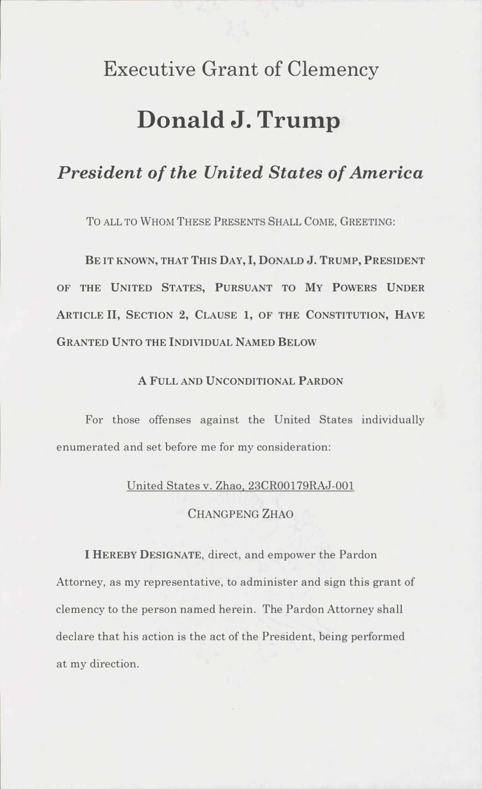 (Image caption) The first page of the pardon document for Changpeng Zhao, signed by US President Trump on October 21, 2025, lists his name, personal criminal case number, and the text of a full and unconditional pardon. This document and the plea agreement with Binance involve different legal entities.
Let trust be tested
People who work together for a long time are often able to understand each other's judgments more quickly. In the early stages of a startup, this tacit understanding can reduce coordination costs and allow the team to make decisions even when information is incomplete. For founders who have shared risks together, trust also includes the understanding accumulated over many years of working experience, and should not be reduced to a personal connection that needs to be questioned.
With the involvement of external shareholders, professional managers, regulators, and a large user base, companies need to explain their decisions to a wider audience. Even an arrangement that aligns with the founders' shared judgment may still affect the assets, rights, or risks of others, thus requiring procedures that allow for objections and reviews.
When Binance announced He Yi as co-CEO, it stated that the platform had nearly 300 million users. This was the company's registered user count at the time, and not the number of active customers simultaneously holding assets. Scale gives governance issues a broader public impact, but it does not lower the requirements for evidence, nor can it be used as a presumption of personal control.
Private trust can be very effective in the early stages of a company; however, as the company begins to provide asset services to hundreds of millions of registered users, the question of what systems are needed to maintain that same trust becomes a question that the company must answer as it grows.
A clear system doesn't require founders to abandon years of accumulated experience, but rather lets others know how that experience enters company decision-making, who reviews cases involving conflicts of interest, and who is responsible when problems arise. For founders, managers, and employees, this also allows their judgments to be evaluated based on concrete actions, rather than relying on external speculation about personal relationships.
Putting the two core founders together reveals a combination of entrepreneurial ability, long-term trust, and capital interests. To understand how this combination influences Binance today, we need equity documents, authorization boundaries, interest declarations, and traceable approval records. For ordinary users, the ultimate safeguard is concrete: even if a decision aligns with the founders' shared interests, someone still has the right to review it, raise objections, and, if necessary, demand its cessation.
Disclaimer
This article is based on publicly available information and is intended for news research and informational reference only. It does not constitute investment, legal, or tax advice. Governance analysis does not constitute a determination of wrongdoing; undisclosed shareholdings, positions, and internal arrangements are not subject to factual presumptions.