

He Yi enters the era of Binance's dual CEOs
She oversees product, users, and organization, while Richard Teng is responsible for oversight and institutionalization; the decision-making process regarding coin listings, risks, and major controversies remains unanswered.
He Yi and Richard Teng have been co-leading Binance for ten months. He Yi is responsible for product, users, and organization, while Richard Teng handles regulatory, licensing, and external institutionalization. However, for a platform that influences the liquidity and pricing of global digital assets, the final decision-making power regarding listings, risk, investment, senior personnel, and major controversies remains undisclosed. The US sanctions investigation and the EU's MiCA inquiry are pushing this dual-CEO system into a public governance stress test.
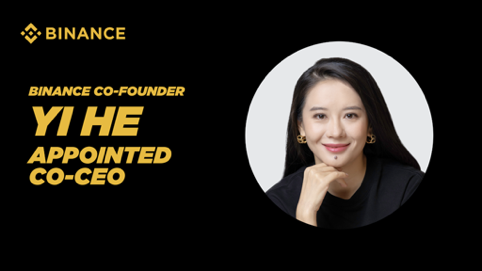 (Image caption) Binance released an official image on December 3, 2025, announcing He Yi's appointment as co-CEO. This appointment formalizes her long-standing responsibilities for product, users, brand, and organization, and establishes a structure in which she co-leads the company with Richard Teng.
The boundaries of power remain undisclosed.
On December 3, 2025, Binance announced at Binance Blockchain Week in Dubai that co-founder He Yi would serve as co-CEO, leading the company together with Richard Teng, who succeeded Changpeng Zhao in November 2023.
According to Binance's current management information, the division of labor between the two is already outlined. He Yi is responsible for business, marketing and brand strategy, and oversees human resources, global communications, customer service, and product lines such as Binance Earn, Binance Square and Binance Academy; Richard Teng, with his experience as a financial regulator, mainly represents the company in handling regulatory, regional market, licensing and government relations.
Ten months later, this division of labor began to face specific pressures.
On September 22, 2026, Reuters, citing sources, reported that the U.S. Attorney's Office for the Southern District of New York and the Department of Justice's Criminal Division were investigating Binance for potential violations of sanctions against Iran. On October 1, the Financial Times reported that the European Securities and Markets Authority (ESMA), along with regulators in France, Germany, and Greece, were questioning Binance's arrangements to continue serving some EU clients without authorization under the EU's Crypto Asset Markets Regulation (MiCA). Binance stated it has zero tolerance for sanctions violations and that the company complies with applicable regulatory requirements.
Both matters are still in process and no legal conclusions have been reached. However, they bring to the forefront questions that the job descriptions cannot answer: In a platform that controls a vast amount of user assets, trading liquidity, and the influence of token pricing, who can approve listings, who can veto high-risk businesses, and who decides on major investments; when the two CEOs disagree, who makes the decision; and after an incident, who bears the ultimate responsibility?
This article examines how power is distributed, without basing her leadership value on gender. Her management skills and actual influence were already operating within the company long before the change in title. The importance of this appointment lies in providing an observable institutional juncture: can Binance transform its power structure, which has long relied on founder judgment, product speed, and community perception, into a governance system that is recognizable to the board of directors, regulators, employees, partners, and users?
Existing powers of professional title confirmation
In its appointment announcement, Binance summarized He Yi's role as product innovation, community growth, user-oriented culture, and Web3 infrastructure development. Prior to this promotion, she used the title "Chief Customer Service Officer" on social media, a title deeply rooted in Binance's culture. While it may not correspond to a formal job title in a traditional company, it reflects her long-standing role at the intersection of user complaints, brand responses, and product feedback.
In a public interview following her appointment, He Yi stated that she had taken over the human resources department about a year prior, with the goal of establishing a long-term organizational system that no longer relies on the abilities of a few individuals. According to her, the co-CEO arrangement is more akin to a formal confirmation of existing management authority than a sudden addition of a top executive.
Richard Teng's authority stems from diverse backgrounds. He previously served as Head of Corporate Finance at the Monetary Authority of Singapore, Chief Regulatory Officer of the Singapore Exchange, and CEO of the Financial Services Regulatory Authority of Abu Dhabi Global Markets. After joining Binance, he oversaw regional markets outside the US, including Singapore, the Middle East and North Africa, Europe, and more. He describes himself as a bridge between Binance and global regulators. This role aligns with his resume and explains his key responsibilities in licensing, government relations, and partnerships with financial institutions.
The duo's partnership has a clear business logic. He Yi continues Binance's product judgment, user experience, and founder culture as a crypto-native platform; Richard Teng is responsible for bringing the company into an institutional environment of licensing, board of directors, external oversight, and cooperation with financial institutions.
Complementarity only indicates what each person excels at. A verifiable power structure must also define who has the right to decide what, who can veto the other, and who is responsible for the final outcome.
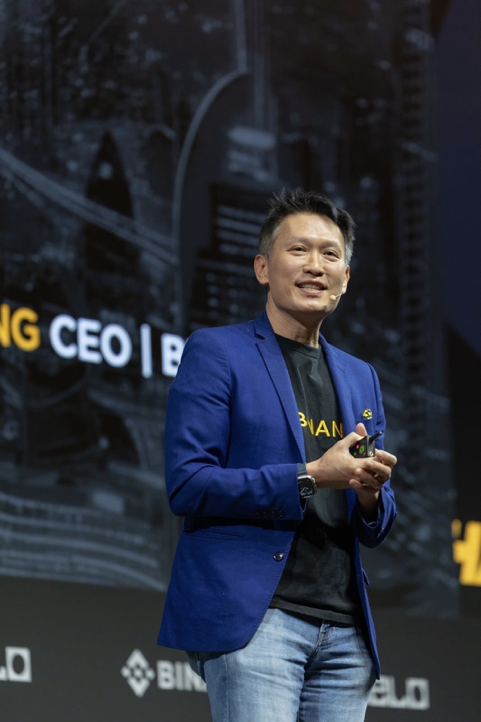 (Image caption) Richard Teng speaks on the main stage of Binance Blockchain Week in Dubai on December 3, 2025. On that day, he announced He Yi's appointment as co-CEO and introduced Binance's new leadership structure; this occasion also marked the official confirmation of the dual-CEO system.
Seven powers still have gaps
Based on Binance's announcements, current website, regulatory documents, and public interviews with its two co-CEOs, as of October 1, 2026, approximately seven categories of power can be identified. The term "not publicly disclosed" below does not mean that there are no internal systems in place, but rather that external parties cannot confirm the final approver, veto power, and escalation procedures from verifiable information.
Product: He Yi is responsible for product lines such as Earn, Square, and Academy, as well as user-oriented strategies; Director Roger Wang is responsible for the trading platform and wallet system; Director Heina Chen is responsible for clearing, settlement, funds, and operations. The final approval process for spot, contract, payment, wallet, and new asset products, and who can veto products when their objectives conflict with compliance requirements, has not been disclosed.
Listing: Binance stated that projects undergo due diligence by a dedicated team and multiple levels of evaluation, and will continue to be reviewed after listing. The company did not disclose the members of the listing committee, voting thresholds, quorum, or conflict of interest avoidance rules, nor did it explain whether the two CEOs participated in the final approval.
Risk: Global Chief Compliance Officer Noah Perlman and the compliance team are responsible for anti-money laundering, customer identity verification, and sanctions screening. Binance is subject to five years of independent oversight under the 2023 FinCEN consent order. There is no public disclosure regarding which co-CEO or board committee the Chief Compliance Officer reports to, or who approves significant risk exceptions.
Regulation: Richard Teng is the primary external representative, while directors and senior executives of each licensed entity bear additional statutory responsibilities. The decision-making boundaries between the group, the Abu Dhabi licensed entities, and other jurisdictions, as well as who is held accountable in the event of a failure to obtain or maintain a license, remain unclear.
Investments: Binance Labs was renamed YZi Labs in 2025. The organization positions itself as an independently operating investment platform and family office, led by Ella Zhang, with Changpeng Zhao involved in investment activities. There is no publicly available information regarding who proposes, approves, and recuses Binance Group's own mergers and acquisitions, strategic investments, and related-party transactions.
Human Resources: He Yi is directly responsible for human resources. The division of authority between the co-CEO and the board of directors regarding senior management appointments and dismissals, compensation, performance evaluations, internal whistleblowing, and succession planning is not clearly defined.
Major controversy: Binance claims the company has shifted from being founder-CEO-led to being board-led, with three independent directors on the current seven-member board. However, complete public documents have not been released regarding which matters must be submitted to the board, how the deadlock between the co-CEOs will be handled, or in which decisions the controlling shareholder exercises its rights.
The most important finding of this power diagram is that while Binance has publicly disclosed its business responsibilities, it has not fully disclosed its decision-making and accountability powers. A manager can be in charge of a department but may not have final approval authority; the CEO can represent the company publicly but may not be able to unilaterally overturn decisions made by the board, licensed entities, or compliance officers. Without separating these layers, executive profiles can easily be misinterpreted as the company's governance charter.
Product and Operating Rights Tier
He Yi's clearest management scope lies at the intersection of users and the organization. Earn handles user asset returns, Square influences information distribution and community, Academy is responsible for education and brand trust, and customer service sends complaints, usage obstacles, and product defects back to management. These departments allow her to adjust product priorities based on user feedback and were also an important source of Binance's rapid iteration in its early years.
Binance's board information also shows that founding team member Roger Wang was responsible for the design and implementation of the trading platform and wallet system, and was responsible for security, stability and scalability; another co-founder, Heina Chen, managed clearing, settlement and funds, and participated in strategy execution and business operations.
Therefore, core business power is divided into at least three layers: He Yi controls users, business and some product lines, Roger Wang controls the core technology architecture, and Heina Chen controls funds and back-end operations.
This is closer to the actual operation of a trading platform than "He Yi Guan's products," and it also reminds the outside world that ultimate management authority is not simply divided between two CEOs. Technical architecture, clearing and funds, compliance, licensed entities, and the board of directors can all constrain key decisions.
If Binance wants to be seen as a regulated financial infrastructure, it needs to explain how these powers check and balance each other, rather than just introducing the professional backgrounds of its executives.
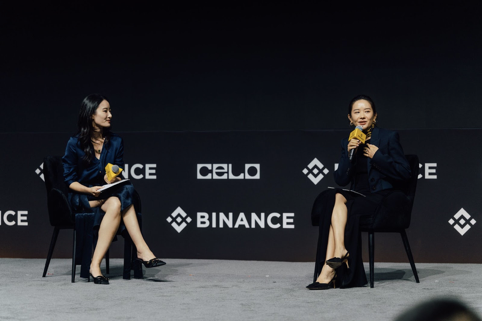 (Image caption) He Yi was interviewed by Alice Liu, a representative of CoinMarketCap, at Binance Blockchain Week in Dubai on October 30, 2024, discussing Binance's corporate culture, product direction, and the necessity of cooperating with regulatory agencies. This file photo, taken before her appointment, shows that her actual leadership role predates her co-CEO title.
The last link in the listing rights is missing.
For major cryptocurrency exchanges, listing a token carries far greater weight than a typical product update. Whether a token can be included in Binance's spot, futures, Launchpool, or other distribution channels can alter its liquidity, price discovery, fundraising capabilities, and retail investor risk. The information presented before the decision is announced has market value in itself, thus the listing process simultaneously involves business judgment, conflicts of interest, insider information, anti-corruption measures, and market integrity.
Binance has publicly stated that projects must undergo due diligence by a dedicated team and are subject to ongoing evaluation after listing; He Yi has also repeatedly emphasized that listing requires multi-layered evaluation and is not decided by a single person. These statements prove that the company has a process in place, but they do not address the final step in that process.
The public controversy made this gap even more apparent. In October 2024, Simon Dedic, co-founder of Moonrock Capital, alleged that Binance had asked an unnamed project to provide a large proportion of its token supply; He Yi denied that Binance charged listing fees in this way.
In October 2025, CJ Hetherington, founder of the prediction market Limitless, announced what he called the listing conditions, which included user airdrops, marketing tokens, and margin deposits. Binance stated that some of the allegations were false and defamatory, and later apologized for the wording of its initial response, stating that the relevant tokens would be distributed to users and the margin deposits would be refunded after the project fulfilled its obligations.
These conflicting claims do not prove any wrongdoing by Binance, nor can social media alone determine which party fully presented the transaction terms. What they do prove is that the market lacks a governance framework that can be independently verified.
As of press time, Binance has not specified in its public filings the members of the listing committee, voting thresholds, veto power, CEO participation methods, rules for avoiding conflicts of interest with related projects, or methods for documenting decisions. The market knows there is a process, but cannot confirm who bears ultimate responsibility for the outcome.
He Yi's close proximity to users, products, brand, and founder culture should theoretically influence asset selection and product direction; meanwhile, YZi Labs, which manages the founder's family wealth, invests heavily in Web3 projects. Even though YZi Labs publicly states that it operates independently, the two systems still require verifiable information segregation, interest disclosure, and conflict of interest avoidance procedures.
This requirement does not presuppose any wrongdoing by anyone, but rather aims to ensure that personal relationships and investment interests cannot alter the rules governing the allocation of platform resources.
Can compliance veto growth?
The 2023 US case showed that Binance's early governance failures did not stem from insufficient growth capabilities, but rather from senior management prioritizing market share, revenue, and user scale over anti-money laundering, sanctions, and US market access rules.
Binance admitted to the criminal charges and reached a settlement totaling over $4.3 billion with the U.S. Department of Justice, the Treasury Department, and the Commodity Futures Trading Commission. According to documents released at the time, the company was required to undergo a three-year independent compliance audit by the Department of Justice and a five-year audit by FinCEN. FinCEN agreed to require the auditors to assess senior management's commitment to anti-money laundering and sanctions compliance and to examine whether compliance requirements were incorporated into the governance processes of new products and services.
In 2025, Binance executives reportedly requested a shortening or elimination of related oversight. As of this writing, FinCEN has not publicly announced the termination of its five-year consent order. The status of the Department of Justice oversight lacks sufficient public documentation to support a definitive conclusion; therefore, the consultations reported in the media should not be interpreted as a completed policy change.
The developments in 2026 also illustrate that oversight arrangements cannot replace management's continuous risk assessment. In April, Bloomberg News reported the departure of several employees involved in financial crime monitoring and sanctions review, and stated that Noah Perlman was discussing his potential departure with management; Binance responded that he had not set a departure date. In August, the company hired Antonio Alvarez from Crypto.com as Deputy Chief Compliance Officer and appointed Duncan DeVille to head global financial crime compliance.
On September 14, the U.S. Attorney's Office for the Southern District of New York filed a civil forfeiture lawsuit seeking to seize approximately $61 million in cryptocurrency assets, alleging that two Hong Kong-registered companies used Binance accounts to launder Iranian oil proceeds. Binance is not a defendant in the case, and the allegations in the complaint remain unsubstantiated.
Eight days later, Reuters, citing sources, reported that federal prosecutors were separately investigating whether Binance knowingly allowed transactions that violated sanctions. As of press time, prosecutors had not filed charges against Binance or its employees.
These incidents, while not constituting a violation of the law, highlight the inadequacy of the dual CEO division of labor: one oversees growth, the other compliance. If growth decisions are driven by one party, and the other only explains to regulators after product launch or business commencement, the system remains fragile.
The compliance and risk departments of mature financial institutions should be involved before product design, customer onboarding, jurisdiction selection, and asset listing, and have the right to delay or veto when necessary.
Binance has publicly disclosed the responsibilities of its Chief Compliance Officer, but it hasn't specified whether he reports directly to the board or to which co-CEO, nor has it clarified who can make decisions that the business unit cannot overturn when revenue targets conflict with sanctions risks. For users, this is more important than whether the two CEOs appear to be on good terms in public.
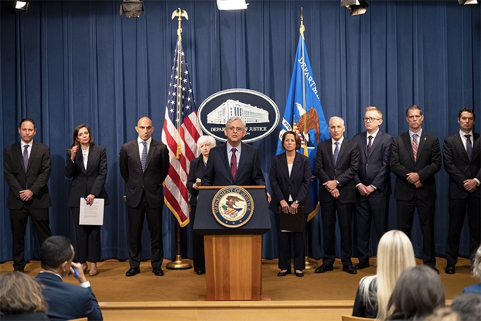 (Image caption) U.S. Attorney General Merrick Garland held a press conference in Washington on November 21, 2023, announcing Binance and Changpeng Zhao's guilty pleas and a settlement of over $4 billion. The case reveals a governance imbalance between growth, anti-money laundering, and sanctions compliance, and is also the historical context that the current dual-CEO system must address.
Licenses are the real test of regulation
Richard Teng's most notable institutional achievements during his tenure were the establishment of the first group board of directors, the introduction of independent directors, and the creation of three regulated entities in the Abu Dhabi Global Market.
In the structure announced in December 2025, Nest Exchange Limited will assume the functions of a regulated trading platform; Nest Clearing and Custody Limited will be responsible for clearing, settlement, custody and central securities depository services; and Nest Trading Limited will be responsible for brokerage trading and other approved businesses.
This separation of entity and function represents a step forward from the earlier practice of having "global platforms" with blurred legal boundaries assume responsibility.
Regulatory capacity will ultimately be tested by licensing outcomes and ongoing compliance. The European Union is currently the most direct testing ground.
Binance applied for MiCA authorization in Greece in early 2026. In June, Reuters reported that the application was not expected to be approved; Binance subsequently withdrew its application in late June and stated that it would seek authorization in another EU member state. After the MiCA transition period ends on July 1, unauthorized platforms will, in principle, only be able to assist existing clients in transferring or selling assets.
The Financial Times reported on October 1 that Binance continues to serve some EU clients under the "reverse solicitation" exception, with some transactions processed through its Abu Dhabi entity. ESMA and regulators in France, Germany, and Greece are inquiring about the arrangements.
"Reverse solicitation" only allows foreign companies to provide specific services when customers actively seek them. ESMA guidelines require this exception to be interpreted very narrowly and cannot be used to circumvent MiCA. Binance stated that it complies with the applicable requirements and is actively seeking MiCA authorization. The regulatory body is still investigating and cannot yet issue a ruling of non-compliance.
This inquiry raises practical questions about the co-CEO structure: Who decides which clients can be served before a license is obtained; who approves the interpretation of legal exceptions; and who bears the consequences when the group's business objectives, the responsibilities of the licensed entity, and regulatory opinions in different countries conflict.
Richard Teng's background makes him a natural regulatory representative, but familiarity with regulations does not mean he bears all the regulatory responsibility. Directors and senior executives of each licensed entity have their own legal obligations, and the group's board of directors should also oversee risk appetite, capital allocation, and major market moves.
For the dual-CEO system to be established, the outside world needs to see Richard Teng's power extended to the front end of product and regional business decision-making, rather than just representing the company in responding after a crisis occurs.
Investment and listing must be kept separate.
He Yi has led Binance Labs since 2022, a period often used to infer that she still retains control over Binance's investments. Current evidence does not support this simplification.
In January 2025, Binance Labs changed its name to YZi Labs and separated from the Binance brand. The organization positioned itself as an independently operating investment platform and family office, with Ella Zhang, who co-founded Binance Labs, returning as its head, while Changpeng Zhao (Zhao Changpeng) was involved in investment activities. Binance's official website describes Zhao Yi's leadership of the organization in the past tense.
This separation has institutional significance. Investment institutions can hold project tokens or equity, while trading platforms may determine whether the same project can obtain listing, liquidity, research, wallet, or promotional resources. If both are controlled by the same undisclosed chain of power, conflicts of interest cannot be determined from the outside.
Changing the brand and management is only the first step. A complete system should also disclose related party definitions, information segregation, avoidance procedures when applying for listing of investment projects, disclosure of interests, and independent review.
Binance Group's own capital transactions also lack a publicly approved process. In March 2025, Abu Dhabi's state-owned investment institution MGX invested $2 billion in Binance, marking Binance's first institutional investment. In May of the same year, it was disclosed that the transaction was settled using the USD1 stablecoin issued by World Liberty Financial, a company associated with the Trump family, raising questions from US congressmen regarding conflicts of interest and transaction governance.
Binance and Changpeng Zhao denied any connection between the arrangement and Zhao's request for a presidential pardon. Publicly available information does not specify who proposed the settlement arrangement or at what level of internal approval it underwent. While there is no evidence of a causal relationship between the transaction and the pardon, the lack of decision-making records itself constitutes an information gap in corporate governance.
When a platform simultaneously influences trading, wallets, payments, asset management, information distribution, and the investment ecosystem, the transparency of investment rights should not be lower than that of listing rights. Every channel of information and profit between the two needs to have auditable boundaries.
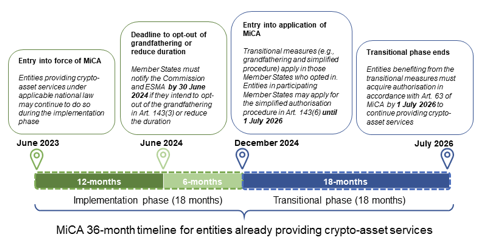 (Image caption) The MiCA transition timeline published by the European Securities and Markets Authority (ESMA) lists key milestones such as the regulations taking effect, full application, and the transitional arrangements in member states ending no later than July 1, 2026. It presents the common regulatory framework that Binance faces when seeking authorization and handling existing customer service in the EU.
Personnel authority tests organizational resilience
He Yi listed insufficient talent density as one of Binance's major challenges. Her reasoning was that the crypto industry still carries a reputational burden and is at a disadvantage when competing with AI, traditional finance, and internet companies for top talent.
This assessment is closer to her mission within the co-CEO structure than typical recruitment slogans: to transform the culture built on a small number of founders, rapid response, and high-intensity execution into organizational capabilities that span jurisdictions, languages, and serve over 300 million users.
Personnel decisions are also the most likely area where friction arises in a dual-CEO system. The compliance department needs independence, the product department prioritizes speed, regional heads face local regulations, and the global brand wants to maintain a consistent public narrative.
Who appoints or dismisses the Chief Compliance Officer, Chief Financial Officer, Legal Director, Regional Heads, and Heads of Core Products, who determines their compensation and performance, and who handles internal whistleblowing involving senior executives, all directly alter the company's risk appetite.
Binance has confirmed that He Yi is in charge of human resources, but has not disclosed the reserved authority of the co-CEO and the board of directors in senior personnel matters. She hopes to build an organization that does not rely on any single person, and the scale of recruitment only indicates investment; a more rigorous test is whether the company's decision-making, compliance, and accountability can continue to operate even if the founder, co-CEO, or key executives leave.
Can the board of directors restrain shareholders?
Binance established its first seven-member board of directors in 2024. Currently, independent director Gabriel Abed serves as chairman, with two other independent directors, Xin Wang and Max Yang. The remaining four seats are held by Richard Teng, Roger Wang, Heina Chen, and He Yi.
In December 2024, Richard Teng told Reuters that Binance had shifted from being led by its founder and CEO to being led by its board of directors; in November 2025, he stated that Changpeng Zhao remained the controlling shareholder, and that day-to-day strategies were jointly formulated by him and the board of directors.
In theory, the board of directors is the governing body above the two co-CEOs. When the two CEOs disagree on major investments, risk-taking, market entry and exit, or senior management appointments, the board should have the power to make decisions, supervise, and even replace management.
However, Binance has not yet publicly disclosed its full bylaws, the composition of its main committees, the investigative and veto powers of independent directors, or the reservations that must be submitted to the board. Three independent directors cannot form a majority on their own in the seven-seat board.
Above the board of directors are shareholders. Zhao Changpeng stepped down as CEO after pleading guilty in 2023 and was pardoned by US President Trump in October 2025; Richard Teng later stated that the company has not yet decided whether Zhao Changpeng will return.
Binance's official website does not list Changpeng Zhao's group management position, but as the controlling shareholder, brand icon, and core figure in the founding team, he still has a significant influence on the BNB ecosystem, industry network, and YZi Labs. He Yi and Changpeng Zhao are long-term partners and have children together; she has publicly emphasized her independent judgment.
Influence is not the same as management power, and a partnership does not necessarily equate to a conflict of interest. The problem is that if the boundaries between the controlling shareholder, the board of directors, and the two CEOs are not publicly defined, it becomes difficult for outsiders to determine whether a major decision originates from the board, management, shareholders, or the founding network.
Disagreements between two CEOs are not necessarily a bad thing. Governance risks arise when a company cannot explain how disagreements are handled, who makes the decisions, and where records are kept.
If the board merely ratifies decisions already made by management, a dual-CEO structure may degenerate into two parallel lines of power; only if the board can review related-party transactions, protect the independence of the compliance department, resolve deadlocks, and leave a traceable record, can this structure have the potential to transform a founder-driven company into an institutionalized enterprise.
 (Image caption) Within the global platform's customer operations layer, customer service personnel handle anonymous work orders. The wall displays product and user queues, corresponding to the unified management scope of He Yitong, which oversees customer service, human resources, and user-oriented product lines such as Earn, Square, and Academy.
Binance still owes governance documentation
He Yi's appointment as co-CEO formalizes her long-held de facto management authority. Richard Teng brings regulatory language, licensing experience, and external institutional interfaces; He Yi brings product intuition, user relationships, branding, talent, and founder culture.
The coexistence of these two capabilities is a condition for Binance to maintain its scale and speed in the next stage, but it may also become a source of ambiguity in responsibility.
The 2026 investigation into Iranian sanctions and the EU inquiry have not yet reached a final conclusion, and the outcome could be favorable or unfavorable to Binance. Regardless of the result, they force the company to answer the same set of questions: Who approves cross-border business, who can block high-risk transactions, who provides the final interpretation of regulatory exceptions, and who bears responsibility between the board and management.
The market needs a verifiable governance statement. It should outline the respective authority of the two co-CEOs, disclose board reservations and deadlock procedures, explain the structure of the listing committee, conflict of interest rules, and decision-making documentation, confirm independent reporting lines for the Chief Compliance Officer and internal auditors, disclose information segregation arrangements between Binance and related parties such as YZi Labs, and define the role of the controlling shareholder in major decisions. In the event of a major regulatory, cybersecurity, or user asset incident, the company should also explain who bears ultimate responsibility.
For ordinary users, this power list is not an abstract corporate governance document. The platform's decisions regarding which tokens to list, which accounts to restrict, which markets to enter, and how much risk to accept ultimately affect the user's assets, trading opportunities, and recourse rights. When a crisis occurs, users need to know not only who manages customer service, but also who has the ability to prevent errors and who is responsible for failing to do so.
He Yi's test is whether she can transform her expertise in user perception and founder culture into a system that can still function after any individual leaves; Richard Teng's test is whether compliance can maintain its actual binding force in the face of revenue, speed, and market share.
Binance can only be considered to have entered the dual-CEO era when the responsibilities for products, coin listings, risks, regulations, investments, personnel, and major controversies can be clearly traced.
Disclaimer
This article is for news research and informational purposes only and does not constitute investment, trading, legal, or tax advice. The investigations and regulatory inquiries mentioned in this article have not yet yielded final conclusions; digital assets carry very high risks, and readers should verify information and make their own prudent judgments.