

Binance has no headquarters, so who is responsible for its global platform?
With trading, clearing and custody, and brokerage services now handled by three separate licensed entities, how can a global crypto platform redefine its responsibilities?
Binance has long served global users under a single brand, website, and app, yet it has not designated a single headquarters. Starting in January 2026, Binance.com's trading venue, clearing and custody, and brokerage services will be handled by three licensed companies in Abu Dhabi. The interface remains unchanged, but the legal representatives, asset custody, and dispute resolution mechanisms have been rewritten. For cross-border platforms, the truly important issue is not just where the company is located, but who is ultimately responsible for every transaction, every asset, and every claim.
 (Image caption) Three office buildings with different exteriors stand side by side on the same waterfront financial island. The diagram corresponds to the functional separation of Nest Exchange, Nest Clearing and Custody, and Nest Trading: they can share the same entrance, but the contracting legal entities, asset custody, and liquidation responsibilities must be identified separately.
Same entrance, three companies
On January 5, 2026, Binance transferred the main services of its global platform, Binance.com , to three licensed companies under the Abu Dhabi Global Market (ADGM). Nest Exchange Limited operates the trading venue; Nest Clearing and Custody Limited handles clearing, settlement, and user asset custody; and Nest Trading Limited provides over-the-counter trading, instant conversion, earning, and other services offered on a proprietary or agency basis. All three companies are regulated by the ADGM Financial Services Regulatory Authority (FSRA).
When users log in, they still see the same app, the same set of accounts, balances, and transaction records, but the legal relationship has changed. Who signed the contract with the user, who holds the assets, who is responsible for liquidation after the transaction is completed, and who should be held accountable in case of disputes are now all named legal entities.
Binance did not announce a global headquarters as a result. In December 2025, a company spokesperson told DL News that a headquarters, as a physical or symbolic concept, was no longer sufficient to describe how Binance operates and even "feels a bit outdated"; the role of the Abu Dhabi license is to provide regulatory clarity and legitimacy, not to concentrate all operations in one city.
This change did not end Binance's decentralized operating model, but it began to answer a question that global platforms could not avoid for a long time: when assets, leverage, and hundreds of millions of users converge at a single point of entry, which legal entity should bear the consequences?
Bitcoin's organizational philosophy of "no office"
When Binance was founded in 2017, cryptocurrency trading was crossing borders at internet speeds. In May 2020, founder Changpeng Zhao was interviewed by podcast host Laura Shin at the Ethereal Virtual Summit and asked where Binance's headquarters were located. He responded that Bitcoin doesn't have an office, and stated that Binance's staff were spread across approximately 50 locations; blockchain companies don't necessarily need to adopt all the traditional corporate setups such as offices, physical locations, headquarters, and bank accounts.
This passage presents an early organizational vision of the crypto industry: blockchains could operate without a single central control point, and businesses seemed unnecessary to be tied to a fixed location. However, Binance's services are not an unmanaged public blockchain. Matching trades requires listing and trading rules; leverage and derivatives require margin systems, risk limits, and default handling; custody requires defining asset control, segregation methods, and retrieval mechanisms; and fiat currency deposits and withdrawals, sanctions screening, and suspicious transaction monitoring require a clear chain of responsibility.
The "entity" that Zhao Changpeng once thought could be omitted is precisely the first entity that users need to find when asserting their rights, courts serving orders, and regulators enforcing rules. Technology can be decentralized, but the institutions that control assets and set transaction rules cannot exist solely as brand names.
 (Image caption) Changpeng Zhao speaks with a microphone at a public forum. The image shows the responsibility center that the platform's founder continues to be pursued by law enforcement and users in various countries even after the statement "Bitcoin has no office".
US law enforcement demands the identification of a center of responsibility.
On March 27, 2023, the U.S. Commodity Futures Trading Commission (CFTC) filed a lawsuit against Changpeng Zhao, former Chief Compliance Officer Samuel Lim, Binance Holdings Limited, Binance Holdings (IE) Limited, and Binance (Services) Holdings Limited. The CFTC alleged that multiple entities operated the Binance platform as a deliberately opaque "joint enterprise." Then-CFTC Chairman Rostin Behnam stated that no location, or the claim of no location, could prevent the CFTC from protecting U.S. investors. These are claims made by law enforcement agencies and do not represent a court's finding of fact on all relevant entities.
On November 21 of the same year, Binance pleaded guilty to the charges against Binance with the U.S. Department of Justice and reached a settlement totaling over $4.3 billion. Changpeng Zhao admitted to failing to maintain an effective anti-money laundering program and resigned as CEO. On the same day, the U.S. Treasury Department announced that the Financial Crimes Enforcement Network (FinCEN) imposed a $3.4 billion civil penalty on Binance, and the Office of Foreign Assets Control (OFAC) imposed a settlement of approximately $968.6 million. FinCEN also established a five-year monitoring arrangement.
On December 18, 2023, the U.S. District Court for the Northern District of Illinois granted a settlement order from the CFTC, requiring Binance to pay $1.35 billion plus an additional $1.35 billion in civil penalties, with Changpeng Zhao personally paying $150 million. The actions taken by the Department of Justice, FinCEN, OFAC, and the CFTC have different legal natures; some amounts can be offset against each other and cannot be directly added together.
Under pressure from the US authorities, Binance began establishing more formal board, compliance, and oversight arrangements. According to Reuters, the company established its first seven-member board in 2024, three of whom are independent directors. Regulators are investigating not only a few transactions, but also who controls the company, who oversees compliance, and to whom management is ultimately accountable.
Having no headquarters is not inherently illegal. However, when the legal relationship and control responsibilities become so blurred that the law is difficult to enforce, decentralized organizations can become obstacles to accountability. The US case requires Binance to gradually transform the governance relationships that were originally hidden behind the brand and network architecture into a board of directors, management, compliance responsibilities, and legal boundaries that regulators can identify.
On October 23, 2025, US President Trump pardoned Changpeng Zhao. This pardon addressed Zhao's personal federal criminal liability and did not equate to rescinding Binance's plea bargain, civil proceedings, or other regulatory orders. On December 3 of the same year, Binance announced that co-founder He Yi would serve as co-CEO, jointly leading the company with Richard Teng. Binance thus formed a management structure that combined continuity with the founding team with a focus on regulatory transition.
Abu Dhabi becomes the legal anchor.
In December 2024, Teng, then Binance's sole CEO, told Reuters during Abu Dhabi Financial Week that the company was still exploring the location of its global headquarters, with tax laws, talent supply, and recruitment capabilities all being considerations. As of September 30, 2026, Binance had not yet officially announced a single global headquarters, but the company's regulatory, managerial, and capital ties with Abu Dhabi had clearly increased.
Teng joined ADGM in 2015 and led FSRA before joining Binance in 2021. In November 2023, he succeeded Changpeng Zhao as CEO. This experience gave him familiarity with how regulators view trading venues, clearing, custody, and anti-money laundering responsibilities, and also provided Binance with a relatively clear executor for its institutional transformation after its handling in the United States.
In March 2025, MGX, a technology investment company established by the Abu Dhabi government, acquired a minority stake in Binance for $2 billion. At the time of MGX's establishment, Mubadala, Abu Dhabi's sovereign wealth fund, and G42, an artificial intelligence company, were its founding partners. Binance stated that this was the company's first institutional investment and one of the largest investments completed in crypto assets at the time.
In May of the same year, Zach Witkoff, co-founder of World Liberty Financial, stated that MGX's investment in Binance used the equivalent of $2 billion in USD1 stablecoins. USD1 was issued by World Liberty Financial, which has business ties to the Trump family.
These capital, political, and regulatory relationships have news value in the public interest, but cannot be directly described as exchange arrangements. As of the date of this review, there is no publicly available evidence showing any transaction exchange or direct causal relationship between the MGX investment, USD1 payment, Changpeng Zhao's pardon, and the FSRA license approval.
On December 8, 2025, Binance announced that the FSRA had approved its global platform to operate under three entities. The announcement was published on the ADGM website, but the page clearly stated it was a third-party communication and not an official statement from ADGM. The terms "world's first," "global license," and "gold standard" used in the announcement should be understood as Binance's description of this regulatory achievement, rather than an independent assessment by the regulatory body.
The truly institutional significance of this license lies in what permissions the three companies are granted, what activities they are prohibited from engaging in, and how user assets and contracts flow between them.
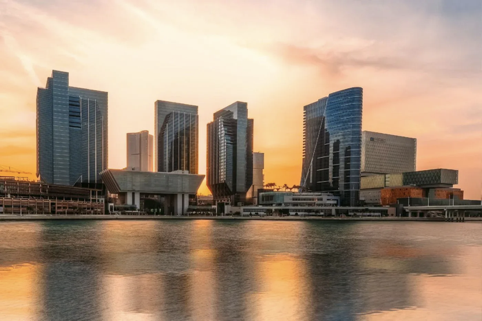 (Image caption) Sunset skyline over Al Maria Island's financial district, where the Abu Dhabi Global Market is located. The article alleges that since January 2026, Binance.com has had its trading venue, clearing and custody, and brokerage services handled by three licensed local companies, making this location a verifiable legal anchor rather than a single global headquarters in the traditional sense.
The interface remains unchanged, but the contract has been replaced.
According to Binance's service update, prior to the new architecture taking effect, global platform services were primarily provided by a company then known as Nest Services Limited, which later changed its name to Nest Exchange Limited. On January 5, 2026, the rights and obligations under the original terms of use were transferred to three ADGM entities through contractual changes, and the service providers for each product term were also redefined. Each of the three companies became the controller of personal data within its respective service scope.
The current Terms of Use, effective July 21, 2026, further clarify roles. Nest Exchange operates the trading venue but is not a counterparty, broker, or agent for users' on-exchange transactions, nor does it assume any general fiduciary obligations to users as a result of operating the exchange.
Nest Clearing and Custody is responsible for clearing, settlement, and custody, and acts as a central counterparty in exchange-traded derivatives transactions. The terms stipulate that it holds user assets as a trustee to the extent applicable, and users have a beneficial interest in the amount of assets recorded in the internal ledger.
Nest Trading can provide brokerage, OTC, convert, and earn services, depending on the product type, either directly or as an agent. Users authorize Nest Trading as their clearing member at the clearinghouse when opening an account. The FSRA publicly states that Nest Trading cannot hold or control Client Money; current terms delegate the custody of user currency and digital assets to Nest Clearing and Custody. Brokerage services and asset custody are therefore handled by separate legal entities.
Why is functional separation important?
In mature financial markets, trading venues are responsible for setting market rules and organizing trades; central counterparties handle clearing, margin management, and default management; brokers accept or execute client orders; and custodians preserve assets and maintain records of interests. This division of labor allows regulators to identify where risks accumulate and prevents a single company from simultaneously setting trading rules, controlling client assets, and unilaterally handling defaults.
Binance's ADGM structure is approaching this layered responsibility system, but the three companies remain within the same group, using a common brand, technology gateway, and account system. Legal separation increases the identifiability of responsibility, but it does not equate to a complete separation of economic interests, management decisions, and operational risks.
Therefore, the core of regulation is not only to confirm that each of the three companies has a license, but also to examine their cash flow, data flow, risk transfer and conflict of interest, so as to ensure that the legal division of labor can be truly implemented in daily operations and market crises.
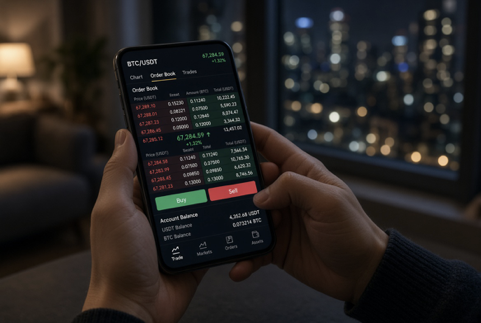 (Image caption) In a residential setting at night, users still check their balance and place orders through the same transaction interface. The image is used to illustrate that the interface remains unchanged, but the terms of use and data controllers were changed in January 2026, and the dispute and recourse paths have been rewritten accordingly.
Summary of how wallets record user rights
The current terms, in principle, classify individual and corporate clients to whom the agreement applies as retail clients, thus granting them the corresponding protections under the ADGM retail client rules. This classification raises the minimum protection standard, but does not mean that every user's assets will be held in a separate on-chain address.
Assets from multiple parties can be aggregated in a central wallet. On-chain addresses are not necessarily segregated on a per-user basis, while users' beneficial rights are recorded separately in internal ledgers. While shared on-chain storage does not equate to a merger of legal rights, it makes ledger integrity, reconciliation mechanisms, and the ability to identify asset ownership in the event of bankruptcy or asset freezes exceptionally important. Nest Clearing and Custody are committed to reconciliation at least weekly.
This arrangement can improve the efficiency of wallet management, liquidity allocation, and on-chain transactions. However, in the event of system failures, ledger errors, law enforcement freezes, or bankruptcy proceedings, whether users can quickly identify and recover their assets will depend on the accuracy of internal records and the recognition of beneficial rights in the relevant jurisdictions.
The terms also allow for the storage of some assets in jurisdictions outside of ADGM, or to be held in custody by financial institutions within the same group. Local client assets and bankruptcy rules may differ from ADGM's, and the actual retrieval process may be affected by foreign courts, custody chains, and local regulatory requirements.
Users simultaneously grant Nest Clearing and Custody a first-priority lien and security interest, which they can exercise on behalf of the ADGM entity to the extent permitted by the terms and applicable law; the terms also allow for cross-entity debt offsetting under certain conditions. This helps the Group manage risk in the event of customer default or arrears, and also means that the debts and claims between users and different Binance entities may not be completely separated during a crisis.
The conflict of interest has not disappeared despite the separation of functions. The terms disclose that ADGM entities and affiliates may buy, sell, hedge, borrow, or lend related assets on the Binance exchange and earn revenue from fees, spreads, and other services. Regulation needs to further ensure enforceable segregation between client orders, proprietary trading activities, exchange rules, and risk management.
Three-person arbitration tribunal raises the threshold for recourse.
The new terms stipulate that disputes relating to the applicable agreement shall be submitted to arbitration by the International Chamber of Commerce (ICC), with the ADGM as the venue, in English, and by a tribunal of three arbitrators. Compared to the Hong Kong arbitration arrangement adopted in the old terms, the new system aligns the venue of arbitration more closely with the legal framework of the three licensed entities, and may increase the cost of recourse for individual users due to the three-person tribunal, cross-border legal services, and procedural fees.
Some historical issues have not been fully transferred with the contract change. Assets frozen by court or government orders prior to January 5, 2026, as well as account assets of Canadian residents in a "withdrawal-only" state, remain held by Nest Exchange. Users need to confirm the time of asset creation, freezing, or transfer when determining the custodian and the target of recourse.
"Global Platform" does not mean that users worldwide are served by the same group of ADGM companies. Binance has local licensed entities in some markets; for example, users in Bahrain are served by Binance Bahrain BSC, which is regulated by the Central Bank of Bahrain. Current terms and conditions stipulate that when local terms apply, they supplement and regulate the relevant services. Under the same brand, there may be different contracting entities, regulatory bodies, and asset protection regimes.
One license cannot cover the whole world
ADGM's authorization places the three legal entities, approved activities, contract changes, and asset arrangements within a transparent and oversight-based framework. For a platform that has long presented itself as a global brand and operates with a decentralized structure, this is more concrete than a general compliance declaration.
ADGM is an international financial center in Abu Dhabi. Its license does not automatically change Binance's legal status in the EU, the US, Japan or other markets, nor does it exempt the platform from its responsibility to comply with sanctions, anti-money laundering, securities and consumer protection rules in the user's location.
On September 14, 2026, the U.S. Attorney for the Southern District of New York filed a civil forfeiture lawsuit seeking to recover approximately $61 million in cryptocurrency assets. Prosecutors allege that Blessed Trust and Hexa Whale used trading accounts on Binance to handle funds related to Iranian black market oil proceeds. The allegations in the civil complaint are pending court proceedings, and Binance itself is not a defendant in the forfeiture lawsuit.
On September 22, Reuters, citing Bloomberg, reported that Manhattan federal prosecutors and the U.S. Department of Justice's Criminal Investigation Service are investigating whether Binance knowingly allowed transactions that violated U.S. sanctions against Iran. As of September 30, the investigation was still ongoing, and no charges had been filed. Binance responded that it has a zero-tolerance policy for sanctions violations and fully cooperates with law enforcement agencies.
These two developments further illustrate that while Abu Dhabi's functional separation can define who operates the transactions and who safeguards the assets, it cannot ensure that cross-border capital flows are subject to the constraints of only one jurisdiction. When the dollar system, sanctioned countries, foreign companies, and global trading platforms appear on the same financial chain, multiple regulatory authorities may still intervene simultaneously.
 (Image caption) Clearing and Custody Room: Server racks and reconciliation screens side by side. The screen points to an overview of wallets, internal ledgers, and weekly reconciliation schedules—on-chain addresses are not necessarily isolated on a per-user basis, and whether a user's beneficial interest can be identified in the event of a freeze, default, or bankruptcy depends on the integrity of the ledger and jurisdictional recognition.
Liquidation and trusteeship still need to withstand market pressure.
The legal division of labor among the three companies has been written into the licenses, terms of use, and regulatory registration, but the true effectiveness still needs to be tested by market pressure. Whether the clearinghouse has sufficient capital, liquidity, and default handling capabilities, whether the trustee can maintain the integrity of books and assets in the event of bankruptcy, freeze, hacking attacks, or technical failures, and whether conflicts of interest between the trading venue, brokers, and the group's proprietary trading activities can be detected in a timely manner all require continuous disclosure and regulatory inspection.
In everyday transactions, most users won't notice these corporate roles. The numbers on the screen will still update in real time, Convert will still complete the exchange, Earn will still display profits, and buy and sell orders will use the familiar entry point. Only when the market fluctuates wildly, accounts are restricted, withdrawals are delayed, or the company is in financial distress will the names in the legal documents translate into real differences in whether users can recover their assets.
A reliable financial system must answer a few simple questions when pressure arises: Where are the assets, who has the right to dispose of them, who bears the losses, and to whom should users make demands? Binance drew up the boundaries of responsibility in Abu Dhabi, and the next market crisis will test whether these boundaries are truly effective.
Headquarters can be absent, but responsibility requires an address.
Binance's institutional changes are not a linear progression from "no headquarters" to "establishing a headquarters." By the end of 2024, the company had still not selected a global headquarters; by the end of 2025, it publicly stated that the traditional concept of a headquarters was no longer sufficient to describe its operations; and after entering 2026, Binance still had not announced a single headquarters, but had already divided its trading, clearing and custody, and brokerage businesses into three licensed companies, specifying their respective powers and responsibilities in the contracts.
The headquarters answers where the company is centrally managed, while the legal entity determines who provides a service, who controls the assets, who must comply with the rules, and who should be held accountable in the event of a loss. The two are interconnected but not interchangeable.
Zhao Changpeng once said that Bitcoin has no office. Today, the company he co-founded with He Yi still does not have a publicly designated global headquarters, but in the regulatory registration and usage terms in Abu Dhabi, three legal entities have been identified that can sign agreements, be subject to supervision, and be held accountable.
Whether these boundaries can withstand extreme market conditions, withdrawal pressures, enforcement freezes, or corporate crises will not be determined by license press releases. The answer ultimately depends on whether liquidation capital is sufficient, whether escrow books are credible, whether cross-entity rights can be enforced, and whether regulators are willing to uphold the drawn lines when risks actually materialize.
Disclaimer
This article is based on publicly available documents up to September 30, 2026, and is intended for news research purposes only. It does not constitute investment, trading, or legal advice; readers should make their own judgments in accordance with local laws and regulations.