

After reaching 300 million users, what does Binance want to become?
With trading, custody, clearing, and payments all centralized on one platform, can Binance shoulder greater market responsibility?
By the end of 2025, Binance disclosed that its global registered users had exceeded 300 million; by September 2026, the number of registered users displayed on its official website had exceeded 320 million. Trading, derivatives, OTC, custody, clearing, yield, payments, institutional collateral, Web3 wallets, and BNB Chain are being integrated into a single global platform. Abu Dhabi's segmented structure has created new regulatory boundaries for it, while the US investigation into transactions related to Iran raises a more direct question: can a platform with massive liquidity and customer assets translate its growth capabilities into verifiable risk control, asset protection, and compliance responsibilities?
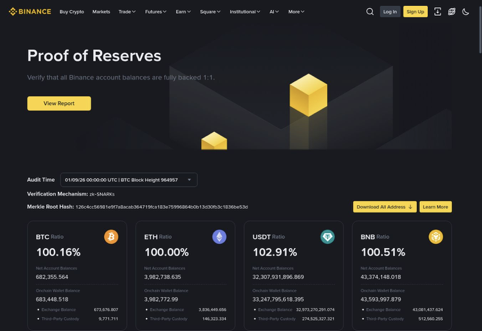 (Image caption) A screenshot of Binance's official "Proof of Reserves" page, showing the platform presenting verification data of some users' asset balances and on-chain wallet balances using zk-SNARKs and Merkle Root Hash mechanisms. This is a transparency tool provided by the company, not a complete financial audit.
300 million registered users, three entities, and a US investigation
By the end of 2025, Binance disclosed that its global registered users had exceeded 300 million. This figure refers to registered users, not active users or trading users, and cannot be used to infer that 300 million people hold assets or use the same product.
In early 2026, Binance disclosed in its year-end report that its total trading volume across all products in 2025 reached $34 trillion, with spot trading exceeding $7.1 trillion; its cumulative trading volume since inception reached $145 trillion. These figures are company disclosures and cannot replace independent audit or regulatory conclusions. They still demonstrate that Binance has become one of the most important gateways to the global digital asset market.
In December 2025, Binance announced a new segmented structure in its Abu Dhabi Global Market, with different entities handling trading, clearing, custody, and brokerage functions. In September 2026, US prosecutors reportedly investigated whether Binance knowingly allowed sanctions-violating transactions involving Iran. Binance stated that it has a zero-tolerance policy for sanctions violations and continues to cooperate with law enforcement agencies; as of this writing, prosecutors have not filed charges against Binance.
The simultaneous emergence of scale, licenses, and investigations has presented Binance with an unavoidable question: When a platform simultaneously controls globally centralized crypto liquidity, hundreds of billions of dollars in user assets, institutional collateral arrangements, and payment channels, what standards should the market use to judge whether it possesses the trust required by market infrastructure?
What does 300 million registered users signify?
With 300 million registered users, Binance possesses a massive account entry point. Compared to the over 250 million registered users disclosed at the end of 2024, the platform added approximately 50 million registered users within one year. The company also stated that retail trading volume grew by 125% and institutional trading volume grew by 21% in 2025; its asset reserves certificate showed user asset balances of approximately $162.8 billion at the beginning of 2026.
These data reflect scale, reach, and platform stickiness. They cannot answer the more important questions on their own: Are user assets adequately protected? Can the trading rules withstand extreme market conditions? Are the company's governance and compliance capabilities commensurate with its market influence?
The most common misconception about large platforms is that the number of accounts and transaction volume are easily mistaken for trust itself. These figures simply indicate that more and more people are using the system. Whether a system is worthy of long-term reliance must be proven by risk isolation, asset rights, information transparency, and legal accountability.
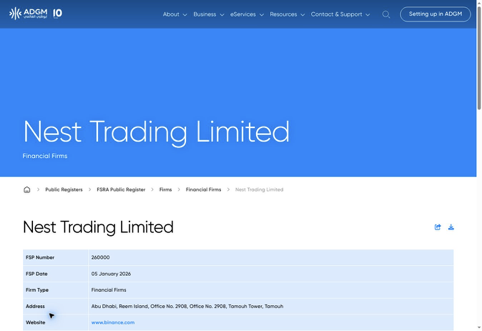 (Image caption) Screenshot of Nest Trading Limited's page in the Abu Dhabi Global Markets Financial Services Regulatory Authority (FSRA) public register, listing the entity's FSP number, effective date, active status, and regulated activities. This image corresponds to Binance's business structure under ADGM discussed in this article.
Liquidity: The Foundation of Binance's Power
For ordinary traders, liquidity means whether orders can be executed quickly and how far the execution price deviates from expectations; for funds and market makers, it determines whether a large transaction will drive prices, whether positions can be adjusted during fluctuations, and whether margin and collateral can be deployed in a timely manner.
Binance's various extended businesses are all built on this foundation. The spot market is responsible for the most basic price formation; leverage, margin, and perpetual contracts take trading into a higher-risk realm; options, futures contracts, and portfolio margin incorporate hedging, leverage, and liquidation pressures into the platform's daily operations.
CCData estimates that in June 2025, Binance accounted for approximately 29.9% of centralized exchanges' spot trading volume and 37.6% of their derivatives trading volume, with monthly turnovers of approximately $430 billion and $1.89 trillion, respectively. This is a monthly market snapshot and cannot be considered a fixed market share; however, it is sufficient to reflect Binance's market weight in both spot and derivatives markets.
The cryptocurrency market lacks a unified central exchange, yet liquidity has formed on a few highly concentrated nodes. When a large volume of trading is concentrated on a single platform, its matching rules, margin system, risk limits, listing and delisting decisions, and the system's ability to operate stably during extreme market conditions all directly impact global price formation. This influence itself does not constitute a violation, but it makes the platform's internal rules begin to have an effect similar to public rules.
Trading, custody, clearing and payment all in one app
Binance remains primarily a trading platform. Spot trading, leveraged trading, perpetual contracts, futures contracts, and options constitute its daily operations. Derivatives expand traders' ability to hedge and express price opinions, but also bring higher risk requirements: how to close positions when margin is insufficient, how to convert different collateral into shares, how to limit losses in extreme market conditions, and what responsibilities users and the platform bear respectively.
OTC services cater to family offices, funds, and corporate treasury departments that prefer not to publish large orders on their public order books. Publicly placing orders can expose trading intentions and potentially increase transaction costs. Binance's OTC trading and execution services provide quote requests, block trades, and settlement arrangements; in 2025, the platform began integrating spot and options quotes from external liquidity providers into its own order book and launched tools that allow institutions to privately express their buying and selling intentions.
Custody is a key topic in Binance's discussions regarding its entry into market infrastructure. Ultimately, crypto asset users are not just concerned with the book price, but rather with who holds the assets, whether the platform fully records user rights, and whether they can recover their assets in the event of a company or market crisis.
In November 2022, after the collapse of FTX shook market confidence, Binance launched a reserve proof based on Merkle Trees; in February 2023, it added zero-knowledge proof technology, allowing users to verify whether their balances are included in the platform's published total user assets. The company claims that user assets are backed by reserves at least 1:1.
This mechanism improves the visibility of on-chain assets and user balances, but it has clear boundaries: it cannot show all of a company's liabilities, related-party transactions, legal control of assets, or how assets are disposed of in the event of bankruptcy. The asset reserve certificate is a transparency tool, not a complete financial audit, and certainly cannot constitute sole evidence that a client's assets are fully protected by law.
Yield products also need to be considered separately. Binance Earn offers products including flexible and fixed-term yields, staking, dual-currency investment, and on-chain yields. The company disclosed that its locked value increased by 144% in 2024, and it distributed approximately $1.2 billion in yields to users in 2025. The risks of these products depend on the source of yield, lock-up period, redemption conditions, token price, smart contracts, and counterparties, and they do not have the same legal protection as bank deposits.
Binance's payment business extends beyond trading. Binance Pay supports transfers between users and payments to merchants. The company disclosed that the service had over 40 million active users in 2024; the number of users is projected to grow by another 30% in 2025, with payment acceptance covering over 20 million merchants. These figures represent the company's statistical data; the specific definition of merchant coverage, actual transaction frequency, and payment currency structure still require ongoing external scrutiny.
Beyond centralized platforms, Binance Wallet, as a self-custodied wallet integrated into the Binance App, allows users to transfer assets across chains, exchange tokens, and access decentralized applications. This lowers the barrier to entry into Web3 and places greater responsibility for the risks associated with private keys, authorization, cross-chain transactions, and smart contracts on the user.
BNB Chain, closely associated with the Binance brand, disclosed that it had over 700 million unique addresses by 2025, and that both BNB Smart Chain and opBNB had over 4 million daily active users. An address is not equivalent to a natural person; a user can control multiple addresses. Furthermore, BNB Chain's legal responsibility and regulatory aspects must be analyzed separately from Binance.
 (Image caption) A schematic diagram of the transaction monitoring, servers, and real-time risk systems relied upon by large digital asset trading platforms, illustrating the market responsibility borne by matching rules, margin systems, and system resilience after a high concentration of liquidity.
Institutional Collateral: RWA Begins to Perform Trading Functions
Institutional clients are often most concerned about counterparty risk and collateral security. In response to institutions' concerns about not keeping their assets on the exchange long-term, Binance launched third-party custody and over-the-counter settlement arrangements in 2023: institutions can place fiat currency, equivalent assets, or part of their collateral under the arrangement of a regulated bank or custody partner, and then obtain trading quotas on the platform.
In 2025, this arrangement began to accept tokenized assets. Binance announced support for assets such as USYC, cUSDO, and BlackRock's USD institutional digital liquidity fund BUIDL as options for some of the off-exchange collateral arrangements. Tokenized money market funds and short-term Treasury bonds thus began to function as collateral in actual transactions; institutions could hold interest-bearing assets while gaining trading capabilities.
This is a specific path RWA takes to enter the financial sector. The core of the institutional judgment lies in who holds the fund shares, how often the valuation is updated, who has priority in handling customer defaults, whether shares can be redeemed promptly under extreme market conditions, and whether different jurisdictions recognize the same set of rights arrangements. The answers are not in the token name, but in the custody agreement, fund documents, and applicable laws.
Abu Dhabi's institutional experiment: splitting functions into different legal entities
In December 2025, Binance announced that it had obtained full authorization in the Abu Dhabi Global Market, with three entities undertaking trading, clearing and custody, and brokerage functions respectively. Starting in January 2026, these services will be provided by entities under this structure; among them, the clearing and custody entity will undertake the central counterparty clearing and custody functions for some derivatives positions on the platform and the digital asset custody functions for users.
The most noteworthy aspect of this architecture is that regulators can observe the three functions of trading, clearing and custody, and brokerage separately, functions that were previously highly centralized in the same system.
The fundamental principles established by traditional financial markets after numerous crises dictate that transactions, custody, clearing, and payments can be interconnected, and that the attribution of responsibility, asset rights, and risk-bearing must be clearly defined. The Committee on Payments and Market Infrastructures under the Bank for International Settlements, together with international securities regulatory bodies, proposed the "Principles for Financial Market Infrastructures," which classifies payment systems, central securities depositories, securities settlement systems, central counterparties, and transaction databases as types requiring higher regulatory oversight. Their failure would impact a vast amount of transactions, asset rights, and market trust.
ADGM's authorization still has clear boundaries. It is a regulatory arrangement within a single jurisdiction and does not automatically extend to Binance's legal status in other markets. For users of Binance services in Europe, Japan, or other regions, asset protection remains dependent on local laws and the licensed entity actually providing the services.
Binance cannot unilaterally obtain the institutional status of "financial market infrastructure" simply because of its business scale or product breadth. This status requires a clear legal basis, regulatory approval, capital and liquidity arrangements, customer asset segregation, default management mechanisms, operational resilience and continuous transparency, and must gain trust in different markets one by one.
 (Image caption) A diagram illustrating custody facilities, ledgers, and encrypted links, used to illustrate that proof of reserves can improve the visibility of user assets and platform-published balances, but cannot replace a full audit of all company liabilities, asset rights, and bankruptcy proceedings.
October 10, 2025: A stress test of the integration platform.
The efficiency gains from placing multiple functions on a single platform are obvious. Retail users can complete buying, selling, storage, yielding, payments, and on-chain exploration all within a single app; institutions can allocate liquidity and collateral across fewer systems; and new projects can reach a massive user base. For the cross-border, decentralized, and 24/7 operating crypto market, consolidation truly reduces operational costs.
In its November 2023 report, the Financial Stability Board defined companies that operate primarily as trading platforms while also offering a variety of crypto asset services as "multi-functional crypto asset intermediaries." The report specifically addressed potential conflicts of interest, contagion risks, governance transparency issues, and cross-border regulatory challenges arising from vertical integration.
The market crash of October 10, 2025, provided a concrete example of these abstract risks. That evening, USDe, BNSOL, and WBETH experienced price deviations on Binance, as these three assets were simultaneously used by some users as collateral for contracts, leverage, or lending. Binance later stated that eligible users affected within a specific time window would receive compensation; media reports indicated total payouts amounted to approximately $283 million.
Binance's swift compensation mitigated losses for some users, a fact that should be acknowledged. However, the incident also highlighted structural problems within multi-functional platforms: the trading venue, collateral pricing, margin risk, and post-event compensation are all highly concentrated within the same set of platform rules. When prices within the platform differ significantly from other markets, losses can be transmitted to leveraged users in a very short time; the compensation timeframe, calculation method, and scope are ultimately handled by the platform according to its announced rules.
In regulated central counterparty systems, similar issues are typically addressed by pre-published and regulatory-reviewed default handling rules. This is precisely what Binance still needs to demonstrate after ADGM separated its clearing and trading functions into different entities.
Zhao Changpeng, He Yi, and a company's governance turning point
Changpeng Zhao and He Yi co-founded Binance in 2017. At that time, the crypto industry was in a phase of rapid expansion and fragmented regulatory rules, and the most important capabilities were to quickly launch products, gather users, and connect global liquidity. Binance's success largely stemmed from this speed and execution; its subsequent regulatory difficulties were also related to the same kind of speed.
On November 21, 2023, the U.S. Department of Justice announced that Binance pleaded guilty to charges including violating the Bank Secrecy Act, operating a currency exchange business without registration, and violating the International Emergency Economic Powers Act. The Department of Justice announced criminal fines and forfeitures totaling approximately $4.316 billion and required the company to retain an independent compliance monitor for three years. On the same day, FinCEN announced a $3.4 billion civil penalty, a five-year monitoring period, and multiple compliance commitments; the CFTC also took action against Binance and Changpeng Zhao.
The funds from these different institutions are offset against each other and have different legal natures, so they cannot be directly added together. The institutional message left by this case is very clear: if large crypto platforms do not establish sufficient anti-money laundering, sanctions compliance, and transaction monitoring mechanisms, the cost will exceed the fines themselves and may affect their management structure, licensing prospects, banking relationships, and market trust.
In 2025, Abu Dhabi's state-owned investment institution MGX announced a $2 billion investment in Binance; the transaction was subsequently settled in USD1, a stablecoin issued by World Liberty Financial. In October, President Trump pardoned Changpeng Zhao. The pardon was for Zhao personally and did not alter Binance's corporate plea agreement or compliance obligations.
In December of the same year, Binance announced that He Yi would serve as co-CEO, leading the company alongside Richard Teng. She has long been involved in Binance's product, brand, and community strategies. This appointment, bringing the co-founder to the company's top management, naturally drew attention to how a company striving to earn long-term trust through its institutional capabilities would maintain a clear boundary between the founding team's influence and independent governance.
 (Image caption) A schematic diagram of fund certificates, custody documents, hardware keys and asset allocation interface, corresponding to the custody, valuation, redemption and rights disposal issues involved after tokenized money market funds and short-term treasury bond assets enter institutional collateral arrangements.
Immediate Verification of Compliance Commitments: Investigations into Transactions Related to Iran
In February 2026, Fortune, The Wall Street Journal, and other media outlets reported that Binance's internal investigators had discovered significant fund flows linked to Iranian entities and raised questions about the company's subsequent handling of the situation. The reports included specific allegations concerning the scale of the funds, account control, internal investigations, and personnel decisions.
Binance denied suppressing investigations or knowingly assisting sanctioned entities in trading. The company stated that the investigation is ongoing, the affected customers have been removed from the platform, and that departing or disciplinary employees were not punished for raising compliance concerns. In March 2026, Binance filed a defamation lawsuit against a Wall Street Journal report.
In September 2026, Bloomberg first reported, and Reuters followed, that the U.S. Attorney's Office for the Southern District of New York and the Department of Justice's Criminal Division were investigating whether Binance knowingly permitted transactions that violated U.S. sanctions against Iran. The Department of Justice did not comment publicly. Binance stated that the company has a zero-tolerance policy for sanctions violations and continues to cooperate with law enforcement agencies. As of this writing, prosecutors have not filed charges against Binance, and no court has made any finding of wrongdoing.
The process is still in its early stages, and conclusions should be drawn from evidence, monitoring reports, and legal proceedings. This investigation has touched upon the core question of this article: After a platform settles with U.S. regulators, accepts independent monitoring, and establishes a new business structure, can its compliance system operate independently and effectively when faced with important customers and business interests?
Binance aims to be a comprehensive platform, and trust must be built through sound systems.
Binance aspires to be more than just a crypto asset exchange. It is building a comprehensive digital asset platform centered on liquidity, extending to custody, clearing, collateral, payments, institutional services, and an on-chain ecosystem.
This integration has both commercial efficiencies and public consequences. It allows users to accomplish more within a single system, enables institutions to access the crypto market at lower operating costs, and gives platforms greater influence in price formation, asset custody, and risk transmission.
The term "exchange" is no longer sufficient to describe Binance today. "Financial market infrastructure" is a qualification that must be granted by an external system and repeatedly verified under pressure.
In the coming years, the market should continue to ask at least three questions. First, in the next extreme market event, will Binance's margin, collateral pricing, and liquidation rules operate according to pre-announced regulations, rather than relying primarily on post-event compensation arrangements? Second, in jurisdictions outside of ADGM, will user assets receive clear and enforceable legal protection, including asset attribution in the event of a company crisis? Third, when business expansion conflicts with compliance responsibilities, is the company willing to prioritize institutional boundaries over growth goals?
The answers that Changpeng Zhao, He Yi, and Binance will provide for the next phase will be written in regulatory documents, court records, and how they handle the next market crisis, and will influence how the global market understands the power and responsibility of crypto asset platforms.
Disclaimer
This article is based on publicly available regulatory documents, company announcements, and media reports, and is for news research purposes only. It does not constitute investment, trading, legal, tax, or other professional advice. The investigations mentioned in this article have not yet resulted in prosecution or conclusion; digital assets are highly volatile, and readers should assess the risks themselves.