

Binance and Web3's "Constitutional" Test
Zhao Changpeng, He Yi and the Boundaries of Platform Power: Who Controls Assets, and How Can Users Hold Them Accountable and Exit?
In March 2026, Ondo announced that tokens tracking US stocks and ETFs would be traded on Binance's regulated trading facility in Abu Dhabi. Buying "Apple tokens" involves acquiring debt instruments issued by offshore issuers, not Apple shares. Who is responsible for fulfilling the product obligations, who holds the assets, and who decides on restrictions are all outlined in separate documents. Whether these arrangements can allow users to recover their assets and hold those responsible accountable when rules change, management changes, or the company faces a crisis is the real test of the platform's power.
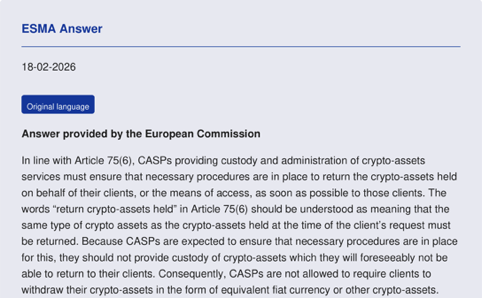 (Image caption) An excerpt from the European Commission's response dated February 18, 2026, included in the European Securities and Markets Authority's Q&A database. The response states that, to the extent applicable under relevant EU rules, custodians must return the same type of crypto assets held by clients and cannot force them to be replaced with an equivalent amount of fiat currency or other crypto assets.
The obligation to pay for the purchase of "Apple Tokens" falls on another company.
On March 3, 2026, tokenized asset company Ondo Finance announced that ten of its tokens tracking US stocks and exchange-traded funds (ETFs) have been accepted for trading on Binance’s multilateral trading facility operating under the Abu Dhabi Global Market (ADGM) framework, covering assets such as Apple, Nvidia, Tesla, and Invesco QQQ ETF.
For investors who buy AAPlon, the name and price on the trading interface are linked to Apple, but the payment obligations established in the offering documents are undertaken by another company. The issuer, Ondo Global Markets (BVI) Limited, is a special purpose vehicle incorporated in the British Virgin Islands in April 2025. Its tokens are defined as debt instruments; holders do not own Apple shares or acquire voting rights as Apple shareholders.
This arrangement provides a new way to access US stock price performance and also brings investors into several different legal relationships: the issuer assumes product obligations, the guarantee arrangement supports repayment, the custodian holds the assets, and the exchange provides the buying and selling channel. The fact that the assets are represented by tokens does not eliminate the intermediaries and their responsibilities.
The first eight articles in this series discussed Binance's products, organization, and founder responsibilities. This ninth article focuses on the rights users can exercise: How will the company continue to fulfill its commitments after Changpeng Zhao left his position as CEO? How are He Yi's and other managers' powers linked to oversight responsibilities? When the company modifies terms, restricts withdrawals, or handles crises, to whom can users seek clarification, and through what procedures can they raise objections?
The "constitution" used in this article is a metaphor for the necessary boundaries of platform power. It examines tokenized arrangements like Binance and Ondo, where services are provided by centralized institutions, and does not represent the operation of all Web3 protocols. The focus of the analysis is whether property law, securities rules, contracts, and technological controls can collectively form a set of rights that users can understand, exercise, and obtain redress for.
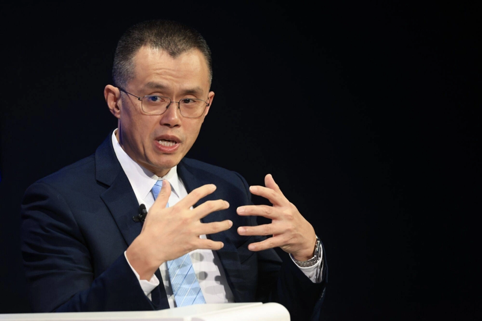 (Image caption) Binance founder Changpeng Zhao speaks in public, addressing the founder's historical responsibility and the boundaries of platform power in a series of discussions.
An investment may involve both the issuer and the custodian.
On February 24, 2026, Ondo announced that ten of its tokens had been added to Binance Alpha, stating that these products were already available through Binance Wallet. The announcement on March 3rd concerned trading arrangements under the ADGM framework. These channels have different service structures, and the legal relationships established between users and parties must be identified based on actual usage and applicable documents.
Ondo's basic prospectus, dated November 11, 2025, defines the relevant tokens as "blockchain-tracked credentials," which are debt instruments. The document explicitly states that the tokens represent an obligation undertaken solely by the issuer, without any guarantee from other institutions; holders do not have ownership of the underlying shares, nor can they participate in the decision-making of the target company through the tokens.
If a user entrusts their assets to an account subject to Binance ADGM's custody terms, another layer of relationship is added. Under these terms, the custodian company holds the relevant assets as a trustee, and the user enjoys beneficial interests corresponding to the quantity, type, and quality recorded in the ledger, rather than having independently identified interests in a few specific tokens.
The first layer of the relationship determines who fulfills the product obligations, while the second layer determines who holds the assets. Issuer inability to make payments and custodian inability to return assets involve different parties and legal procedures. If users hold tokens through self-managed wallets or other methods, the rights and responsibilities under that method must be separately confirmed.
Eligibility restrictions also vary. Ondo's published rules impose restrictions on individuals from the United States, Canada, and other regions, and impose professional qualification requirements on investors from certain jurisdictions. For example, the portfolio threshold for individual professional investors in Hong Kong is generally HK$8 million.
Binance classifies customers as retail customers under a certain service contract, but this does not remove the eligibility restrictions in the product documentation. Buying tokens on the secondary market does not necessarily mean that the holder can directly subscribe to or redeem them from the issuer. Account access, product eligibility, and redemption channels each determine what a user can do.
Regulatory procedures also need to be identified. The classification of a product as a security, its acceptance by a trading venue, and the approval of its prospectus by the regulatory authority each have different legal implications. Ondo's statement regarding the ADGM transaction arrangements indicates that the local financial services regulator has not approved or verified the relevant transaction access documents.
Regulated venues provide trading services under specific rules. What rights investors acquire, whether issuers can fulfill their obligations, and what restrictions apply to exits still need to be addressed in the product and service documents.
 (Image caption) Binance co-founder He Yi, now co-CEO, embodies the specific arrangements of management authority and supervisory responsibility.
Collateral can reduce risk, but recourse is still conditional.
Ondo's basic prospectus was approved by the Liechtenstein Financial Markets Authority (FMA) on November 11, 2025. The document states that the approval pertains to the completeness, comprehensibility, and consistency of the prospectus and does not constitute an endorsement of the issuer or the quality of the product.
The offering documents also disclose that the issuer itself is not subject to the relevant financial business regulations of the FMA or the British Virgin Islands Financial Services Commission, and state that there are no applicable investor compensation schemes in those jurisdictions. This is a separate matter from the prospectus approval; securities offerings, anti-money laundering, and other applicable legal obligations remain to be complied with separately.
Holders are primarily protected by the collateral structure. Each token type has its corresponding collateral, and holders of the same type share the distributable recovery proceeds according to the terms of the agreement. However, the issuer's obligations are subject to limited recourse. After the collateral and additional guarantees are liquidated, the funds available to holders are limited by the actual amount recovered and the priority payment items; any shortfall cannot be automatically recovered from the issuer's other assets.
Enforcement authority is also centrally managed. The document delegates these functions to the guarantor, preventing individual holders from bypassing agreed procedures to directly exercise their rights under the tokens against the issuer or its assets. The guarantor's actions are subject to requests from holders and the provision of what they deem sufficient indemnification or security.
Collective enforcement helps prevent creditors from vying for the same batch of collateral, but it also requires holders to go through coordination, enforcement, and distribution procedures before they can receive funds. The value of the collateral, the conditions for initiating the proceedings, and related costs all affect the final recovery outcome.
The document also includes a clause prohibiting bankruptcy proceedings. Holders are generally prohibited from initiating or participating in any specific bankruptcy or liquidation proceedings against the issuer until one year and one day after the last token ceases to be in circulation. Exceptions are reserved for filing claims in liquidations initiated by third parties and requesting confirmation of the issuer's obligations; these restrictions are subject to the extent permitted by applicable law.
The token documentation is governed by Swiss law, and any disputes arising therefrom will be submitted to arbitration in Zurich, while retaining the compulsory rights of retail investors in the European Economic Area under applicable law. Service disputes between users and trading platforms or custodians may be subject to a different procedure.
The version of the document can also affect the determination of rights. The basic prospectus is valid until November 11, 2026, with supplemental documents approved in May and August 2026, concerning arrangements for authorized participants, asset baskets, and portfolio products. Whether individual modifications apply to AAPLeon depends on the final terms of the product.
For investors, the concept of "guarantee" needs to be broken down into several questions: what is being guaranteed, who can enforce it, to whom the recovered funds will be paid first, and who will bear any shortfall. These conditions determine risks beyond stock price fluctuations.
One Binance account connected to three different corporations
According to Binance's Terms of Use, the contractual relationships of existing accounts will be transferred to the ADGM company structure starting January 5, 2026. The version effective July 21, 2026, specifies the division of responsibilities among the three companies.
Nest Exchange Limited operates the trading venue but does not act as a broker or agent for users in this capacity. Nest Clearing and Custody Limited provides clearing, settlement, custody, and lending services and acts as a trustee in custody relationships as agreed. Nest Trading Limited is a broker-dealer and may participate in trading as principal or agent, depending on the service arrangements.
The three companies have their own legal identities and contractual obligations, yet users access services through the same account. Interface integration reduces operational complexity, but legal responsibility remains with each of the different entities.
The Terms of Use are not the only applicable document. Transaction and clearing rules, contract specifications, relevant notices, procedures, and product terms are all subject to applicable arrangements; local terms may also supplement them. To determine the rights and obligations of a transaction, it is necessary to first identify which service is being used.
Digital asset custody terms provide a concrete example.
Article 8.4 allows client assets to be jointly stored in an on-chain integrated wallet along with the custodian company's own and other clients' digital assets; other clients may include Binance's ADGM entity and affiliated companies. Each beneficiary's share is distinguished by an internal ledger, and the terms stipulate that reconciliations must be conducted at least weekly.
This arrangement places the crucial task of asset identification within an internal ledger. The extent of a user's rights must be verified against the ledger and the actual assets held. While a shared on-chain address is not evidence of misappropriation in itself, the success of the trust arrangement depends on the accuracy of the records, the authorization of asset movements, and the timely identification and correction of discrepancies.
Article 8.5 generally prohibits custodian companies from re-pledging, lending, or using customer assets for their own or others' purposes, while listing several exceptions: when the user expressly agrees in the product terms; when the contract grants rights such as deduction or lien; for operational purposes necessary to directly provide services to the user; and for specific temporary use arrangements during the settlement process.
The final clause allows client assets to be temporarily used for the benefit of the custodian company or other clients during the settlement process. Its applicability and limitations must be understood in conjunction with the liquidation and settlement rules. The terms also state that users who agree to specific asset reuse arrangements must assume the risk that the assets may not be immediately returned.
Article 12 also allows trading venues and broker-dealers to issue irrevocable settlement instructions to custodian companies in accordance with their contracts. Asset control therefore involves not only who holds the wallet, but also who can issue valid instructions, and when the user has granted the relevant authorization.
For users, these permissions should be clearly identifiable within the service: which company holds the assets, which company can direct the movement, which products will change the use of the assets, and who should handle any problems that arise.
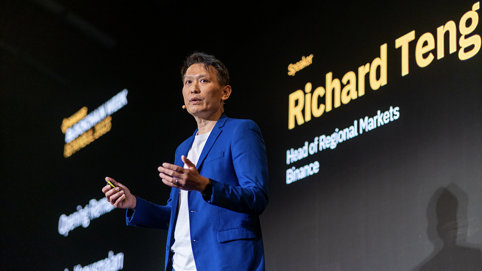 (Image caption) Richard Teng, then Head of Regional Markets at Binance, speaks at Binance Blockchain Week in Istanbul on November 9, 2023. How management authority is allocated and how company commitments are maintained after personnel changes are important issues to examine Binance's governance.
After the rules are changed, exiting may not be immediately possible.
Binance's Terms of Use, Section 23.1, allows for modifications to the Terms of Use and certain documents incorporated therein, including product terms, but expressly excludes the trading and clearing rules manual. Continued use of the services constitutes acceptance of these modifications.
Platforms typically attempt to provide prior notice; however, modifications may take effect immediately in cases of legal or regulatory requirements, or to clarify terms, with notice provided afterward.
Users who do not accept the modifications may close their accounts in accordance with the terms and conditions. However, Article 24 also lists account closure restrictions, including pending transactions, outstanding claims, debts, and situations where the account is frozen, detained, or restricted. Account closure may also be impossible in cases involving evading investigations by regulatory authorities; in certain circumstances, the platform may not provide a reason for the restriction.
These terms serve operational, risk management, and legal requirements respectively, but together they affect an important choice: can users who oppose major changes dispose of their existing parts and leave?
Closing an account involves the termination of the service relationship, and withdrawals, redemptions, and sales are subject to conditions. If assets cannot be delivered or disposed of temporarily, account closure is not an immediate exit method.
The custodian entity may also change. Section 18.6 allows for the removal of the trustee upon notification and the appointment of an affiliated company to take over. At the product level, the Ondo offering document also reserves the issuer's right to redeem all related tokens on a date of its own choosing, as agreed. The former changes the custodian, while the latter may alter the investor's original holding period.
GFM.News believes that any major changes involving the trustee, asset use, fees, and remedies should specify the differences between the old and new versions, the effective date, and the handling of existing parts, and provide a period sufficient for making choices when legal and operational conditions permit.
Safety incidents and lawful orders may require the platform to act immediately. This power should still have identifiable basis, scope, and records, and be subject to review when conditions permit. Whether restrictions remain in place should be reassessed as the incident progresses or the legal basis changes.
After the conflict of interest is disclosed, checks and balances must be implemented in the decision-making process.
Binance Terms of Use 18.4 acknowledges that ADGM, a Binance entity or affiliate, may participate in trading on the platform, hold positions contrary to the interests of users, and may also hold, borrow, or lend on-exchange assets and earn income.
The same clause states that the company has organizational arrangements for identifying and managing conflicts of interest; if such arrangements are insufficient to prevent harm to clients, the company will disclose the nature, source, and mitigation measures of the conflict, and will refuse to act on behalf of clients if necessary. Unless otherwise required by applicable rules, the company is not required to disclose proprietary positions or trading strategies.
Contractually permitted activities and the company's committed control measures need to correspond to each other in actual decision-making. When related companies participate in transactions, who has access to customer information? Who approves product access? In the event of a conflict of interest, who has the right to request recusal or cessation of the transaction? And who reviews customer complaints?
These questions cannot be answered solely by the name of the legal entity or policy documents; they require corresponding information access, decision-making, and oversight records.
Ondo's underlying prospectus also disclosed overlapping roles. According to the shareholding structure described in the document, Ondo Finance Inc., which provides tokenization services, holds 9.99% of the issuer's common stock, while Flux Finance Inc. holds the remaining 90.01%; some directors also hold positions at the tokenization service provider, and the issuer relies on these key personnel.
The document notes that the interests of the parent company and service providers may differ from those of token holders. These relationships warrant scrutiny of service pricing, related-party transactions, and conflict resolution, but the relationships themselves do not necessarily indicate undue interference; equity and management arrangements must also be confirmed on a specific date.
In November 2023, the International Organization of Securities Commissions (IOSCO) released 18 policy recommendations for the crypto and digital asset markets, highlighting conflicts of interest arising from vertical integration, customer asset protection, and operational risks. These recommendations are intended for regulatory bodies worldwide, providing a framework for action, and are not directly applicable to all companies' global laws.
When the same corporate system participates in market access, transactions, custody, and dispute resolution, the division of responsibilities must be implemented in terms of decision-making authority, information segregation, and review mechanisms. Those with the authority to prevent conflicts of interest must possess the necessary information and have the ability to ensure that their decisions are implemented.
 (Image caption) Ledger HW.1 Bitcoin hardware wallet, photographed on September 19, 2016. Self-custody of private keys involves the access and control of assets; whether one can demand performance or redemption from the issuer after holding tokens depends on another layer of product terms and legal relationships.
Safety incidents in 2019 revealed two different types of protection.
On May 7, 2019, Binance announced a major security incident. According to the announcement at the time, attackers obtained users' API keys and two-factor authentication information through phishing and viruses, and then withdrew approximately 7,000 bitcoins from a Bitcoin hot wallet in a single transaction. The announcement stated that this hot wallet represented approximately 2% of Binance's total Bitcoin holdings.
The announcement, issued in the name of Changpeng Zhao, stated that Binance would absorb the losses through the "User Security Asset Fund" (SAFU), while suspending deposits and withdrawals for security review, although trading would remain open. The review period was estimated to be about one week at the time.
SAFU was established in July 2018, with Binance announcing at the time that it would allocate 10% of transaction fees as funding. This is a corporate-established contingency reserve arrangement, and its protection basis differs from insurance policies underwritten by third-party insurance companies.
This incident demonstrates that customer protection involves two distinct tasks. The company's assumption of losses from theft prevents the financial shortfall from being directly passed on to customers; restoring secure access determines when customers can redeploy their assets.
Suspending withdrawals can reduce the risk of further losses, but waiting still incurs costs for those who need to make payments, transfer funds, or adjust positions. Whether other losses caused by service interruptions are compensated, how the scope of compensation is determined, and how customers can appeal if they disagree with the outcome all require separate rules.
The 2019 announcement documented the company's commitments regarding the incident, but did not establish a compensation system applicable to all future events.
Businesses can make decisions that exceed their minimum legal obligations during a crisis. If responsibilities, resources, and procedures are pre-defined and formalized into the system, the response to future incidents will have a clearer basis and will reduce reliance on the ad-hoc judgment of individual managers.
The roles of Zhao Changpeng and He Yi should be placed back into a traceable responsibility structure.
The 2019 commitment to cover customer funding shortfalls; the 2023 plea bargain, on the other hand, concerned the platform's fulfillment of its public legal obligations.
On November 21, 2023, the U.S. Department of Justice announced that Binance pleaded guilty to federal charges under the Bank Secrecy Act, operating a money transfer business without a registration, and the International Emergency Economic Powers Act, and agreed to pay approximately $4.316 billion, including approximately $1.805 billion in criminal penalties and $2.511 billion in forfeitures.
Zhao Changpeng admitted to failing to maintain an effective anti-money laundering program and resigned as CEO. He was sentenced to four months in prison and fined $50 million on April 30, 2024.
The pardon document released by the U.S. Department of Justice is dated October 21, 2025, and was confirmed by the White House on October 23. The pardon concerns Changpeng Zhao personally; Binance is not listed as a recipient of the pardon. Whether the company's obligations will be subject to change will depend on the relevant case and regulatory documents.
These incidents need to be assessed individually. Replenishing stolen assets cannot replace customer identification, transaction monitoring, and anti-money laundering controls; the effectiveness of rectification commitments also requires continuous implementation and external verification.
On December 3, 2025, Binance announced that co-founders He Yi and Richard Teng would serve as co-CEOs. The founders' continued involvement in company management ensures that the allocation of authority and oversight remain concrete governance issues.
Job titles can identify management roles, but they are insufficient to explain the responsibility for every decision. Who approved the trusteeship arrangement, which supervisor can veto related-party transactions, and how incident handling is divided still require referring back to authorization and decision-making records.
Institutional assessments of He Yi and other current managers should focus on their powers, supervisory obligations, and actual actions. Analysis of Zhao Changpeng, however, must distinguish between his confirmed historical responsibilities, public statements, and his current role supported by evidence. Personal reputation, shareholder status, management position, and the obligations of a specific legal entity each play a different role.
This series takes the founders as its starting point, but ultimately it must return to how the company operates: whether commitments can be continued despite personnel changes, and whether users can directly find the responsible organization without first getting the attention of a particular founder.
 (Image caption) May 11, 2017. A view of the city across the water from Maria Island in Abu Dhabi, with a bridge spanning the waterway. The regulatory and legal framework of Abu Dhabi's global markets is an important context for understanding Binance's trading, clearing, and custody arrangements discussed in this article.
Retrieving tokens and realizing token value are different issues.
When a company goes bankrupt, asset protection primarily involves two types of claims: retrieving property held in custody by others, and demanding that the issuer settle debts associated with the product. A single token investment may encompass both of these relationships simultaneously.
According to Binance's Terms of Use 8.4.2, the trust assets held by clients are not the property of the custodian company itself and are protected under the applicable ADGM rules in the event of its bankruptcy.
The terms also address the allocation of expenses. If the law requires related expenses to be paid from the trust assets, the custodian company's own beneficial share will be used first, and any remaining amount will be borne proportionally by the relevant clients.
Section 8.4.3 further clarifies that the trust arrangement does not supersede Section 263 of the ADGM Insolvency Ordinance 2022 and its related liquidation, default, and priority provisions. Asset segregation is legally significant, and restitution may still require identification, verification, and distribution procedures, involving time and costs.
At the product level, Ondo tokens still represent the issuer's obligations. Even if the holder retrieves all the tokens from the custodian, the final value realized is still affected by the product terms, collateral recovery, and distribution procedures.
Custody and segregation handle storage risks, while issuer performance and market prices determine other risks. A token may be safely returned to the wallet, but may still fail to be realized as originally expected due to product or market issues.
The EU's Crypto Asset Markets Regulation (MiCA) provides another regulatory reference. Article 75, paragraph 7, requires custodians within its scope to legally segregate clients' crypto assets from their own, preventing creditors from pursuing client assets in the event of bankruptcy. ESMA's related Q&A released in June 2025 also clarifies the on-chain segregation of client assets from the custodian's own assets.
Binance ADGM terms allow related digital assets to coexist in a unified wallet, with beneficial interests identified through a trust and internal ledger. Comparing the two arrangements requires examining their legal validity, ledger quality, control measures, and bankruptcy proceedings simultaneously; a comprehensive security assessment cannot be made solely based on the wallet format.
The scope of application is also limited. Article 2 of the MiCA excludes crypto assets that constitute financial instruments; tokenized securities that fall under this category are subject to other applicable laws. EU rules provide a benchmark for comparison here and do not directly constitute a guarantee of rights to all Ondo tokens or Binance ADGM services.
There are four ways to quit, each with different conditions.
Users can take four different actions to leave an investment: withdraw assets from the platform, redeem from the issuer, sell or transfer them on the market, and close the account. Each method may involve different objects and restrictions.
Regarding withdrawals, Binance's Terms of Use, Article 16.4, allows the platform to refuse to process withdrawals if it reasonably believes that the law or agreement prevents it, and also allows for the suspension of withdrawals to handle platform incidents, which will be resumed after the incident is resolved. When assets are delisted, users should also pay attention to the notification period; failure to do so may result in the assets being converted into other supported assets in accordance with the agreement.
Related guarantees and set-off clauses may also affect delivery, but their exercise is still subject to the applicable Customer Funds and Customer Assets Rules.
Regarding redemption, Ondo's offering documents stipulate arrangements for holders to exercise their put options in accordance with the terms, while requiring compliance with identity verification, investor eligibility, and other applicable conditions. The method of processing through authorized participants or other channels must also be confirmed in relevant documents. Whether the redemption right can be exercised depends on both the product terms and the holder's eligibility.
The document further states that even if prohibited individuals acquire tokens through the secondary market, they will not enjoy the relevant rights under the transaction documents. This restriction directly affects the holder's ability to assert their rights under the agreement, and its validity must be determined under applicable law.
Selling or transferring shares depends on the market. Ondo's prospectus warns that liquidity is not guaranteed, and the transaction price may not be close to the net asset value. For holders who do not qualify for direct redemption, whether someone is willing to take over and how much they are willing to pay may determine the outcome of their exit.
Closing an account terminates the service relationship and does not automatically clear any outstanding transactions, debts, or legal restrictions. Having a sell button on the account does not mean assets can be withdrawn at any time; tokens can be transferred, but this does not mean the recipient is eligible for direct redemption.
The European Commission's response published in the ESMA Q&A database on February 18, 2026, provides specific details regarding the return of assets. According to this response, the assets required to be returned under Article 75, Paragraph 6 of MiCA are the same type of crypto assets held by the customer at the time of the request; conversion to fiat currency or other assets can be an option for the customer, but cannot be a mandatory replacement for the original assets. Fees and technical conditions must be agreed upon in advance and should not make it difficult for the majority of customers to retrieve their assets.
This interpretation is limited to its application under EU law, but it raises questions for scrutiny: what is to be returned, what conditions are required, and how many options customers have regarding the method of conversion.
There are appeal channels, but the time and cost must be weighed.
Users will also encounter a notification period if their exit is blocked or if there is a dispute over the transaction.
Binance's Terms of Use stipulate that objections to account settlements or transaction confirmations must generally be raised within seven days, while settlement disputes must be notified within 48 hours of settlement or other applicable timeframes. These provisions apply to specific contractual matters and are not the same as the statute of limitations for all legal claims, but they do affect the raising of objections and how they are handled under the contract.
Article 36 stipulates that if customer service fails to resolve the complaint within 80 calendar days of receiving it, the party concerned must submit a formal claim notice, specifying the basis of the dispute, the remedies requested, and relevant account information. After the notice is served, an additional 90 calendar days are allowed for good faith negotiation.
Article 37 stipulates that individual arbitrations shall be administered by the International Chamber of Commerce in accordance with its relevant rules, held in the ADGM, conducted in English, and conducted by a tribunal composed of three arbitrators. The article excludes the use of emergency arbitrators and expedited procedures, but reserves the right to seek interim relief from the ADGM courts, and also explicitly preserves mandatory legal rights under the ADGM Rules.
This arrangement provides a dispute resolution pathway. Whether ordinary users can use it depends on factors such as the amount in dispute, document preparation, language barriers, legal assistance, and procedural costs. The existence of provisional remedies and compulsory legal rights also means that the time required for all remedies cannot be extrapolated from the general negotiation period in individual cases.
For minor disputes, even if the rights are legally established, the costs required to pursue recovery may still influence the parties' choices. The specific burden must be assessed based on actual fees, the case handling method, and the assistance available.
If platforms can publish complaint processing times, common dispute resolution methods, and suitable channels for handling minor disputes, users will find it easier to determine how to file a claim. Ultimately, the effectiveness of remedies lies in whether users can understand the procedures, submit evidence, and obtain a resolution.
If a program malfunctions, the responsibility must be traced through the control and decision records.
Ondo's prospectus discloses that program vulnerabilities could cause holders to lose control of their tokens or have their holdings diluted due to accidental issuance; blockchain attacks may also be difficult to stop or reverse. In the event of a fork, the issuer decides, according to its documents, which chain to recognize, demonstrating that the product retains significant institutional decision-making power.
The document also includes provisions for specific exceptional events. When events such as fraud, theft, or cyberattacks, as defined, involve or affect the underlying asset and related collateral, the redemption amount may be reduced accordingly, down to the smallest unit of the settlement currency, such as US$0.01. This clause allocates the risk of loss under specific events, and its application is subject to the conditions of this document.
Correcting internal ledgers and changing the underlying blockchain are different levels of issues. Binance's actions of canceling obviously erroneous transactions, adjusting prices, or reversing settlements in accordance with its agreements address the platform's transaction and settlement relationships, and do not equate to rewriting confirmed public blockchain records.
The 2019 Binance incident involved the theft of account credentials, reflecting issues of custody security, loss mitigation, and service interruption. Smart contract flaws, however, could occur at a different control level and require different evidence.
Program design flaws, external data errors, compromised management keys, and operator violations can involve developers, data providers, administrators, and operators, respectively. The investigation must first determine who had the authority to upgrade or suspend the contract, who could change parameters, what authorizations were required to restore service, and what records were left at the time of the incident.
Control capability is the starting point for liability analysis; legal liability also depends on obligations, negligence, causation, contracts, and applicable law. Safety audits examine specific technical risks, accident investigations reconstruct the process, and court or arbitration proceedings handle disputes over liability—each serving a different purpose.
The essential arrangements required by users include identifiable incident handlers, a description of key controls, evidence preservation, and progress updates. This information can be provided while protecting private keys and security details, ensuring a traceable investigation after a loss occurs.
 (Image caption) The Abu Dhabi Global Market (ADGM) complex and waterfront, reflecting the institutional context of Ondo's tokenized products entering regulated trading facilities.
The test of rights is the day when the interests of businesses and users clash.
This article examines issues covering asset ownership, usage rights, trusteeship, rule changes, bankruptcy proceedings, related interests, checks and balances, technological responsibility, and exit strategies. These arrangements collectively determine what users can rely on beyond normal transactions.
Publicly available documents already include a significant portion of the protections, along with limitations and exceptions. Contractual agreements demonstrate how rights are stipulated, and public notices record the commitments made by the company. The effectiveness of the protections depends on records of actual control, decision-making, and execution. Raising questions about the terms and establishing that a company has breached its obligations require different evidence.
GFM.News believes that the platform's institutional safeguards should ensure that users know what rights they acquire and who is responsible for fulfilling obligations before a transaction; understand the use of assets and major rule changes during the holding period; obtain explanations and apply for review within the scope permitted by law when restrictions are imposed; and initiate enforceable exit and relief procedures after an accident, bankruptcy, or dispute occurs.
These capabilities require support from law, contracts, regulations, technological controls, and actual services. Disclosure facilitates selection, while compliance requires personnel, resources, and oversight. Corporate specialization can determine liability and must ensure that users can identify the responsible entity.
Changpeng Zhao's historical role and He Yi's management responsibilities make Binance a specific case to observe: can the trust built by the founders be sustained by a stable responsibility structure and remain effective after personnel changes?
The investor who bought Apple tokens can choose to bear the price volatility, or, after understanding the terms, accept the increased risks of participating in the market through debt instruments. Before the transaction, they need to know who bears the product obligations, who controls the assets, what restrictions apply to exits, and who they can appeal to in case of a dispute.
Binance's system is ultimately put to the test when the company and users disagree. If the platform believes the restrictions are still necessary, can users request a review? If the company believes it has fulfilled its obligations, can users provide evidence and seek a ruling? With management changes, do existing commitments still stand by a clearly defined legal entity?
If a "constitution" implies that platform power is subject to enforceable constraints, then it should fall within these specific relationships. Users' rights must be guaranteed even when the platform is unwilling to accept their demands.
Disclaimer
This article is for news research and informational purposes only and does not constitute investment, legal, or tax advice. All cited documents have effective dates and scopes of application; specific rights and obligations are subject to applicable law and valid contracts, and professional advice should be sought when necessary.