

Anthropic IPO Deconstruction: $895.4 Billion in Computing Debt and the Governance Cliff
—Analyzing the time lag of committed expenditures, unit economic improvement, and the boundaries of public shareholder control in the S-1/A filing.
Anthropic's IPO application simultaneously exposes the massive financing needs of cutting-edge artificial intelligence and its unique control arrangements to the public capital market. The massive computing power commitments disclosed in the prospectus require objective analysis based on payment terms, fulfillment conditions, and funding sources; while the public benefit corporation (PBC) and special voting rights structure demand that investors be keenly aware of the significant gap between "economic risk" and "voting control." The core questions to consider in this IPO are: can commercial cash returns support astronomical long-term investments, and can a highly centralized decision-making mechanism maintain sufficient market transparency and accountability?
Editor's Note:
The disclosure of Anthropic's S-1/A filing simultaneously exposed the high cost of computing power procurement and its highly centralized voting rights structure to the public capital market. This study abandons market sentiment and promotional rhetoric, objectively dissecting the time lag of its $895.4 billion contract commitments, the trajectory of unit economic improvement, and the boundaries of interests for public shareholders under the public interest corporation (PBC) structure from a forensic perspective, providing institutional investors with a verifiable institutional analysis.
— GFM.News Editorial Department
 (Image caption) Anthropic co-founders Dario and Daniela Amodei 's decisions directly determine the company's balance between its AI safety mission and return on capital.
The payment arrangements for computing power and the right to elect directors determine how this IPO should be read.
Anthropic's application to list on the Nasdaq Global Select Market under the ticker symbol ANT raises two core questions that public investors must answer simultaneously: how the company will translate AI demand into real revenue sufficient to support long-term computing power investments, and to what extent the common shareholders who provide funding can influence the company's strategic decisions.
According to the S-1/A filing dated November 2, 2026, which we reviewed, the offering price range and the specific number of shares have not yet been determined. Therefore, any conclusions regarding the reasonableness of the listing valuation must be drawn after the specific offering conditions are released, and then quantitative calculations can be performed based on the complete equity structure and financing arrangements.
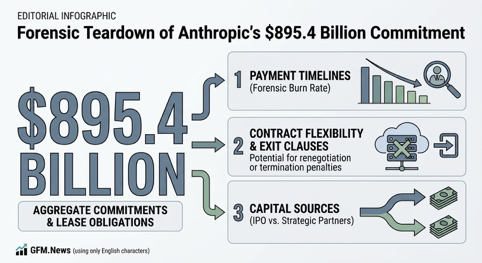 (Image caption) Deconstructing Anthropic's long-term procurement commitments of up to $895.4 billion, analyzing its payment schedule, contractual flexibility, and financing sources.
Committed expenditures need to be broken down by time and conditions.
The much-discussed $895.4 billion in the prospectus represents a multi-year contractual commitment covering procurement and lease arrangements entered into up to and after September 30, 2026. This amount carries significant risk but should not be directly treated as recorded debt, current expenses, or immediately due cash outflows .
The filing also disclosed that some arrangements included termination clauses or preconditions for performance. When assessing its financial stress, analysts must consider payment schedules, supplier delivery pace, contractual flexibility, and available financing channels, rather than concluding a company is inevitably facing a liquidity crisis based solely on a large number.
Locking up computing power long-term can indeed ensure service delivery and reduce the risk of supply shortages; however, if enterprise customer demand, actual receipt of payments, or subsequent financing progress lags behind the massive payment obligations, the company will be forced to adjust capital expenditures, draw on reserves, or raise funds frequently. For shareholders, what they really need to closely monitor are the dynamic changes in these time lags.
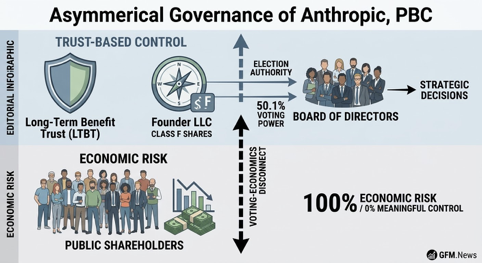 (Image caption) This illustrates the power asymmetry under the PBC structure, where public shareholders bear 100% of the economic risk, while the founders and the trust hold absolute voting rights.
The board of directors needs to continuously balance the mission of public welfare with the interests of shareholders.
Anthropic employs a Public Benefit Corporation (PBC) structure, designed to allow directors to balance shareholder financial interests, the interests of those substantially affected by the company's actions, and the company's designated public benefit objectives. This arrangement provides institutional space for long-term investment in basic research and AI security, but it also requires investors to accept the reality that financial returns are not the sole, or even the exclusive, metric considered in board decisions.
Its governance structure further restricts the possibility for public shareholders to change the company's direction through voting. However, voting rights, board responsibilities, and economic distribution are different legal issues. The fact that control is highly concentrated in the founders and the Long-Term Interest Trust (LTBT) does not mean that public shareholders have no rights or that their economic distribution status is necessarily lower than that of other entities.
The ultimate value of this system needs to be tested by actual business decisions. If management can clearly explain to the market the trade-offs between research investment, business expansion, and security requirements, investors will find it easier to judge the rationality of the long-term commitment; conversely, if information disclosure is insufficient, lofty missions cannot replace substantive market accountability.
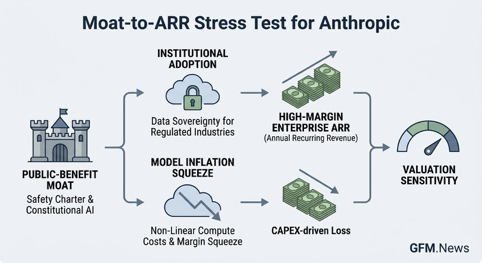 (Image caption) Mott stress test was performed on Anthropic to assess whether its secure positioning could be converted into high-margin ARR to combat the pressure of nonlinear computing costs.
Whether secure location services can generate returns depends on customer behavior and service costs.
The market often regards Anthropic's Constitutional AI as its core competitive advantage, but whether enterprise customers are willing to pay for it long-term and continuously still needs to be verified through customer renewal rates, actual usage, pricing power, and marginal service costs. Gaining market attention for a product and whether revenue can be stably converted into free cash flow are two related but distinct issues.
Similarly, the expansion of computing power investment does not alone prove that unit economics are deteriorating. Model inference efficiency, hardware utilization, and product mix can change cost structures at any time. S-1/A data shows that revenue per unit of computing power output is improving (for example, the ratio of computing power costs to revenue has decreased from 160% in 2025 to 55% in the first half of 2026). Objective research should track observable operational data and avoid treating "larger scale inevitably leads to higher cost pressures" as an unprovable premise.
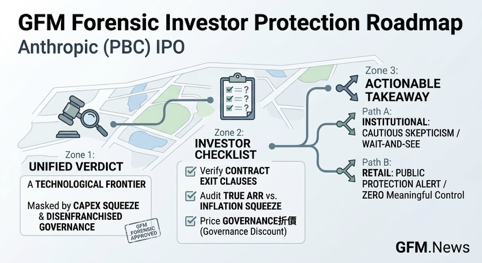 (Image caption) GFM News' Investor Protection Blueprint, which combines capital expenditures and governance structure, reminds institutional and retail investors to carefully assess the risks of ANT's listing.
Investment decisions require both price and verifiable accountability.
Anthropic's cutting-edge technological prospects cannot be exempt from rigorous financial scrutiny, and its unique governance arrangements should not be deemed a failure simply because of their special structure. A mature institutional assessment should link the offering price, capital requirements, contractual flexibility, and shareholder rights item by item, accurately explaining what potential returns and structural constraints correspond to every dollar paid by investors.
For the public capital market to accept long-term research and philanthropic missions, the company must make investors fully aware of how the funds are used, how decisions are made, and how the final results are subject to continuous and open scrutiny.
Disclaimer
This article is based on news research and regulatory analysis of the S-1/A filing dated November 2, 2026, and related publicly available SEC filings. It does not constitute any investment advice, securities recommendation, or guarantee of returns. The filing details and offering conditions may be updated at any time; readers should consult the latest official documents and assess the investment risks themselves.