

Who Decides the Boundaries on X: A Four-Year Test of Musk's Freedom of Speech Pledge
The legal controversies surrounding the release of the documentary "Musk" have once again raised a series of questions: Can journalists speak out? Can advertisers withdraw? Can researchers verify information? How does X treat those who challenge its interests?
Alex Gibney's documentary "Musk" is scheduled for a limited release in New York and Los Angeles today (October 9, 2026). More than a month ago, Musk's lawyers sent a letter warning of a possible defamation lawsuit. The allegations in the film still need to be verified one by one; the past four years have also left a verifiable public record of journalist suspensions, government removal requests, advertiser lawsuits, and the Grok controversy. These events raise a question that is relevant to users, media, and businesses alike: when advocates for freedom of speech control platform rules, who can raise objections, and what are the consequences?
Editor's Note:
As the film *Musk* is set to release today, we choose to examine Musk's commitment to free speech through a public record, and to scrutinize the allegations in the film by the same standard. Having a platform means being able to influence how hundreds of millions of people speak, are seen, and make a living. When the rule-maker is also a party to the controversy, fairness cannot rely solely on his self-restraint. Musk has the right to refute criticism and seek legal redress, and critics should also have the space to present evidence, appeal, and continue to speak out. The weight of a commitment to free speech depends on whether the process remains reliable when interests are challenged, and whether the rules apply equally to supporters and opponents.
Jeff Morgan
Editor-in-Chief of GFM.News
 (Image caption) On May 21, 2016, documentary director Alex Gibney (right), editor Andy Grieve (left), and producer Kristen Vaurio (center) attended the 75th Peabody Awards. Their work at the time was *Going Clear: Scientology and the Prison of Belief*. This file photo shows the background of the director and his documentary work, and is not from the screening of *Musk*.
A movie, a lawyer's letter
On September 3, more than a month before "Musk" was scheduled to hit US theaters, Musk's lawyer, Alex Spiro, sent a legal notice to the production company, Jigsaw Productions. According to the letter disclosed by TheWrap, Spiro alleges the film is based on preconceived conclusions and that the production team refused to allow Musk's representatives to participate in fact-checking. HBO, Bleecker Street, and Universal Pictures, among other production and distribution-related parties, were also listed as recipients of the notice.
In its response, Jigsaw defended the film's research methodology, stating that fact-based examination of powerful public figures is protected by the First Amendment. The production company has the right to defend its work, and Musk has the right to refute allegations he deems inaccurate. Judging both sides' claims requires concrete evidence; the existence of the lawyer's letter neither proves the film is inaccurate nor is it sufficient to prove that the letter's purpose was to suppress criticism.
The nearly four-hour documentary, distributed in North America by Bleecker Street, had a limited run in New York and Los Angeles on October 9, followed by a wider release on October 16. On September 18, Variety, citing sources familiar with the project, reported that Universal was proceeding with its overseas distribution plan, though dates were yet to be set; the film was then expected to launch on HBO in the first quarter of 2027. Current arrangements do not support the claim that the film has been banned; the pressure exerted on production and distribution by legal disputes is another issue that requires further evidence.
Films weave a character's experiences into a narrative. Examining platform governance requires another type of material: company documents, disciplinary records, court rulings, and regulatory reports. Since Musk's acquisition of Twitter in 2022, these materials have gradually revealed a set of relationships—owners can set rules, governments can demand removal, advertisers can withdraw budgets, and researchers attempt to verify how the platform operates.
Ordinary users are rarely at the center of these negotiations and lawsuits, yet they bear the brunt of the consequences. Whether an account can be retained, whether the work reaches its audience, and whether photos misused can be removed promptly all depend on procedures they typically have no say in. For businesses and investors, the same set of procedures also determines brand security, operating costs, and the predictability of revenue.
$44 billion in control
In April 2022, Twitter's board of directors accepted Musk's offer of $54.20 per share, valuing the deal at approximately $44 billion. In the company's announcement, Musk linked free speech to democratic processes, describing Twitter as a digital marketplace for discussing major issues concerning the future of humanity. The transaction was completed on October 27 of the same year, and according to filings with the U.S. Securities and Exchange Commission, Musk became the sole director at the time of the deal.
This transaction transferred control of the company, but it also had a wide-ranging impact on the conditions of public discourse. Users provide content, journalists bring news, creators manage their audiences, and advertisers buy attention; they collectively maintain the value of the platform, but they do not collectively control the platform's rules.
Ownership subsequently underwent two more restructurings. In March 2025, xAI and X were integrated through a stock swap. Musk at the time valued X at $33 billion, while the valuation including debt was $45 billion. These figures represent different financial concepts and cannot be indiscriminately compared to the acquisition amount in 2022.
On February 2, 2026, SpaceX completed its acquisition of xAI. According to subsequent financial filings, X and Grok were incorporated into SpaceX's artificial intelligence business, placing them within the same group as its rocket and Starlink communications businesses. The governance controversy surrounding the social platform thus became linked to broader technology investments, management resources, and corporate reputation.
 (Image caption) A portrait of Elon Musk taken on July 13, 2018, during an event at the Royal Society in London. This article examines the relationship between platform ownership, commitments to freedom of speech, and rule enforcement based on his public record since acquiring Twitter.
Public role of private platforms
"Digital Square" describes the platform's public use and does not change its legal status as a private company. In the United States, the First Amendment primarily binds the government; a private platform's selection, arrangement, and presentation of third-party content can also constitute protected expression. The Supreme Court articulated this principle in Moody v. NetChoice in July 2024, but overturned the original judgment and remanded the case for retrial due to insufficient analysis by the lower court, without granting unconditional exemptions to all functions of the platform.
Therefore, whether the law allows a platform to make a certain decision and whether that decision aligns with the platform's own stated commitments are two different issues. Evaluating Musk requires examining how he uses his power of control; evaluating the government, on the other hand, requires examining whether it respects the legitimate rights of both the platform and its users when regulating the platform.
This distinction is particularly important because the platform's commitment to freedom itself has commercial value. Whether users are willing to invest time, whether creators are willing to accumulate work, and whether businesses are willing to run ads long-term all relate to their trust in the rules. Control can be acquired through transactions, but this trust needs to be maintained through concrete decisions.
Procedures for suspending journalists' rights
On December 15, 2022, Twitter suspended the accounts of several journalists who reported on Elon Musk and his companies. The platform cited its rule against publicly disclosing others' real-time locations, while some of the journalists involved denied publishing such location information. The Committee to Protect Journalists issued a statement the following day demanding the reinstatement of the accounts. Musk subsequently lifted the suspensions based on a vote he initiated on the platform, and some accounts were reinstated.
Personal safety is a legitimate management justification. Publicly available information, after being compiled, located, and disseminated instantly, may create risks that were not originally present; being a journalist does not exempt one from the platform's security rules. However, whether an individual post violates the rules still requires verification of the content, time of publication, and the version of the rules in effect at the time.
Voting can express users' opinions, but it cannot complete this review process. A higher number of people supporting account restoration does not equate to the original punishment being proven wrong; a higher number of people supporting account suspension is also insufficient to prove the individual violated regulations. Whether rules are consistent ultimately requires concrete reasons, not just popularity.
The most unavoidable issue in this case is that the platform owner is also a party to the dispute. When there is a high degree of overlap between the person being protected, the person making the rules, and the person announcing the disciplinary action, the platform needs to more clearly explain how to prevent personal interests from influencing enforcement. Rule change records, written reasons for disciplinary actions, and appeal procedures that are not directly influenced by the parties involved are all related to this trust.
For journalists, account recovery doesn't mean interruption is costless. Interviewees may contact them through the platform, news relies on followers to share it, and readers identify long-time authors there. These relationships can have asset value, but it's difficult to completely transfer them to another platform when account access is lost.
This is also an economic consequence of platform governance: content is produced by creators, and audience relationships are built up over time by both parties, but the channel connecting the two remains controlled by the platform. Whether the rules are stable will affect how much effort people are willing to invest in this channel.
 (Image caption) March 6, 2015, Twitter's then-headquarters on Market Street in San Francisco, with the blue bird logo and Twitter sign still hanging on the exterior wall. The photo documents the platform company's image before Musk's acquisition, providing a historical comparison for the article's discussion of its ownership and governance changes.
Government requirements and cooperation rate
Multinational platforms face different legal systems every day. A government request may involve criminal investigations, privacy protections, or even political criticism; a post protected in the United States may face a removal order in other countries. Whether a platform cooperates must be determined by examining the legal basis and actual content of each request.
In April 2023, *Rest of World* analyzed records Twitter submitted to Harvard University's Lumen database. According to the report, between October 27, 2022, and April 26, 2023, the company received 971 requests from governments or courts. Of these, 808 were fully complied with, approximately 83%; 154 were partially complied with; and the results of 9 were not reported. The report noted that the full compliance rate in the year prior to the acquisition was approximately 50%.
These figures are noteworthy, but they come from records submitted by companies and included in the researchers' analysis, not from an independent census of all government requests. The data also includes content removal and user data requests, and cannot be directly used to measure the incidence of political censorship, much less to prove that every instance of cooperation violates freedom of speech.
In its global transparency report for the second half of 2024, X listed the two types of requests separately. According to company data, of the 97,006 content removal requests, 79,438 were acted upon, approximately 82%; of the 20,925 user data requests, 10,581 resulted in data disclosure, approximately 51%. These self-reported company data differ from the aforementioned research methodology and cannot be pieced together to form a trend of increasing or decreasing compliance rates.
X also challenged the government.
Public records show that X has filed legal challenges against the government. In 2025, the company challenged the Sahyog platform used by the central government to send notifications in the Karnataka High Court of India, arguing that the mechanism bypassed legal procedures. The court dismissed the appeal on September 24, ruling that the platform constituted a coordination mechanism between the government and online intermediaries. X subsequently appealed; according to a report in the Indian Economic Times on March 10, 2026, the High Court panel has requested a response from the central government.
This case is insufficient to generalize X's behavior in all countries, but it illustrates that the notion that "platforms must comply with all government demands" is inaccurate. Similarly, the fact that a platform has raised objections does not provide a general justification for cooperating with other government decisions.
A more valuable test is to require platforms to explain: what laws each requirement is based on, whether objections have been raised, whether the restrictions are only effective locally or extend globally, and whether affected parties can be informed and appeal. The significance of transparency lies in enabling outsiders to question the specific decisions made, rather than simply publishing a seemingly precise percentage.
 (Image caption) On February 6, 2018, SpaceX's Falcon Heavy rocket lifted off from the launch pad for its first demonstration mission. This official file photo showcases the aerospace business within Musk's corporate structure, corresponding to the discussion in this article regarding platform control, corporate restructuring, and group risks.
Constraints on advertising revenue
Twitter's 2021 annual report shows that advertising revenue that year was approximately $4.51 billion, accounting for about 89% of total revenue. This is the historical structure before the acquisition and cannot represent X's current revenue sources, but it reveals an important condition for the platform's original business model: attracting a large number of users and getting advertisers to pay are two things that need to be accomplished simultaneously.
Controversial content can generate attention, but it doesn't necessarily translate into a corresponding level of commercial demand. Advertisers also buy into the environment in which brands appear and their ability to explain the expenditure to customers, employees, and shareholders. Platforms' content policies are therefore reflected in revenue through advertising budgets.
In August 2024, X filed a lawsuit in the Northern District of Texas federal court against the World Federation of Advertisers (WFA) and several companies, alleging that they violated antitrust laws by coordinating a boycott of X through the Global Alliance for Responsible Media (GARM). Days after the lawsuit was filed, the WFA announced the cessation of GARM's operations. According to a report in the UK's *Marketing Week*, the WFA stated that its resources had been severely depleted, and insufficient financial resources were a major reason for discontinuing the plan.
On March 26, 2026, Judge Jane Boyle dismissed X's case. For some of the foreign defendants, the reason was lack of jurisdiction; for the remaining defendants, the court held that X failed to make sufficient claims, including failing to adequately assert the damages required by antitrust law. On July 29, X and the WFA announced a settlement, with the WFA confirming in a public statement that GARM had permanently ceased operations and promising not to revive the program or establish any similar programs.
The settlement left behind concrete business results, but it didn't turn X's allegations into facts confirmed by the court. Whether an individual company's refusal to place an advertisement constitutes illegal collusion with another company requires different evidence; advertisers setting common standards are not automatically exempt from competition law scrutiny simply because they use the term "brand safety."
Another outcome of this dispute occurred before the court ruling: the industry project in question ceased operations. Therefore, litigation is not merely a retrospective process for determining right and wrong; it can also alter the capabilities and choices of market participants during its duration.
For platforms, this constitutes a persistent constraint. Ownership can determine product direction, but it cannot guarantee that other market participants will accept its full costs; advertising revenue, research criticism, and legal disputes will bring these costs back into the company's operating decisions.
Researcher data threshold
While transparency reports published by the platform itself have their value, external researchers need access to examine the methodology, identify omissions, and, if necessary, reach conclusions different from those of the platform. If only the platform has access to complete data, external assessments of its governance will rely heavily on the assessment of the entity itself for an extended period.
In 2023, X sued the Center Against Digital Hate (CCDH), alleging that it scraped platform data in violation of its terms of service and used flawed methods to publish reports, resulting in lost advertising revenue. On March 25, 2024, Judge Charles Breyer of the Northern District of California granted the dismissal and anti-SLAPP requests, dismissing the lawsuit. In his ruling, he stated that the case was punishing the defendant's speech.
This ruling addresses the litigation and related legal issues, and does not endorse all of CCDH's research findings. X has appealed, and the Ninth Circuit Court of Appeals will hold oral arguments on September 30, 2026. As of this writing, a decision is pending.
 (Image caption) EU flags lined up in front of the European Commission's Bellemont building on January 22, 2009. This historical archive photo illustrates the EU regulatory environment discussed in the article, serving as a backdrop to discussions on platform transparency, access to researcher data, and cross-border regulation.
Media Matters' Two Fronts
The experience of another watchdog, Media Matters, presented a different process. In November 2023, the organization published a report indicating that advertisements from several major brands appeared next to content promoting Nazism. X subsequently sued, alleging that it created misleading screenshots through unrepresentative methods. Judge Reed O'Connor rejected X's motion to dismiss the case in August 2024, allowing the case to continue, but did not find X's allegations guilty.
X's affiliates subsequently filed lawsuits in Ireland and Singapore. In April 2025, a California federal court imposed restrictions on proceeding with the Irish lawsuits and some other overseas actions, but did not similarly block the Singapore proceedings at the time. The cross-border litigation broadened the scope of the confrontation and increased the ongoing costs for the research institution.
Separately, there was the government investigation. Texas Attorney General Ken Paxton announced an investigation into Media Matters in November 2023 and issued a civil inquiry. On May 30, 2025, the District of Columbia Circuit upheld a preliminary injunction restricting the investigation, finding Media Matters' claims of First Amendment retaliation likely to succeed.
Private corporate claims and government investigative powers are two different powers. The court's restriction on Paxton's investigation cannot be written as a ruling that X's civil lawsuit is unconstitutional; however, the fact that both procedures fall on the same institution at the same time makes the question of "whether it can afford to continue the research" an undeniable practical issue.
EU data access requirements
The EU has chosen to enshrine some verification requirements as platform obligations. The Digital Services Act includes provisions for access to research data by large platforms, including access to publicly available data by qualified researchers. On December 5, 2025, the European Commission fined X €120 million for misleading the public, advertising a lack of transparency in its database, and hindering researchers' access to publicly available data.
X subsequently filed a judicial challenge with the General Court of the European Union, arguing that there were significant problems with the investigation, legal interpretation, and procedures. Platforms need to be subject to external scrutiny, and the enforcement actions of regulatory authorities also need to be subject to judicial review; protecting research space should not come at the cost of depriving any party of their right to defend themselves.
Research institutions must also explain how they selected their samples, processed their data, and whether their conclusions exceed the evidence. A reliable system should empower platforms to refute erroneous research and enable researchers to publish results that platforms would not want to see. For organizations with limited resources, even if they ultimately win a case, the manpower wasted, the research delayed, and the opportunities lost may not be recovered.
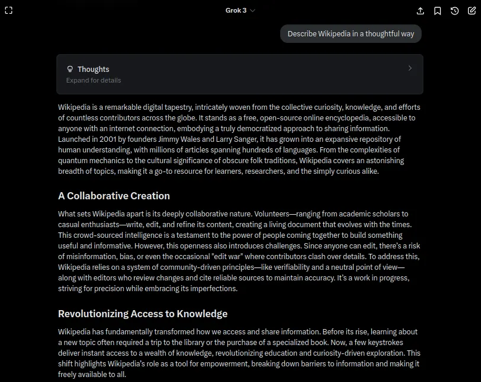 (Image caption) Screenshot of Grok 3's interface answering related questions on Wikipedia. The version shown was updated on June 16, 2025. The screen presents a typical text-based question-and-answer function to help readers understand the generative AI products discussed in this article; it is not related to the sexualized images involved in the regulatory investigation.
Grok generation responsibility
In late 2025 and early 2026, multiple media outlets reported that users were using Grok to alter ordinary photos of women and children into explicit or sexually suggestive images. This controversy extends beyond simply whether the platform should delete third-party posts: the same company provided the generation tools and distribution channels; once users input prompts, where does the company's responsibility begin?
On January 12, 2026, Ofcom, the UK's communications regulator, launched a formal investigation under the Online Safety Act to examine X's risk assessment of illegal content, safety measures, and child protection obligations. X subsequently stated that it had taken measures to restrict the relevant functions. On February 3, Ofcom stated that it had issued a legally binding information request to X; as of the time of writing, its case page still shows that the investigation is ongoing.
Ofcom also pointed out at the time that the scope of the law limited its investigative powers regarding illegal images generated by the independent Grok service. The UK Information Commissioner's Office announced on the same day that it had launched an investigation into how X and xAI processed personal data. The same technological products may face different liability issues under content security and personal data regulations.
California Attorney General Rob Bonta announced an investigation into xAI on January 14. The European Commission launched a new formal investigation on January 26 to examine whether X properly assessed and mitigated systemic risks, such as the distribution of illegal content, before deploying its Grok functionality. These announcements document the direction of regulatory scrutiny and do not, in themselves, constitute a determination of wrongdoing.
Canadian survey findings
The Canadian proceedings took a mixed turn on June 11. The Privacy Commissioner released his report, concluding that X and xAI failed to obtain valid consent regarding the personal data involved in generating personalized deepfakes, a practice that violated Canada's Private Sector Privacy Act. The report noted that both companies disagreed with the findings and stated they had taken steps to prevent and address the issue.
This is the conclusion of the regulatory authorities' investigation, not a final court ruling. According to the official announcement, the company has committed to submitting periodic reports and independent third-party audit reports to explain the improvements and effectiveness of its safeguards. For those affected, this kind of ongoing monitoring is more meaningful than a one-off announcement that "functionality is limited."
The Canadian case also revealed limitations in law enforcement capabilities. The Privacy Commissioner pointed out in releasing the findings that the law at the time did not grant it the power to directly order companies to comply. Identifying a problem, drawing conclusions, and ensuring that the problem is resolved are not necessarily the same thing.
Regulatory power also has boundaries
US courts are simultaneously examining the boundaries of regulatory measures. xAI filed a First Amendment challenge against a Minnesota law restricting AI-generated "undressing" video tools. On October 2, 2026, the Eighth Circuit Court of Appeals granted the company's request for an injunction during the appeal process, providing temporary relief without definitively ruling the law unconstitutional. The legislative purpose of protecting victims and the constitutionality of the restrictive measures employed by the law still require separate examination.
These procedures cannot be generalized to mean that all countries have ruled Grok illegal, nor can the fact that the company obtained a temporary injunction lead to the conclusion that the product has proven safe. They demonstrate that different systems are defining the responsibilities among the tools used to generate the product, the users, and the distribution platforms, and that those affected still require timely and effective remedies.
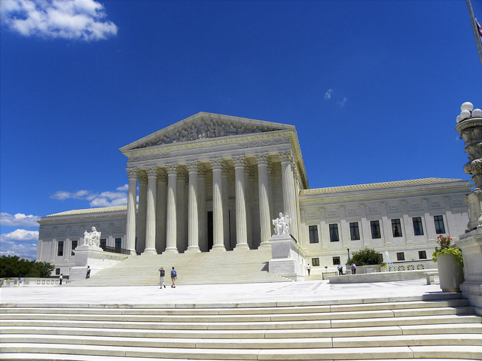 (Image caption) The facade of the U.S. Supreme Court building in Washington, D.C., on July 12, 2019. This article, through the Supreme Court's discussion of platform content editing rights, distinguishes between editorial choices by private companies, the limits of government intervention, and users' expectations of a fair process.
Integration of generation and recommendation
The EU's January 2026 announcement also included an easily overlooked detail: the Commission expanded its existing investigation to include the risks associated with X's announcement of switching to a Grok-based recommendation system.
This brings the issue of platform governance to a new level. Removal rules determine which content cannot be retained, recommendation systems influence which content is more likely to reach the audience, and generation models further increase content production capabilities. When these three stages are designed and operated by the same corporate system, external scrutiny must include how the products interact with each other.
This integration may improve product collaboration efficiency, but it also increases the difficulty of external verification. Without sufficient data, researchers will find it difficult to determine whether the widespread dissemination of content stems primarily from user preferences, recommendation mechanisms, or the cost reduction in production and distribution by generation tools. While open-source code, company statements, and transparency reports each have their uses, it remains to be answered whether they are sufficient to support verification of actual operations.
For businesses, risks extend beyond fines. Model adjustments, security testing, regional feature restrictions, complaint handling, and litigation all require resources. How these costs are allocated will impact product launch speed and long-term operations; if the primary costs are borne by the victims, the company's financial statements will not fully reflect the consequences of the product.
For those whose photos are misused, these institutional distinctions ultimately translate into daily life: how easy it is to file a complaint, whether it's possible to prevent the images from being uploaded again, and how much time it takes to explain things to others. The content of the images may be fabricated, but the impact can be on work, family relationships, and a sense of security. Discussions of platform responsibility must return to these specific circumstances.
Procedural safeguards for dissenters
Returning to "Musk," filmmakers have the right to express their opinions, and Musk has the right to refute false accusations and seek redress. The media has no reason to demand that those being reported on waive their right to defend themselves, nor should it stop scrutinizing their public actions simply because they possess substantial resources.
The materials from the past four years cannot serve as an overall judge for every decision Musk makes, but they are sufficient to examine some specific issues: whether there is consistent justification for disciplinary actions, whether government demands are challenged, whether commercial disputes alter others' ability to participate, whether researchers can obtain data, and whether harm caused by technology is addressed in a timely manner.
These issues bring the discussion of freedom of speech back to the institutional level. Owners can make promises, but the credibility of those promises needs to be maintained by day-to-day rules, grievance arrangements, and external verification. Courts and regulatory bodies can impose constraints, but their powers must themselves be limited by law; advertisers and researchers can influence platforms, but they also need to provide evidence for their practices.
GFM's assessment is that the public credibility of a large platform depends on people's ability to reasonably anticipate the rules, understand the reasons for penalties, and have the practical capacity to object when faced with unfavorable decisions. This standard should not change with the owner's political stance, nor should it be accepted only if the outcome meets one party's expectations.
Trust is also a condition for business.
For creators and businesses, the foreseeable rules are the conditions for investing time and money. For investors, X is now part of the same group as rocket, satellite, and artificial intelligence businesses, and platform governance may affect broader business assessments through reputation, compliance costs, and management resource allocation. Specific legal liabilities still need to be determined based on the company structure and individual cases; group integration does not automatically mean all liabilities are shared.
A film may end in about four hours, but the relationships on the platform continue the next day. Journalists still need to contact sources, creators still need to publish their work, researchers still need to obtain information, and those who have been abused by images are still waiting for their fate. Whether they can continue to work and live speaks volumes more about the actual weight of the rules than any public declaration.
The most crucial test for a platform that upholds freedom of speech is when its own interests are challenged. Whether critics can still obtain clear reasons, reasonable appeals, and the space to present evidence determines whether this commitment can transcend the personal will of its owners and become a system that others can rely on.
Disclaimer
This article is based on publicly available information as of October 9, 2026, and is for news research purposes only. It does not constitute investment, legal, or tax advice. Case status is as listed; charges, investigations, and court rulings should be interpreted separately.