

Where exactly is the rebuilding of Los Angeles stalled?
$25.2 billion in insurance payouts and 9,376 licenses still don't answer how many families have returned home.
Nearly two years after the fires, Los Angeles has accumulated $25.2 billion in insurance payouts and 9,376 reconstruction permits, while California has applied to Congress for $12.98 billion in additional recovery funds. These figures seem enormous, but they represent three separate systems: claims processing, approvals, and public works, which are not fully interconnected. Insurance money may not be available, permits may not have been issued, and construction does not guarantee that residents have returned home. What Los Angeles truly needs to rebuild is not just a house, but a road that reconnects funding, construction, and family life.
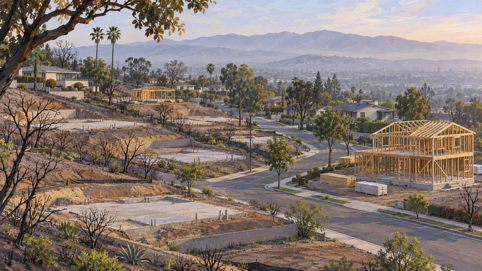 (Image caption) The Los Angeles hillside residential area is in the early stages of reconstruction after the fire: some plots have been cleared and a few homes have begun construction, but whether most families can return to their original homes still depends on whether compensation, financing, permits and construction progress can be truly coordinated.
None of the three sets of progress figures have reached the same endpoint yet.
Nearly two years after the Eaton and Palisades fires in January 2025, Los Angeles reconstruction has accumulated three massive figures: insurance companies have paid out a total of $25.2 billion, local building authorities have issued 9,376 reconstruction permits, and the California state government has applied to Congress for $12.98 billion in additional recovery funds. These figures record the progress of private insurance, local approvals, and public infrastructure, respectively, but none of them answer the most important question in post-disaster reconstruction: how many indigenous residents have returned to their original homes?
Insurance payouts, building permits, and government funding are all increasing, but they use different statistical methods, update times, and administrative purposes. Insurance payments may not necessarily translate into construction payments, permits may not indicate commencement of construction, and occupancy permits do not necessarily signify the return of original residents. When funding, construction, and family life are not placed on a verifiable timeline, Los Angeles' reconstruction easily becomes merely an administrative process, losing sight of its essential benchmark: whether people can return home safely, affordably, and with dignity.
Data Baseline Notes: The official data cited in this article comes from different regulatory and administrative systems, and their public update deadlines are not consistent. These include claims statistics from the California Department of Insurance as of July 6, 2026; appropriation records from CalAssist as of September 14; and the latest supplemental appropriation request submitted to Congress by the state government on November 16-17. These cross-agency figures reflect the stage-specific status of each process and cannot be directly combined into a uniform completion rate or return-to-home rate for the same period.
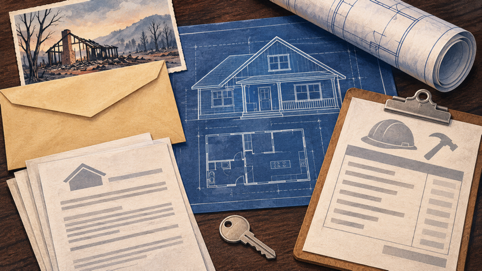 (Image caption) Insurance claims, mortgage payments, building plans, and project budgets constitute different links in the post-disaster family reconstruction funding chain; the fact that payments have been made does not mean that the homeowner can pay the contractor and start the project.
$12.98 billion remains outside Congress
On November 16, 2026, California Governor Gavin Newsom sent a letter to congressional leaders requesting that $12.98 billion in supplementary recovery funds for the Los Angeles fire be included in the year-end appropriations bill to be processed in December. The following day, he met with congressional leaders from both parties in Washington, D.C., and reiterated his request for Congress to process the funds.
This money has not yet been approved or disbursed. Its structure illustrates that California faces more than just individual homeowners rebuilding their homes. $8.4 billion is earmarked for housing and community infrastructure, $2.5 billion for FEMA-eligible public assistance programs, and additional funds are allocated to disaster mitigation, drinking water, wastewater, childcare, business recovery, employment, and transportation. The state government has also requested adjustments to the cap and rules for SBA disaster loans.
California formally requested $39.68 billion in supplemental federal funding in February 2025; a revised request in December of the same year brought the figure to $33.9 billion. The current $12.98 billion is approximately one-third of the original request. The state government stated that this amount was restructured based on the most pressing unmet needs.
These figures should be understood as an outstanding public bill. Water, roads, schools, childcare, commercial corridors, and community facilities will not automatically be restored simply because private insurance companies make payments to individual policyholders. Labeling $12.98 billion as "federal investment in Los Angeles reconstruction" is inconsistent with the current system.
$25.2 billion does not equal $25.2 billion in project costs.
According to the California Department of Insurance tracker, as of July 6, 2026, a total of 41,727 claims were filed for the Eaton and Palisades fires, with 40,482 claims receiving at least partial payment, totaling $25.2 billion in payouts.
This figure covers residential, commercial, automotive, additional living expenses, and other disaster-related claims; payments include legally expedited advance payments, property repair or replacement funds, and some local cleanup program expenditures. It does not directly represent the total investment in residential reconstruction projects, nor does it indicate that all cases have been closed.
For comparison, data released by the Insurance Bureau at the end of 2025 showed that as of November 17 of that year, cumulative payouts totaled $22.4 billion; by July 2026, the publicly available figure had increased to $25.2 billion. In large-scale wildfire claims practice, later disbursements often involve write-offs of replacement cost differences, release of recoverable depreciation, or supplementary payments after an agreement has been reached on the scope of repairs. This indicates that reconstruction-related funds are still in circulation, but the increase in the amount itself cannot be directly equated to an accelerated pace of new construction projects, and publicly available data does not reveal how much of it has become available to pay contractors, designers, material suppliers, and utilities.
Regulatory data also shows that the increase in total payouts has not eliminated disputes in individual cases. In September of this year, the California Department of Insurance stated that after reviewing over 2,000 complaints from Los Angeles fire victims, it had facilitated over $338 million in additional payments, of which over $50 million were related to smoke damage. While this cannot extrapolate the dispute rate for all policyholders, it is sufficient to illustrate that an insurance payout already recorded may not have solved the family's rebuilding problems.
The first article, "When is a House Safe?", tracked the inspection and repair of smoke-damaged homes. For many families, the exterior of the house remains intact, but disputes over pollution testing, contents removal, repair standards, and additional living expenses may prevent them from moving in immediately. After the fire is extinguished, the insurance system faces another, more difficult-to-quantify loss: when a dwelling truly returns to a safe and habitable state.
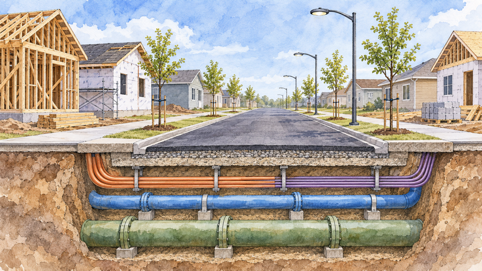 (Image caption) Residential reconstruction must be coordinated with water supply, sewage, electricity, communications, roads and fire protection capabilities; if public infrastructure is not in place on time, individual houses may not be able to be constructed or occupied smoothly even if they have obtained permits.
Issuance of the permit is just the beginning, not a certificate to return home.
The Eaton and Palisades fires destroyed approximately 16,300 buildings. This figure includes residential, commercial, and other structures and cannot be directly equated with the number of households affected or directly compared to rebuild permits.
As of November 17, 2026, the four local governments had issued a total of 9,376 reconstruction permits: 4,076 for the Los Angeles County incorporated, 5,133 for the City of Los Angeles, 111 for Malibu, and 56 for Pasadena. This is a significant step forward in post-disaster approvals, but a single permit only indicates that a plan has passed specific administrative and technical reviews, allowing construction to begin legally.
The public dashboard also lists figures for under construction, completed, or with occupancy permits, but the local definitions are not entirely consistent. Los Angeles County uses "Completed/Available for Occupancy Permit," while the City of Los Angeles, Malibu, and Pasadena use the "Occupancy Permit" or "Other Completion" column. The existing data fails to provide a uniform completion rate and cannot answer a crucial structural question: behind these issued permits, which properties belong to original residents, and which were redeveloped by new buyers after the original owners sold the land due to financial difficulties?
Issuing a rebuilding permit may mean that a new house is being built on a piece of land, but it doesn't necessarily mean that the families who lost their homes have received the keys to their new homes. The City of Los Angeles has stated that the Palisades-led debris clearing is complete, and independent clearing is nearing completion. The completion of clearing is only the starting point for private rebuilding. Project advance payments, contractor schedules, design modifications, geological and fire safety requirements, utility connections, and construction inspections can all mean that an issued permit may remain merely a piece of paper.
Mortgage relief addresses the immediate crisis, but it doesn't solve the cash flow problem for construction projects.
The $105 million CalAssist Mortgage Fund, funded by nationwide mortgage settlements, aims to assist eligible disaster-stricken families in paying their mortgages. The state government announced that as of September 14, 2026, CalAssist had disbursed $54 million to 1,575 households, with 76% going to homes affected by the Eaton fire. New applications closed on November 2nd.
The purpose of this plan is to buy time for families who are still burdened with mortgages and paying rent or temporary accommodation costs. It is not equivalent to a housing reconstruction grant, nor can it replace the upfront payments required for design, geology, materials, and construction in the initial stages of construction.
California's Disaster Rebuilding Assistance Program, launched in September, is a tool directly targeting construction financing. The state budget allocated $100 million to CalHFA to encourage lenders to provide construction or renovation loans to eligible homeowners through construction loan interest rate subsidies and loan loss guarantees.
However, as of the timeframe of this article, CalHFA has only disclosed the program's mechanisms and lending rules, and has not yet released data on the actual number of borrowers approved for loans at Eaton and Palisades, the average loan amount, interest subsidy payments, collateral usage, or project completion results. This is insufficient to determine the program's effectiveness or ineffectiveness, but it does mean the public currently cannot assess whether the $100 million has truly narrowed the rebuilding gap for families.
For families still awaiting supplemental claims or unable to access insurance funds immediately due to project inspections and fund release procedures, low-interest construction loans may not immediately translate into the first payment to the contractor. If insurance premiums, loans, mortgage grace periods, and construction progress are not aligned, families often only gain more time, rather than a financial path to complete the reconstruction.
 (Image caption) The problems faced by temporary families are not only moving away from their original homes, but also include mortgage payments, rent, children's education, commuting and construction waiting costs; the ultimate measure of reconstruction should still be whether residents can return home safely and with dignity.
The grace period extends the time, but it does not eliminate the waiting cost.
AB 1847, signed in September of this year, extends the legally available mortgage grace period for Los Angeles wildfire victims from 12 months to 24 months, and requires loan servicing institutions to offer the option to defer payments until the end of the loan term, provided that legal requirements are met and it is not restricted by investor agreements and service rules. AB 1842 establishes a statewide mortgage grace framework for future federally declared disasters.
These systems reduce the risk of families losing their homes in the short term after a disaster, but they do not eliminate debt. Interest, rent, commuting, children's education, care, inadequate insurance, and construction costs will still coexist in a family's cash flow.
In June of this year, FEMA approved extending housing assistance for eligible homeowners until July 9, 2027; the extension for eligible tenants is only until October 9, 2026. When the state government submitted the extension application in May, it stated that nearly 29,500 potentially eligible families were still processing insurance claims, and nearly 1,000 families were continuing to receive extended temporary housing assistance. These are administrative figures from that time and cannot be considered representative of today's displaced population; however, they serve as a reminder that the time lag between temporary housing and permanent resettlement continues to alter a family's ability to remain.
After the tenant assistance period expired, there is no complete record of how many people moved to other communities, how many are still waiting, and how many are unable to return. This gap also exists for elderly families, low-income homeowners, and families who have sold their land.
Without the street's utility lines connected, construction is difficult to begin even with a single blueprint.
Private residential projects are driven by homeowners, insurance companies, lenders, and contractors; public works projects, on the other hand, depend on funding and coordination from federal, state, county, city, and utility agencies. If these two lines cannot be connected on-site, residential redevelopment may repeatedly face constraints related to roads, water supply, sewage, electricity, fire protection, and construction traffic.
The Los Angeles City redevelopment plan has incorporated underground water supply, sewage, stormwater, gas, and major electrical infrastructure into a phased, coordinated engineering arrangement, along with roads, streetlights, communications, and transportation systems. The state government's inclusion of $759 million in its federal request for drinking water and sewage systems also reflects the possibility that inadequate public infrastructure could become the next bottleneck for private home rebuilding.
The approval of a house's plans does not mean that the neighborhood is ready for timely construction and long-term occupancy. Water supply and fire protection capacity, sewage systems, electrical design, road accessibility, and future disaster preparedness will ultimately affect the home's construction costs and move-in date.
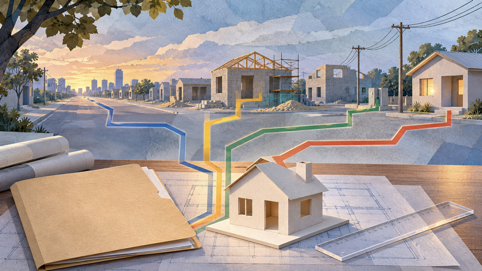 (Image caption) Insurance payments, building permits, financing arrangements, construction inspections, and access to public utilities are subject to different systems and timelines; whether they can be integrated into a single household determines whether a reconstruction project is truly completed.
The final accounting for the reconstruction should be who has returned home.
The available data is insufficient to support the conclusion that "the Los Angeles reconstruction has failed." Insurance payments continue, cleanup work is largely complete, more than 9,000 permits have been issued, homeowner housing support has been extended, and California has established mortgage and construction financing facilities.
However, the available data is also insufficient to prove that reconstruction is on track. The latest publicly available statistics from the Insurance Bureau stop in July; DRAP has not yet released actual loan disbursements; permit and engineering data vary across different regions; there is still a lack of complete public records regarding resident return rates, tenant destinations, land buyer structure, and household out-of-pocket shortfalls; and $12.98 billion in federal supplemental funding remains outside of Congress.
What's truly stalling in Los Angeles isn't just a sum of money, a permit, or a road; it's that the progress of different systems hasn't converged to achieve the same result. In some cases where mortgages are still outstanding, insurance claim checks may list both the homeowner and the lender; whether and when the funds can reach the construction site still depends on the loan agreement, service provider procedures, construction documents, and installment payment arrangements.
In its next round of investigation, GFM.News will link insurance payments, mortgage services, joint checks, building permits, engineering inspections, and utility connections back to the same household, the same plot of land, and the same timeline, questioning how a claim, a permit, and a government commitment can become a home that allows a family to rebuild their lives.
Next article: <Insurance payments have been made, so why are reconstruction funds still stuck?>
Disclaimer
This article is compiled based on publicly available government documents, regulatory information, and verifiable sources. It is intended for news research and public information reference only and does not constitute investment, insurance, legal, tax, construction, or loan advice. Individual cases should be consulted with qualified professionals.