

When is a house considered safe? California establishes new standards for smog pollution claims.
The house may not have burned down, but it may still be temporarily uninhabitable: Two new laws begin to regulate smoke damage detection, residential repairs, and temporary living expenses.
Following the 2025 Los Angeles wildfires, over 13,000 smoke damage claims came from families whose homes still exist but may be temporarily unsafe to live in. California's newly signed AB 1642 and AB 1795 laws establish clearer rules for smoke pollution detection, home repair, re-occupancy, and temporary living expenses, turning "when is a home truly safe" into a measurable, verifiable, and legally permissible public issue.
Editor's Note
More than a year has passed since the devastating Los Angeles wildfires of 2025 , but the reconstruction efforts, centered on insurance, mortgages, housing, land, population relocation, and public responsibility, continue. GFM.News 's "Financial Investigation" is launching a long-term public research project, "After the Fire, Who Will Rebuild Los Angeles?", which will continuously track how insurance funds are paid out, when families can return home, how reconstruction is progressing, and the responsibilities of the government, financial institutions, and the market.
On September 15 , 2026 , California signed a new wildfire recovery bill, ushering in a new era for the inspection, repair, insurance claims, and temporary living support of smoke-damaged homes. This article chooses to start with the question, "When is a house that hasn't been destroyed by fire truly safe?" to document an important change taking place in the reconstruction process of Los Angeles, and to further observe the actual distance between the law, insurance system, and the lives of ordinary families.
The data, case studies, and question list generated from this long-term investigation will form an important research foundation for GFM.News 's "New Opportunities in California" public dialogue platform. Future research can be further integrated into discussions among government, industry, academia, capital, and the community. GFM 's investigative reporting and platform activities operate separately; no partner participates in GFM 's topic selection, verification, title selection, or editorial decision-making.
Jeff Morgan
Editor-in-Chief of GFM.News
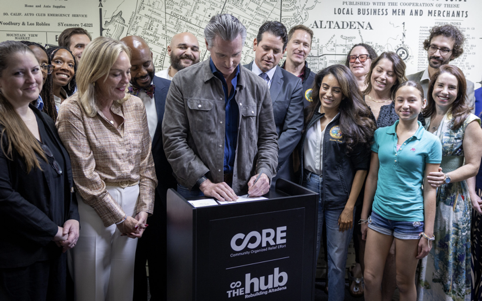 (Image Caption) On September 15, 2026, California Governor Gavin Newsom signed the Wildfire Recovery Act at the CORE/The Hub reconstruction site in Altadena. Residents affected by the fire, advocates, and legislative stakeholders were present. An old neighborhood map on the background wall indicates the location of the signing ceremony. The image documents the public milestones in the legislative process of AB 1642 and AB 1795: smoke damage assessment, residential repair, and temporary living allowance rules were reinstated in the affected communities.
The house wasn't burned down, so why can't we go home?
On September 15, 2026, California Governor Gavin Newsom signed four wildfire recovery bills in Altadena. AB 1642 and AB 1795 established a framework for the detection, remediation, and insurance claims related to wildfire smoke pollution. AB 1842 and AB 1847, also signed at the same time, primarily address mortgage forgiveness and mortgage protection for affected families. GFM's "Financial Investigations" focuses on the first two laws in this article because they directly address a problem left over from the 2025 Los Angeles wildfires that still troubles many families: what standards should be used to determine the safety of a home that was not destroyed by fire but has lead, asbestos, soot, combustion byproducts, and other contaminants inside? Who is responsible for paying for detection and remediation costs? Under what conditions can insurance companies stop paying temporary living expenses?
The California Department of Insurance estimates that the Los Angeles fires in January 2025 will generate more than 40,000 insurance claims, with over 13,000 involving homes that are still standing but contaminated by smoke. The Smoke Claims and Remediation Task Force, established by the California Department of Insurance, documented numerous disputes in its report, including which contaminants should be tested, how samples should be taken, the extent of repairs required, how to interpret different test results, and when a home can be considered truly restored to its pre-disaster condition.
For many families, the fact that their house didn't burn down is a stroke of luck, but as they prepare to return home, a new kind of uncertainty truly emerges. The walls may still be intact, the furniture may not show obvious damage, and from the street it may be difficult to tell what happened to the house, but whether the indoor air, dust, and surface residue are safe is something the naked eye cannot answer, and insurance companies and experts hired by the homeowner may not reach the same conclusion.
California is now attempting to establish a common set of standards that all parties can use. Environmental and public health standards will determine when a home is ready to be re-occupied, and insurance rules will use these standards to handle inspections, repairs, payments, and temporary living expenses. The governor's office describes this arrangement as the first enforceable wildfire smoke damage standards in the nation. While GFM does not consider this government positioning as an independent research conclusion until a state-by-state comparison of the laws in all 50 states is completed, it is certain that California is changing its past practice of handling cases primarily on a case-by-case basis, involving homeowners, insurance companies, and inspection agencies.
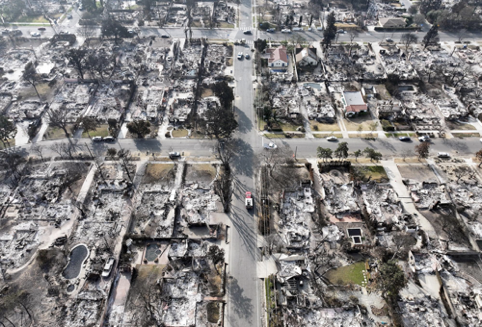 (Image caption) Aerial view of Altadena after the Eaton fire shows vast areas of housing reduced to ashes, with a few houses still standing amidst cleared land and scorched earth. The article's core discussion is not about "all burned down," but rather how these remaining homes were encroached upon by smoke, ash, and combustion byproducts. ZIP Code-style wildfire impact zones become entry points for claims precisely because burned and unburned houses can appear simultaneously in the same neighborhood.
The two new laws jointly address safety and compensation.
AB 1642, officially titled the Wildfire Environmental Safety and Testing Act, was introduced by State Representative John Harabedian and is primarily responsible for establishing scientific standards for the detection, remediation, and relocation of pollutants after wildfires.
The Smoke Damage Recovery Act (AB 1795), introduced by State Assemblyman Mike Gipson and supported by the California Insurance Authority, aims to integrate these standards into residential insurance claims, repair procedures, and liability settlements.
The two laws are interdependent. AB 1795 stipulates that its operation is contingent upon AB 1642 being enacted and meeting certain conditions; AB 1642 also contains corresponding provisions. Both bills were signed by the governor on the same day, thus completing the legislative process for this interconnected legal framework. It is important to note that the official California legislature records classify both bills as Non-Urgency, and they cannot be described as emergency legislation that took full effect immediately upon the governor's signature.
There are very practical reasons for this arrangement.
If insurance companies are required to restore homes to a "safe and habitable" state, there must be safety standards recognized by public institutions; conversely, if environmental departments establish pollution standards but lack compensation obligations, inspection periods, and payment rules, these scientific standards are difficult to translate into rights that affected families can actually use.
AB 1642 provides a scientific baseline, and AB 1795 connects this baseline to the insurance processing procedure. Both laws address a very specific issue: who has the right to say a house is safe, and how that judgment affects insurance payouts.
The phrase "being able to go home" has begun to have a measurable scale.
AB 1642 requires the California Department of Toxic Substances Control (DTSC) to collaborate with agencies such as the Office of Environmental Health Hazard Assessment to develop rules for the testing, remediation, and re-occupancy of lead and asbestos after wildfires by December 31, 2028. The California Air Resources Board is also required to publish guidance on indoor air pollution in homes damaged by wildfire smoke by the same date.
The law also requires the DTSC to establish broader contaminant guidelines by December 31, 2029, specifically addressing substances such as CAM 17 heavy metals, cyanides, lithium, manganese, dioxins and furans, and polycyclic aromatic hydrocarbons. Where scientific evidence permits, relevant agencies also need to establish screening levels for soil, air, and surface swab samples, as well as testing standards after remediation.
It will take several years to develop a complete standard, but affected families cannot wait until 2028 or 2029 to decide whether to return home, so the law also sets out transitional arrangements.
Until new state-level rules are finalized, lead and asbestos contamination in homes within wildfire-affected areas can be determined according to existing federal and state standards. This prevents a complete gap of several years between the law and future regulations.
For families, there remains a very real time lag. Families typically decide whether to return home in weeks or months, while public health standards are often established in years. While rules exist for lead and asbestos, a unified screening system for other contaminants still needs to be gradually implemented. When science can provide sufficiently clear answers will directly influence when a family dares to bring their children, elderly relatives, and daily life back to their original home.
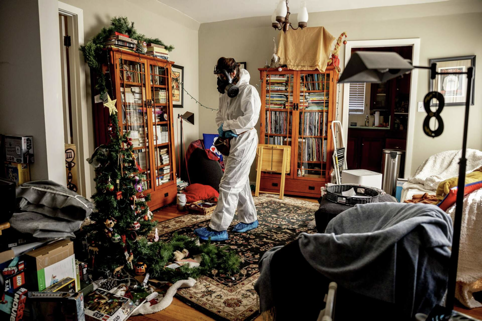 (Image caption) In September 2025, Altadena homeowner Debbie McMahon, wearing protective clothing and a gas mask, enters the living room of a house that was not destroyed by fire. The Christmas tree, bookshelves, and everyday furniture are still in place, but she cannot enter her house in a normal way. This photo directly addresses the question raised in the article: the walls are still there, and they may not be noticeable from the street, but the safety of indoor air and surface residue has become the core of the dispute between families, testing agencies, and insurance companies.
The burden of proof for tobacco damage claims has changed.
The most direct change AB 1795 made to the claims system was the establishment of a "rebuttable presumption".
Within a legally defined wildfire impact zone, if a surviving residence produces smoke, ash, soot, char, or other combustion byproducts after a wildfire, the law generally presumes that the smoke damage was caused by that wildfire. Insurance companies can still raise counter-evidence, so this is neither automatic nor unconditional liability, but the starting point for homeowners to file a claim is different.
Previously, some families needed to first prove the existence of pollution, and then prove a causal relationship between the pollution and a specific fire, before disputes arose regarding the scope of testing, the extent of remediation, and the cost. The new presumption system at least reduces friction in proving the first layer of causality.
The law uses a relatively easy-to-enforce geographical definition for wildfire impact zones: a zone may be included as long as a ZIP Code is wholly or partially located within the fire boundary defined by CAL FIRE.
This approach offers advantages in administrative efficiency but may also create new boundary issues. Within the same ZIP code, the distance between different residences and the fire, the prevailing wind direction, the degree of building sealing, and the level of smoke exposure can vary significantly. California has chosen to first establish a claims entry point based on geographical location, and then determine specific damages based on actual inspections and scientific standards. Whether this approach can improve claims efficiency while controlling new disputes remains to be seen, pending actual claims data.
Inspection, repair, and accommodation fees will now use the same standard.
AB 1795 sets specific time requirements for some claims procedures.
If an insurance company decides to exercise its right to inspect a smoke-damaged residence, it must do so as soon as possible, and no later than 30 calendar days after receiving notice of the claim; if the residence is inaccessible due to government restrictions, the 30-day period begins from the date it gains access.
The insurance company must also cover the necessary sampling and testing costs for restoring the residence to its pre-disaster state and confirming that the residence is ready for occupancy again, but the specific payment is still subject to the policy terms and coverage.
For undisputed personal property repair costs, the law sets a payment deadline based on the actual cash value; similar payment deadlines are also set for residences and property covered by replacement cost insurance. The law also allows policyholders to choose the vendor or contractor who will actually perform the home repair work.
These seemingly technical regulations are actually very specific to families. Who enters the house to inspect, who decides the extent of cleaning, who is responsible for the work, and what conditions are used to determine if the house is ready to be moved back in after the repairs are completed—all of these directly affect the amount of compensation and the time it takes to return home.
One of the most important benefits for families is Additional Living Expense, which provides additional living expenses during periods when a home is uninhabitable.
AB 1795 stipulates that for smoke damage claims within wildfire-affected areas that meet the coverage criteria, the insurance company may not terminate the relevant Additional Living Expense coverage until the dwelling has been restored to its pre-disaster condition and confirmed to be habitable according to relevant standards. However, this obligation remains subject to the applicable policy limits.
Therefore, the new law does not create unlimited coverage for hotels or rentals. Policy limits, contract terms, and other existing insurance rules remain in place. What it changes is the relationship between safety assessment and payment: when an insurance company can determine that a residence is suitable for returning home, it will need to rely more on measurable and verifiable criteria, rather than solely on a one-sided claims judgment.
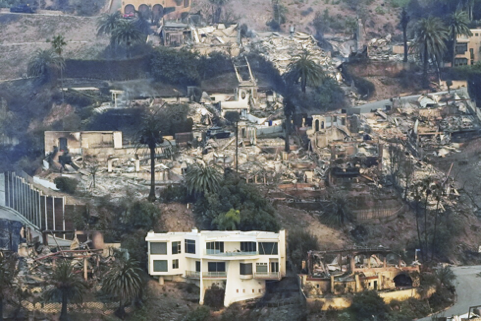 (Image caption) On the slopes of the Pacific Palisades hillside, a white house still stands intact, surrounded by ruins. Many of the smoke damage claims from the 2025 Los Angeles wildfires come from these types of homes that are still standing but may be temporarily uninhabitable. The image illustrates that not being burned doesn't mean you can immediately return home; whether lead, asbestos, soot, and other pollutants exceed safe levels requires measurable public standards, not just visual assessment.
The family law of 2025 spurred new legislation, but existing cases still need to be handled on a case-by-case basis.
The policy context of AB 1642 and AB 1795 is directly related to the controversy surrounding smoke damage to numerous unburned homes following the Eaton and Palisades fires in 2025. The Governor's office and the California Insurance Department have also made it clear that the new system incorporates the experiences of Los Angeles fire survivors.
However, the new law, prompted by the disasters of 2025, does not mean that all existing claims from 2025 will automatically receive the new procedures and protections.
The new procedural provisions in AB 1795 explicitly limit their application to residential property insurance claims occurring on or after the date specified in the Actual Operating Date. At least in terms of inspection periods, payments, and related procedural coverage, it cannot be simply described as a comprehensive retrospective of all cases up to 2025.
There is a very real time lag for the affected families.
Families in 2025 have contributed to the new law through their own experiences, but the timing of the new system's implementation does not entirely coincide with the time they spend dealing with claims, paying mortgages, renting temporary accommodations, and deciding whether to return home. For families still dealing with existing cases in Eaton and Palisades, the original policies, existing California insurance laws, the Department of Insurance's oversight and enforcement, and the facts of each case itself remain important.
GFM's Financial Investigation will continue to follow this story. The signing of the law is a clear institutional milestone, but it won't make the accumulated claims disputes from the previous year disappear on the same day.
Boyle Heights extends the issue beyond wildfires.
AB 1795 also included another fire of a different nature in the subsequent study.
On June 17, 2026, a fire broke out at a large Lineage Logistics cold storage warehouse in Boyle Heights, Los Angeles. According to the bill, the facility was nearly 500,000 square feet and contained over 85 million pounds of food, including an ammonia refrigeration system, rooftop solar panels, and other industrial equipment. The incident caused persistent smoke, food spoilage, odors, and sanitation problems. An initial shelter-in-place order was issued due to the risk of ammonia depletion, but nearby residents did not receive a mandatory evacuation order.
This difference exposes another type of insurance problem.
The activation of certain residential Additional Living Expense and Business Interruption Coverage may be related to government orders, physical damage, or other specific policy conditions. If residents voluntarily evacuate due to smoke, odors, health symptoms, or persistent pollution without a government-issued mandatory evacuation order, there may be a discrepancy between their actual living costs and the legal trigger conditions of the policy.
AB 1795 does not directly extend wildfire smoke damage rules to all industrial fires. Instead, it requires the California Insurance Department to study the coverage gaps exposed by lineage incidents, including whether Additional Living Expense and Business Interruption require additional triggering conditions in the absence of a mandatory evacuation order. The bill outlines research areas including Air Quality Index thresholds, public health alerts, and voluntary evacuations of vulnerable groups such as children, the elderly, pregnant women, people with disabilities, and those with chronic illnesses. The final report must be submitted to the Governor and the State Legislature by December 1, 2027.
Another study, conducted by the California Office of Emergency Services and the California Environmental Protection Agency, covers interagency coordination during incidents, regulatory authority, decisions regarding shelter-in-place versus mandatory evacuation, and cleanup delays. The final report is due by July 31, 2028.
The Lineage case thus brings the issue to the broader realm of urban risk: a home may not be destroyed by fire, and the government may not have ordered residents to evacuate, but smoke, chemicals, or other pollution can still render a family unable to live normally in reality. Whether traditional insurance can recognize this type of loss—where the house remains but its habitability is temporarily lost—has become a research question for the state government in the next phase.
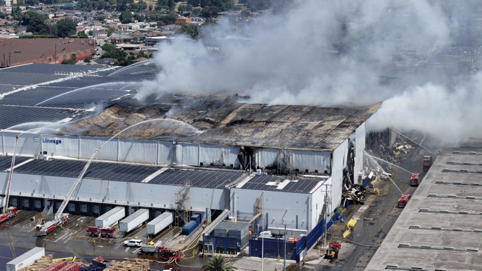 (Image caption) In June 2026, a fire at the Lineage cold storage warehouse in Boyle Heights, Los Angeles, spread from rooftop solar panels. Firefighters sprayed water onto the approximately 500,000-square-foot facility, with smoke continuing to billow out. AB 1795 requires the California Insurance Department to study the insurance gaps exposed by such industrial fires: nearby residents may evacuate voluntarily due to smoke, odors, or health risks without receiving mandatory evacuation orders, thus additional living expenses and business interruption coverage may not be triggered. This extends the issue of "the house remains, but its habitability is temporarily lost" from wildfires to urban industrial risks.
Public health science is beginning to influence insurance claims.
The insurance industry typically measures risk using loss, probability, and price, while public health and environmental science rely on exposure levels, pollutant concentrations, and health thresholds to determine safety. The 2025 Los Angeles fire brought these two professional systems together directly in the homes of thousands of families.
The walls may be intact, the windows may not be burned, and the house may not even appear to be obviously damaged from the street, but whether soot, heavy metals, and other combustion byproducts have entered the house, and whether it is truly safe to live in after cleaning, requires professional testing to answer.
When insurance company-hired experts, homeowner-hired industrial hygienists, and public health agencies use different approaches, "safety" itself can become part of the claims dispute.
In 2025, the California Department of Insurance established the Smoke Claims and Remediation Task Force, whose members include public health, environmental health, fire safety, industrial hygiene, the repair industry, consumer representatives, and the insurance industry. The Task Force's report confirms that while there is broad consensus on establishing statewide standards, significant disagreements remain regarding testing methods, the extent of repairs, and how related costs should be allocated.
AB 1642 and AB 1795 now leave some of the disputes to be addressed by law and subsequent rulemaking.
The new framework will not eliminate all conflicts. Inspections will increase costs, remediation standards may raise some claims amounts, and ZIP code-style zoning of impact areas may create new boundary cases. As to whether and how these additional costs will be reflected in future insurance rates, there is currently insufficient regulatory data to support reliable conclusions.
One confirmed change is that the safety of a residence will gradually rely less on the subjective judgment of a single party. Inspections will need to be compared against public standards, repairs will need to be verifiable, and a clearer legal link will begin to be established between insurance payments and whether a residence can be reopened to occupancy.
The ultimate criterion for reconstruction is whether families can return to live peacefully.
GFM.News continues to track insurance payments, housing reconstruction, population return, and public responsibility following the 2025 Los Angeles wildfires. AB 1642 and AB 1795 fill in a previously easily overlooked part of this survey line.
When it comes to post-disaster reconstruction, people usually think of clearing rubble, obtaining building permits, finding contractors, raising funds, and rebuilding their lost homes. For families whose homes were not destroyed, the situation is entirely different. Their homes remain in their original locations, and some family belongings may still be inside, but smoke and pollution make "when can we go home" a question that involves science, law, insurance, and family health all at once.
Such losses are difficult to fully capture in a single disaster photograph. They exist in indoor air, dust, walls, and furniture, and also in the choices a family must make every day: whether to let the child sleep in the original room, whether to continue paying rent for another place, whether to hire a new testing expert at their own expense, and which report to believe when two test results give different answers.
California is now trying to reduce this uncertainty.
AB 1642 establishes environmental and health standards, and AB 1795 links these standards to insurance claims, repairs, payments, and temporary living support; follow-up studies of the Lineage fire further examine whether existing insurance trigger conditions are still sufficient when a disaster does not conform to traditional wildfire or mandatory evacuation patterns.
In my opinion, the most noteworthy aspect of these two laws is that they address a very common yet very serious family issue: what conditions must be met for a family to truly feel at ease moving back into their home, which remains in its original location?
The law will not provide all the answers at once. New scientific standards will take years to develop, regulatory agencies, insurance companies, and courts will continue to define the boundaries of liability, and existing cases being handled by affected families in 2025 will not automatically end with the signing of the new law.
But a significant change has begun. After the next major fire, California hopes that for those homes that are still standing, "safety" will no longer depend solely on the judgment of insurance companies, inspection companies, or homeowners, but will gradually become a measurable, verifiable, and legally permissible public issue.
Ultimately, reconstruction needs to restore not just the house itself, but the sense of security that a family once again feels when living in it.
About this project
This article is part of the ongoing "California Wildfire Reconstruction Public Research Project" under GFM.News's "Financial Investigations". GFM will continue to track insurance payments, mortgage and bank funding, housing reconstruction, population migration, land transactions, industrial opportunities, and public responsibility following the Los Angeles wildfires in 2025, and will continuously update relevant data, profiles, and policy developments.
Disclaimer
This article is based on publicly available California laws, government documents, and regulatory information as of September 16, 2026, and is intended for news research and public policy analysis only. It does not constitute legal, insurance, or investment advice. Specific coverage, claims rights, effective dates, and case-by-case liability are subject to official laws, regulatory interpretations, and relevant policy terms.