

The next battle in China's micro-drama market: After AI makes production cheaper, who gets the profits?
430,000 titles were launched in eight months, with AI dramas accounting for over 90%; whether the production advantages can generate sustainable returns depends on customer acquisition costs, platform revenue sharing, ownership of rights, and cash recovery.
AI is lowering the production threshold for micro-dramas, allowing more works to compete for viewers. Whether the money saved by producers can stay in their accounts depends on customer acquisition costs, platform revenue sharing, copyright arrangements, and the speed of payment collection. Chinese companies have accumulated experience in content development and mobile distribution, but listed company financial reports, platform incentives, and overseas market data raise more practical questions: How much revenue can the increased output generate, and how much of that revenue can be retained to allow companies and creators to continue investing in the next project?
 (Image caption) Editors review vertical video footage and editing timelines in the studio. The full cost of AI-assisted production still needs to include manual editing, sound processing, and post-production editing. (GFM.News AI-generated illustration)
Production surges, but returns still need to be proven.
On September 17, 2026, Wang Xiaoliang, Director of the Online Audiovisual Program Management Department of the State Administration of Radio and Television of China, introduced at a press conference held by the State Council Information Office that in the first eight months of that year, 430,000 micro-dramas were launched nationwide, 13 times the number for the entire year of 2025, with AI dramas accounting for over 90%. This comparison, comparing the first eight months of 2026 with the entire year of 2025, measures the number of dramas launched and does not represent the same proportion of viewership or revenue achieved by AI dramas.
At the same press conference, Wang Xiaoliang proposed supporting live-action dramas and introduced arrangements to guide platforms in setting up dedicated live-action drama sections. These two statements, taken together, highlight a problem the industry is facing: while technology is rapidly expanding content supply, whether works can attract audiences and whether revenue can cover investment still needs to be tested by the market.
The micro-dramas familiar to the public are mostly presented on vertical mobile screens, with each episode lasting only one or two minutes. Current Chinese regulations have a broader definition, covering dramas with episodes shorter than twenty minutes, a clear main storyline, a continuous and complete plot, and prominent characters, and their broadcast channels are not limited to mobile phones. This market encompasses different production methods, viewing scenarios, and revenue models, and cannot be explained by the experience of just one product.
Micro-dramas can attract new viewers and capture time previously spent on other forms of entertainment. However, increased online releases do not guarantee a proportional expansion in viewing time, advertising budgets, and household entertainment spending. The more readily available production tools become, the more companies need to rely on irreplaceable works, sustainable licensing rights, and the ability to effectively reach audiences to retain profits. The difference between the amount invested and the final return lies in contracts, distribution channels, and audience choices.
The entrance to the audience affects profit distribution.
The scale of distribution platforms is already enough to influence the business choices of production companies. According to data from QuestMobile cited by 21st Century Business Herald in September 2026, Hongguo Short Drama had 168 million daily active users in July, which is higher than the simple sum of about 155 million users of Tencent Video, iQiyi, Youku and Mango TV.
These figures measure mobile app activity, not the same as paying viewers, total viewership, or the audience across all devices on the platform; the sum of users from the four apps doesn't exclude cross-platform overlap. It still shows that leading distribution channels have amassed a massive daily user base, and a production company's ability to access these channels will affect its chances of reaching an audience.
When numerous production companies vie for the same platform's procurement and recommendation resources, the platform may gain a stronger negotiating position regarding prices and cooperation terms. However, this advantage is constrained by competition: if other platforms are willing to offer more attractive terms for good content, production companies may gain new options; teams that consistently deliver popular works are also harder to replace than suppliers offering a large amount of similar content.
The money saved in production goes in different directions. It might become production company profit, translate into lower copyright acquisition prices, be invested in more advertising, or be passed on to viewers through free viewing. The extent to which technology improves efficiency and the amount of revenue ultimately retained by creators need to be calculated separately.
For businesses, a truly valuable advantage lies in the ability to retain customers and keep viewers engaged even after tools have become more widespread. This ability can stem from a series of works, a creative team, copyright arrangements, or distribution experience; it's difficult to build simply by increasing production volume.
 (Image caption) Passengers watch short dramas on their phones during their commutes. Mobile viewing is a key use case for micro-dramas, and platforms need to attract and retain viewers within the limited viewing time. (Image generated by GFM.News AI)
Chinese Online: Spending is down, and income is also declining.
The financial report of ChineseAll, a Shenzhen-listed company on the ChiNext board, provides a case study that can be examined item by item. This company started with online literature and has expanded its business to short dramas and the overseas platform FlareFlow.
According to the adjusted business classification in the 2025 annual report, the company's revenue from short dramas and IP derivatives was approximately RMB 896 million, representing a year-on-year increase of 125.02%, accounting for 54.09% of total revenue. This classification includes both short dramas and IP derivatives, and is not revenue solely from AI short dramas. In the same year, the company's sales expenses reached RMB 953 million, a year-on-year increase of 105.02%, equivalent to 57.51% of total revenue; the company attributed the increase in expenses primarily to overseas business promotion.
In the first three quarters of 2026, both revenue and expenses contracted. The company's revenue was approximately RMB 833 million, a year-on-year decrease of 17.64%; operating costs decreased by 32.91%, which the company explained was mainly due to the conversion of some overseas short dramas to AI production, resulting in reduced production costs; sales expenses decreased by 41.84% to approximately RMB 384 million, mainly due to reduced overseas promotion expenses.
During the same period, the net loss attributable to shareholders of the listed company narrowed to approximately RMB 132 million, a year-on-year reduction of 74.63%; operating cash flow turned from a net outflow of approximately RMB 173 million in the same period last year to a net inflow of approximately RMB 42.8 million. However, revenue in the third quarter was approximately RMB 255 million, with the year-on-year decline widening to 43.95%.
This account also includes other factors affecting profit and loss. Investment income turned from a loss of approximately RMB 44.94 million in the same period last year to a gain of approximately RMB 27.73 million, which also helped reduce losses. The third-quarter report also noted that equity investment income from the investee company Crazy Maple Studio (CMS) only includes the first quarter of 2026, excluding the second and third quarters. The quarterly financial report is unaudited and does not provide sufficient information to break down the profitability of each AI drama.
The disclosure by ChineseAll indicates that the simultaneous occurrence of reduced spending, narrowed losses, and decreased revenue is insufficient to determine the individual impacts of AI or promotional adjustments on revenue changes. Contraction itself is not necessarily a bad thing; ceasing inefficient spending can improve operations. What companies need to further demonstrate is whether the adjustments will lead to profitable growth.
Therefore, when studying short drama companies, production costs, promotional expenses, investment returns, and actual cash inflows should all be examined separately. An improvement in a particular expense may indicate that a part of the business is improving, but it cannot replace a judgment of overall profitability.
Saving on production costs does not equate to increasing profits by the same amount.
How AI-driven cost reduction affects profits can be illustrated with a simplified assumption. A project's original production cost was 1 million yuan; after using AI, it was reduced to 400,000 yuan, saving 600,000 yuan. However, if the additional promotional expenses to achieve the same revenue were also 600,000 yuan, then, all other things being equal, the project's profit would not improve. This is merely an example of cost relationships and does not represent the industry average.
Customer acquisition costs don't necessarily increase. Better content, more accurate audience targeting, and audience sharing can all reduce reliance on paid advertising. However, when suppliers can generally complete their work using similar tools, platforms may demand lower prices. How much cost reduction a company can retain depends on contracts and actual business results.
The comparison of production costs should also adopt a comprehensive approach. The price per minute of footage produced only measures a specific technical step; the price per minute of broadcastable content delivered is closer to the commercial cost borne by the production company. The latter includes discarded versions, manual corrections, sound processing, editing, licensing, and localization.
Inexpensive output may not translate into a corresponding reduction in delivery costs if extensive rework is required. If companies only showcase the price of successful outputs, investors may mistake localized technological efficiency for overall cost advantages.
 (Image caption) The creator is revising character sketches and storyboards. Recording equipment and folders are on the desktop. This record of creation versions and revisions helps document the human creative input during the development of a work. (Image generated by GFM.News AI)
After watching for free, the key question is how to settle the bill.
The main monetization methods for micro-dramas include pay-per-episode, membership subscriptions, and ad-supported free viewing; these methods can also coexist. The People's Daily Overseas Edition, citing the China Netcasting Association's "White Paper on the Development of China's Micro-Drama Industry (2025)," estimated that free micro-dramas would account for approximately 66.3% of the overall market size in 2025. This estimate at the time reflected the important position of the free model in the industry.
After revenue shifts to advertising and platform settlement, the number of views a work attracts and the final amount the production company receives are separated by the processes of valid view verification, advertising monetization, fee deduction, and settlement. The contractual recipients of revenue may also be the copyright holder, distributor, or mini-program operator. Increasing the platform's revenue share does not necessarily translate into a proportional increase in the income of screenwriters, actors, and production teams.
Platform incentives especially need to be analyzed in detail. According to a report by the Beijing News on October 16, 2026, WeChat's incentive program for short dramas in the fourth quarter offers high-quality new dramas that participate in joint distribution and meet the conditions to receive up to 90% cash revenue sharing and 10% advertising bonuses. The program also involves requirements such as viewing time, performance ranking, and a limited incentive period.
The maximum 100% revenue incentive comprises two parts with different uses and cannot all be treated as freely disposable cash. Advertising revenue can support subsequent advertising campaigns, but it cannot be directly used to pay all salaries and production expenses; the production company must also calculate the costs incurred in obtaining this revenue.
When comparing platform terms, it's necessary to confirm which revenue stream is used as the basis for revenue sharing, what is deducted before revenue sharing, what obligations the content provider bears, and what conditions apply after the discount ends. Platforms with a large audience may generate more revenue even with a lower revenue sharing rate; however, a higher rate may not necessarily compensate for lower viewership and monetization.
The platform itself also makes reasonable investments, including acquiring viewers, maintaining products, selling advertising, processing payments, and reviewing content. Sustainable cooperation requires both parties to verify revenue calculations, deduction bases, and payment dates, and to have procedures for handling disputes. The production company's initial salaries and production costs are in real cash; pending revenue may not be enough to support the next production run in a timely manner.
For a market worth hundreds of billions of yuan, it's crucial to understand the boundaries of statistics.
Market size influences capital's judgment on micro-dramas, but discrepancies still exist between publicly available figures that need clarification. Related reports cited a 2025 white paper predicting a market size of 63.43 billion yuan for that year; however, Wang Xiaoliang stated at a press conference in September 2026 that the market size had already exceeded 100 billion yuan in 2025.
The two figures describe the same year but belong to forecasts and official disclosures released at different times, and cannot be directly pieced together into a market growth sequence. Existing public citations are also insufficient to confirm whether both figures account for advertising, paid subscriptions, different content types, and transactions across the industry chain in the same way.
For business valuation, it's even more important to differentiate between different levels of revenue. The amount paid by viewers, the platform's confirmed operating revenue, the production company's copyright revenue, and the output value generated by upstream and downstream enterprises cannot be directly added together. The same end-user expenditure may flow multiple times along the industry chain; double-counting could overestimate market opportunities.
A figure of hundreds of billions of yuan can serve as a description of an industry scale with a clear source, but estimating a company's revenue still requires clarifying who it receives payment from, what it delivers, whether revenue is recognized grossly or net, and which costs increase in tandem with its operations. Industry scale provides context, and the way companies generate revenue and retain profits within that context is the starting point for business analysis.
 (Image caption) An illustration of an indoor drama filming scene, showing camera, sound, and lighting equipment working in conjunction with the actors to complete dialogue shots. The image does not correspond to any specific production or series. (Graphic generated by GFM.News AI)
Overseas download growth still requires analysis of monetization sources.
According to a report released by Sensor Tower in June 2026, the number of downloads of short-form video apps worldwide exceeded 850 million in the first quarter, a year-on-year increase of 140%; in-app purchase revenue was approximately $750 million, a year-on-year increase of 20%.
There's a significant gap between download and in-app purchase growth rates, but this alone doesn't prove a weakening monetization ability. New users may come from regions with varying spending power, and free apps may also generate revenue through advertising that isn't reflected in in-app purchase data. Whether a company is building a better business during expansion requires considering geographic structure, user retention, advertising revenue, and customer acquisition costs together.
The report's download estimates are based on the App Store and Google Play, excluding third-party Android app stores; in-app purchases do not represent advertising or direct payments from the official website. Download counts differ from unique users; dividing quarterly in-app purchase revenue by download count does not yield the long-term value of each user.
Overseas competitors are also increasing. On October 9, 2025, Fox Entertainment announced its investment in HOLYWATER, with its studio committing to produce over 200 vertical-screen titles for My Drama within two years. This is a production commitment, not a completed output, but it demonstrates that traditional entertainment companies are entering this market.
The experience accumulated by Chinese companies in content development, mobile distribution, and rapid feedback provides a foundation for continued growth; studios in other markets possess talent, brand recognition, and local operational resources. Whether these overseas advantages can be sustained will depend on whether companies can continue to understand local audiences and convert viewership into revenue sufficient to cover costs.
Even a short piece requires a long period of polishing.
When discussing AI short dramas, it's easy to mistake speed for the most important competitive criterion. The creation process of "Home and Abroad" offers another point of reference.
In an interview with China Literature and Art Network in October 2026, director Yang Kenan explained that the first film took 17 days to shoot, while a similarly sized film could usually be completed in 10 to 12 days. When filming the second film, the team rebuilt the family set from the first film and collected stills and behind-the-scenes photos from the first film, turning them into props to hang in the home, allowing the family to retain traces of their previous life.
In a previous interview with People's Daily Overseas Edition, Zang Nan, vice president of Tinghuadao, explained that the script for "Home and Abroad 2" was polished by five screenwriters over three months. These are the creators' explanations of the production process; while they don't directly show the return on investment, they reveal the meticulous work required to maintain familiar characters and family relationships.
AI can reduce some of the manual labor involved, but where to allocate the saved resources remains a choice for businesses. Companies can increase the number of projects they produce, or they can invest in scripts, characters, and production management; the former requires distribution and testing capabilities, while the latter requires financial arrangements to accommodate longer development cycles.
Both strategies should be tested by revenue returns and need to accommodate different audiences. Reducing the cost of experimenting with new topics may increase content diversity; evaluating teams solely based on output may encourage faster replication of existing formulas. Even with similar technological tools, business choices can still lead to different outcomes.
This also directly links profit distribution to creative quality. If a team spends more time refining their work, it only increases their costs, and if they don't receive corresponding returns after the work is successful, it becomes difficult for companies to expect them to continue investing in the long term. Quality requires professionalism, and it also requires arrangements that ensure that professionalism is reasonably compensated.
Whether a work can be licensed indefinitely depends on first confirming the rights.
Completing a work and holding content assets that can be operated long-term involve a series of rights issues. Whether the licensing of the original work, script, music, performances, and other materials covers the intended use needs to be clarified before production. After using AI, character portraits, voice reproduction, other language versions, sequels, and advertising uses may also involve different rights.
Copyright recognition of AI-generated content varies across regions. A report released by the U.S. Copyright Office in January 2025 argued that, given the technology available at the time, prompts alone were insufficient for users to claim authorship of the generated content; however, human creative expression and creative arrangement or modification of the content were likely to be protected. This is the Copyright Office's analytical stance; individual works still require specific legal judgment.
In a 2023 case involving AI-generated images, the Beijing Internet Court, considering the user's choices regarding prompts, parameters, and subsequent modifications, ruled that the images in question were protected by copyright. This ruling, addressing a specific creative process, cannot be extended to mean that all AI-generated films and television shows will receive the same protection in China or overseas.
Companies preparing to sell overseas copyrights need to retain copies of the script, manual modifications, editing decisions, and material licenses to ensure the counterparty understands exactly which rights the company controls. A work file or tool usage license cannot replace confirmation of all rights.
Content assets in business terminology cannot be directly equated with assets that can be recognized on financial statements. Having a large number of generated files is insufficient to prove their recoverable value; the term of rights, authorized territory, historical revenue collection, and repeat sales capabilities are closer to the evidence needed for long-term valuation.
For producers, these records are of practical significance: when a work has the opportunity to be re-licensed, adapted, or released in new markets, can the company clearly prove that it has the right to make the deal without having to deal with the licensing gaps left in the early stages?
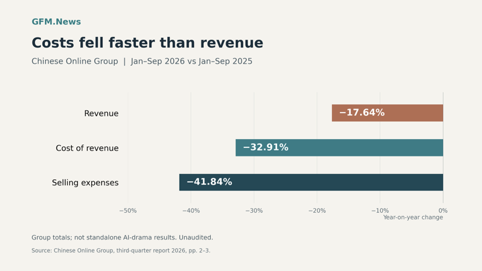 (Image caption) ChineseAll's revenue, operating costs, and sales expenses for the first three quarters of 2026 decreased by 17.64%, 32.91%, and 41.84% year-on-year, respectively. The data is taken from the company's unaudited third-quarter report and represents the overall performance of the group, not the separate operating results of AI short dramas. (Graphic by GFM.News)
Regulatory requirements have been incorporated into the broadcasting and promotion process.
China’s “Measures for Identifying Artificial Intelligence-Generated Synthetic Content,” released in 2025 and implemented on September 1 of the same year, establishes explicit identification requirements that can be perceived by users, as well as implicit identification requirements written into file data.
The "Administrative Measures for the Development of Micro-Dramas" were subsequently reviewed and approved on July 27, 2026. The State Administration of Radio and Television issued an order on July 30, published it on the official website on July 31, and it came into effect on September 1. The measures stipulate different filing, licensing, or platform review requirements based on investment amount and subject matter, and standardize AI content identification, algorithm recommendation, fee notification, and promotion information.
For businesses, both the main product and promotional materials need to be subject to compliance management. Discovering insufficient authorization or problems with the distribution materials only after the work is completed may lead to rework, suspension of promotion, and delayed revenue. All of these should be included in the cost and risk assessment when the project is initiated.
On November 6, the State Administration of Radio and Television announced a new round of special governance against the "vulgarization and homogenization" of micro-dramas, with a period from November 1 to the end of December. The focus includes issues such as "face theft," "voice theft," repeated broadcasts of the same drama with different titles or lead actors' names, and homogenization of content recommended on homepages and featured lists. The announcement also stated that a total of 75,000 illegal micro-dramas were removed that year, an increase from the 68,000 disclosed at the September press conference.
Supporting live-action dramas does not equate to prohibiting AI-generated content, but the policy reminds companies that low-cost mass production does not guarantee continued support and recommendations. Companies also need to demonstrate that the increased supply complies with content, rights, and consumer protection requirements.
On the other hand, compliance costs should also have predictable boundaries. The clearer the classification standards, review requirements, reasons for removal, and appeal procedures are, the better small and medium-sized production teams can estimate their investment in advance and reduce operating costs incurred due to unclear rules.
Investment should follow returns, not production.
Businesses can start by improving their accounting practices. For each project or batch of projects, costs for production, copyright, AI tools, manual rework, localization, and deployment should be recorded. These costs should then be reconciled with the platform's settlement and actual receipt of funds. This will prevent the double counting of fees already deducted by the platform and avoid treating outstanding payments as readily available cash.
Companies that need to manage their own distribution can separate small-scale testing from full-scale release, pre-setting budgets, conditions for additional funding, and stop-loss criteria. The criteria should include subsequent views, paid or ad contributions, refunds, and complaints, not just click-through rates. For works suitable for revenue sharing, verifiable subsequent revenue streams can be designed for creators in addition to fixed compensation, ensuring that continued investment in quality is rewarded accordingly.
Investors need to differentiate the value sources of different businesses. Production service companies rely on delivery quality, efficiency, and customer relationships; copyright companies rely more on the duration of rights and continued licensing; audience-facing platforms must demonstrate retention, monetization, and user management capabilities; and AI tool companies have different product cost and revenue structures. A company can have multiple businesses, but using AI itself cannot be a reason to value all revenue as a software platform.
How much revenue older content can generate after paid promotion stops is one indicator of continued demand, but it shouldn't be the sole criterion. Profitable paid customer acquisition can also support sustainable operations. A more comprehensive question is: can new advertising generate sufficient returns within a reasonable period? Is the content portfolio overly reliant on a few hit products? And can the company continue operating after major platforms adjust their purchasing, revenue-sharing, or recommendation methods?
These questions require answers based on results from multiple quarters and different batches. A single blockbuster hit can prove there is demand for certain content, and cutting spending for a period can improve cash flow, but stable profitability requires companies to repeatedly demonstrate it through continuous production and distribution.
What will sustain your investment in your next project?
AI has lowered the barrier to entry for short drama production, allowing more teams to explore themes and expressions that were previously unaffordable. This openness is valuable, but whether the industry can develop in the long term depends on whether the new opportunities can be converted into reasonable returns, enabling companies to bear the uncertainty of future creations.
GFM.News believes that the next stage of companies with sustainable competitiveness will be those that can simultaneously manage creation, rights, distribution, and revenue generation, and demonstrate their business success through multiple batches of works. Lowering production costs will only become a long-term advantage if companies retain sufficient profits to reinvest.
Profits don't automatically go to whoever uses AI. They depend on whether the work offered by the company is worth choosing, whether the rights held can be sustainably managed, and whether the contract can translate that value into actual revenue.
For production companies, the most practical test is whether the money recouped from one production can support the next worthwhile project. For screenwriters, actors, and the behind-the-scenes team, it's whether their professional and life experience will allow them to continue receiving reasonable compensation. The next round of competition in Chinese micro-dramas will ultimately hinge on this kind of management capability: ensuring that those who are dedicated to creating content have the means to continue doing so.
Disclaimer
This article is based on publicly available documents, company disclosures, research, and media materials, and is for informational purposes only. It does not constitute investment, legal, or tax advice. Relevant data and rules may be updated, and readers should verify the original sources and make their own judgments.