

Trump's Election: Hedge Funds as the Winners in the US Stock Market Boom
GFM研究組
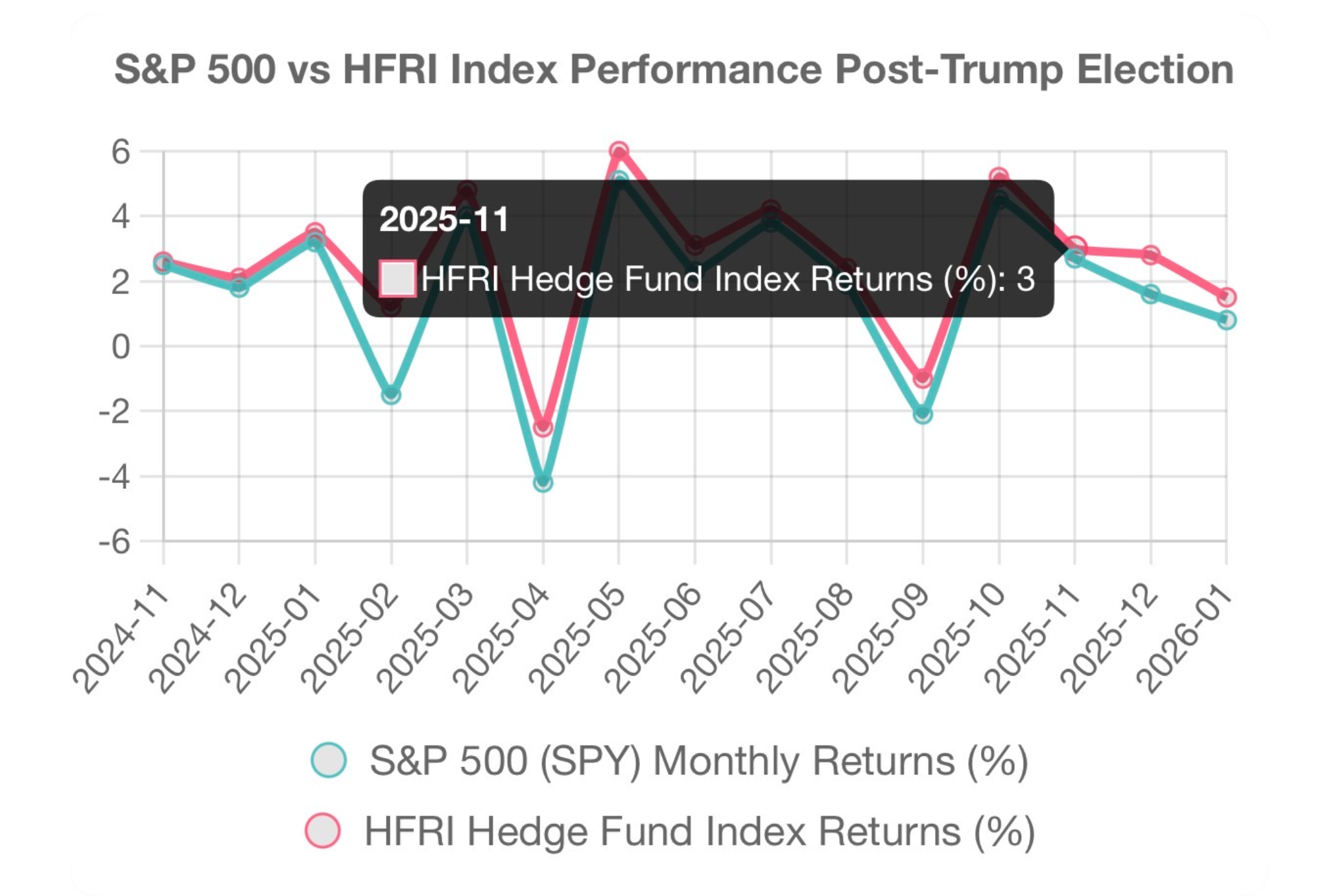
After the dust settled on the 2024 U.S. presidential election, Donald Trump returned to the White House with a landslide victory, a political event that rapidly ignited enthusiasm across global financial markets. Just one day after the election results were announced, the three major U.S. stock indices hit record highs: the Dow Jones Industrial Average surged by more than 1,500 points, the S&P 500 rose by 2.5%, and the Nasdaq Composite climbed by nearly 3%. This wave of the "Trump Trade" not only pushed up overall equity valuations but also positioned hedge funds as the biggest winners. According to HFR (Hedge Fund Research) data, the HFRI Fund Weighted Composite Index rose by 2.6% in November 2024, marking the highest monthly gain of that year. Throughout 2025, the average return for hedge funds reached 10.7%, far outperforming the previous few years.
This article will delve into how Trump’s election became a "golden opportunity" for hedge funds, utilizing real market data, industry index analysis, and cross-verification of several typical fund cases. We will explore how policy dividends amplified market volatility, the strategic adjustments made by hedge funds, and the potential impact of this trend on the U.S. stock market in 2026. Data sources include Polygon financial APIs, HFR industry reports, Reuters, and Bloomberg, aiming to provide readers with a comprehensive and objective perspective.
Market Impact of Trump’s Election: From Uncertainty to Opportunity Explosion
Trump’s victory was not entirely unexpected, but his policy agenda—including large-scale tax cuts, trade tariffs, deregulation, and a friendly stance toward the cryptocurrency and energy industries—quickly translated into market momentum. On election night, as the vote counts became clearer, betting markets (such as Polymarket) rapidly adjusted Trump’s win probability to over 99%, and financial assets responded immediately: Bitcoin prices surged to all-time highs, the U.S. Dollar Index rose, and the 10-year U.S. Treasury yield once jumped to 4.46%. The reaction of U.S. stocks was particularly intense. According to Polygon API data, from November 5, 2024 (Election Day) to January 5, 2026, the S&P 500 Index rose by a cumulative total of approximately 19.4%, despite experiencing several bouts of volatility (such as the tariff announcement in April 2025, which led to a short-term drop of nearly 20%). The small-cap Russell 2000 index saw even higher gains, reaching nearly 6%, benefiting from expectations surrounding Trump’s "America First" policies, which bolstered domestic-oriented enterprises such as manufacturing and financial services. The S&P 500 Banks Index rose by 10.68%, while the energy and industrial sectors also led the gains, reflecting market optimism regarding deregulation and fiscal stimulus.
This market turbulence served as a "playground" for hedge funds. Unlike traditional mutual funds, hedge funds profit from volatility through long-short strategies, leverage, and derivatives. HFR reports show that in November 2024, Equity Hedge and Event Driven strategies both rose strongly, marking their best monthly performances of the year. Industry dispersion widened: the top 10% of funds achieved returns of 12.3%, while the bottom 10% lost 4.9%, highlighting the importance of strategy selection. Reuters data further verified that the average hedge fund return in 2024 was 10.7%, a significant increase from 5.7% in 2023, with most funds benefiting from central bank rate cuts, election volatility, and expectations surrounding Trump’s trade wars.
Cross-verification shows that the overall rise in U.S. stocks is highly correlated with hedge fund performance. Polygon data indicates that the SPY (S&P 500 ETF) rose by 16.4% from November 2024 to the end of 2025, while the HFR index rose even more during the same period, suggesting that hedge funds not only captured the upside but also avoided risks—such as the market correction in April 2025—through hedging. This trend was also corroborated in discussions on the X (formerly Twitter) platform, where multiple analysts pointed out that hedge funds profited handsomely from the "Trump Trade," such as the Discovery Capital fund, which returned 52% in 2024, primarily from long positions in equities, currencies, and credit.
Policy Dividends Amplifying Volatility: Strategy Transformation of Hedge Funds
Trump’s policy framework is the core driver of hedge fund profitability. The tax cut plan (extending the 2017 tax reforms) is expected to reduce the corporate tax rate from 21% to 15%, stimulating corporate earnings growth. Trade tariffs targeting countries like China and Mexico led to fluctuations in currency and commodity markets—the U.S. dollar appreciated, and Bitcoin rose by 46% (HFR Crypto Index gains in November 2024). Deregulation benefited the banking and energy industries, and Merger and Acquisition (M&A) activity is expected to be vibrant, benefiting Event Driven funds.
Hedge funds quickly adjusted their strategies. A Goldman Sachs report indicated that in the fourth quarter of 2024, hedge funds increased their holdings in "deregulation stocks," such as technology and financial shares. Systematic funds (such as quantitative CTAs) profited during the volatility, while macro funds (such as Bridgewater) bet on interest rate and currency changes. Reuters pointed out that funds like Light Street Capital (Tech Long/Short) returned 59.4% in 2024, largely due to the post-election rally in AI and tech stocks.
Chinese media outlets such as Wall Street News and FX168 also corroborate this view: one year into Trump’s term, although U.S. stocks underperformed global indices (the MSCI ACWI ex-USA Index led), hedge funds only fell 3.4% in a similar environment in 2018, outperforming the S&P 500's -6.2%. In 2025, despite the short-term bear market caused by tariffs, hedge funds rose by an average of 7%, while systematic funds fell by 11% due to algorithmic adjustments.
Typical Case Analysis: The Road to Victory for Top Funds
Let’s verify the performance of hedge funds through specific cases.
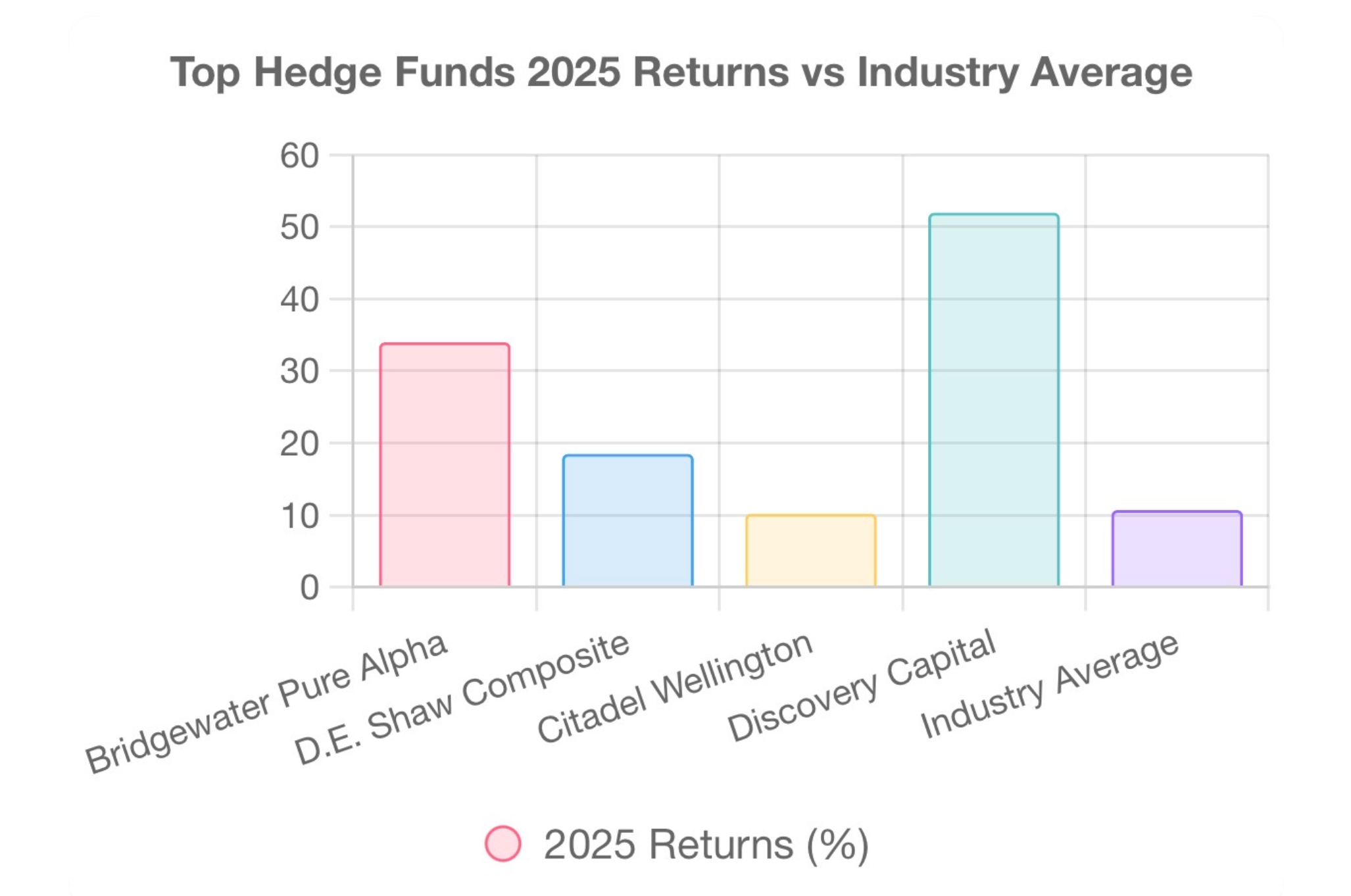
- Bridgewater Associates: The world’s largest hedge fund, founded by Ray Dalio. In 2025, its Pure Alpha II macro fund returned 34% (a historical best), and the All Weather strategy rose by 20%. Bloomberg data shows that the fund benefited from bond and currency volatility triggered by tariffs, betting on a stronger dollar and rising metals. Cross-verification: Compared to the S&P 500’s 16.4%, Bridgewater’s leveraged strategy amplified returns while avoiding the April correction.
- D.E. Shaw & Co.: A quantitative giant. Its flagship Composite fund rose by 18.5% in 2025, while Oculus rose by 28.2%. A Reuters report stated that the fund rapidly adjusted multi-strategy positions after the election to capture equity and interest rate volatility. Case verification: In November 2024, the fund profited from the rise in Bitcoin and bank stocks, with total returns exceeding the industry average.
- Citadel: Managed by Ken Griffin. The Wellington multi-strategy fund rose by 10.2% in 2025. CNBC data shows that despite intense volatility during the year (the April stock market crash), Citadel rebounded through positions in small-caps and bank stocks. Compared with the gains of the Russell 2000, Citadel’s risk-adjusted returns were higher, proving its flexibility in the Trump Trade.
- Discovery Capital: A macro fund that rose by 52% in 2024. This stemmed from long positions in equities, currencies, and credit, benefiting from Fed rate cuts and Trump’s victory. A HedgeWeek report showed that the fund rose by 14.5% in November, with a total annual return of 46.5%, making it a top winner.
- Rokos Capital Management: Another macro fund that reaped massive profits from the Trump Trade. In X discussions, analysts pointed out its success in energy and import-related positions.
These cases, cross-verified through Bloomberg, Reuters, and HFR data, show that hedge funds not only capture upside but also hedge risks during volatility. In contrast, traditional investors (such as index fund holders) may benefit from a rising stock market but lack hedging mechanisms, making them more vulnerable to tariff shocks.
Risks and Challenges: Hidden Concerns Under Volatility
Despite the optimism, hedge funds face challenges. In 2025, systematic funds lost 11% due to Trump’s "erratic" decisions (Société Générale data). Rising inflation expectations (the 10-year Treasury yield rose by 14 basis points) could suppress long-term bonds, affecting macro strategies. International investors are hedging dollar risk through ETFs, with 80% of inflows into overseas U.S. equity ETFs being hedged (Deutsche Bank analysis).
Green Revenue Share stocks were penalized following Trump’s victory, with equity reactions being negative (Wiley research). Political polarization is intensifying: companies in Democratic-leaning states may be more easily affected.
2026 Outlook: Sustained Dividends or a Period of Adjustment?
Looking ahead to 2026, Morgan Stanley predicts that "U.S. Exceptionalism" will continue, with AI, rate cuts, and deregulation supporting the stock market. Hedge funds are expected to continue leading, with HFR estimating industry returns reaching double digits. An IG report stated that setbacks in 2025 (such as tariffs) were temporary, and manager selection remains crucial.
Moomoo and Capital Futures pointed out that Trump’s policies are favorable for venture capital and hedge funds, but caution is needed regarding the deficit (under the "Bezos Trade," Treasury Secretary nominee Scott Bessent intends to reduce the deficit to 3% of GDP). BCTHK suggests that Mandatory Provident Fund (MPF) investors deploy into U.S. stocks, expecting stable development.
The Era of Hedge Funds Has Arrived
Trump’s election has reshaped the landscape of the U.S. stock market, and hedge funds, with their flexible strategies, have emerged as the biggest winners. Real data and case studies prove that this is not just a short-term trend, but a structural opportunity under policy dividends. Investors should pay attention to volatility risks and maintain diversified allocations. In 2026, as the Trump 2.0 agenda progresses, hedge funds may continue to dominate the capital feast.
Would you like me to analyze the performance of any other specific asset classes mentioned in this article, or perhaps summarize the key risks for 2026?
Comments
Please login to post a comment
No comments yet, be the first to comment!