

If peace cannot be written into the balance sheet, how does the world measure its economic value?
By Sun Xiaoming
Editor's Note
The economic losses caused by war can often be calculated through destroyed assets, increased military spending, decreased trade, and rising financing costs; however, the long-term value created by peace is rarely included in the measurement systems of national balance sheets and public policies. In fact, investment confidence, institutional credibility, educational continuity, population stability, and social cooperation are all built upon the predictable environment provided by peace.
The 2026 UN High-Level Political Forum was held with less than four years remaining until the 2030 Agenda for Sustainable Development. The participation of the World Peace Association delegation in this forum once again brought the discussion of how peace can be integrated into development, finance, and institutional building to the forefront.
The publication of this article by GFM not only documents the participation of an international conference and NGOs, but also aims to explore the following questions: Can peace generate measurable public returns? How can peace initiatives be incorporated into budgets, contracts, and governance mechanisms? How can pronouncements on the international stage be transformed into verifiable and replicable institutional achievements? These are both long-term challenges that the World Peace Association needs to address and common questions that the global governance system must answer.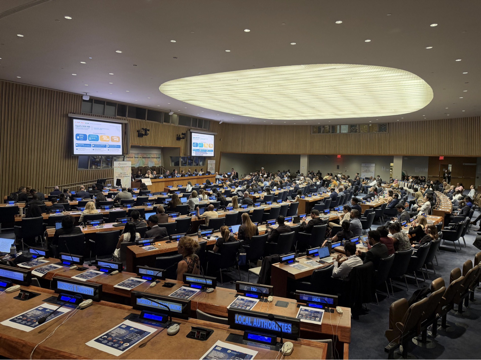
(Image caption) The 2026 United Nations High-Level Political Forum will be held at the United Nations Headquarters in New York. Representatives from governments, UN agencies, international organizations, and civil society will gather to discuss pathways to advance the 2030 Agenda for Sustainable Development.
How is the Economic Value of Peace Visible?Economics can calculate the losses caused by a war: destroyed buildings, shut-down factories, declining trade, and increased military spending. The benefits of peace, however, are rarely calculated with the same precision—the investment confidence, institutional credibility, educational achievements, and demographic stability accumulated by a society through long-term stability rarely appear fully on any national balance sheet.
This discrepancy is being re-examined. According to the 2026 Global Peace Index released by the Institute for Peace and Economics in June of this year, the economic impact of global violence last year reached $21.81 trillion, equivalent to 10.5% of global GDP, the highest proportion since the index was established in 2007.
This is not an abstract moral figure, but a financial indicator that can be discussed alongside military spending, trade losses, and sovereign credit ratings—it means that simply maintaining the world at its current level of conflict is equivalent to burning one-tenth of global output every year.From July 7 to 15, 2026, the United Nations High-Level Political Forum was held at the United Nations Headquarters in New York. This is a core platform hosted by the United Nations Economic and Social Council to review the progress of the 2030 Agenda for Sustainable Development. With less than four years until 2030, this forum focused on five objectives: clean water and sanitation, affordable clean energy, industrial and infrastructure innovation, sustainable cities and communities, and global partnerships—these five issues together constitute the underlying conditions for modern economic operation. Water resources, energy, and infrastructure determine whether industries can survive and move; urban governance determines whether public services can withstand growth pressures; and global partnerships determine whether financing and institutional experience can reach those who need them most. The World Peace Association delegation was invited to attend this forum. Executive Vice President Xie Huiling and Secretary-General Liu Junming exchanged views with representatives from various countries, UN officials, and civil society leaders on topics such as peace, sustainable development, and cross-cultural cooperation. This participation is worth recording not only because an organization was present at the New York conference, but because it brought back a question long considered a moral issue to the economic and institutional framework of discussion: When the world still cannot accurately calculate the economic value of peace, has humanity therefore underestimated all the wealth that peace underpins?
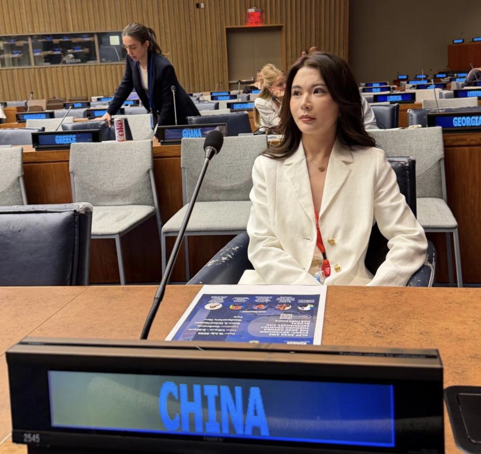
(Image caption) Xie Huiling, Executive Vice President, represented WPI at the HLPF Forum.
Peace as a Public Asset Not Yet Fully PricedFrom a financial and institutional perspective, peace is a public asset of enormous scale that has long lacked a pricing mechanism. Only when a country remains stable are businesses willing to invest over ten, twenty, or even longer periods; banks willing to provide housing and industrial loans; insurance companies able to cover commercial risks at affordable prices; and international capital willing to hold that country's currency and bonds. Peace reduces transaction costs, extends investment cycles, and makes laws and contracts predictable—conditions rarely appear on financial statements, yet they determine whether almost all financial statements are valid.
At the moment conflict erupts, the market will very honestly price the disappearance of peace: sovereign credit ratings are downgraded, financing costs rise, currencies depreciate, capital outflows occur, insurance rates increase, and talent and families begin to leave. This year's Global Peace Index also cited a specific example—if a renewed war with Iran could be prevented through diplomatic means, the estimated value to the global economy would be approximately $2.2 trillion. This figure itself is a form of pricing: the market is already using capital flows, risk premiums, and insurance costs to price the gap between peace and conflict; however, this pricing mechanism is currently scattered across various financial markets and has not been integrated into a language that can be directly used in public policy.
The losses caused by war go far beyond the tangible assets destroyed in the present. The lost educational time for children, the abandoned long-term investments by businesses, the loss of scientific talent, and the collapse of urban credit will continue for decades, difficult to quantify all at once, yet continuously lowering a nation's ability to create wealth. From this perspective, peace is not an adornment after development is complete, but a prerequisite for all long-term development. How Development Deficits and Security Deficits Amplify Each Other
During her exchange at the forum, Xie Huiling mentioned that in the current international environment, development deficits and security deficits are intertwined. Any grand development blueprint is difficult to truly implement once a stable social and security environment is lost. This judgment is supported by a clear economic logic—poverty, unemployment, and unequal resource distribution can exacerbate social conflicts, which in turn destroy industrial and fiscal capacity, further worsening poverty. When this cycle forms, humanitarian aid alone cannot solve the fundamental problems, and commercial investment alone cannot withstand the highly uncertain risks.
This is also why seemingly pure development issues such as water, energy, land, and housing also possess peaceful attributes. A water conservancy project may improve water supply, but it may also cause community conflicts due to unequal distribution of benefits; an energy project may create growth, but it may also create new conflicts due to disputes over land acquisition and profit distribution. The institutional requirements for sustainable development are shifting from whether projects are completed to whether benefits are fair, information is transparent, and communities participate. This means that peacebuilding cannot wait until conflict occurs before intervention occurs, but needs to be integrated into the decision-making process of urban planning, industrial investment, and infrastructure financing in advance—this is precisely why this forum has placed the agendas of peace and sustainable development on the same table for discussion.
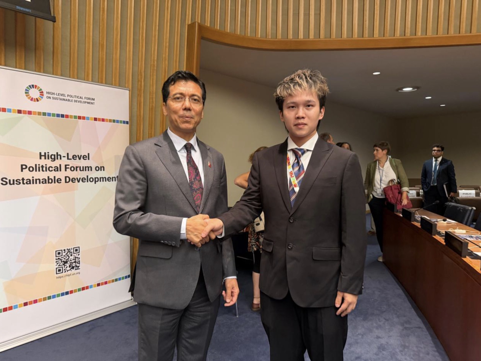
(Image caption) Secretary-General Liu Junming and UN Economic Council President Locke Bahadur Thapa pose for a photo.
People-to-people diplomacy preserves a scarce form of social trust.During the forum, UN Economic and Social Council President Roque Bahadur Thapa emphasized in relevant sessions that, facing multiple crises intertwined by climate change, regional conflicts, and uneven development, the international community needs to re-strengthen multilateralism and global partnerships. Canadian Permanent Representative to the UN and Vice-President of the Economic and Social Council, Bob Ray, pointed out in several sessions that policy continuity and broad participation of civil society organizations are crucial conditions for overcoming global development bottlenecks. These assessments by these two officials outline a fundamental consensus of this forum—intergovernmental cooperation is facing increasing pressure, and the importance of coordination at the civil society level is rising accordingly. In several exchanges, Liu Junming introduced the World Peace Association's recent practices in promoting regional mutual trust, cross-cultural youth exchange, and ecological peace initiatives. He stated that the association hopes to consolidate the grassroots foundation needed for sustainable development through pragmatic social cooperation. In a time of declining political trust among major powers, the value of such exchanges needs to be accurately understood—government diplomacy deals with sovereignty and national interests and is constrained by formal positions; cooperation between civil society organizations, schools, and professional institutions can preserve space for communication in areas such as youth education, public health, and cultural exchange. This cannot replace state diplomacy, nor should it be exaggerated as an independent solution to international conflicts, but it can accumulate a scarce social credit—allowing people from different countries to retain the possibility of understanding each other and cooperating to address common problems even when formal political relations deteriorate.
It should be noted that the positive evaluation of civil society organizations' participation in multilateral cooperation by UN officials during the forum refers to the role of civil society as a whole within the forum mechanism, and is not a special certification or institutional endorsement of the World Peace Association by the United Nations.The association's involvement this time establishes an opportunity for contact, not a certificate of qualification.
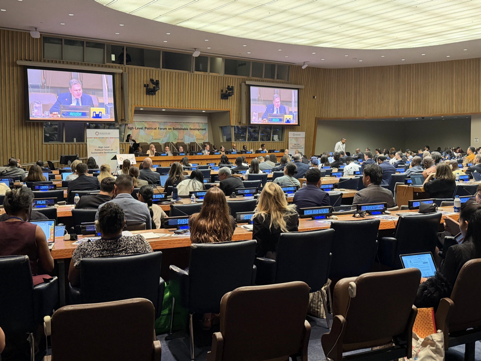
(Image description) HLPF venue.
The work only begins after the meeting
Participating in high-level political forums at the United Nations provides NGOs with opportunities to access global agendas and transnational cooperation networks, but the meeting itself does not automatically create institutional influence. The long-term value of the World Peace Association's participation in this conference will depend on its ability to translate peace ideals into cooperative projects with clear objectives, funding sources, governance structures, and evaluation standards—whether youth peace education can establish transnational courses and long-term exchange mechanisms, whether eco-peace initiatives can be incorporated into water resource and community governance projects, and whether humanitarian actions can establish transparent funding management and results disclosure systems. Peace initiatives can only become sustainable public capabilities, rather than being one-off exchanges confined to the conference hall, when they are included in budgets, contracts, and evaluation reports.
This is also the standard that institutional media should maintain when observing any international organization or non-governmental organization: speeches at meetings present an organization's values, while projects resulting from the meetings demonstrate its implementation capabilities; the number of high-level interactions demonstrates the scope of participation, and the number of verifiable changes brought to a certain number of people constitutes true international influence.Peace Needs Its Own Financial Language
The global sustainable development agenda has long faced a real dilemma—the work with the most public value is often the most difficult to secure stable funding. Road and power plant projects have clear assets and cash flow, making them relatively easy to obtain commercial financing; however, the benefits of peace education, community trust, and conflict prevention are dispersed throughout society and are difficult for a single institution to recover. This makes peacebuilding reliant on government funding and short-term public welfare projects, and also causes many valuable actions to be interrupted when funding cycles end. The real change lies not in simply commodifying peace, but in establishing methods to measure its public returns—how much can conflict prevention reduce public safety and relief spending, how much can youth exchanges enhance cross-cultural understanding, and whether inclusive community projects can reduce violence and population loss. The Global Peace Index has already demonstrated that the economic cost of violence can be calculated to trillions of dollars; the positive value of peace should be measured with the same rigor. When these achievements can be seen through data and long-term tracking, peace projects can obtain more stable public budgets, philanthropic capital, and corporate social responsibility funding—this may be a crucial step in moving peace from a moral vision to an institutional capability, and it is the most valuable lesson this forum has left for all participating organizations, including the World Peace Association.
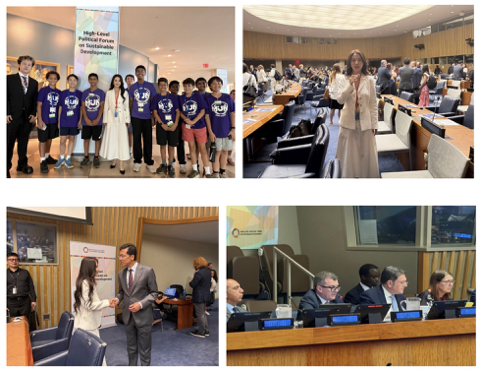
(Image caption) Executive Vice Chairperson Xie Huiling attended the meeting, posed for a group photo with the youth delegation, gave an interview, and posed for a photo with the Chairman of the Economic Council.
The value of peace lies in the institutional confidence in cooperation.This year's UN High-Level Political Forum reflects more than just whether the 17 Sustainable Development Goals can be achieved by 2030. It is testing whether the existing global governance system still has the capacity to coordinate governments, international organizations, businesses, and civil society to address problems that no single country can solve alone. The world is highly interconnected economically and technologically, yet continues to be divided politically and socially—therefore, peace cannot be understood merely as the result of diplomatic negotiations; it is also an institutional condition for the sustainability of global supply chains, international investment, and public finances.
During the forum, Xie Huiling stated that peace is the cornerstone of sustainable development and a common aspiration of humanity. Standing on the global stage to discuss the future with all parties is an honor, but even more so, a responsibility. This statement itself requires institutional support—understanding requires education, cooperation requires platforms, projects require funding, funding requires governance, and all commitments must ultimately withstand the test of time and facts. The World Peace Association's attendance at the UN High-Level Political Forum is a concrete example of its participation in the global peace agenda. The questions it needs to answer in the future include not only how to make its voice heard on the international stage, but also how to transform that voice into institutional achievements that can be seen by the public and replicated.
The value of peace lies in cities that haven't been bombed, in education that hasn't been interrupted, in the long-term investments that businesses dare to make, and in the institutional confidence that different societies are still willing to cooperate. It exists quietly in ordinary times, only revealing its high price when a crisis strikes. A mature global governance system cannot only tally losses after war breaks out; it should also invest sufficient resources to maintain it while peace still exists. A responsible media should not only record meetings and speeches, but should also inquire into how a commitment will be implemented and what changes an international conference ultimately brings to the lives of ordinary people. This is precisely what GFM understands the significance of institutional media, and it is also the question this report attempts to answer.
Comments
Please login to post a comment
No comments yet, be the first to comment!