

National Flag and Cross: The Weight of Freedom
Kevin Guo
SY Puts the Stars in My Hands
On the morning of July 11, 2026, I attended Love Local Serve Day at Saddleback Church in Orange County, California.
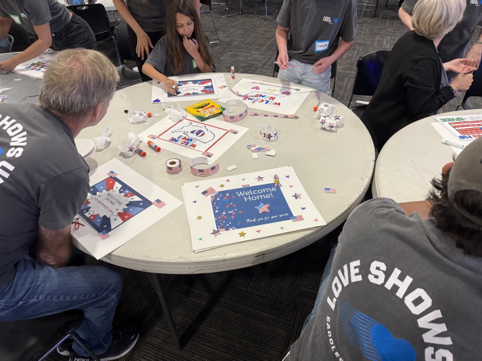
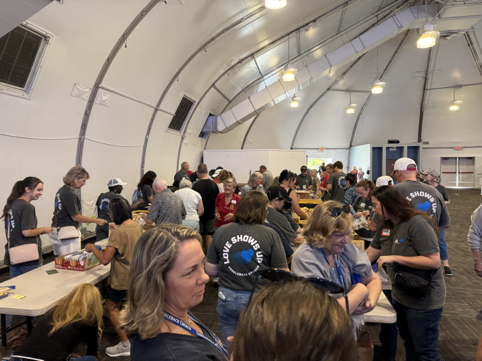
Tables were set up under the tents outside the church. Volunteers were organizing supplies, packing food and daily necessities into bags, ready to deliver them to soldiers about to be deployed; children were drawing at the tables, writing "Thank You" and "You Are Our Hero" in crooked handwriting on the paper. The elderly, young people, parents, and children, all wearing the same gray volunteer shirts, were quietly busy in different work areas.
There were quite a few people, but it wasn't noisy. At each table, someone was working, packing bags of supplies into boxes, waiting to be delivered to the soldiers who were about to leave their families to perform missions in different regions.
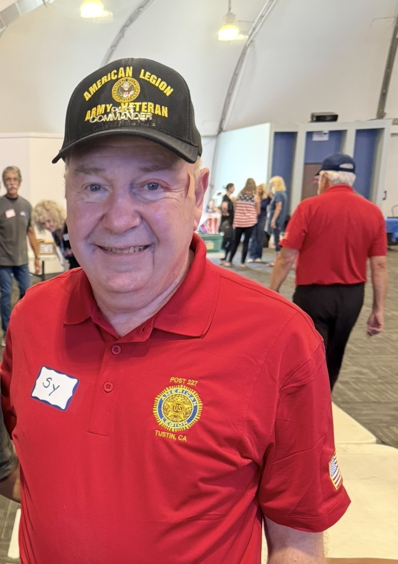
I noticed an elderly man wearing a red shirt.
His hat was embroidered with "American Legion," along with "Army Veteran" and "Commander." A simple name tag on his chest read "SY." His red shirt bore the insignia of American Legion Post 227, and a small American flag was sewn onto the cuff.I went over to talk to him.
SY was a U.S. Army veteran. He spoke slowly and calmly, with a constant smile on his face. I told him I was from Hong Kong and had lived in the United States for two years. He listened attentively, showing no impatience despite my less-than-fluent English.
As the conversation drew to a close, he reached into his pocket and took out his wallet.
It was an everyday wallet. SY opened it, carefully took out a card, and handed it to me.
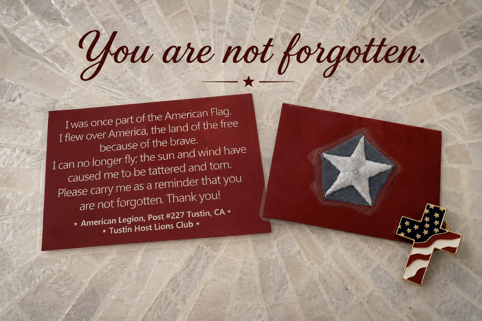
The card contained a white five-pointed star. It wasn't a factory-made souvenir, nor a decoration specially produced for an event; it was a star truly cut from an American flag. That flag, having flown for years, endured sun, rain, and time, was worn and faded, no longer fit for display.
According to American flag etiquette, flags no longer suitable for display should be retired with solemnity and dignity. Many veterans' organizations hold formal ceremonies for this, including the traditional burning ceremony. Some retired flags have their stars pre-cut, placed in commemorative cards, and given to active-duty service members, veterans, military families, and anyone wishing to express respect and well wishes.
SY handed me the one she treasured in her wallet.
I looked down at the star in my hand, speechless for a moment.
It was just a small piece of white cloth, with frayed edges, without any luster or decoration. But when it was taken from the wallet of a U.S. Army veteran and handed to a Hong Kong immigrant who had been in the U.S. for two years, I felt a weight completely disproportionate to its size.
The front of the commemorative card reads:
You are not forgotten.
You have never been forgotten.
The text on the card roughly translates to:
I was once part of the American flag.
I once flew over America. This land of freedom exists because brave people once protected it.
Now, sun and rain have worn me down and damaged me; I can no longer fly.
Please keep me with you, so I can remind you: your dedication has never been forgotten.
The commemorative card is printed with the names of the American Legion, Tustin Chapter 227, and the Tustin Host Lions Club. It preserves clearly more than just a fragment of a retired national flag; it holds memories of those who once donned their uniforms, left their families, and risked their lives.
Reading this, I'm reminded of a widely circulated saying in America:
Freedom is not free.
I've read this phrase many times in the news, history books, and in books, and I know it's often used to commemorate soldiers and those who died in war.
However, when it's placed alongside a star actually cut from a retired national flag, and then personally handed to me by a veteran from his own wallet, it transcends just a widely circulated proverb.
It takes on a human face, the warmth of a palm, and the weight of history.
A Flag That Has Completed Its Mission
A worn-out flag, in many places, might just be an object that has lost its value. In the United States, it cannot be discarded casually.
When a flag is damaged to the point of being unsuitable for display, people respectfully allow it to complete its final retirement. Some flags are used in formal ceremonies, while some stars are preserved, continuing to carry the memories that the flag once represented.
I don't know where this star in my hand once hung.
It may have come from a military camp, a school, a government agency, or the flagpole in front of an ordinary family's house. It may have witnessed the salutes at the morning flag-raising ceremony, the crowds passing by on holidays, and the silence when the flag was lowered to half-mast.
It was once one of fifty stars, sewn onto the same blue cloth, forming a symbol of a nation along with the other stars.
Now, it's no longer in its original place, but it hasn't been treated as a useless piece of trash.Someone kept it.
Later, an old man who had served for many years put it in his wallet and carried it with him. Until that Saturday morning, he opened his wallet and gave it to someone who had just started a new life in this country.
I didn't ask how long the card had been in his wallet.
But it was this detail that gave it a different meaning from a souvenir handed out at an event. SY didn't pick up a card from the table and hand it to me; instead, he took out his wallet from his pocket and then took it out of the wallet.
What a person keeps in their wallet is usually something they need to use frequently or something they want to keep close to their body.
That star once belonged to a national flag, and later was kept by a veteran. Now, he gave it to me.
The flag needs someone to guard it
As the founder of an institutional media outlet, I have long been concerned with how a country's institutions are established, how laws operate, how power is constrained, and how individual rights are protected.
To understand why the American system has been able to operate for so long, one cannot simply look for answers in constitutional provisions and court rulings.
Any system, once separated from specific individuals, may only remain as arrangements on paper. The continuation of freedom in the United States relies on the Constitution defining the boundaries of power and rights, and also on generations of people being willing to assume responsibility in their respective positions.
Soldiers guard the country in danger, judges make rulings without pressure, journalists question how power is used, and citizens participate in elections and public life. In communities and families, this guardianship becomes people's respect for rules and the education of the next generation.
These people, distributed across different positions within state institutions and civil society, collectively uphold the responsibility and trust necessary for the system to function.The national flag itself cannot protect freedom.
What truly ensures the continuation of freedom are those willing to stand under its banner and shoulder responsibility.
A soldier donning a uniform signifies a willingness to obey orders, distance himself from family, and even risk his life when necessary. A veteran returning to his community will remind the next generation of his experiences: freedom is not innate, nor will it be lost simply because people possess it.
SY sitting in a church tent, handing a star from a national flag to a stranger, seems like a small act.
However, the values a nation cherishes are affirmed time and again, and passed down from generation to generation, precisely in these actions that are not written into law. You have never been forgotten.
The most important sentence on the commemorative card isn't a description of how the national flag was decommissioned, but rather the simple statement:
You are not forgotten.
When a person serves in the military, they wear a uniform and belong to an organized and disciplined group. After retirement, the uniform is put away, rank becomes a thing of the past, and the original order of life changes accordingly.
Some return home with injuries and illnesses, some lose...Some veterans, even years later, are still affected by war memories and psychological trauma.
A single star certainly cannot replace the healthcare, housing, and employment security of veterans; these responsibilities still require public policy and long-term services. But systems cannot address all of a person's feelings.
When a veteran is told, "You have never been forgotten," what is being affirmed is not just his service record, but also his dignity and the understanding he deserves even after retirement.
When these words are personally conveyed by a veteran like SY, they carry a sentiment that only those who have truly left their families, worn the uniform, and experienced military life can fully understand.
I am not a soldier, nor have I served in the United States.
SY gave me this star probably not because of anything I did for this country. He simply heard where I came from, knew I was starting a new life here, and entrusted me with a cherished memory. When I received it, "You have never been forgotten" took on another, very personal meaning.
It was as if it were saying to someone who had crossed the ocean and was settling back into life in a foreign land: You have also been seen by this community.
Acceptance from a community sometimes doesn't require lengthy ceremonies or grand pronouncements.
It can be accomplished by an elderly person, through a single star.
Why Americans Cherish the National Flag
After living in the United States, I often see the national flag.
It hangs in front of schools, courthouses, fire stations, and government agencies, and also appears on community lawns and the porches of ordinary homes. On Independence Day, Memorial Day, or Veterans Day, there are many more national flags on the streets.
Outsiders sometimes simply interpret these sights as patriotic fervor. Only after truly immersing themselves in the daily lives of Americans do they gradually understand that many people's feelings for the national flag are closely linked to their family history.
Some people see the national flag and think of their fathers or grandfathers who served in the military.
Some people think of friends who never returned from the battlefield.
Some people think of how their grandparents first arrived in America and how they rebuilt their families in unfamiliar land.
Some people also thought about the rights granted to them by the Constitution, and the possibility of choosing their beliefs, expressing their opinions, starting businesses, and beginning anew under the protection of the law.The same national flag holds different memories in different people's hearts.
What people cherish is the life experiences carried by this red, white, and blue cloth, the price paid for war, and the identification of generations with the national system and their shared life.
This feeling doesn't necessarily have to be expressed aloud every day. It might be a natural removal of a hat during a flag-raising ceremony, a national flag being slowly folded at a soldier's funeral, or an old soldier opening his wallet and handing a star to a stranger.
A Star and a Cross
SY gave me a commemorative card containing the stars of the national flag.
During the day's activities, another volunteer gave me a cross. The cross featured the American flag design, with red, white, and blue accents incorporated into its shape.
These two gifts originally came from different people and were given to me at different times.
Later, I placed the commemorative card with the white star next to the cross with the American flag design and took a photo.
In the photo, one side shows the star from the retired flag, and the other side shows the cross with the American flag design.
They weren't deliberately arranged together at the event; they were two gifts that arrived in my hands on that day. I placed them together because I saw a resonant relationship between them.
The cross reminds me of love, sacrifice, and redemption.
The star from the retired flag reminds me of the enduring protection behind freedom, and how the system is maintained by generations of people with their lives, responsibilities, and daily actions.
Faith and the system are not the same thing. The cross belongs to faith, and the national flag belongs to a nation's public memory. But when they meet in that photograph, I don't see a simple juxtaposition of religion and nation, nor any grand political slogans.
What I think about is what people are willing to bear for the values they believe in.
Christian faith tells us that love cannot remain merely in words. True love requires giving, entering into the suffering of others, and being there for them when they need it.
The institutions of a free society also cannot remain merely in the constitution and laws. Institutions need people to abide by them, to guard them, and to be willing to continue caring for those who have taken risks for the community beyond national regulations.
The volunteer's uniform bears the following message:
Love Shows Up.
Love will be there.
Love can only be truly felt when it enters people's lives. That day, it was a bag of supplies to be sent to the military, a child's crookedly drawn thank-you note, SY's smile, and the star I kept from the retired national flag.
The warmth of a system is created by people
The achievements of a nation's system cannot be measured solely by the completeness of its laws or the efficiency of its government.
Laws can stipulate what protections veterans should enjoy, and governments can establish medical, educational, housing, and employment services. However, while public institutions can provide protection, they cannot replace the understanding and companionship between people.
Even after being protected by the system, people still need to be seen and know that their contributions have not been forgotten by society.
This part requires the joint responsibility of communities, families, churches, and civic organizations.
What I saw in the church was precisely this kind of social relationship maintained by ordinary people.
Veterans organizations preserve the dignity of a retired national flag; the Lions Club participates in the presentation and distribution of memorial cards; churches provide venues and organizational capacity; families participate with their children; and finally, veterans like SY pass a star to the next person.The government did not assign these tasks outright, nor did it mandate anyone's attendance on Saturday morning.
People voluntarily completed these tasks out of faith, responsibility, and affection for the country.
The strength of the American system is embodied in the government, the military, and the courts, and also in the communities, churches, and civil society organizations scattered throughout the country. They connect the national system with individual lives, ensuring that freedom, responsibility, and dignity do not remain merely on legal documents and commemorative days.
Laws can establish order, and rights also need institutional guarantees. But trust in a society, and whether an individual truly feels seen in times of hardship, still depends on ordinary people maintaining it little by little. When a society is willing to remember those who have served, to solemnly bid farewell to a flag that has completed its mission, and to hand over one of its stars to a new immigrant who has just arrived in the United States, something that society cherishes is thus passed from one pair of hands to another.
SY gave me more than just a star
After the interview, I said goodbye to SY.
The people in the tent were still busy. Some were sealing the packed supplies, some were counting them, and the children were still drawing with their heads down. Those cardboard boxes would soon leave the church and be delivered to different units and soldiers; those handwritten cards would be read by strangers.
I carefully put that star away.
It's small; it can fit in a wallet or be tucked into a frequently read book. But I know I will keep it for a long time.
It records more than just a church activity; it also records my gradual understanding of this country since coming to America.
I'm from Hong Kong and arrived in the United States two years ago. For me, America is still a country that needs to be slowly explored.
It has fierce political debates, conflicts between ethnic groups and classes, and many unresolved systemic problems. A single, well-intentioned encounter cannot represent the entirety of America.But the existence of these problems does not prevent me from acknowledging that the actions of these ordinary people are also a real part of America.
SY didn't inquire about my identity, nor did he ask what I could do for him.
He simply listened to where I came from, then took out his wallet and placed a star in my hand.
My eyes welled up with tears.
The emotion was complex, a mixture of respect for a veteran and the overwhelming gratitude of a new immigrant being kindly received in unfamiliar land.
This feeling doesn't mean I fully understand America.
It simply makes me more willing to continue exploring this country, to understand why its system has endured, and to understand the kind of people who stand behind that system.
I brought the star home
An American flag, having completed its mission, was solemnly retired.
One of the stars was preserved, placed in a commemorative card, and came into SY's hands. Later, he put it in his wallet. Until that Saturday morning, he opened his wallet and gave it to me.
The actual distance it traveled may not have been long, but behind it lies a flag, a soldier, a community, a church, and the life of a new immigrant.
From now on, whenever I see this star, I will remember that Saturday morning, the child drawing a thank-you card, the supplies waiting to be sealed, the cross with the American flag design, and the old soldier in the red shirt with a constant smile.
Freedom can continue because of the constraints of institutions on power, and also because generations of people are willing to take on the responsibility of protecting it.
Today, SY gave me a star.I took the star home.
From then on, it became part of my understanding of America.
Comments
Please login to post a comment
No comments yet, be the first to comment!