

The woman who controls the purse strings of the world's fourth largest economy
—An Interview with Fiona Ma: A Chinese-American Woman in California's Financial Center and Her Path to Lieutenant Governor
(Image caption ) Fiona Ma, as the current California State Treasurer and Lieutenant Governor candidate, is in charge of the fiscal lifeline of the world's fourth-largest economy. She is a data-driven and experience-based fiscal helmsman.
The campaign rally that day wasn't grand. People stood close together, and the questions were direct. When Fiona Ma walked into the middle of the crowd, she didn't raise her voice or try to stir up the atmosphere with excessive emotion. She was more like a finance official accustomed to dealing with numbers, budgets, and bonds: laying down the facts before answering questions.
A relaxed moment on set.
During the conversation, she mentioned with a smile that this year is the Year of the Horse, her surname is Ma, which also means "horse" in Chinese, and she herself was born in the Year of the Horse. As soon as she finished speaking, someone in the audience responded in Chinese: "Wishing you instant success!" The crowd burst into laughter. This brief moment added a touch of familiar warmth from the Chinese community to the otherwise politically and financially weighty occasion. The English name Fiona Ma, at that moment, returned to its Chinese context: surname, zodiac sign, blessing, and election, all gently linked together by the phrase "instant success."

(Image caption) In the Chinese-speaking world, Fiona Ma's surname is Ma, she was born in the Year of the Horse, and this year is also the Year of the Horse, symbolizing "instant success." The image shows a horse-shaped campaign mascot.
She is running for Lieutenant Governor of California. But if you only see her as a candidate campaigning for votes, you'll miss something more important—she is currently the California Treasurer.
This location is special enough in itself.
California is no ordinary state. According to data from the International Monetary Fund and the U.S. Bureau of Economic Analysis cited by the California Governor's Office in April 2025, California's nominal GDP had reached approximately $4.1 trillion, surpassing Japan's approximately $4.02 trillion, making it the world's fourth-largest economy. A single state, considered in isolation, already exceeds the GDP of most sovereign nations.
This is also a question that GFM has long been asking: When a state already has a world-class economy, who manages its money? And how does this money affect the lives of ordinary people?
The question I posed to Fiona Ma began here.
As California's Treasurer, she doesn't just manage ordinary government accounts; she oversees the cash flow, debt, bonds, investment portfolios, and fiscal credit of this mega-economy. I asked her how she understood her role.
She did not shy away from numbers.
She said her office handles more than $3 trillion in cash flows annually and manages a massive short-term investment portfolio. She said she knows how governments operate and how budgets balance deficits and pressures.
This is not a fancy answer, but it is the most important answer for a finance official.
Public finance is never abstract. It's the lifeblood of government. Schools, roads, hospitals, housing, pensions, bond interest rates, local government cash flow, and a state's creditworthiness in the capital markets all depend on this system. Whether a government can borrow money, repay it on time, and maintain the capital markets' trust ultimately depends not on rhetoric, but on fiscal discipline.

(Image caption) Fiona Ma runs for lieutenant governor, representing the interests of different ethnic groups.
Departing from San Francisco
Fiona Ma is not a figure who suddenly appeared on the California political stage.
Her political career began in San Francisco. From 2002 to 2006, she served as a San Francisco City Supervisor, learning how communities function within local government. She then joined the California State Assembly, serving from 2006 to 2012, and later became the first Asian American woman to serve as acting chair of the California State Assembly. In 2014, she joined the California Department of Tax Equalization. In 2018, she was elected California State Treasurer and took office in January 2019.
This road may seem smooth, but it's not easy to actually make it through.
The San Francisco Board of Supervisors put her in touch with the most specific community issues; the state legislature put her in charge of budgets, legislation, and partisan coordination; the Equalizer took her deep into the tax system and fiscal structure. By the time she became the state treasurer, politics was no longer just about making statements, but about dealing with cash, debt, bonds, and the security of local government funds every day.
She is also the first woman of color to serve as California's state treasurer, and the first person to hold the position as a practicing certified public accountant. In 2018, she was elected with over 7.85 million votes, setting a record for the highest number of votes ever received for the position at the time, and was successfully re-elected in 2022.
At the event, she repeatedly emphasized her experience and qualifications. She said she had been elected to many different positions, especially statewide positions. Statewide positions mean representing nearly 40 million people.
This statement is not just campaign rhetoric. It reflects a very real standard in American politics: local name recognition does not equal state-level governance capacity, community support does not equal statewide authority, and identity does not equal public finance capacity.
California is not a political market that can be easily explained by a single label.
This place boasts the technological wealth of the Bay Area, as well as the agricultural labor of the Mid Valley; it has Hollywood's cultural industry, along with ports, energy, manufacturing, and logistics; it has world-class capital, but also a large number of ordinary families squeezed by high housing prices and the cost of living. To attain a higher position in California, one must traverse ethnicities, industries, regions, social classes, and party factions.
Fiona Ma spoke about "coalition" and building alliances. This isn't just empty talk; it's the reality of California politics.
In California, a candidate cannot represent only one identity. She must translate that identity into governance credibility.
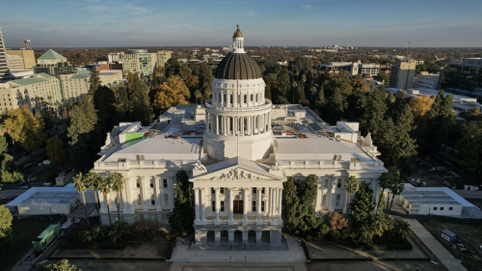
(Image caption ) The California State Capitol, the heart of the State Treasurer's office. More than $3 trillion in funds are processed here daily. The PMIA and LAIF systems, acting as both the "main reservoir" and "capillaries," operate here, safeguarding the public finances and credit of nearly 40 million people.
Reservoirs and capillaries
To understand the significance of the position of state treasurer, one cannot look at the title alone; one must look at the financial machinery behind it.
These abbreviations may seem cold, but they determine how California's public funds are moored, flow, and grow every day.
The PMIA, or Pooled Money Investment Account, is the main reservoir of California's public funds system. It is governed by a Coordinating Investment Committee comprised of the State Treasurer, the State Comptroller, and the Secretary of Finance, with the State Treasurer responsible for day-to-day cash management and investment execution. According to monthly reports released by the State Treasurer's Office, as of the end of March 2026, the PMIA's assets totaled approximately $165.3 billion. In fiscal years 2024 and 2025, the PMIA completed over 13,000 investment transactions, with an overall average return of approximately 4.4%, generating over $7 billion in revenue for the year.
If PMIA is the main reservoir, then LAIF, the Local Agency Investment Fund, is the capillary network that runs throughout the state.
It allows local governments and special administrative regions to deposit idle funds into state-level investment pools, leveraging the state government's professional management capabilities to obtain safe and profitable returns. As of the end of March 2026, LAIF had 2,336 participating institutions with approximately $27.3 billion in funds, covering the vast majority of counties, cities, and special administrative regions across the state.
Many small and medium-sized local institutions lack the capacity to establish mature short-term investment systems. The significance of LAIF is that it enables these local governments to leverage state-level credit, professional management, and economies of scale to safely store public funds and generate reasonable returns.
From an investment portfolio perspective, this system primarily consists of U.S. Treasury bonds, government agency notes, and high-credit-rating commercial paper. Its mission is not to create investment legends, but to uphold the most basic and stringent principles of public funds: safety, liquidity, and moderate returns.
State government money should not be romanticized.
It belongs to taxpayers, to schools, to public projects, and to many arrangements that ordinary people cannot see but rely on every day. Public funds are not for storytelling; they must first be safe, then readily available, and only then should they strive for returns within an affordable range.
The state treasurer's influence is also reflected on the debt side.
California's general liability debt is currently rated AA by Fitch, Aa2 by Moody's, and AA- by S&P. While ratings are ostensibly for bond investors, they ultimately impact taxpayers' bills. The stronger a state's credit rating, the lower the interest rates it can pay for loans to build schools, hospitals, and roads, and the more efficient its use of fiscal resources.
The state treasurer may seem to be sitting in his office dealing with interest rates and bills, but these decisions ultimately make a real difference in whether a highway, a school, or a local government can safely navigate a period of tight cash flow.
This is the true weight of public finance.
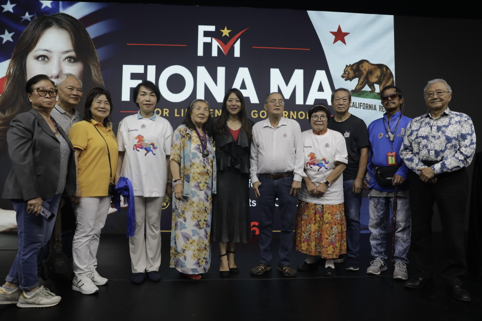
(Image caption) Community leaders, entrepreneurs, educators, and representatives from various ethnic groups across California gathered to congratulate State Treasurer Fiona Ma on her primary victory.
The weight of identity, and the scrutiny that must be traversed.
Fiona Ma doesn't put her Chinese identity first, but she doesn't shy away from it either.
She mentioned that if elected, she would become one of the highest-ranking Asian Americans to hold this position in California history, and the second female lieutenant governor in California history.
This statement is important not only because it brings community pride, but more importantly, because it reminds us that Asian American politics, if it only focuses on community mobilization and business success, hasn't truly penetrated the depths of the American power structure. Finance, education, housing, capital markets, and the public budget are where resources are actually allocated.
For Chinese people, this is a breakthrough. But for GFM, the more pressing question is: can this breakthrough transcend status symbols and enter the realm of budgeting, bonds, education, housing, and the allocation of public resources?
Fiona Ma's political value lies not only in the fact that she is a Chinese American woman, but also in the fact that, as a Chinese American woman, she has entered the financial center of California.
This is why the title "The Woman Who Controls the Money in the World's Fourth Largest Economy" should not be interpreted as an exaggeration or praise, but rather as a factual entry point.
She is not in charge of a static treasury, but rather a public finance order that is constantly flowing, constantly financing, and constantly generating credit.
But true political scrutiny is never just about report cards.
In 2021, a former employee filed a lawsuit against Fiona Ma, accusing her of sexual harassment and racial discrimination. The lawsuit was ultimately settled by the California government for $350,000 in 2024. Ma denied the allegations and publicly stated that the case did not reflect the facts. With the 2026 Lieutenant Governor election progressing, the controversy has been revived by some of the opposing camps and media outlets.
GFM chose to clarify this matter not to amplify the attacks, nor to characterize either side. Documenting the controversy is necessary because public trust cannot be built solely on achievements.
A complete portrait of a public figure includes both her achievements and the scrutiny she has faced and has faced. This is especially true for financial figures. The essence of fiscal power is public trust, and public trust must withstand public scrutiny.
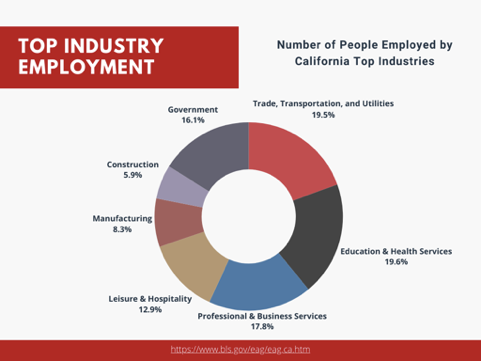
(Image caption ) Employment structure of major industries in California. Government, education and health services, professional business services, trade and transportation, leisure and tourism, and other diverse sectors collectively support the world's fourth-largest economy, which is also the basis for the state treasurer's need to balance cash flow, debt, and investment portfolio.
After the preliminary selection, the real test has just begun.
This interview took place before the primaries. Now, the primaries have concluded.
On June 2, 2026, the California Lieutenant Governor primary concluded. Based on the publicly released election results, Fiona Ma and Republican candidate Gloria Romero advanced to the November general election. This primary employed California's unique "top two advance" system, disregarding party affiliation; the two candidates with the most votes directly qualified for the runoff election.
Within the Democratic Party, she is not facing a weak opponent.
Josh Fryday has the support of Governor Newsom's system and a clean energy track record; Michael Tubbs enters the fray with the labels of anti-poverty, universal basic income, and young progressive. In contrast, Ma's core narrative is not about novelty, but experience; not about a single issue, but the credibility she has built up over a long period in the state's financial and governance system.
She attempts to translate her financial experience into a narrative of ability to protect California’s interests, understand how the state government works, and cope with federal pressure and financial challenges.
The lieutenant governor is not the most powerful position in California's administrative system, but he is an important interface: he connects the state government succession order, the state Senate process, higher education governance, and the future higher political stage.
Few people see this position as the end. More often, it's a corridor leading to greater public responsibility.
For Fiona Ma, this is a new political battle.
For California, this is a choice about experience, identity, financial capacity, and the direction of future governance.
For the Asian community, this is also a test: are we satisfied with just seeing "one of our own" on stage, or can we gain a deeper understanding of the resources and responsibilities that the stage she has entered actually governs?
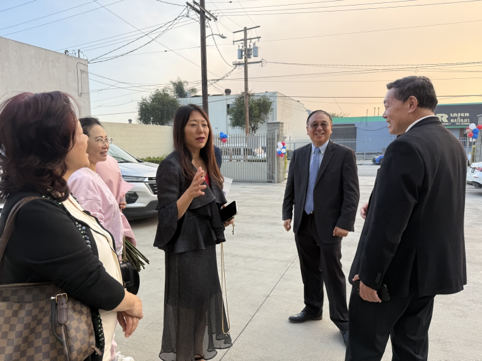
(Photo caption) California Treasurer Fiona Ma had a cordial exchange with Li Ji, Chairman of Hantian TV, Shen Qun, Chairman of the China-US Business Summit, and many other guests, and the conversation was very pleasant.
58 counties, one asset map
During the on-site exchange, she also talked about California's openness to business.
She said that California has 58 counties, each with different industries, communities, and opportunities; businesses that want to enter California can contact her, and she is willing to help determine which type of business is suitable for which area.
This seemingly simple statement reveals her understanding of the economy.
Many people who talk about California only see Silicon Valley, Los Angeles, and San Francisco, or only see high taxes, high housing prices, and high regulations. But someone who truly understands the California economy will not see California as a political label, but as an asset map consisting of 58 counties.
Agriculture, technology, entertainment, ports, education, healthcare, energy, manufacturing, logistics, and financial services—different industries occupy different locations in different counties and cities. For businesses, entering California is not an abstract decision, but a concrete site selection. For the government, attracting investment is not just a welcoming slogan, but a comprehensive assessment of industries, labor force, land, transportation, education, and local finances.
This is also the aspect that financial news reports should focus on.
Politicians often talk about visions, but finance officials have to deal with balance sheets. Candidates can talk about the future, but the state treasurer has to manage today's cash flow every day. California is the world's fourth-largest economy not only because it has innovative companies and a huge market, but also because it has a fiscal machine that can sustain this size.
Fiona Ma has been one of the core operators of this machine for the past seven years.
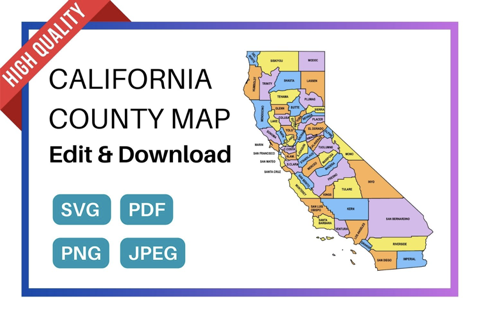
(Image caption ) Economic asset map of California's 58 counties. Technology, agriculture, entertainment, ports, manufacturing, finance, and other diverse industries each have their own distinct roles in different counties. This is precisely the true picture of California's "world's fourth largest economy" as understood and managed by Fiona Ma—not a single label, but a living asset map composed of all 58 counties.
Ultimately, public finance must return to the people.
Speaking about the plight of women, she said that women must be more confident, work harder, and work smarter because opportunities never come automatically and fairly. A candidate's ability to truly win support depends on whether she understands the living conditions of ordinary people, especially in a place like the Bay Area with an extremely high cost of living.
This statement brought the entire exchange back to the human element.
Finance may seem cold and impersonal, but it ultimately serves the most concrete aspects of daily life.
A budget shortfall may ultimately lead to the cuts to school projects; a failed bond financing may ultimately result in a road project being delayed; a safe and stable investment pool may ultimately alleviate the pressure shared by local governments and taxpayers; a fluctuation in credit rating may ultimately change the financing costs of public projects.
If the power of the state treasurer is a key, it never unlocks the vault itself, but rather the possibilities of public life.

(Photo caption) GFM founder Kevin Guo (right) speaks with California Treasurer Fiona Ma at an event in California. For GFM, this interview was not just a personal interview, but also a window into the core of California's fiscal system and Asian American politics in state governance.
GFM's article on Fiona Ma doesn't focus on campaign endorsement or inspirational narratives. Our primary concern is how a Chinese-American woman enters California's financial center and how she faces public scrutiny in the competition for higher positions.
What positions has she held? What resources has she managed? Has she transformed her individual identity into genuine governance credibility? When applause, attacks, experience, and controversy all come at once, what she delivers are truly verifiable answers, or merely a carefully prepared rhetoric?
These are the questions that financial news reports should really be asking.
She certainly wasn't in charge of a vault.
It's a system of public credit that flows every day: the construction of schools, the commencement of road projects, the cash security of local governments, the bond market's trust in California, and the unseen fiscal bottom line behind the lives of nearly 40 million people.
In November, the ballot will provide the political answer.
Before the vote, the treasury had already given another answer: whether a person can rise to a higher position cannot be determined solely by who she is, but also by what she has done to protect the system.
Disclaimer:
This article is compiled based on on-site interviews at GFM, publicly available information from the California Governor's Office and the California State Treasurer's Office, as well as publicly available information from Ballotpedia, CalMatters, and Local News Matters. It aims to provide observations on financial figures and systems and does not constitute any endorsement of elections or voting advice. Sections concerning public controversies are based on publicly available reports, legal documents, and public statements by the parties involved.