

OpenAI CEO Sam Altman and the Energy Boundary
 (Image caption) OpenAI CEO Sam Altman : One of the leading technology leaders at the forefront of AI demand, whose public statements and capital movements repeatedly point to the same reality—the expansion of AI will eventually hit the limits of energy and infrastructure capacity.
Artificial intelligence is expanding at an astonishing pace. Model size, chip capabilities, and capital investment are constantly pushing the limits, and computing power is transforming from a purely technical capability into an infrastructure permeating writing, programming, design, scientific research, and industrial processes. However, as the technological narrative continues to accelerate, a more fundamental, and less frequently discussed, question is gradually emerging: what exactly underpins all of this?
When computing power is no longer just an engineering problem but begins to become an integral part of societal operations, energy inevitably comes to the forefront, becoming a core variable that cannot be avoided. Sam Altman, standing at the forefront of AI demand, did not continue with a purely optimistic technological narrative, but instead pointed out a reality: when demand itself has no brakes, what determines how far AI can go will no longer be just algorithms, but rather the limits of energy and institutional constraints.
⸻
The real bottleneck Sam Altman saw
Over the past two years, artificial intelligence has entered the public discourse at an unprecedented pace. The exponential expansion of model parameters and the rapid deployment of generative AI in various scenarios have led to a continuous increase in the demand for computing power. On the surface, this is a technological wave driven by algorithms and chips; but behind it, a more sober and realistic question is gradually emerging: what will support this expansion of computing power in the long term?
While the market tends to understand the upper limit of AI as model capabilities, chip performance, and capital scale, reality is pulling the discussion back to a more fundamental level—energy.
Sam Altman's position is particularly unique in this structural shift. He is neither an energy expert nor a traditional infrastructure builder, but as one of the key figures driving the commercialization and scaling of large-scale models, he stands at the forefront of the demand curve, feeling the pressure earlier than most technology decision-makers.
For Altman, AI is not an industry that will naturally slow down after the technology matures. Once the model's capabilities cross the usability threshold, the demand itself begins to reinforce itself: the more abundant the computing power, the richer the applications; the more applications there are, the harder it is to suppress the dependence on computing power. This does not depend on a single product or company, but is a structural trend.
It is against this backdrop that the true bottleneck of AI is gradually becoming apparent. The question is no longer "how smarter can the model become," but rather "can the entire system withstand this continuous expansion?" When computing power exceeds the carrying capacity limits of data centers, cities, and even regional power grids, energy is no longer just a back-end cost, but becomes a prerequisite for determining the speed of technological expansion.
⸻
The need for AI is no longer an abstract concept.
As led by Sam Altman, OpenAI has never faced just the growth curve of a single product, but rather the scaling up of an entire technological paradigm. From the large-scale model experimentation stage centered on training, to the large-scale deployment of inference capabilities in enterprise processes, public services, and daily life, AI has completed a crucial transformation from the laboratory to industry, and then to social infrastructure.
This shift completely changed the nature of computing power requirements.
In traditional technology products, resource investment often has a phased nature: after research and development is completed, marginal costs gradually decrease; however, AI does not follow this path. Computing power is no longer a one-time technological investment, but a long-term, stable, and continuously expanding consumable resource.
Especially during the inference phase, the demand does not level off as the model matures; instead, it continues to amplify with the increase in user scale, application scenarios, and call frequency. Every conversation, every content generation, and every call embedded in enterprise processes or public systems corresponds to real, immediate, and uninterrupted power consumption.
This consumption doesn't grow linearly. Once AI applications prove effective, new scenarios are rapidly replicated, and once new users become dependent, it's difficult to reverse the trend. Therefore, computing power demands exhibit highly sticky and self-reinforcing characteristics. It is precisely in the face of this structure that Altman's judgment appears particularly clear: what truly constrains the speed of AI development is not entirely the technological capability itself, but rather whether energy and infrastructure have the capacity to support this demand.
⸻
Unlike "optimistic narratives" of technology leaders
In Silicon Valley, talking about stronger models, faster chips, and lower costs constitutes a highly familiar narrative of technological optimism. However, there are actually very few people willing to discuss both "limitations" and "boundaries." Sam Altman's difference lies precisely in the fact that he does not depict the future of AI as a frictionless, ever-rising technological curve.
In numerous public speeches and interviews, he repeatedly mentioned a frequently overlooked yet crucial fact: if energy systems and infrastructure cannot expand in tandem, the pace of AI development will ultimately be forced to slow down. This is not a pessimistic assessment of the technological future, but a realistic judgment from an engineering and systems perspective.
Algorithms can iterate rapidly, model architectures can be continuously optimized, and chip manufacturing processes can break through continuously driven by capital and competition; however, energy and power grids do not follow the same time logic. The coordination of power generation facilities, transmission lines, and power grids often requires planning and implementation on a yearly or even decadely basis. This incompressible time scale is creating a structural mismatch between AI's monthly or quarterly progress.
It is this mismatch that has gradually transformed the limitations of AI from technical issues into institutional and infrastructure problems.  (Image caption) Data center server racks: AI training and inference ultimately fall on the long-term, continuous load of data centers ; when inference needs become daily infrastructure usage, power consumption changes from a "cost" to a "precondition".
⸻
When demand begins to directly confront energy issues
It is worth noting that Altman did not stop at simply pointing out problems. As the demand for AI expands in a near-irreversible manner, his focus on energy issues has clearly extended from conceptual reminders to capital allocation and practical actions.
The discussions and investments surrounding nuclear energy and new energy infrastructure in recent years are a concrete manifestation of this shift. This is not simply a matter of technological preference, nor is it solely driven by environmental or long-term investment considerations; rather, it represents a rational choice made by the demand side after fully understanding its own growth trajectory. For Altman, without proactively addressing energy issues, the long-term development of AI will lack a stable and predictable foundation.
This shift also reveals a change in the role of the AI industry. As computing power becomes a long-term, continuous, and uninterrupted consumption, energy is no longer just a cost item, but a core variable directly affecting technological feasibility and the pace of expansion. Actively focusing on energy from the demand side signifies that AI companies are crossing traditional boundaries and entering the intersection of energy, infrastructure, and public policy.
⸻
Energy boundaries are redefining the limits of AI .
From GFM's perspective, Sam Altman's significance lies not in proposing a specific energy solution, but in clearly revealing an undeniable trend: the demand side of AI is actively pushing energy issues to the center stage.
When computing power remains confined to laboratories or single-industry applications, energy can be considered a background condition. However, when AI is deeply embedded in enterprise operations, public services, and core social systems, energy becomes a prerequisite for the long-term operation of the technology. Even if model capabilities can still be improved and chip performance continues to advance, if the energy system cannot expand in tandem, the application boundaries of AI will ultimately be limited.
These limitations may not manifest as a crisis, but are more likely to appear as deployment delays, limited application choices, or even forced adjustments to technological approaches. When those who best understand the direction of the demand curve begin to repeatedly emphasize the importance of energy and infrastructure, it in itself signifies that the development of AI has entered a new phase that requires transcending the boundaries of technology, energy, and institutions.
⸻
Why GFM chose Sam Altman
Sam Altman was chosen from GFM’s list of figures not because of his exposure or the buzz he generates, but because of the highly structural significance of his position—he is at the forefront of AI needs.
If energy systems experts reveal constraints at the engineering and institutional levels, then Altman presents an unavoidable fact on the demand side: once AI becomes usable, there is no natural braking mechanism for its demand. Demand will not automatically slow down as the technology matures; instead, it will be continuously replicated and amplified as efficiency improves.
This is why energy issues are no longer peripheral discussions, but have become a core variable determining how far and how long AI can go. GFM pays attention to Altman not because he provides the answer, but because he understands the weight of the issue best. He makes the energy boundary, which was originally hidden behind the technological narrative, concrete, imminent, and undeniable. 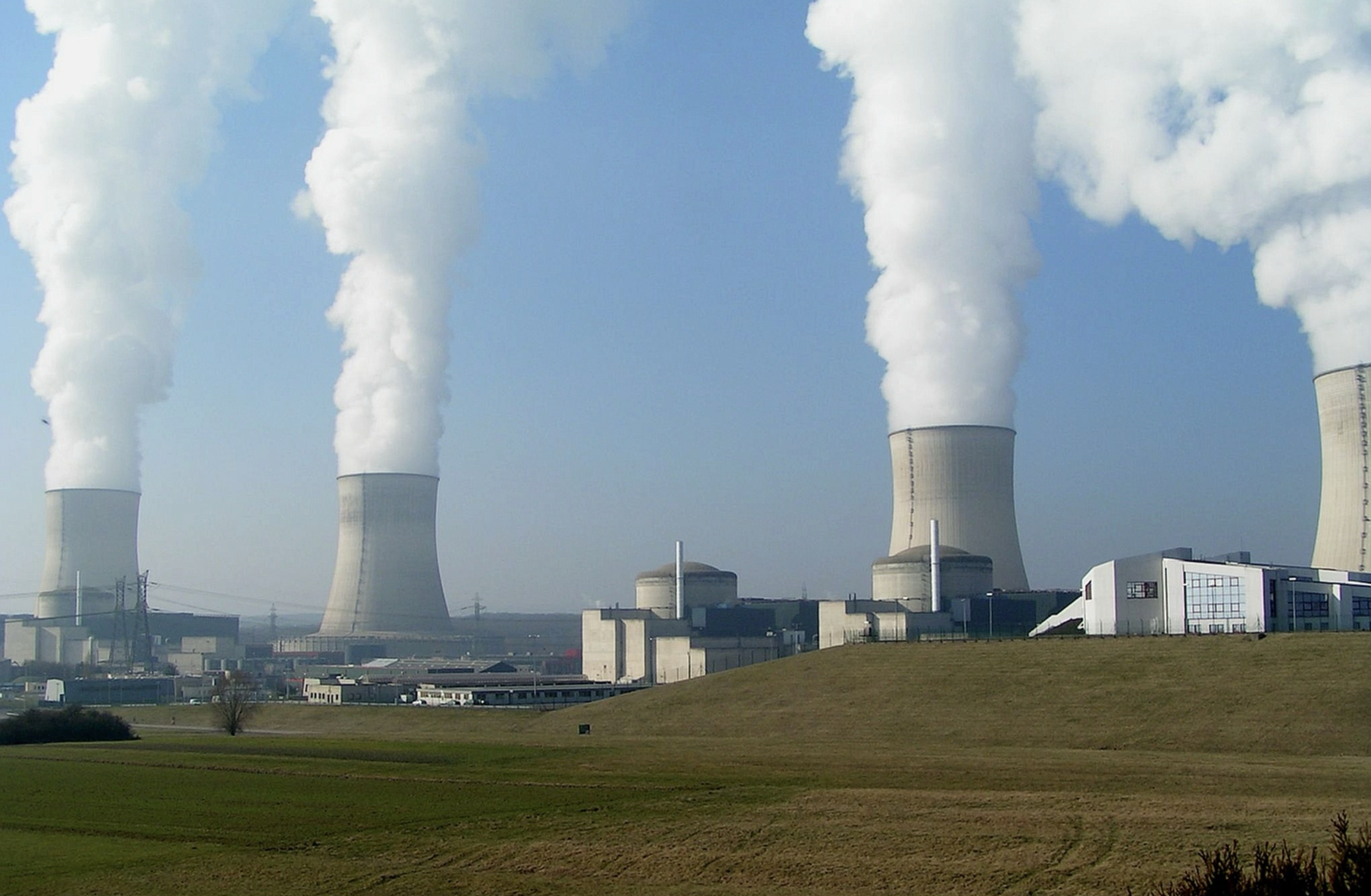 (Image caption) Nuclear power plant : When the demand curve for AI lacks a natural braking mechanism, the demand side begins to regard "stable and scalable base station energy" as a prerequisite for feasibility, and nuclear energy is therefore frequently brought up again in discussions.
⸻
When the future must return to the physical world
For a long time, the narrative of AI has been dominated by speed, scale, and capability; but as AI truly embeds itself into enterprise operations and public systems, the limitations of the physical world are returning to the forefront. Computing power can grow exponentially, but electricity and infrastructure cannot expand at the same pace. This is not a matter of technological backwardness, but rather a reality of engineering and institutions.
No matter how advanced the model, AI ultimately operates on top of electricity, power grids, and infrastructure. As demand continues to grow, energy issues are no longer a challenge to be faced in the future, but rather a key variable that has already begun to influence the technological path. Deployment pace, application scope, and system stability are all directly related to energy carrying capacity.
This is precisely why GFM chose Sam Altman as a figure in the financial world: he is not a figure of energy transition, but a figure of boundary reveal. When the future of AI must return to the physical world, those who understand this boundary will determine the direction of the next stage.
—————————————————————————————————————————————————————
GFM Editor's Note:
The macroeconomic data and infrastructure indicators mentioned in the above three articles are cited from publicly available data from the U.S. EIA, DOE, NREL, Grid Strategies, Deloitte, LBNL, etc. The judgments on "AI × Energy × Institutions" in the articles are commentary analyses, aiming to establish a verifiable and debatable research framework, rather than investment advice.