

Mr. Tung Chee-hwa is gone, and the Hong Kong in that photograph is also gone.
A Hong Kong journalist's personal memories and the historical position of Hong Kong's first Chief Executive
The passing of Mr. Tung Chee-hwa took with him not only Hong Kong's first Chief Executive, but also evoked a generation of journalists' personal memories of Hong Kong in the early days of the handover. This article begins with an old photograph taken in 1999, looking back at the housing, economic, and institutional issues during Mr. Tung's eight years in office, and also recording the intergenerational human and journalistic friendship between the author and this elder statesman, as well as his mentor, Mr. Xu Simin. Beyond historical controversies, the warmth of genuine human encounters should still be preserved.
The First Chief Executive in the Eyes of a Hong Kong Journalist
On September 8, 2026, Mr. Tung Chee-hwa, the first Chief Executive of the Hong Kong Special Administrative Region, passed away at the age of 89. According to multiple media outlets citing sources from his office, he passed away peacefully surrounded by his family.
When the news came, I remained silent for a long time.
When people reach this age, upon hearing of the passing of a familiar elder, what often comes to mind first is not their title or the controversies already written in history, but a very specific image: a handshake, a conversation, an old photograph, or someone who was once thought to remain in their memory forever, suddenly becomes someone they will never see again.
Mr. Tung's passing marks the end of an important political figure's career. He assumed office as Hong Kong's first Chief Executive on July 1, 1997, the day of Hong Kong's return to China, and resigned in March 2005 citing health reasons. He then served as Vice Chairman of the National Committee of the Chinese People's Political Consultative Conference (CPPCC) until his resignation in 2023. His life was closely intertwined with the establishment of Hong Kong's system, economic crisis, housing disputes, social conflicts, and political transformation during the first eight years after the handover.
But to me, he is first and foremost an elder I have met up close many times and heard speak in person. During my years working in Hong Kong's journalism industry, I saw him many times at parties, news events, and in public. Today, as I reorganize old photos, many fragments that had been buried deep in the past have resurfaced one by one.
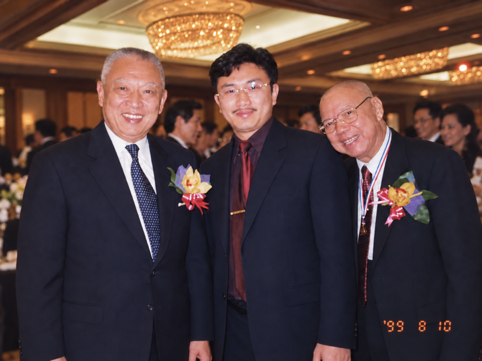 (Photo caption) August 10, 1999, Hong Kong. From left: Mr. Tung Chee-hwa; from center: myself, founder of GFM.News, author of this article, and then-chief reporter for the Hong Kong newspaper *Mirror Daily*; from right: Mr. Tsui Simin, founder and publisher of the Hong Kong newspaper *Mirror Daily*. This photo was taken at the 22nd anniversary celebration of the Hong Kong newspaper *Mirror Daily*, recording a precious memory of that era.
A photograph of two elderly people.
I found a photo taken on August 10, 1999. It was a reception celebrating the 22nd anniversary of the founding of the Hong Kong newspaper "Mirror": Mr. Tung Chee-hwa is on the left, I am in the middle, and Mr. Tsui Si-min, the founder and president of the Hong Kong newspaper "Mirror," is on the right.
The photo wasn't grand, but it kept me looking at it for a long time.
That year marked the second anniversary of Hong Kong's return to China. Mr. Tung was already serving as the first Chief Executive; Hong Kong society was still figuring out how to live and operate under the new system; and those of us working on the front lines of the news were also trying to understand what the city was going through in our own ways.
For me, Mr. Xu Simin in the photo is not just a newspaper editor.
I moved to Hong Kong in the 1990s, just as I was embarking on a new chapter in my life. It was Mr. Xu who introduced me to the Mirror Daily, giving me the opportunity to truly enter the Hong Kong news industry. He treated me like an adopted son, as well as a teacher and friend. Looking back many years later, I understand even more clearly that it is not a given that a young person can gain trust, a position, and the opportunity to be taken seriously in a foreign land.
Mr. Xu is a mentor I deeply respect throughout my life. He valued the responsibilities of journalists and cared about the development of Hong Kong and China. He gave me more than just job opportunities; he gave me a set of requirements for journalism, for being a person, and for the times: to have a long-term vision, to stand firm on one's feet, and to have the lives of ordinary people in one's heart.
Mr. Xu passed away on September 9, 2007. Looking at this photo again now, Mr. Dong has also passed away. The two elders in the photo are no longer here, leaving me standing in the middle.
It's hard to describe this feeling. It's not just sadness, but a sudden weight on the passage of time: the days I once experienced are so far away; the people who once guided me forward have all faded into the depths of history.
He hopes reporters will get into the lives of ordinary citizens.
What impressed me most about Mr. Tung Chee-hwa was not his image on the podium, but the details of his conversations with others. He spoke calmly and disliked ostentation. He interacted with a large number of officials, business people, representatives of social organizations, and media reporters every day, but sometimes I could still remember their names when we met again.
For a young journalist, this makes them feel like they're not just another face in the room.
On one occasion, Mr. Tung told me something along the lines of: Hong Kong journalists should have more contact with citizens, understand their living and housing conditions, write down and reflect the true situation, and let the government know what citizens really need.
I remember this passage to this day.
News should not be confined to official settings, nor should it rely solely on press releases. The specific circumstances of citizens—how they live, whether they face hardship, and whether they can afford housing—should be brought back into public discussion.
Today, as I founded GFM.News in the United States, I still believe in this principle. When institutional decisions affect housing, income, education, businesses, and families, the news cannot simply record what decision-makers say; it must also inquire about what citizens have endured.
Looking back, this is perhaps a common reminder left to me by Mr. Xu and Mr. Dong: the value of news ultimately lies not in how close a journalist is to power, but in whether he is still willing to get close to real life.
Hong Kong has its first Chief Executive
Tung Chee-hwa's historical position primarily stems from being the "first in office".
Before 1997, Hong Kong used the colonial governor system. After the handover, the Special Administrative Region operates in accordance with the Basic Law, and the relationships between the Chief Executive and the Central Government, the Legislative Council, the civil service, the business community, and other sectors of society must be established in practice. He had no predecessors to learn from.
However, shortly after taking office, he encountered the Asian financial crisis. Currency speculation pressures, rising interest rates, stock market volatility, and a property market downturn followed one after another; this was followed by the outbreak of avian influenza and SARS. For a newly established special administrative region government, this was not a smooth start.
The original intention and the cost of "85,000"
The most controversial policy during Tung Chee-hwa's tenure was undoubtedly housing.
The first Policy Address in 1997 proposed that no less than 85,000 residential units be built annually by the public and private sectors. The government also hoped to increase the homeownership rate to 70% within ten years and shorten the average waiting time for public housing to three years.
Looking back today, this policy later became a heavy political burden. During the Asian financial crisis, Hong Kong's property market plummeted, leaving many families burdened with negative equity. Market cycles, supply rhythms, and policy expectations intertwined, leading to strong criticism of the government. This history must be recorded truthfully.
At the same time, Hong Kong's housing problem at the time was real: high property prices made it difficult for ordinary families to buy homes, and the waiting time for public housing was long. Increasing supply was originally intended to address the problem of citizens "not being able to afford housing." Policy outcomes and policy motivations should be examined separately. History can criticize policy judgments, but it should not erase the public issues that the policies initially aimed to address.
More than two decades later, housing remains one of the most intractable livelihood issues in Hong Kong. The "85,000 units" policy has left behind not only controversy, but also an unresolved question: How can Hong Kong enable ordinary people to afford housing?
Long-term issues and unresolved answers
Tung Chee-hwa's administration cannot be summarized solely by housing policies. Information technology, Cyberport, education, tourism, logistics, cooperation between Hong Kong and the Pearl River Delta, and economic ties between Hong Kong and the Mainland are all directions he repeatedly emphasized during his tenure.
He proposed early on that Hong Kong, facing competition in the information age, could not simply be a follower; he also hoped that Hong Kong could find a new place in the process of China's rapid economic development. Some of these ideas progressed slowly, some caused controversy, and some continued in new ways under different governments.
A politician's vision may not be fully realized during their term; it also depends on economic cycles, administrative capabilities, social consensus, and market conditions. The question left by Mr. Tung Chee-hwa is how Hong Kong can maintain its existing advantages while finding the next growth opportunity for its industries and the city. This question remains relevant to this day.
The social turning point in 2003
Tung Chee-hwa's term of office also cannot bypass 2003.
SARS devastated Hong Kong, exacerbating the economic downturn and unemployment. That same year, the Hong Kong SAR government pushed for legislation on Article 23 of the Basic Law, sparking widespread social controversy. The large-scale protest on July 1st became a significant turning point in Hong Kong's political development after the handover, ultimately leading to the shelving of the relevant legislative draft.
There have always been differing interpretations of Article 23 in Hong Kong society: supporters emphasize the constitutional responsibility enshrined in the Basic Law; opponents, on the other hand, worry that the legislation may affect existing freedoms and rights. This divergence itself is part of the institutional adjustment process in Hong Kong during the early years after the handover.
That year, Tung Chee-hwa faced not only a bill, but also a city's differing expectations regarding politics, freedom, governance, and the future direction. In March 2005, he resigned as Chief Executive for health reasons, ending his eight-year term.
Mr. Dong in my memory
I am not writing this today to defend every policy of Mr. Tung Chee-hwa. His administration had its mistakes and controversies, and it has left behind issues for future discussion. These issues should be studied and understood within the institutional, economic, and social context of the time.
I am unwilling to dedicate my entire life to just a few political labels.
I remember Mr. Dong speaking slowly and deliberately; I remember his willingness to talk to young people; I remember him reminding reporters to go among the citizens and understand housing and life; I also remember the natural familiarity and warmth between him and Mr. Xu Simin when they met on some occasions.
These details may not change history's overall assessment of an administrator, but they can restore a historical figure's warmth and complexity as a "human being".
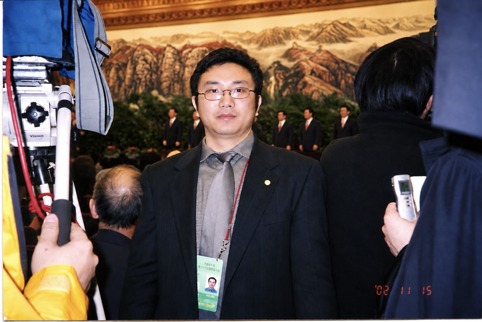 (Photo caption) November 15, 2002, Great Hall of the People, Beijing. The author, in his capacity as chief reporter for the Hong Kong-based *Mirror Daily*, covered the meeting between the new central leadership and Chinese and foreign journalists following the closing of the 16th National Congress of the Communist Party of China. Hu Jintao and the newly elected members of the Politburo Standing Committee are seen in the background. That year marked the transition of power from the Jiang Zemin era to the Hu Jintao era; for Hong Kong journalists who still had access to major political events in Beijing, it was an era in which the journalistic profession remained passionate and believed that recording had its place.
Hong Kong in the photo
In that 1999 photo, I was still young. Mr. Tung was serving as the first Chief Executive, and Mr. Tsui was still running the Mirror Daily. Hong Kong had only been back in China for two years, and many of the things that would later change the city had not yet happened. Back then, we talked about the future, about Hong Kong, about China, and about how young people should do their jobs well.
Twenty-seven years have passed; the city has changed, and so have the people.
After Mr. Tung Chee-hwa's departure, people will review his eight-year term from their own perspectives, which is an inevitable discussion in history. To me, aside from his policies, positions, and controversies, he was also an elder who had genuine interactions with our generation of journalists in the early days of Hong Kong's return to China.
The kindness left by Mr. Xu is like a quiet lamp, illuminating my later path in journalism.
Photographs fade, and memories diminish with each passing year. Therefore, we should strive to write down our experiences honestly. This isn't about making judgments for anyone, but about preserving the genuine warmth and connection between people before history recedes into the distance.
Mr. Dong, may you rest in peace.
Disclaimer
This article is based on publicly available information, photographs, and the author's memories; personal interactions and conversations are carefully relayed from memory and have not been verified item by item by a third party. The article aims to commemorate and provide historical observations and does not constitute a sole evaluation of Mr. Tung Chee-hwa, his administration, or the history of Hong Kong.