

Is Elon Musk an alien?
What's most terrifying about him isn't his audacity to dream, but his ability to break down distant goals into factories, supply chains, timelines, and valuations.
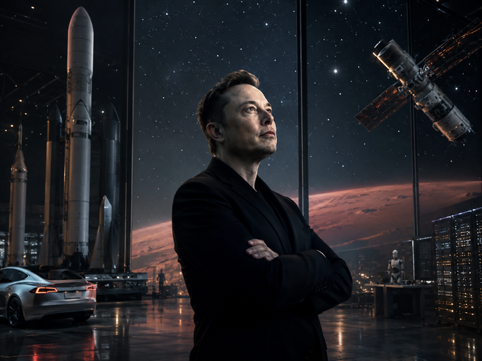 (Image caption) Musk stands between Earth and Mars, like a question of our time.
Editor's Note:
Musk is certainly not an alien.
The outside world is used to describing Musk as an "alien." This statement may seem like a joke on the surface, but it is essentially an acknowledgment of an anomaly that defies easy categorization.
He is unlike traditional entrepreneurs. Traditional entrepreneurs usually start from market demand and look for the optimal solution for products, costs, users, and profits; Musk's path is exactly the opposite—he first sees a world that does not yet exist, and then goes back to organize the company, engineering, capital, supply chain, and people to drag that world into reality inch by inch.
Therefore, the question has never been whether Musk is an alien. Of course not.
The real question worth asking is: why can the same person make the market, engineers, governments, institutional investors, and the general public all believe in things that originally only existed in science fiction—reusable rockets, Mars colonization, global low-Earth orbit satellite networks, trillion-parameter AI data centers, brain-computer interfaces, fully autonomous driving, and hyperloop underground transportation—and believe them willingly, even rushing to enter the market?
His "abnormality" lies not in his appearance, nor in the legends surrounding him, but in the rare combination of his way of thinking and the consequences of his actions. He breaks down the distant future into timelines, imagination into projects, projects into companies, and then hands the companies over to the capital market, letting valuations measure for him how far into the future humanity is willing to bet on.
That's what makes him so fascinating, and that's also what makes him so dangerous.
When a founder's vision expands to the point of rewriting industry boundaries and reshaping the infrastructure landscape, the institutional response cannot be limited to mere adoration. The public market must ask: Who truly controls this infrastructure? Who bears the downside risks? And who has the qualifications and ability to check and balance this founder's empire?
Musk is not an alien.
He is more like a stress test specially assigned to the capital market by this era—and the time to answer the question has already begun to count down.
Jeff Morgan
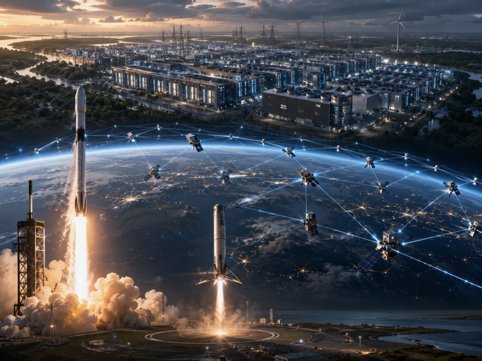 (Image caption) Space, satellites, and data centers are all packed into the same engineering drawing.
Musk has already constructed that impossible world in his mind.
Musk rarely acts like a traditional company CEO.
He's more like someone who immerses himself in the construction site.
He talks about Mars, AI, rockets, computing power, and whether a person has a kind heart. These topics may seem unrelated, but when applied to Musk, they all point to the same thing: he is always looking for people who can push the impossible forward by even an inch.
The phrase "a kind heart" seems somewhat contradictory when applied to Elon Musk.
He is neither a mild-mannered manager nor a lenient boss. His company often operates like a high-speed machine, characterized by high pressure, high speed, and a high turnover rate. But it is precisely for this reason that this statement is worth pondering repeatedly.
Perhaps what he's looking for isn't a gentle person, but someone who, under immense pressure, doesn't betray their mission, their companions, or their authenticity.
Some entrepreneurs seek opportunities in the market. Others rewrite the rules within the boundaries of the system.
Musk is a different kind of person.
He first put an almost impossible world into his mind, and then used companies, engineering, capital, talent, and a near-brutal execution pace to push that world closer to reality, layer by layer.
When he was making electric cars, the market said they were just toys for the rich. When he was making reusable rockets, the aerospace industry said rockets were inherently disposable. When he was making low-Earth orbit satellite networks, many people thought it was impossible to provide global broadband via satellites. When he was making AI data centers, people began to doubt again—how could computing power, electricity, water cooling, GPUs, and regulation be compressed into a super factory in such a short time?
What makes him truly special is not that he is always right, but that he dares to treat the impossible as an engineering problem first, and then turn that engineering problem into a capital market problem.
SpaceX's IPO is ostensibly a listing of a space company.
On a deeper level, it is an institutional event of an era: rockets, satellite communications, AI computing power, energy, data centers, social platforms, model training, founder control, and the public market are all crammed into the same capital container.
This is not an ordinary IPO.
This is the first time Musk has laid bare the world he has built over the past two decades in such a complete, massive, and dangerous way before the public market.
⸻
SpaceX is much more than just a rocket company.
According to SpaceX's IPO prospectus, the company plans to issue approximately 555.5 million Class A common shares at an expected price of $135 per share, with the ticker symbol SPCX, and applies for listing on Nasdaq. Based on this size and price, the total amount raised could reach $75 billion, making it one of the largest IPOs in human capital market history.
It is important to emphasize that the securities cannot be sold or offered for purchase before the relevant registration documents officially take effect. This is the first institutional boundary for understanding this IPO.
But to understand this IPO, the first thing to look at is not the amount of funds raised, but the change in the company's identity.
SpaceX is no longer just a rocket company.
Musk is transforming it into a company that spans three layers of infrastructure.
The first layer is the transportation capability into space. This is the foundation formed by Falcon, Starship, launch sites, recoverable rockets, and orbital payload capacity. It answers one of the oldest and most difficult questions: how to send people and goods off the Earth's surface at a lower cost and with a higher frequency.
The second layer is Starlink's global connectivity. Low-Earth orbit satellites, ground terminals, spectrum, subscribers, and global network coverage transform orbit from something distant into a network that can be accessed and charged for daily.
The third layer comprises the AI computing power capabilities comprised of xAI, Grok, X, and the Colossus data center. GPUs, electricity, data centers, model training, cloud computing contracts, and the vision of future orbital data centers are propelling SpaceX into another valuation narrative.
These three capabilities correspond to three real bottlenecks in the future economy: how to put objects into orbit; how to enable more people in various places to access high-speed networks; and how to obtain sufficient computing power, electricity, and data center capacity in the AI era.
If Tesla is rewriting the narrative of automobiles and energy, then SpaceX is trying to rewrite the infrastructure itself.
It's not simply about sending people to Mars.
It is trying to answer the question: Who will build, own, price, and control the future of connectivity, computing, energy, and orbital resources?
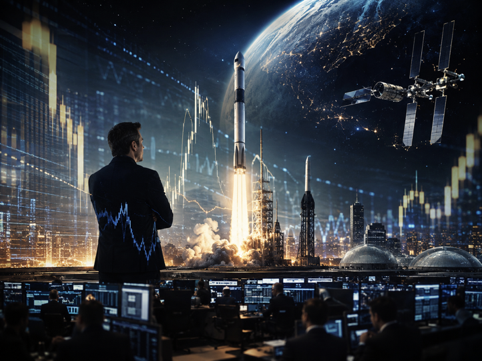 (Image caption) The rocket launches, and the capital market begins to price the distant future .
Behind the numbers lies a new valuation grammar.
SpaceX's valuation is not easy to understand if you only look at traditional financial figures.
Public documents show that the company's total revenue was approximately $18.674 billion in 2025, $14.015 billion in 2024, and $10.387 billion in 2023. This is a clear high-growth curve. However, at the same time, the company still recorded a net loss of approximately $4.937 billion in 2025, and also recorded a large loss in the first quarter of 2026.
According to the traditional financial analysis framework, this is a company with high growth, high losses, high capital expenditures, and high execution risks.
Yet the market is still willing to give it an extremely high valuation.
If we roughly calculate based on a valuation of approximately $1.75 trillion and revenue of approximately $18.674 billion in 2025, the market is not pricing SpaceX at a multiple of that of a traditional industrial company, but rather at a price close to "future control".
The reason is that SpaceX is no longer priced as a "rocket company." It has been repriced as a potential control point for next-generation space, communications, and AI infrastructure.
This is where Musk excels.
He always convinces the market that what appears to be an expensive valuation today may simply be the early price of future infrastructure power.
Tesla was like that before. When it was still losing money, had limited production capacity, and was short of cash, the market was buying more than just a car; it was buying the future of electrification, autonomous driving, batteries, and the energy grid.
The same is true for SpaceX today.
The market is buying more than just rocket launches; it's buying orbital transportation, global broadband, AI computing power, defense contracts, space data centers, and Musk's ability to continue rewriting industry boundaries.
This valuation method is fascinating, but also dangerous.
The allure lies in its ability to allow capital markets to back grand projects ahead of time. The danger lies in the fact that when the narrative is stretched too far, investors can easily mistake an unrealized future for a guaranteed cash flow.
⸻
Starlink is making stargazing a monthly subscription service.
In SpaceX’s vast story, Starlink is the part closest to the ground.
Rockets are spectacular, but rocket launches aren't a business that can charge families, businesses, airlines, governments, and military systems every day. Starlink is different. It has turned space engineering into subscription revenue, satellite constellations into a global communications network, and orbital assets into sustainable, revenue-generating infrastructure.
According to public documents, as of March 31, 2026, Starlink had approximately 10.3 million subscribers, covering 164 countries and markets, and was supported by approximately 9,600 low-Earth orbit satellites.
In humanity's past imagination, space belonged to nations, military, science, and expeditions. Starlink brings space into homes, schools, battlefields, airplanes, ships, remote farms, disaster areas, and mobile communications.
It made stargazing a monthly fee.
However, this model also faces real-world pressures. Documents show that Starlink's average monthly revenue per user (R/U) dropped from $86 in Q1 2025 to $66 in Q1 2026, and its average R/U for the entire year of 2025 was also lower than in 2024. While rapidly expanding, Starlink is also experiencing downward pressure on per-user revenue due to internationalization, low-price plans, and differences in payment capabilities across different markets.
This is precisely the true fate of infrastructure companies.
In the early stages, growth was driven by technology; in the later stages, profits must be supported by scale, efficiency, cost control, and market segmentation.
Starlink's value lies not only in the number of subscribers it has today, but also in its transformation of SpaceX from a "launch company" to a "connectivity company." This shift in identity is one of the most important institutional changes in SpaceX's entire valuation system.
Because rockets are engineering marvels.
Starlink is the language of finance.
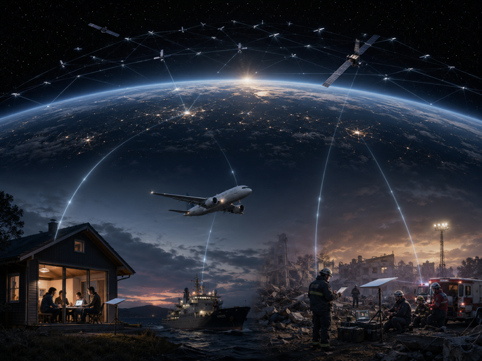 (Image caption) Connecting Earth, bringing the starry sky into real life.
⸻
AI computing power propels SpaceX into another chapter.
What truly propelled SpaceX into a new narrative was its AI computing power.
Public documents show that SpaceX has incorporated its xAI-related businesses into its overall disclosures. This changes SpaceX's identity once again: it is no longer just a space transportation and satellite communications company, but a company that integrates space, communications, and AI into a single engineering blueprint.
According to public documents and market reports, SpaceX and Google have signed a cloud services agreement. Google will pay approximately $920 million per month for a certain period to acquire large-scale NVIDIA GPUs and related computing capacity.
The significance of this agreement lies not in proving that SpaceX has become a mature AI cloud service giant, but in illustrating that the scarcest resources in the AI era are shifting from the models themselves to computing power, electricity, data centers, and delivery speed.
This is a huge business signal, but also a clear risk signal.
The business signal is that even AI giants like Google are willing to pay nearly $1 billion per month for external computing power, indicating that AI competition is shifting from competition over models to competition over computing power, electricity, data center speed, and supply chain execution.
The risk is that these types of contracts are not a perpetual moat. They have delivery conditions, termination rights, and capacity discount clauses. They can prove the existence of demand, but cannot guarantee long-term profitability; they can support a narrative, but cannot replace risk management.
Anthropic's computing power agreement is also noteworthy. Public information shows that SpaceX will provide Anthropic with computing power across Colossus and Colossus II, amounting to approximately 325,000 NVIDIA GPUs; Anthropic will pay monthly fees until 2029, and the agreement also includes ramp-up arrangements and early termination clauses.
This means that SpaceX's AI infrastructure is generating new revenue streams. However, the stability of this revenue, gross margin, equipment depreciation, energy costs, customer concentration, and renewal capabilities are the real questions investors need to ask.
Musk always manages to talk about the future in a very far-reaching way.
But the question the public market needs to ask is: can this distant destination be delivered on a quarterly basis?
⸻
His greatest strength lies in turning a story into an engineering project.
Musk's truly rare ability is not storytelling, but turning stories into engineering projects.
His attitude towards time was almost inhumane.
Others treat time as a cost, but he treats time as an enemy.
xAI and NVIDIA have disclosed that the Colossus supercomputer was built in 122 days, and it took only 19 days from the arrival of the first batch of racks to the start of training. This speed is almost a microcosm of Musk's companies: disregarding traditional timelines, refusing to accept conventional construction periods, not using complexity as an excuse, but forcibly compressing land, electricity, cooling, GPUs, networks, engineers, supply chains, and capital into an almost inhuman timeline.
In 2015, SpaceX successfully returned the first stage of its Falcon 9 rocket to Earth, proving that the reusability of orbital-class rockets was no longer just a theory. In 2017, SpaceX reused a recovered rocket for the first time, pushing "recovery" towards "reuse." These engineering milestones have not only changed aerospace technology but also altered the market's understanding of launch costs, launch frequency, and the commercialization of space.
Musk has accomplished more than just landing rockets.
He has transformed a field that was originally controlled by the state, the military, and a few aerospace giants into one governed by the logic of engineering iteration, cost curves, commercial orders, and platform-based infrastructure.
That's what makes him terrifying, and that's what makes him fascinating.
He always breaks down what others see as the distant future into parts, processes, supply chains, and timelines.
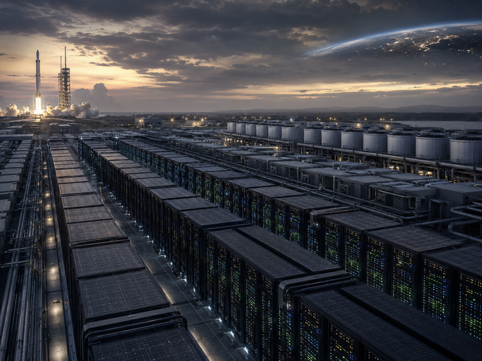 ( Image caption) AI data centers are expanding, and computing power is becoming a new infrastructure.
⸻
Founder Empire in the Public Market
GFM is more concerned with another issue: how should these ingenious infrastructure companies be governed once they enter the public market?
SpaceX’s equity structure has provided the answer, but it has also brought controversy.
The prospectus shows that each Class A ordinary share has one vote, while each Class B ordinary share has ten votes. Class B shareholders can elect a majority of the board members on their own; removing Musk from the board, as well as from his positions as CEO and chairman, also requires a majority vote from Class B shareholders.
In other words, SpaceX is going public, but it doesn't intend to hand over substantial control to public shareholders. It will become a publicly traded company, while remaining an institutional entity heavily controlled by Musk.
This arrangement has its own inherent logic. SpaceX's pursuit of a Mars base, Starships, orbital data centers, AI computing power, and a global satellite network are not projects that can be supported by quarterly profit statements. If it were entirely dependent on short-term stock price pressures, long-term projects could easily be fragmented by fluctuating market sentiment.
But this arrangement also comes at a cost.
It requires investors to accept the reality that what they are buying is economic rights, not necessarily governance rights; what they are participating in is Musk's long-term project, rather than the democratic governance of a public company in the traditional sense.
SpaceX's complexity goes beyond its dual ownership structure.
The related-party transactions are even more complicated.
The prospectus discloses that SpaceX has multiple commercial, leasing, equipment and service arrangements with Musk's affiliates or directors, including Tesla, xAI, X Holdings, The Boring Company, Musk Industries, and Valor Equity Partners.
These relationships do not necessarily imply problems.
In Musk's industrial universe, Tesla has batteries and energy, SpaceX has launches and satellites, xAI has models and computing power, X has data and distribution, and The Boring Company has underground engineering ideas. Connecting these capabilities could indeed create synergies that are difficult for ordinary companies to replicate.
However, the other side of synergy is the conflict of interests.
When multiple companies operate around the same founder, the same supply chain, and the same group of capital partners, what public shareholders really need to know is: How are transactions priced? How are resources allocated? Who bears the losses? Where do profits go? How does the board of directors review these transactions? How are minority shareholders protected?
The responsibility of institutional media is not merely to praise collaboration, but to clearly explain the rights, obligations, pricing, and risks behind collaboration.
The grander Musk's world becomes, the less these issues can be obscured by romantic narratives.
Public markets can provide capital for geniuses, but can they also constrain them? Public shareholders can share in the upside potential, but can they also mitigate the risks of decision-making? When a company's valuation includes a significant founder premium, is this premium an asset or a potential liability?
Musk has instilled confidence in the market about the future.
But the system must be responsible for investigating the future governance costs.
⸻
People inside high-voltage machines
When discussing talent, Musk has emphasized whether a person has a kind heart.
This statement, though seemingly gentle, is quite interesting when applied to Musk.
He is not a gentle manager. His company culture is known for its high pressure, high speed, and high turnover rate. Numerous reports about Tesla, SpaceX, X, and xAI all point to a work pace that leaves almost no room to breathe.
But his repeated emphasis on character is no accident.
When a company is undertaking extremely complex engineering projects, intelligence can only solve part of the problem. What truly determines whether a team can overcome long-term adversity is the reliability of its people under pressure, their ability to withstand failure, and their willingness to dedicate themselves to a larger mission.
Musk doesn't need employees in the conventional sense, but rather people who are willing to keep pushing forward even when tasks overwhelm life, engineering overwhelms emotions, and timelines overwhelm comfort.
This is also the most controversial part of Musk's company.
It can attract the most formidable people, but it can also drain the most sensitive ones; it can create astonishing engineering speeds, but it can also bring enormous organizational pressure; it can accomplish in a year what ordinary companies cannot do in ten years, but it can also make people gradually lose their boundaries in the face of a grand mission narrative.
Musk-style companies are machines that push people to their limits.
It creates miracles, but it also comes at a price.
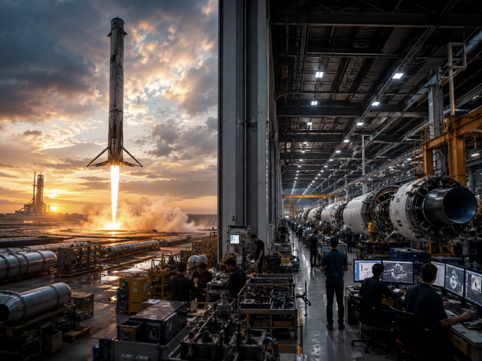 (Image caption) A reusable rocket lands, and in the distance , it is dismantled into an engineering process.
⸻
Musk's premium is also Musk's risk.
What sets Musk apart from ordinary entrepreneurs is that he doesn't just manage markets; he manages boundaries.
He doesn't just pursue efficiency; he pursues moderation.
He doesn't just look at income models; he looks at the path of civilization.
His greatest danger comes from here.
When a person is simultaneously the source of vision, the source of engineering pressure, the center of capital narrative, and the core of corporate control, he is no longer just the founder, but becomes an integral part of the company itself.
SpaceX's valuation includes a significant Musk premium.
The question is, can this premium be institutionalized?
If not, it could also become a risk for Musk.
How does Musk allocate his energy? What are the priorities among SpaceX, Tesla, xAI, X, Neuralink, and The Boring Company? When a company needs capital, computing power, energy, or managerial attention, which comes first? When Musk's public statements, political stances, or platform actions spark controversy, will this controversy affect SpaceX's valuation, government contracts, international markets, and employee recruitment?
These issues are not a denial of Musk personally, but rather the institutional realities that the public market must confront.
For investors, SpaceX is not a simple matter of buying or not buying.
It is a systemic issue.
Do you believe that the cost of space launches will continue to decline?
Do you believe Starlink can maintain its leading position in the global connectivity market?
Do you believe that the shortage of AI computing power will persist in the long term?
Is it acceptable for a company to simultaneously have high losses, high capital expenditures, high concentration of control, and high complexity of related-party transactions?
Would you be willing to entrust your capital to someone who acts almost entirely outside the conventional logic of governance?
These questions cannot be answered with emotions, nor can they be glossed over with the phrase "Musk has accomplished a lot in the past."
Historical success can enhance trust, but it cannot eliminate risk. Engineering marvels can justify valuations, but they cannot replace financial discipline. Founder vision can foster long-termism, but it does not inherently exempt one from governance scrutiny.
A truly mature market should not only cheer when a rocket launches, but also read line by line when the prospectus is opened.
This is the true meaning of the public capital market: it can embrace dreams, but it cannot abandon the pursuit of answers.
The greater a person is, the more they need a system.
Because without a great system, what often results in is not order, but dependence.
⸻
He incorporated the anxieties of the times into the company.
Musk's companies have never been just companies; they are more like containers for the anxieties of our time.
Tesla embodies humanity's anxieties about energy transition, autonomous driving, and the restructuring of manufacturing. X embodies anxieties about social media platforms, freedom of speech, information control, and the boundaries of public discourse. xAI embodies humanity's anxieties about the truth of AI, computing power, model power, and machine intelligence. SpaceX, on the other hand, embodies humanity's anxieties about Earth's boundaries, space colonization, global connectivity, national defense, and the continuation of civilization.
And now, all these anxieties have been packed into the same prospectus.
This is precisely where SpaceX's IPO transcends ordinary financial news.
This is not just a financing event for a single company, but rather the first time that the public market has faced a single issue so collectively:
When someone places space, AI, energy, communications, data centers, social media platforms, and control within the same narrative, how should the market price these elements? How should the system scrutinize them? How should the public interpret them?
Musk has shown us how far into the future one can project.
This also forces us to ask: when someone talks about the future too far ahead, how can the system keep up, how can capital remain calm, and how can the public make a judgment?
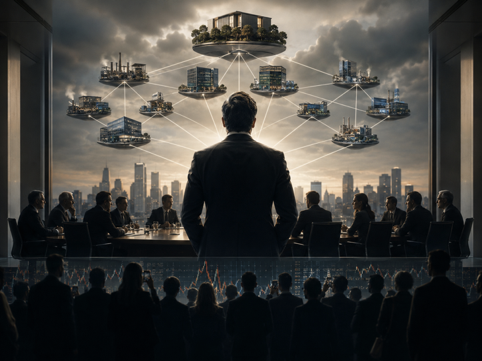 (Image caption) Mars, rockets, and capital constitute Musk's future theater.
⸻
Not because he's always right, but because he's always rewriting boundaries.
In 2002, SpaceX was just a small company without furniture.
More than two decades later, it attempted to enter the public market on an unprecedented scale.
In the meantime, Musk has accomplished many things that others once thought were impossible: reusable rockets, commercial manned spaceflight, low-Earth orbit satellite networks, and giant AI data centers.
However, GFM's assessment of Musk cannot be limited to the word "genius".
Genius is about narrative, not systems.
Execution is a capability, not risk control.
Vision is the fuel, not financial discipline.
What makes Musk truly worthy of study is his constant transformation of new scarce resources into control points for his company: in the past it was battery and electric vehicle manufacturing, then rocket recovery and launch costs, then low-Earth orbit communications, and now it's GPUs, electricity, data centers, and AI models.
He is not competing within one industry, but rather rearranging the institutional relationships between several industries.
The SpaceX IPO is not the end, but rather a recognition by the public market of Musk's institutional experiment and the first comprehensive pricing of Musk's risks.
If the IPO succeeds, Musk will gain more than just $75 billion in capital; he will receive a public market pass to the next stage of his civilization project. If it fails, the market will question not only SpaceX's valuation, but also Musk's entire logic of linking space, communications, AI, energy, and personal control.
In this sense, Musk is not someone who can be easily categorized as either liked or disliked.
He was more like a stress tester for an era.
He pushed humanity's imagination of the future to its limits, and also pushed the system's capacity to withstand individual genius to its limits.
This is precisely why GFM continues to monitor Musk.
Not because he's always right, but because every major thing he does forces the market to re-answer the same question:
In an era of restructuring in AI, energy, space, and capital markets, who has the capability to build infrastructure, and who has the right to control it?
⸻
Disclaimer:
This article does not constitute investment advice, legal advice, tax advice, or any securities recommendation. Information regarding SpaceX's IPO, including offering size, price, trading schedule, business disclosures, governance structure, and contractual arrangements, should be based on the official prospectus, the latest SEC disclosures, exchange announcements, and official company documents. Investors should read the complete prospectus and make independent judgments based on their own risk tolerance.