

Alex Karp: Who is flipping the AI switch for the country?
—Palantir, war, data sovereignty, and a PhD in philosophy redefining technological power
Over two decades ago, in Frankfurt, he researched how aggression exists within communities. Today, his company helps militaries, governments, and businesses sift through vast amounts of data to determine what is important, dangerous, and worth acting upon. This is a very modern form of power. It doesn't exist in uniforms or government badges; instead, it resides in data models, access control systems, algorithms, and software interfaces.
 (Image caption) Palantir CEO Alex Karp is a technology leader with a philosophy background who dominates the global power structure of data and AI.
Starting with a doctoral dissertation in Frankfurt
In the 1990s, a young man from the United States came to Frankfurt and stayed in Germany for nearly five years.
He initially spoke almost no German, yet chose to study social theory at Goethe University. His interests weren't finance, computers, or how to start a tech company. He studied a question that seemed incredibly far removed from Silicon Valley: how a society accommodates conflict, how aggression enters daily life, and how language, culture, and human desires work together to maintain a seemingly stable community.
That young man was Alexander C. Karp.
In 2002, he completed his German doctoral dissertation, *Aggression in the Lifeworld*, attempting to understand the relationship between aggression, language, and culture beyond Talcott Parsons' social theory. For many years, Karp has been described as a student of Jürgen Habermas. This isn't entirely unfounded; he did participate in Habermas's seminars and was influenced by the Frankfurt School. However, later published academic materials and the recollections of his dissertation's first reviewer, Karola Brede, suggest that things were more complex. Karp and Habermas had significant disagreements on several issues, and Brede ultimately continued to supervise the completion of his dissertation.
Looking back on this experience more than two decades later evokes a peculiar historical resonance. The man who once tried to understand "how communities deal with power and conflict" later founded a company whose software began to penetrate intelligence agencies, battlefields, hospitals, corporations, and government departments. The questions Karp pondered in philosophy in his youth have resurfaced before him in a completely unexpected way in the world of technology and power.
Today, this company is called Palantir.
Karp is already 58 years old.
 (Image caption) Exterior view of the main building of Goethe University Frankfurt, where Karp completed his doctoral dissertation on social theory and aggression, laying the foundation for his later thinking on power and community.
He doesn't seem like the founder of Silicon Valley.
Karp was born in New York and grew up near Philadelphia. His father was a pediatrician and his mother was an artist. He has spoken extensively about his severe dyslexia. For a child, it is first and foremost a challenge; for Karp as an adult, it has gradually become a way of understanding himself. He has said that dyslexia makes it difficult for him to follow ready-made "playbooks" and he has to find his own way.
This may explain why he later always kept a distance from the most popular culture in Silicon Valley.
He attended Haverford College and later Stanford Law School. There, he met Peter Thiel. Their political views were not similar. Karp grew up in a progressive environment, while Thiel gradually became one of the most well-known libertarians and conservatives in American technology. They often argued, yet they also saw a similar character trait in each other: a lack of patience for mainstream consensus.
After graduating from law school, Karp neither became a lawyer nor taught at a university. After obtaining his doctorate, he founded a small asset management company, Caedmon Group, in London, managing funds for a group of high-net-worth clients, until Thiel approached him.
At that time, the United States had just experienced 9/11.
PayPal previously encountered a very real problem in its anti-fraud system: computers can process large amounts of data, but struggle to independently understand complex fraud networks; humans can make judgments, but cannot read massive amounts of transactions in a short time. PayPal's final solution was to let the software identify connections first, and then let humans make the decisions.
After 9/11, the U.S. intelligence system faced a dilemma that was somewhat similar, but far more serious. A vast amount of data existed across different agencies, databases, and security levels. The real difficulty often wasn't the lack of data, but rather the inability to readily see the relationships between different pieces of information.
Palantir was born in this context.
Peter Thiel brought his experience at PayPal, capital, and insights into the national security market, while Karp led the company's growth. CIA investment firm In-Q-Tel became one of the early investors, giving Palantir access to real-world intelligence scenarios. Initially, the company didn't have hundreds of millions of ordinary users or popular social media products; its first major clients were governments.
This road is not easy to travel.
For a long time after its founding, Palantir was difficult for outsiders to understand. It required engineers to go deep into client sites, reorganize data scattered across different systems, establish connections, and set permissions. This model seemed neither like traditional software nor a typical consulting firm. When it went public in 2020, the market valued it at almost the same level as it is today.
What truly changed Palantir's fate was not a newly invented technology, but the fact that the world had finally reached the position it had been waiting for for twenty years.
The AI boom is here, and Palantir has been waiting in its data for this.
What initially attracted the world to generative AI was its ability to write articles, answer questions, generate images, and create code. However, once businesses actually began using it, the allure quickly faded.
A global manufacturing company may have decades of ERP data; banks have transaction records and strict permissions; pharmaceutical companies have clinical data; government departments have data with different levels of security; and the military system even contains intelligence that cannot be transferred across networks.
No matter how intelligent an AI model is, it must first know what it can and cannot see, which information is up-to-date, and who has the authority to make the final decision.
This is exactly what Palantir has been doing for many years.
Its most important platforms, Gotham and Foundry, are not primarily about generating beautiful text for clients, but rather about establishing computational data relationships between real-world organizations, equipment, people, orders, assets, and permissions. AIP, or Artificial Intelligence Platform, integrates large-scale models into this system, allowing AI to truly enter enterprise processes without having to hand over all data to a single model company.
By 2026, this capability began to translate into impressive financial figures. Palantir's second-quarter revenue reached $1.935 billion, a 93% year-over-year increase; of which, revenue from the U.S. government business was $809 million, a 90% year-over-year increase, and revenue from U.S. commercial transactions was $764 million, a 149% year-over-year increase. The company raised its full-year 2026 revenue guidance to $8.15 billion to $8.158 billion.
In 2025, the company's annual revenue reached $4.475 billion, with 954 clients, of which 54% came from the government and 46% from the commercial market; U.S. clients contributed 74% of the revenue. These figures demonstrate that Palantir is no longer just a niche software vendor serving intelligence agencies; it is simultaneously entering two huge markets: enterprise and government.
Karp has been talking a lot about the word "Sovereignty" in recent years.
The question he posed to businesses is easy to understand: When companies begin to entrust their supply chains, pricing, engineering knowledge, and customer data to AI, who ultimately owns the corporate intelligence formed from this data? If in the future all core data can only operate within the environment of a single large model company, does this mean that the company is essentially handing over a portion of its competitive advantage to another company?
Palantir puts itself in the middle of this issue. It tells clients that data should remain within the company's own governance framework; models can come in and work, or they can be replaced.
This argument is very appealing to today's CEOs. At the same time, it creates a subtle contradiction: Palantir warns companies against over-reliance on AI vendors, while companies need to entrust Palantir with understanding their most sensitive data structures.
For Karp, trust is no longer just a corporate culture slogan; it has become a true business asset for Palantir.
Data analysis is beginning to approach the battlefield.
The controversy surrounding Karp does not primarily stem from the corporate market.
Palantir's ties to the U.S. government are so deep that it's difficult to understand the company as an ordinary software vendor.
In recent years, the U.S. Department of Defense has been expanding its cooperation with Palantir. Maven Smart System uses artificial intelligence for intelligence analysis and combat support, while TITAN attempts to integrate sensor data from space, high altitude, air, and ground into a single system to shorten what the military calls "sensor-to-shooter" time.
This is an extremely technical military term, but it describes something that is not abstract: after a target is detected by sensors, how the information is identified, analyzed, sent to the command system, and then used for fire control decisions.
The speed of warfare will change once AI begins to enter this chain.
Palantir has consistently emphasized that humans should retain the final judgment. The company has also explicitly stated in its regulatory filings that decisions involving personal freedom, rights, and vital interests should not be entirely delegated to machines; system design must retain human verification, auditing, and accountability. This principle is important, but it hasn't eliminated the systemic problems.
In the past, an analyst might spend tens of minutes or even hours verifying intelligence. When AI compresses the time to a few seconds, the human may still be sitting at the back, but how much time does the human actually have left to question the model, re-verify the data, and understand why the algorithm gave that answer?
On the battlefield, the difference between efficiency and prudence can be as short as a few seconds.
This is where Karp's philosophical question returns. Power can be amplified by technology, but technology itself is incapable of answering the question of to what extent power should be used.
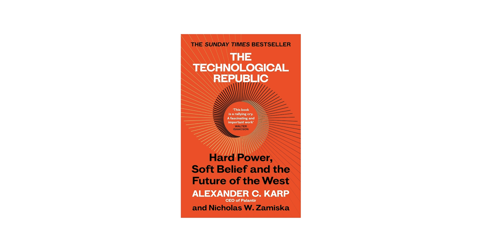 (Image caption) The cover of "The Technological Republic," co-authored by Alex Karp and Nicholas Zamiska, reflects his advocacy for a shift in the technology industry's role to serve national and public missions.
A company begins to participate in the nation's "seeing the world" approach
The most noteworthy aspect of Palantir's relationship with the government goes beyond just the contract amount.
It's easy to understand a government purchasing office software. But the nature of such procurement begins to change when a government gradually integrates intelligence, public health data, military analysis, and administrative decision-making on a platform provided by the same company.
Software has become part of how organizations see the world.
Palantir's competitive advantage is built on this very principle. What's hardest to replace is often not a piece of code, but rather the data structure, permissions, work habits, and processes accumulated over many years. The more deeply a system is integrated into the core business, the more valuable it is, and the harder it is to remove.
The UK has brought this issue to the table in Parliament.
In 2023, Palantir won a £330 million contract with the UK NHS for its Federated Data Platform, designed to help integrate healthcare data. Supporters argue that a unified platform could improve bed utilization, surgical scheduling, and resource allocation, while opponents worry about the increasing reliance on a single US technology company for public healthcare data. In 2026, a cross-party parliamentary committee even described the government's dependence on US technology companies like Palantir as an "unacceptable weakness" and called for a review of contract exit mechanisms.
France chose a different path. In June 2026, the French government confirmed that its domestic intelligence agency, DGSI, would gradually replace Palantir with products from the French company ChapsVision. The replacement would not be completed immediately, as the security agency could not afford a sudden system outage, but the policy direction was clear: in the area of national security, France wanted to reduce its dependence on American software.
The same Palantir technology has thus been interpreted differently on both sides of the Atlantic.
The US sees capability. Europe is beginning to see dependence.
The reason why "digital sovereignty" has become one of the most important terms in the AI era lies precisely in this difference. A country can purchase the best technology, but as the best technology gradually becomes irreplaceable, will it still have complete control over its choices?
Karp is selling more than just software efficiency.
Technology in Immigration, War and Civil Liberties
The most difficult part of Palantir to write is perhaps precisely the part that Karp himself is most willing to discuss.
His intellectual background has long leaned towards liberal and progressive views, and he has consistently emphasized the importance of privacy, civil liberties, and human judgment; however, Palantir is deeply involved in U.S. homeland security, immigration enforcement, military, and intelligence work.
The company has a dedicated Privacy and Civil Liberties Engineering team that strives to incorporate permissions, auditing, data minimization, and human oversight directly into the product design. This isn't just empty corporate rhetoric; it reflects Palantir's awareness of the sensitivity of the issues it deals with.
However, regulations cannot rely solely on corporate self-regulation.
In late 2025, the Congregation of the Sisters of St. Joseph of Peace proposed a shareholder motion to Palantir, demanding that the company release a human rights impact assessment report on its ICE-related business. At the shareholders' meeting in June 2026, the motion received public support from institutions such as the Norwegian sovereign wealth fund NBIM and the New York City Comptroller's Office. ABP, the largest pension fund in the Netherlands, had previously withdrawn its investment in Palantir. Supporters worry that data analytics tools could be used to track, detain, and deport immigrants. Palantir's objection statement argues that the company is bound by confidentiality clauses in its contracts and cannot conduct individual human rights impact assessments for specific business operations. It also states that its cooperation with ICE dates back to the Obama administration, involving combating human trafficking and transnational crime, and that the government is the ultimate decision-maker in law enforcement policy.
The Israeli issue is even more sensitive. Palantir has partnerships with the Israeli government and defense system, and the two sides announced an expansion of these partnerships after October 2023. These operations have drawn criticism from some human rights organizations and institutional investors. Norwegian asset management company Storebrand sold its Palantir shares in October 2024 due to concerns that its products could be used for surveillance in occupied territories, raising humanitarian law risks. Palantir has repeatedly denied allegations regarding its automated target recognition systems, stating that the use of its products must comply with international humanitarian law.
On such issues, the last thing a news organization should do is to rush to a verdict for either side.
Palantir can establish technical security barriers, formulate ethical principles, and retain human verification; however, when software enters warfare, immigration enforcement, and intelligence work, who should be tracked, under what circumstances force can be used, and what information can be obtained by the government are ultimately not software engineering issues.
Those decisions can only be made by the law, the courts, Congress, the government, and democratic institutions.
Businesses can enhance a nation's capabilities, but they cannot thereby qualify to define the boundaries of national power.
 (Image caption) The Palantir Foundry platform data dashboard interface demonstrates how businesses and governments can integrate healthcare, supply chain, and administrative data within a unified architecture, while highlighting data sovereignty disputes.
In addition to corporate sovereignty, there are also the rights of the founders.
Palantir's discussion of sovereignty also includes another layer of structure that is rarely noticed by ordinary customers.
The company's governance is also highly unique.
Palantir has three classes of common stock: Class A, Class B, and Class F. Each Class A share has one vote, each Class B share has ten votes, and Class F shares are placed in a founders' voting trust established by Karp, Peter Thiel, and Stephen Cohen. Under certain shareholding conditions, this arrangement allows the founders to control up to nearly 49.999999% of the total voting power. Palantir even explicitly acknowledges in its SEC filings that this structure allows the founders to maintain effective control over board elections, major corporate transactions, and other shareholder matters for the foreseeable future.
For a typical technology company, multiple voting rights are primarily a corporate governance issue.
Palantir's situation is more delicate.
When a company is simply selling software products, the founder's control mainly involves shareholder interests; as its products gradually enter the military, intelligence, public health, and government decision-making fields, the company's governance takes on an additional layer of public significance.
If society starts asking "who can oversee Palantir," the problem isn't just outwards.
Within Palantir, how many people can say no to the founder's judgment?
This does not mean that Karp or its founders will necessarily abuse their power. Institutional design is never based on the assumption of "whether a person is trustworthy." A mature system is important precisely because it needs to work with good and bad people, in good times and in crisis, today and twenty years from now.
Karp probably understands this better than many tech CEOs. He's read enough political philosophy to know that the most dangerous time for power is not when someone publicly announces they're going to abuse it, but when everyone believes they're doing the right thing.
 (Image caption) U.S. military personnel operating an AI intelligence analysis interface, symbolizing the "sensor-to-shooter" process by which systems like Maven rapidly import sensor data into operational decisions.
The PhD in philosophy eventually encountered his own philosophical dilemma.
Karp's recent ideology has changed significantly from his earlier leftist image.
He co-authored "The Technological Republic" with Palantir executive Nicholas Zamiska, offering a near-anti-Silicon Valley critique of the US tech industry. They argue that while decades of engineering and capital have been poured into advertising, consumer products, social networks, and convenience, tech talent has increasingly drifted away from defense, industry, and public service.
Karp doesn't believe that tech companies can stand outside of countries forever.
The Russia-Ukraine war, the US-China tech competition, cyberattacks, and the restructuring of global supply chains have given this idea a wider market. Silicon Valley used to regard "Don't be evil" as its moral stance, but now more and more companies are beginning to re-examine an older and more difficult question: If democracies don't possess the most advanced technologies, then who will?
Karp's answer was very clear. He supported Western countries maintaining their technological advantage and was willing to let Palantir directly serve this goal.
This garnered him support, but also drew criticism.
But the most valuable part of his story is not whether we ultimately choose to support or oppose him.
What's truly worth studying is the evolving relationship between the technology industry and the nation-state.
Twenty years ago, the most powerful internet companies were primarily competing for user time, advertising, and consumers.
Today, some AI companies are vying for government budgets, defense contracts, public data, and national infrastructure.
The company's power began to expand along another path.
Palantir was just one of the first companies to get there.
Who will see Palantir?
Palantir in 2026 is difficult to fit accurately into a traditional category.
It has the high profit margins of enterprise software companies, government contracts from defense contractors, the growth narrative of AI companies, and an asset that other software companies find hard to replicate: the trust, data structure, and institutional stickiness accumulated through long-term involvement in the core processes of governments and large enterprises.
The company's revenue is $4.475 billion in 2025, and by the second quarter of 2026, quarterly revenue had reached nearly $1.94 billion. This growth will attract the attention of all capital markets.
However, the real reason why Karp deserves to be included in the "People" section is not because Palantir's market value might rise further.
More than two decades ago, he studied in Frankfurt how aggression exists within communities. Today, his company is helping militaries, governments, and businesses sift through vast amounts of data to determine what is important, what is dangerous, and what is worth acting upon.
This is a very modern form of power. It has no military uniform or government insignia; instead, it exists within data models, permission systems, algorithms, and software interfaces.
Therefore, the real question left by Alex Karp should perhaps be asked in reverse: when Palantir helps the country see more, who will see Palantir?
Who can know how its system influences decision-making? Who is qualified to audit it? Sometimes, national security demands speed, businesses demand efficiency, and citizens demand privacy—these three are difficult to satisfy simultaneously. In such situations, should the decision-makers be the engineers who write the code, the people sitting on the board, government officials, or ultimately the democratic system itself, accountable to the voters?
These questions won't appear in any of Palantir's product demo images, nor can they be solved by larger models and more computing power. Ultimately, they still need to be answered by humans.
That young man who once went to Germany to study society, language and aggression, after more than 20 years, may have finally returned to the question he initially faced: When a community gains more power, how can it ensure that this power is still restrained?
This time, however, it is not a doctoral dissertation.
It's happening in the real world.
Disclaimer
This article is based on publicly available information, regulatory documents, and company disclosures as of the time of writing. It is intended for research on individuals and analysis of systems and does not constitute investment, legal, political, or transaction advice. Related contracts, policies, and business practices are subject to change.