

Why should we commemorate Charlie Kirk?
A year after Charlie Kirk's passing, I still want to write about him. A person's life deserves a more complete record than political labels. Starting at 18 and ending at 31, he left behind a career and controversy, a wife and two young children, and his wife's words of profound grief: "I forgive him." As a journalist and a Christian, I want to rethink a question that transcends politics: life is so finite, how do we face differing opinions, how do we cherish those around us, and how do we prevent hatred from defining the rest of our lives after being hurt?
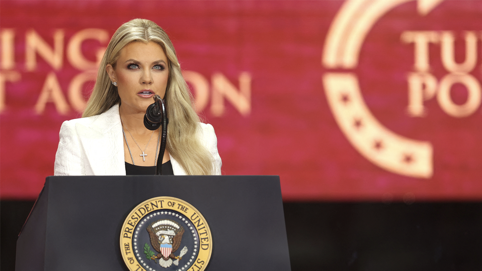 (Image caption) On September 21, 2025, Erika Kirk speaks at a memorial service at State Agriculture Stadium in Glendale, Arizona. Eleven days after her husband's murder, she said "I forgive him" on the podium. This article uses this as a starting point to re-document Charlie Kirk's life and reflect on forgiveness and public life.
Eleven days after her husband's murder, a simple "I forgive him" left the living with the difficult questions of faith, life, and forgiveness.
On September 21, 2025, Erika Kirk stood on the stage at State Farm Stadium in Glendale, Arizona, for her husband's memorial service. Eleven days earlier, her husband, Charlie Kirk, was shot and killed at a public event at Utah Valley University at the age of 31.
Speaking of the man accused of murdering her husband, Erica said, "I forgive him."
Later, I read that speech repeatedly, and what kept me stopping was always those four words. I am also a Christian. I know how the Bible talks about forgiveness, and I've read verses like "Love your enemies and pray for those who persecute you." But sitting at my desk understanding a passage of scripture and saying "I forgive him" eleven days after her husband's murder are worlds I haven't experienced. That's why I'm unwilling to measure Erica's pain for her, and I dare not rashly say that if the same thing happened to me, I could definitely do it.
September 10, 2026, will mark the first anniversary of Kirk's passing. As the founder of a financial media outlet, I still decided to write about him. Wealth, position, market capitalization, and market influence are only part of measuring a person's life. A person's life also exists in what they believed, what they built, and who they influenced; it also exists in the controversies they sparked, the opposition they faced, and the unanswered questions they left for their family and society after their death.
Kirk's political views, public statements, and political influence can and should be examined. Remembering him does not require anyone to accept every word he said; criticizing his views does not need to erase the real parts of him as a husband, father, and a life he once lived. This is the measure I hoped to maintain when writing this article, and it is also the reason why GFM preserved it as a biographical record.
Eighteen-year-old Kirk, and those who were willing to listen to a young man finish speaking.
In 2012, 18-year-old Charlie Kirk began establishing what would later become Turning Point USA (TPUSA). William “Bill” Montgomery, a much older retired businessman and Tea Party activist, played a crucial role in the organization's early days. Kirk later recalled that that same year, while seeking support in Tampa with Montgomery, he met investment manager and Republican donor Foster Friess and presented his idea. A few weeks later, Friess provided TPUSA with $10,000 in early funding.
While there is other publicly available information to support this $10,000 donation, the details of their initial meeting and conversation, and how Kirk introduced TPUSA, are primarily based on Kirk's own recollections. Therefore, I'm reluctant to embellish it into a completely reconstructed teenage entrepreneurship saga. What truly captivated me was a very ordinary detail in the story: an 18-year-old approaching people with an unproven idea, and someone willing to sit down and listen to him finish.
Anyone who has ever started a business knows that the hardest thing to obtain is often not the large sums of resources that come later, but rather the person who was willing to believe in you from the very beginning. At that time, there aren't many achievements to show for yourself, no impressive data, and you might not even be able to fully predict where the business will ultimately lead. The fact that someone is willing to listen attentively to your ideas is itself a form of support.
So when I read about Kirk's experiences at 18, I wasn't thinking about how to mold him into a role model of teenage success, but rather how we treat young people just starting out today. When someone in their early twenties presents a still-rough idea, do we immediately tell them "you don't understand," or are we willing to listen for another ten minutes? Is anyone willing to give someone with no impressive resume, no resources, and who can't even fully answer all questions a chance to try for the first time?
Kirk's later path cannot be simplified to that $10,000. Montgomery, Fries, and later colleagues, supporters, and donors who joined the organization all became part of this history. Human growth is rarely truly achieved in isolation, and there shouldn't be only one standard answer to a young person's life. Some found organizations, some pursued academic research, some taught, worked on projects, or cared for their families, while others simply focused on doing their first job well. What's worth reflecting on from Kirk's story isn't whether every young person should become another Charlie Kirk, but rather whether a person has the courage to begin forming their own thoughts, and whether there are adults around them willing to listen to them finish speaking.
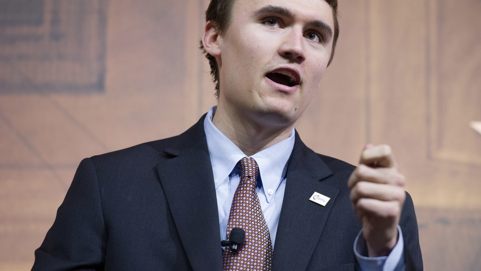 (Image caption) Charlie Kirk around 2015. The article recounts how he founded Turning Point USA in 2012 when he was only 18 years old, and emphasizes that what is truly worth remembering is not the embellished teenage legend, but a young man who approached people with an unproven idea, and who were willing to listen to him finish speaking.
A table and a microphone became Kirk's way of entering American campuses.
Kirk's later most recognizable public image was actually quite simple: he would sit on campus with a table and microphone in front of him, inviting those who disagreed with him to come up and ask questions, rebuttals, or even challenges. These exchanges were filmed and disseminated via YouTube and other social media; TPUA, in turn, brought some of the viewers into the real organization through campus chapters, training sessions, and large events. This combination of online dissemination and offline organization later became one of the important forms of youth mobilization for TPUA.
Watching a film and actually engaging in public life are two different things. The former may only require a few minutes of attention, while the latter requires collaborating with others, organizing events, taking responsibility, and means that one day you must stand in front of a crowd and explain your reasons.
However, I also don't want to romanticize this kind of campus clash. A public figure who is already familiar with the camera, masters the rhythm of debate, and has a large platform, and a college student stepping in front of a microphone for the first time, do not have the same level of preparation. A short, edited video intended for dissemination cannot replace a complete discussion of ideas.
Having worked in media for a long time, I've become increasingly skeptical that "speaking loudly" equates to "speaking correctly." While those with microphones certainly have the right to express themselves, the more difficult thing is to remain willing to listen to those without microphones when you yourself have one.
Therefore, the true value Kirk left to young people should not be determined by a film depicting "who won the argument." I am more concerned with whether a person can clearly articulate their reasoning, accurately understand what the opponent is saying, and is willing to examine the evidence they rely on; and whether they retain the ability to revise their judgment when new facts emerge. Public discussion does not require us to arrive at the same answer; what it tests is whether, after differing answers, we still acknowledge the other party's right to continue speaking.
Even when writing a commemorative article, the controversy surrounding him cannot be removed.
When writing about the controversies surrounding Kirk, I did ask myself: was it necessary to rewrite these events in a memorial article marking the first anniversary of his death? In the end, I decided to leave it out. Because if we have to delete someone's controversies before we're willing to commemorate them, what remains might not be the real person.
In 2016, TPUSA launched the "Professor Watchlist," stating its purpose was to document professors accused of discriminating against conservative students or promoting left-wing ideology in the classroom. Supporters argued that students have the right to publicly criticize ideological bias in universities; however, organizations such as the American Association of University Professors (AAUP) criticized the practice, arguing that some of the listed materials involve professors' social media posts or academic publications, which cannot directly prove classroom discrimination and could expose individual professors to online harassment.
This controversy raises a question that remains relevant today: When we demand freedom of speech for ourselves, are we also willing to extend that same freedom to those we dislike? When we publicly scrutinize others, how should we verify evidence, correct errors, and prevent criticism of viewpoints from escalating into intimidation?
Kirk's remarks on race and civil rights have also drawn strong criticism. In 2025, FactCheck.org, part of the Annenberg Public Policy Center at the University of Pennsylvania, confirmed during a review of records that Kirk had called the passage of the Civil Rights Act of 1964 a "major mistake," linking his reasoning to the later development of the Diversity, Fairness, and Inclusion (DEI) system and what he perceived as issues of free speech.
The same investigation also found that some of the accusations against Kirk online after his murder were inaccurate. A widely circulated video was interpreted as him using anti-Asian slurs, but the full context shows that he was actually calling out the name of his debate opponent, Cenk Uygur.
I believe both of these aspects should remain in the biographical record. The media cannot erase genuine controversies simply because someone has passed away; nor can they attribute untrue events to someone simply because they disagree with their political views. Facts should not be rearranged according to our likes or dislikes of a person.
His death did not make every word he uttered during his lifetime correct, nor could the most scathing criticism of his statements justify taking his life. These two things are not contradictory.
 (Image caption) Charlie Kirk sits at a table during a campus event, holding a microphone and speaking to students who come to ask questions. This is his most well-known public approach: bringing a table and microphone onto campus and inviting those who disagree with him to come forward and refute him. The article uses this to discuss the boundaries between expression, listening, and public discussion.
Beyond his political label, he is also a husband who writes notes to his wife on Saturdays.
Politicians can easily end up with only one set of labels: conservative activist, commentator, youth organization leader, Christian. But death often allows us to see a life beyond those labels.
Kirk left behind his wife and two young children. In her memorial speech, Erica recalled that her husband would write her a love note on Saturdays, recording the events of the week and expressing his gratitude to his wife and children.
We can't know the whole story of a marriage from a single note, nor is it necessary to imagine anyone's family to be perfect. But I'm willing to record this detail because when the political noise temporarily subsides, a note from a husband to his wife sometimes reveals more about a person's daily life than a thousand social media posts.
Kirk's posthumously published book, *Stop, in the Name of God: Why Honoring the Sabbath Will Transform Your Life*, offers another entry point into understanding him. The book discusses the Sabbath, and temporarily disconnecting from phones, news, and social media to reclaim time for faith, rest, and family.
For me, there is a contrast that is hard to ignore: a person who built his career by constantly speaking, constantly appearing in front of the camera, and constantly responding to public events left behind a book in the last stage of his life that talked about "stopping".
As a media founder, I understand the kind of life where it's hard to truly stop. There's never a day when the news is finished; today's article is published, and tomorrow there will be new events; one feature is just completed, and the next issue has already arisen. It's easy to tell ourselves, "I'll spend time with my family after this busy period," "I'll rest when the media situation stabilizes," "I'll give my time back to life when things calm down."
But as people get older, they gradually realize that many things at work can wait until tomorrow, but what truly cannot be scheduled is time spent together. A meal not finished today, a word not spoken, an afternoon not spent with family—there may never be a next time.
I wouldn't conclude that Kirk had resolved all the conflicts between work, family, and faith just because of a book about the Sabbath. But the sudden end of a 31-year-old life certainly gives a different weight to the seemingly ordinary thing of "stopping".
"I forgive him": Forgiveness is her choice, and it shouldn't be a lesson that other victims must learn.
In her memorial speech, Erika connected her forgiveness to the teachings of Christ and expressed her belief that her husband would make the same choice. This latter point reflects a wife's understanding of her husband, something we cannot verify for the deceased Kirk; but her own choice is enough to give me much to ponder.
I respect her, but I don't want to turn that respect into a lesson that other victims must learn. Some people may need many years to cope with the trauma, and some may never be able to say "forgive." Faith, if it loses its understanding of human weakness, anger, and pain, can inadvertently become another form of pressure.
So I don't want to ask why others can't do what Erica did. I'd rather keep the question to myself: If one day faith is no longer just a passage of scripture I hear on Sundays, but truly comes to the places in my life I'm least willing to forgive, how will I cope?
I wish I had that kind of faith, but I dare not answer for myself in advance.
Forgiveness is a matter of the human heart; legal responsibility must still be determined by evidence and the court.
Forgiveness does not absolve legal responsibility. As of this writing, Tyler Robinson, accused of murdering Kirk, has pleaded not guilty to all seven charges, including aggravated murder. On September 1, 2026, Utah Judge Tony Graf ruled that the prosecution's evidence was sufficient to proceed to trial, but the prosecution is still seeking the death penalty. The trial is not yet complete, and Robinson's criminal responsibility will ultimately be determined by the court according to law.
The Kirk family's lawyers also served notice of claim to the University of Utah Valley and the state of Utah in September 2026, arguing that there were shortcomings in the security arrangements for the events surrounding the incident. This is a procedural step before formally filing a lawsuit, and the claims have not yet been adjudicated by the court. Criminal cases and this civil claim have their own standards of evidence and legal procedures, which cannot be replaced by the emotions expressed at a memorial service.
This is also the line I hope to uphold when I understand Erika's statement, "I forgive him." Forgiveness belongs to one's faith and heart, while the judiciary belongs to the public system. An individual can decide not to let hatred continue to control their life, but the state still has the responsibility to ascertain the facts, and the courts must still determine responsibility based on evidence. Both can coexist.
Her husband won't come home because of forgiveness, and the fact that her child has lost her father won't change. Erica can only decide how she chooses to live with this loss. Bystanders should be especially cautious: the law requires evidence, grief requires time, and faith is a path each person must walk alone. We have no right to dictate when the victim should be angry, when she should forgive, or how she should remember those she has lost.
 (Image caption) September 10, 2025, a public event in the courtyard of the University of Utah Valley campus. Approximately 3,000 people gathered that day, and Kirk was shot and killed while speaking in front of the "Prove Me Wrong" tent. The image depicts the actual campus environment where the incident occurred, echoing the article's statement: the shooting ended one person's life, but it did not end the divisions on campus.
The shooting ended one life, but it did not end the divisions on campus.
Life goes on at Utah Valley University and for those present that day, following Kirk's murder. The FBI established a family support channel for those affected; some survivors later spoke publicly about the psychological stress, cyberbullying, and unresolved memories of the shooting. These experiences vary, and no single account can represent the entire campus, but they serve as a reminder that the consequences of public violence extend far beyond the day of the incident.
By September 2026, the first anniversary, divisions remained. Some attended memorial events, some continued to support the organizations Kirk left behind, and some students publicly protested the memorial arrangements. Turning Point USA continued to operate and expand after Kirk's death, and the youth involved in the movement did not develop a completely unified political judgment.
If commemoration can only accommodate agreement, it easily degenerates into another form of political mobilization; if criticism requires first denying the value of a person's life, it also causes public discussion to lose its most basic human standards. Opinions on Kirk can continue to differ, and likely will remain so for many years to come. The media has no need to prematurely end these debates for the next generation.
What I'm more concerned with is whether, after reading his story, a person is willing to rethink how they participate in public life. If you disagree with someone, you can refute their arguments; if you think their data is wrong, you can provide more reliable evidence; if you oppose their political views, you can vote, write, debate, protest peacefully, or choose to walk away. These methods are sometimes slow and may not provide immediate satisfaction, but they at least acknowledge one fundamental thing: the person standing opposite us is still a human being.
Over the years in journalism, I've become increasingly convinced that many important things in public life are slow. Verifying a fact is slow, building trust is slow, and understanding someone with a completely different perspective is slow. Violence, however, is incredibly fast; it only takes seconds to permanently rob a person of the opportunity to speak, explain, and accept rebuttal.
Therefore, we cannot allow violence to dictate the conclusions of public discussion.
Why would a financial media outlet preserve Charlie Kirk's story?
Having written this far, I can finally answer the question posed at the beginning of the article: Why would a financial media outlet write about Charlie Kirk in its "People" section?
I don't want to deliberately convert his life into organizational size, fundraising amount, traffic, or political influence just to prove that this article belongs to financial media. GFM studies markets, capital, companies, and institutions, but the longer I work in media, the clearer I become that these grand terms ultimately come down to specific people. Markets need trust, companies rely on contracts, media need facts, and a well-functioning society also needs to leave public space for different opinions.
If these most basic conditions are not met, even the most sophisticated market system will find it difficult to function in the long run.
Therefore, my inclusion of Kirk in GFM's biographical section is not intended to make a final judgment on his political career, nor does it hope that readers will become his supporters or opponents because of this article. Political judgment should be left to the readers themselves.
I hope to leave behind a more complete person.
At 18, he began doing something no one knew how far it would go. He met adults willing to listen to him and offer help, gradually building his own organization and public influence. He went into schools, arguing with those who disagreed with him, leaving behind statements and actions that are still criticized today. He became a husband and father, writing notes to his wife on Saturdays, and also wrote a book about rest, family, and faith. Then, at the age of 31, his life abruptly ended.
Only by putting all these factors together can we get closer to understanding the real person. His death should not rewrite his history, nor should his controversies prevent us from acknowledging that the end of a 31-year-old life was a tragedy.
Ultimately, we are commemorating a human life.
If, many years later, an 18-year-old happens to read this article, I hope he doesn't see a life path he must follow, but rather a young person's thoughts, however rough, that are worth taking seriously. If he's lucky, he might meet an adult willing to sit down and listen to him finish speaking. And when you one day have a microphone, resources, or power, don't forget to give others the same opportunity to finish speaking.
It's important to bravely express your own opinions, and equally important to be willing to accept rebuttals. In life, we'll say some things right and some things wrong. The ability to retain is the capacity to correct oneself in the face of new facts and to still acknowledge the personality and dignity of others even in heated disagreements.
Now that I'm this age, looking back on a life that ended at 31, there are many things that are far more ordinary than politics. Career is important, of course, and ideals are important too. The companies, works, and influence we strive to build every day all have their own value; but a person's life is not ultimately composed of just these things.
And the meals we ate together, whether we spent quality time with our parents, whether we remembered our wives and children even when we were busiest, whether we thanked those who helped us, and whether we expressed our love while there was still time.
These things rarely make the front page of the news, nor do they appear in any company's financial statements. But after a person is truly gone, they often become the things that their family keeps the longest.
So, that note I wrote to my wife on Saturday has stayed with me. It reminds me of myself, and of many others like me who are busy with work every day, always feeling like there's so much to do tomorrow. We always think we have plenty of time. The news will still happen tomorrow, and the work will still be unfinished, but the people around us shouldn't always be relegated to "after we're done."
This is probably the most personal and simple reminder that Charlie Kirk's 31 years of life left me with.
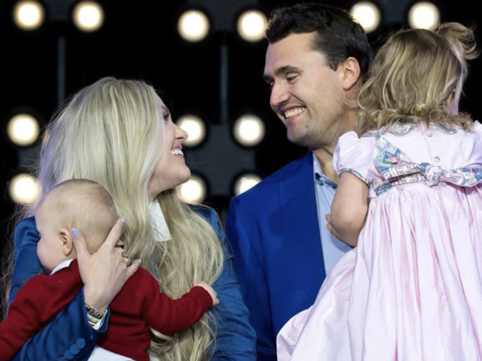 (Image caption) Charlie Kirk with his wife Erika and their two young children in a public photo. The article states that beyond his political labels, he is also a husband and father who writes notes to his wife on Saturdays; family details may not make a perfect story, but they bring the commemoration back to a specific person, rather than a set of positions.
In the end, I still come back to "I forgive him".
I started writing this article because of those four words Erica uttered. Having traced Kirk's life from his 18th year, through his career, controversies, family, faith, and death, I found myself ultimately returning to the same question.
"I forgive him."
I don't know if, one day, life were to present me with the same cruel question, I would be able to utter those four words. I wish I had that kind of faith, but at this age, I'm even less willing to feign courage for a life that hasn't yet unfolded. Some answers can never be truly known by sitting at a desk; only those who have walked that path can provide them.
Charlie Kirk can no longer answer anyone's questions. His words can still be examined, and his political legacy will continue to be evaluated by supporters, critics, and subsequent research. These debates do not need to end with a memorial article.
But there are some things that you don't need to determine your political stance to understand: a 31-year-old man dies, a wife loses her husband, two young children lose their father, and every September 10th thereafter, a family will know what this day means.
As a Christian, I am willing to pray for this family; as a media professional, I am willing to preserve the facts that can be verified, as well as the controversies; as someone who also has a family and a career, and knows that life will not always go according to plan, I am even more willing to remind myself not to wait until I lose something to realize what cannot be regained.
This is also my current understanding of "commemoration".
We don't need to portray Charlie Kirk as a hero, nor do we need to set aside criticism of him simply to commemorate him. Commemoration is acknowledging that a real and complex person once lived in this world. He believed in things, acted on them, built organizations, loved his family, and said things that caused great controversy; now his life is over, but we are still alive.
Those who are alive still have choices. We can decide how to treat those who disagree with us, how to use the microphone in our hands, how to face the facts, and how to cherish the people around us. When harm truly comes, we will ultimately have to answer for ourselves whether we want to let hatred dominate our entire lives thereafter.
I don't have that answer. But I'm willing to remember the four words Erica said, and I'm willing to let this question continue to remind me how to live.
That's why, a year later, I'm still willing to write about Charlie Kirk, and why I'm commemorating him.
Disclaimer
This article, based on publicly available information, conducts research on individuals, analyzes public events, and reflects on the author's personal beliefs. It is intended for news research and informational reference only and does not constitute legal, political, or investment advice. Related criminal cases, civil claims, and legal liabilities are subject to judicial proceedings; the religious views expressed in this article represent only the author's personal understanding.