

Two car manufacturers, and the same credit test.
Jia Yueting and RJ Scaringe: Why GFM puts two electric car founders together for reading.
Jia Yueting and RJ Scaringe are not people who should be put together.
One came from the noisiest era of the Chinese internet, carrying the legacy of LeEco, its ecosystem, capital frenzy, debt pressure, and the credit shadow that stretches across the Pacific; the other started from MIT's automotive lab, quietly building cars in factories in the American Midwest, not saying much, and spending most of its time behind the products and production lines.
One with such a fascinating story.
It doesn't quite feel like a story.
But in the end, the process of building cars will smooth out many of these differences.
It doesn't care where you come from, nor how dazzling or low-key you were in the past. When the car is actually built, delivered, running on the road, undergoing maintenance, facing users, and bearing the scrutiny of financial reports and the market, all founders will be put to the same test.

(Image caption) Jia Yueting (left) and RJ Scaringe (right) – two car makers with completely different personalities and backgrounds, yet facing the same "credibility test".
There was only one question on that exam paper:
Can the future you've described become a deliverable, usable, and sustainable reality?
This is why GFM put Jia Yueting and Scaringe together.
This isn't about comparing who's more successful, nor is it about creating a comparison chart between Chinese and American founders. Such comparisons are too easy and too crude. What's truly worth watching is how two people with drastically different personalities, backgrounds, and circumstances are gradually shaped by the same industry, the same capital market, and the same manufacturing logic.
Jia Yueting's story is first and foremost a story about "narrative".
During the LeEco era, his greatest strength wasn't in creating single products, but in integrating numerous products into a larger system. Video, television, mobile phones, sports, finance, and automobiles were all incorporated into the concept of "ecosystem." Looking back today, that term wasn't just a business concept, but also a sentiment of the times. It was an era when the Chinese internet believed that speed, access points, capital, and user scale could rewrite everything.
Jia Yueting pushed that emotion to the extreme.
What happened next is well-known: LeEco crisis, debt pressure, going to the US to make cars, Faraday Future, bankruptcy reorganization, SPAC listing, regulatory inquiries, governance controversies, and today FF's renewed shift towards EAI, Physical AI, and embodied intelligence.
For Jia Yueting, his most valuable ability is that he can always see the next industry trend earlier than many others.
But that's also where his greatest risk lies.
Because the market initially rewards imagination, and capital is willing to bet on the future; however, once imagination is capitalized, it is no longer just a vision, but a promise. If a promise is not delivered and fulfilled, it will turn into debt, into lawsuits, into regulatory documents, and into repeated questioning from investors and creditors.
Jia Yueting is not unaware of the future.
His problem was that he saw things too early, talked too big, and moved too fast, while car manufacturing is a very heavy undertaking. It's not like an internet product, which can be launched first and then patched up; it's not like a press conference, which can use emotions to create a climax; nor is it like a grand strategic article, which can first present a coherent logic. Cars need to be produced, put on the road, carry people, be safe, be maintained, be delivered, be audited, and be weighed in financial statements.
Scaringe 's story is completely different on the surface.
He didn't gain popularity through grand ecological narratives. Rivian wasn't born amidst a flurry of enthusiastic rhetoric. It's quieter and more grounded: electric pickup trucks, SUVs, commercial vehicles, outdoor lifestyle, Made in the USA, factory ramp-up, supply chain, and cost control. Putting these words together doesn't evoke much of a legendary aura, but they're closer to the essence of car manufacturing.
Scaringe has products, factories, car owners, and public market status. Rivian isn't just a car company on paper. But the real test begins precisely because it has actually delivered cars.
The public market won't relax its scrutiny of a company just because its product design is beautiful. It looks at production volume, delivery volume, gross profit, losses, cash flow, inventory, and the timeline for the next model. It doesn't oppose idealism, but it demands that idealism be backed by numbers.
Scaringe's problem is not whether it has a past credit burden, but that its future is too heavy.
He doesn't need to deal with a historic credit repair like Jia Yueting did; but he must prove that an engineer-founder can lead a good product to sustainable operation. This is equally difficult. The car manufacturing industry has a quiet cruelty: it may not make you collapse overnight, but it slowly wears you down with each quarter, each production line, and every cost detail.
Therefore, the true reflection of two people lies not in their personalities, but in their trustworthiness.
What Jia Yueting needs to do is rebuild trust.
Scaringe 's job is to maintain credit.
One question is to answer the market: can the stories we've told in the past be proven again with today's deliveries?
One must answer the market's question about the future: can the products already delivered transform a company into a truly stable enterprise?
These two questions are different, but they lead to the same core: founders cannot live off their vision forever, and companies cannot live off the next round of funding forever.
What's even more interesting is that both of them are moving towards AI.
Jia Yueting proposed EAI, Physical AI, embodied intelligence, and robotics education from FF's predicament. This seems to be his consistent approach: finding the next entry point from a huge new term, reorganizing imagination, and also reorganizing the market's attention to him.
Scaringe's Mind Robotics takes a different approach. It didn't start with a concept, but rather stemmed from questions arising in Rivian's factories: Which processes still rely on human labor? Which workflows are difficult to automate? What manufacturing pain points require smarter industrial robots?
A journey from narrative to AI.
A journey from factory to AI.
This difference is more noteworthy than "who understands AI better".
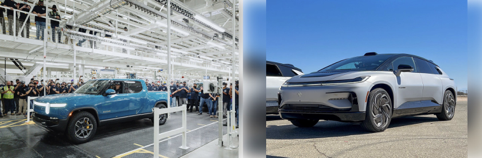
(Image caption) Rivian factory production line and Faraday Future FF 91 real car - the ultimate test of car manufacturing is not narrative, but the hard power of delivery, factory and sustainable operation.
For electric vehicle founders, AI represents both a new growth curve and a new allure. When vehicles are too heavy, factories too slow, and capital too eager, AI can easily become a new outlet. It could be a genuine industrial upgrade, or it could simply be a narrative shift. The criteria for judgment remain not language, but rather product, revenue, customers, delivery, and the boundaries of responsibility.
This is why GFM chose to write about these two people from an institutional perspective.
Electric vehicle companies are not ordinary technology companies. They are subject to scrutiny from several systems: manufacturing systems examine your factories, quality, and supply chain; capital systems examine your financial statements, financing, and shareholder trust; and public systems examine your governance, disclosure, safety responsibilities, and creditor relations.
Jia Yueting and Scaringe were simply brought to the forefront in different ways by these different systems.
One repaired the past through cracks.
One that bears the future in deep water.
GFM's "People" section doesn't write about them to create biographies after the game is over. Quite the opposite, they're all still taking tests. FF is still searching for a new business model, Rivian is still navigating manufacturing and cost pressures, and AI and robotics are just beginning their new chapters.
The press conference simply involved turning on the lights.
What truly determines the fate of car manufacturers is what happens after the lights go out: whether the production line can still run, whether suppliers are still willing to wait, whether users will still trust the company when they open their car doors the next morning, and whether the numbers on the financial statements can gradually look better.
Dreams are never wrong.
Without dreams, no one would enter such a demanding, difficult, and expensive industry.
But dreams are just the beginning.
What car manufacturers really need to deliver is not a grander narrative, but more solid evidence.