

The fireworks on July 4, 2024, illuminated my connection with America.
Written on the occasion of the 250th anniversary of the founding of the United States and the second anniversary of my arrival in the United States
Editor's Note:
On July 4 , 2024 , Kevin Guo and his family arrived in Los Angeles. Before their luggage was even properly placed, fireworks were already lighting up the city's celebrations for American Independence Day outside the window.
Two years later, coinciding with the 250th anniversary of the founding of the United States, he wrote this piece as the founder and publisher of GFM Global Financial Media Group. It wasn't to commemorate a holiday, but to look back on a journey from silence to writing.
This article shouldn't be categorized as a personal interview, nor is it a festive piece. It's more like a founder's personal notes — how a media professional who was once forced to put down his pen, after picking it up again in a foreign country, gradually came to understand why a free system is precious, why journalistic responsibility is heavy, and why GFM must set off at this time and in this place.
The birth of a media outlet is rarely just the start of a business. Behind it often stands a person's entire experience — the losses they've suffered, the beliefs they've held, and the stubbornness they still harbor towards public responsibility. GFM 's "People" section publishes this article to tell readers that the sense of proportion and restraint in the stories of the people we write about can actually be traced back to this. To truly understand GFM , perhaps we must first return to that night that arrived with the scent of fireworks.
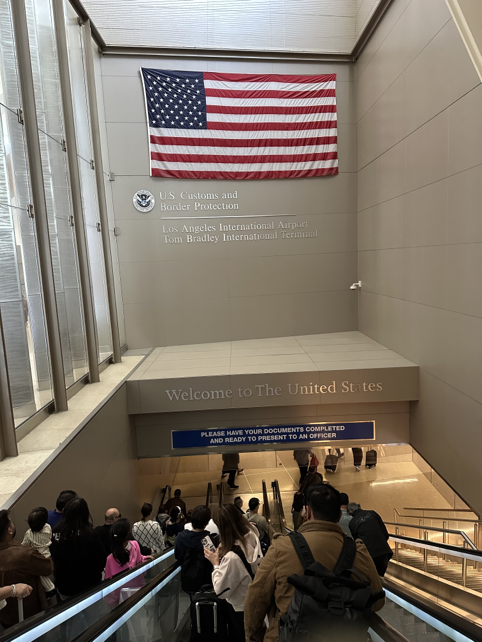 (Image caption) On July 4, 2024, American Independence Day, my family and I arrived at Los Angeles International Airport. Flying across the Pacific Ocean from Hong Kong and setting foot on American soil marked the beginning of a new journey to rebuild my life and GFM.
On July 4, 2024, my family and I landed at Los Angeles Airport.
It was a night after departing from Hong Kong and flying across the Pacific. The long flight was tiring, and jet lag was still weighing me down. I pushed my luggage, following the flow of people out. The airport was brightly lit, and the air had that dry, expansive quality unique to unfamiliar cities. At that time, I didn't have many grand pronouncements, nor did I have any clear blueprint for the future. When one truly reaches a turning point in life, the heart is often very calm.
Leaving the airport, the car drove onto the roads of Los Angeles. Night had fallen. Fireworks rose in the distance, one after another, blooming in the California night sky. Red, gold, blue—some were close, some were far away. Outside the car window was the festive atmosphere of American Independence Day; inside, my family and I were silent, having just arrived in this country.
I know those fireworks weren't for me. They belonged to America, to this country's birthday, to the commemoration of independence, freedom, family, and homeland every July 4th.
But for me, the fireworks that night did indeed illuminate another path.
Two years have passed. On July 4, 2026, the United States will celebrate its 250th anniversary. I, too, will be on this land, marking my second year in the United States. The time is short, but enough for one to understand that starting over is never just a nice phrase. It's not as simple as moving to a different place, nor is it as easy as simply leaving the past behind.
A true fresh start is waking up every morning to still face language, identity, family, bills, work, children, direction, and a deep sense of uncertainty. You know what you've been through, but you can't always look back. You know what you've lost, but you can't let loss become your only identity.
The past experiences are too heavy, too deep, too unforgettable; I don't want to go into details here. I increasingly believe that if a person is constantly defined by their wounds, it's difficult to truly reach the future. I prefer to keep the past deep within my life. It reminds me of what silence is, what loss is, what the crushing power of the individual is, and it also reminds me of what true freedom is. This freedom is not a slogan, not a banner, not a holiday speech; it's the ability to rewrite, to start a media outlet, to openly discuss systems, and to transform one's own experience into public responsibility.
The United States never promised me success. It simply gave me the institutional space to start over. That was valuable enough.
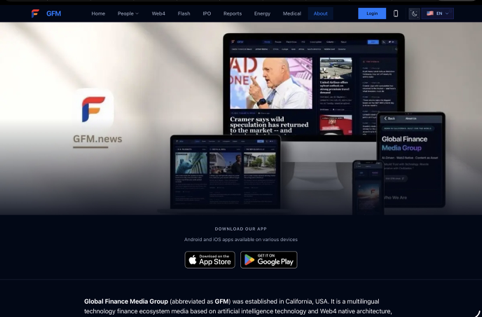 (Image caption) GFM's origins are not grand slogans, but rather the choice of a founder who refused to give up on media even in difficult times. In an era of information overload and AI reshaping content, GFM attempts to build a layer of trust in financial information, starting with individual articles and thorough verification.
After arriving in the United States, I rebranded the Asia Financial Media Group, which I had previously founded in Hong Kong, as GFM.News, or Global Financial Media Group in Chinese.
Many people believe that starting a media company requires funding, a team, an office, investors, and a complete business plan. Asia Finance, for example, was once recognized by investors and had a relatively complete corporate structure. However, GFM's beginnings were far more rudimentary than any of these.
It started with just a computer, a desk, and one person writing for long hours. Many late nights I spent organizing materials, revising manuscripts, and calculating how long I could keep going. Since founding GFM, I haven't actually received a salary from the company. Most of the time, it was my limited savings from Hong Kong that sustained the initial framework of this media organization.
If entrepreneurship is reduced to nothing more than a beautiful narrative, it easily becomes mere packaging. True entrepreneurship, in its early stages, is often cumbersome, even undignified. It's not about standing on a stage reciting a vision, but about answering the same question day after day in days without revenue, applause, or guaranteed returns: Should we continue today?
I've asked myself time and again why I still work for GFM. Later, the answer became clearer and clearer: because I still believe in the media, and I still believe that in an era where information is mass-produced, rapidly distributed, and repeatedly polluted, credible media is not outdated, but has become even more important.
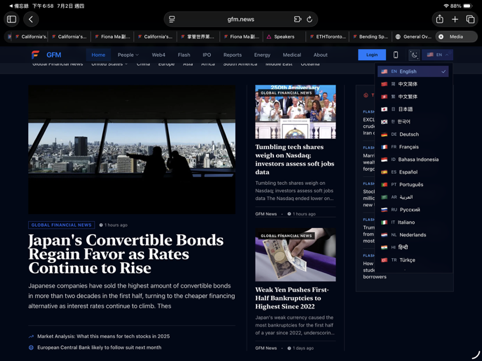 (Image caption ) Founded in the United States, GFM.News is distributed globally in more than 25 languages, supports day and night modes, and covers a variety of sections including finance, IPO, Web4, energy, and healthcare, gradually attracting the attention of international readers.
AI is rapidly changing the world. Content will become increasingly abundant, text will become increasingly cheap, and articles will increasingly resemble products on an assembly line. When everyone can produce content, the truly scarce resources will become judgment, responsibility, sourcing, verification, institutional explanation, and whether a media outlet is still willing to maintain basic honesty under pressure.
GFM aims to create an emerging layer of trust for financial information in the AI era. This sounds like a grand vision, but its starting point is not so ambitious. It must begin with each article, each instance of fact-checking, each questioning of power, capital, markets, and systems, and with a founder's unwavering commitment to media even during the most challenging times.
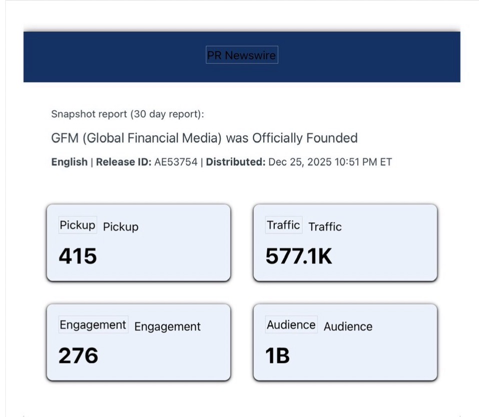 (Image caption ) GFM News, launched on Christmas Day, December 25, 2025, was published globally through PR Newswire. Within 30 days, the news was reprinted and included by 415 media outlets and platforms, generating approximately 577,100 views and potentially reaching an audience of about 1 billion.
Over the past period, GFM has written about the IPO system, Web4 and RWA, and healthcare sovereignty. While the topics seem scattered, they are all connected by a single thread: in a rapidly changing world, power, capital, technology, healthcare, cities, families, and individual destinies are intertwined in new ways. Media outlets that merely relay news will soon lose their reason for existence. What I truly want to do is examine these changes within the context of systems.
Institutions are not just cold, impersonal concepts. Sometimes, institutions refer to whether a new immigrant can enter a hospital, be seen, be respected, and receive basic treatment in their most vulnerable moments. In my writings on healthcare sovereignty at GFM, I once revealed the experience of an Asian immigrant who was initially denied medical care but was later rescued by the system. It was the pain of suddenly finding oneself blocked by the system in a foreign land, facing language barriers, identity, medical procedures, and practical hurdles.
My feelings are complex as I write this. I love America and I am grateful to America, but gratitude does not equate to silence. True gratitude means treasuring the rights this system grants to the media, and then using those rights to see where it still needs improvement. America's greatness has never been because it is free of discrimination, loopholes, or indifference. America's greatness lies in the fact that even when a new immigrant is treated unfairly, the media can still write about it, the person involved can still appeal, society can still discuss it, and the system still has the potential to be pushed forward, questioned, and repaired.
If a country's media can only sing praises and not expose wrongdoing, can only express gratitude and not question, then such media is not part of public trust, but merely an ornament for power and interests.
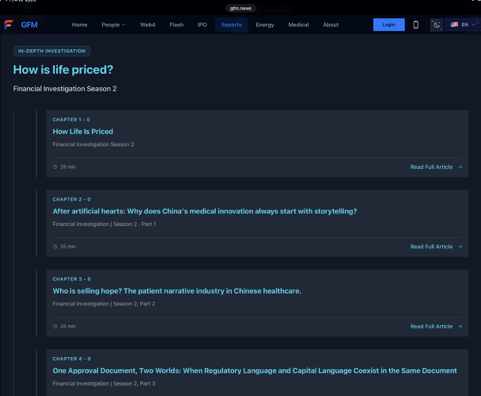 (Image caption) This reveals how China's four leading artificial heart companies are packaged by capital and media, how their technology is mythologized, and how patients may be placed in opaque experimental boundaries.
In its financial investigation column, GFM also explored the shadows behind philanthropic medical collaborations: revealing how China's four leading artificial heart companies are packaged by capital and media, how technology is mythologized, how patients might be placed in opaque experimental boundaries, and whether there are deliberately concealed gray areas between funding, reputation, regulation, medical ethics, and philanthropic narratives. These kinds of topics involve expertise, personal relationships, institutions, and also many vested interests that people are unwilling to confront. But this is precisely where institutional media should enter. True freedom often comes from being able to touch on uncomfortable issues, from bringing hidden details to the surface, and from giving those who were previously silent at least one chance to be heard.
In some places, you're not allowed to investigate the dark side of the medical profession, nor are you allowed to examine power, capital, and bioethics on the same level. Therefore, whenever I write these articles in the United States, I know I'm exercising an extremely precious right. This right comes from America's long constitutional tradition, and from generations of people's protection of freedom of the press, freedom of speech, freedom of religion, and the right to public criticism.
For me, the First Amendment isn't just words hanging on the wall. It's in every piece of writing, in every publication, in every decision about the topic. It gives someone who was once forced into silence the ability to ask questions again.
I wrote about the Trump family's currency on GFM. Some might ask: if you're grateful to America, why analyze the relationship between American political figures' families and crypto finance? My answer is simple: precisely because I'm grateful to America, I cherish the media's right to ask questions. Discussing the Trump family's currency isn't about hostility or taking sides; it's an observation that institutional media must make when facing new finance, new political brands, and new on-chain assets. When political symbols, supporter sentiments, on-chain transactions, and family brands are placed in the same market pricing system, the media should ask: Where are the boundaries of power? Where is the responsibility for the assets? How is trust built, and how is it eroded?
The true strength of the United States lies not in the fact that any powerful figure cannot be discussed, but in the fact that powerful figures can be openly discussed. Markets can be questioned, presidents can be commented on, capital can be dissected, and the media can retain its independent judgment in the open. America's greatness lies in the fact that problems can be seen. Immigration-run newspapers and dissent writing are themselves part of the founding spirit of this nation.
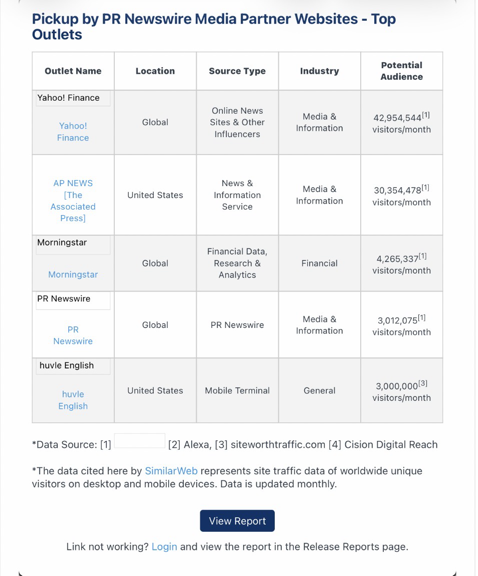 (Image caption) GFM’s content has been included in mainstream financial and news platforms such as Yahoo Finance, Associated Press, and Morningstar, indicating that GFM’s content has begun to enter mainstream US media, financial information and global news distribution systems.
I am a Christian. I believe that sometimes we don't design our own path. Many experiences are like darkness when they happen, but in retrospect, we realize that they may have been God allowing us to traverse the wilderness, to learn humility, and to learn responsibility.
I don't see GFM as an ordinary business project. Of course, it needs a business model, revenue, a team, funding, and truly sustainable operation. But at a deeper level, GFM is my response to God's grace, the free system, and media responsibility after I stood up again in the United States.
Today, GFM is still small and fragile, and many things are still being explored. It doesn't have the capital of a large organization, a large editorial department, or a stable cash flow that inspires confidence. Often, it still relies on me alone for long periods of writing, organizing, judging, and pushing forward. But I know that some paths must be trodden first.
Media civilization in the AI era cannot be determined solely by algorithms. The future of financial information cannot be left to traffic, advertising, and sentiment alone. When content production costs approach zero, human judgment becomes more expensive; when true and false information are mixed, media credibility becomes even more crucial; when power, capital, and technology align at an unprecedented pace, independent institutional explanations become indispensable. This is the reason for GFM's existence.
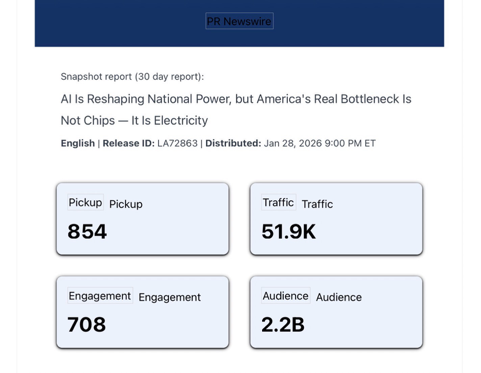 Image caption: GFM's article on AI energy and power bottlenecks was published globally, garnering 854 media reprints within 30 days, generating 51,900 views, and potentially reaching 2.2 billion viewers. This demonstrates GFM's emerging international communication capabilities on AI, energy, and national competition issues.
The 250th anniversary of the founding of the United States is a grand historical milestone for many. For me, it also has a very personal and specific meaning. Two years ago, on July 4th, my family and I arrived in Los Angeles. On that day, I never imagined that I would be writing this article two years later, nor did I imagine that GFM would become part of my rebuilding of my life order in America.
I only remember the fireworks that night. They rose into the Los Angeles night sky, brief, bright, and quickly faded. But what they left behind lasted longer than I imagined. A person can leave the past, but cannot lose their memories; a person can start over, but cannot abandon their responsibilities; a media professional can lose many things, but as long as they can still write, they have not completely lost themselves.
I am grateful to America. This gratitude is not cheap praise, nor is it a perfunctory statement for a holiday. It comes from my daily life over the past two years, from my family's settlement in this land, from my freedom to pick up writing again, from the hardship of building GFM from scratch, and from my ability to openly write about issues that are not easily written down in this country.
GFM begins in the United States after July 4, 2024. It begins with a long night journey after a person and family arrive in Los Angeles. It begins with fireworks illuminating the sky, illuminating the moment a media professional begins writing again.
On July 4, 2026, the United States will be 250 years old. On this day, I write this to dedicate to the country that has welcomed me and my family, and to those who still believe in freedom, in writing, in the possibility of reforming institutions, and in the conscience of the media.
Two years ago, those fireworks weren't for me. But they illuminated my connection with America, and they illuminated the reason why GFM started in America.