

Ma Shih-yun: The Two Accounts Behind the Ballots
What does California's public finances mean for family dinner bills?
California's economic size doesn't fully reflect how much money a family has left at the end of the month. With State Treasurer Fiona Ma running for Lieutenant Governor, her record offers a glimpse into the gap between public finances and family financial security. From retirement savings and small business loans to disability savings accounts and college housing, who has access to these resources, and who remains excluded? Evaluating her performance requires separating the size of the institutions she oversees from her own contributions, and ultimately asking: How are public resources translated into support that families can truly benefit from? And when that translation fails, who is held accountable?
Editor's Note
In June of this year, GFM.News published "The Woman Who Controls the Treasury of the World's Fourth Largest Economy," featuring an interview with Ma Shih-yun about her political career, the responsibilities of a state treasurer, and her platform for running for lieutenant governor. This article continues that report, further examining the relationship between public finances and family life: what assistance can public fund management, retirement savings, small business loans, and education support provide to families, and what needs remain unmet?
During elections, governance records receive increased scrutiny, making it even more crucial to accurately distinguish between responsibilities and achievements. The operation of existing systems, the specific contributions of incumbents, and candidates' promises for the future need to be evaluated separately. This article analyzes publicly available documents, data, and published interviews, and discusses the limitations of existing information and questions that remain to be answered.
The scale of public finances can be presented in numbers, but whether households truly benefit requires more concrete evidence. This is the starting point for our renewed reporting on Ma Shih-yun. This article does not endorse any election, but aims to provide readers with a basis for understanding policies and evaluating governance.
Jeff Morgan
GFM.News Editor-in-Chief
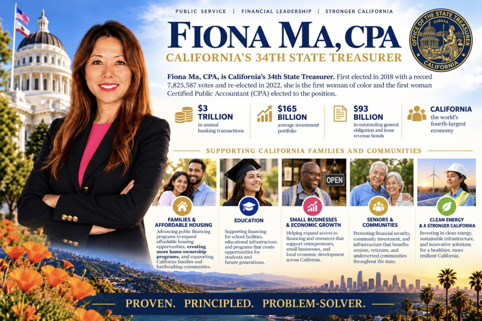 (Image caption ) Fiona Ma, California's 34th State Treasurer. The image shows the vast scale of public funds management in California, as well as policy areas such as housing, education, small and medium-sized enterprises, and community development. Behind these fiscal figures are the housing burdens, education expenses, and livelihood security of ordinary families, reflecting how public finances respond to the actual needs of people's daily lives.
Politics between the two accounts
Elections in California are a competition between candidates. Beneath the campaign speeches, it is also a process of two accounts intersecting.
One book belongs to the government: taxes, bonds, cash flow, public works, and funds for local agencies. The other book lies on the family dinner table: rent, gasoline, insurance, tuition, food receipts, and the expenses needed to create a future for their children.
Politics becomes concrete and tangible where these two accounts meet.
This intersection provides a useful starting point for understanding Mary Ma's campaign for Lieutenant Governor. As California's Treasurer, her oversight involved public investment, financing, and a range of financial programs for families and businesses. Whether this experience constitutes a convincing record of governance depends on the actual results of how funds and policies, after navigating the administrative system and reaching the lives of ordinary citizens.
The State Treasurer's office has released resource guidelines for veterans, small businesses, families, and college students. By comparing these documents with publicly available information on retirement and disability savings plans, what was originally an abstract discussion of public finance becomes relatable to real-life contexts.
How can people working in small businesses start saving for retirement? How can people with disabilities save money without jeopardizing essential benefits? Where can veterans find housing, employment, and healthcare after leaving the military? How can a community small business secure financing, obtain licenses, and continue paying salaries? When college acceptance letters arrive, can a family afford both tuition and rent?
These questions measure the distance between the two sets of accounts.
However, a program catalog does not equate to the number of families receiving assistance. Evaluating a public official requires more than just looking at the size of the funds they manage; it also involves examining what changes they have implemented within existing systems and whether those changes have reached the intended target population.
 (Image caption) Fiona Ma talks with students in Orange County and exchanges ideas.
Huge economic and household bills
California's economy is large enough to rival that of major world economies. In a statement released in April 2026, the governor's office, citing then-available data from the U.S. Bureau of Economic Analysis, indicated that California's nominal GDP in 2025 was approximately $4.25 trillion. Technology, entertainment, agriculture, ports, education, healthcare, and manufacturing all contribute to this output.
But GDP cannot be used to pay rent.
Economic output is not the same as the revenue that the state government can use. How much businesses produce, how much tax the government collects, and how much cash the state treasury holds are different metrics. Confusing them will allow a striking headline figure to obscure the truly important issues.
Ma Shiyun's work was partly carried out within this less-noticed financial infrastructure.
California's Pooled Money Investment Account (PMIA) invests state government funds and funds deposited by participating local institutions, prioritizing safety, liquidity, and returns. As of the end of August 2026, its portfolio totaled approximately $179.3 billion. This included $26.6 billion in the Local Agency Investment Fund (LAIF), which has 2,318 participating institutions. LAIF is part of PMIA; adding the two figures results in double counting of the same sum.
These abbreviations may seem unrelated to household finances, but the questions they raise are very real: Where should a city store funds that are not currently in use? How can these funds generate returns while ensuring they are readily available for paying salaries, maintaining public services, and dealing with unexpected expenses?
LAIF allows local entities to voluntarily participate in investment pools managed by the state government and to withdraw deposits according to applicable rules. It manages funds that these entities already held, and is not an automatic bailout provided by the state government to local governments when they face funding gaps.
This system was not created by Ma Shih-yun. The PMIA began in 1955, while the LAIF began in 1977. The investment division of the State Treasurer's office manages the PMIA and is governed by a committee composed of the State Treasurer, the State Comptroller, and the State Secretary for Finance. Therefore, the size of the investment portfolio itself cannot measure the performance of any official.
The real test is how she fulfills her management responsibilities within the scope of her authority: whether the funds are safe, whether the liquidity is sufficient, whether the returns are commensurate with the risks undertaken, and whether the supervision is effective.
Sound management can mitigate avoidable risks and help public services operate reliably. However, it cannot generate budget allocations, nor can it solve housing shortages or insufficient household income on its own.
Much of the work of public finance is ensuring that promises are kept on time. Schools have bills to pay, cities have services to maintain, and public works require financing. When this system is functioning well, it receives little attention; but when it malfunctions, the consequences can ripple through the bills that households and businesses have to pay.
 (Photo caption) Fiona Ma visits the Thai community and interacts with community members.
$154 per month to start your retirement account
Compared to public investment portfolios worth billions of dollars, $154 per month is a figure that a family can concretely understand.
This is the median monthly contribution as of September 30, 2026, published by CalSavers. The program reports a total of 669,331 capitalized accounts with total assets of approximately $1.933 billion. The median balance of capitalized accounts is $691.
One figure illustrates the scale of the plan's coverage, while the other shows how much capital has accumulated in a middle-ground, funded account.
CalSavers provides a pathway for workers whose employers do not provide retirement plans to save for retirement through payroll deductions. Private financial institutions offer professional services under the oversight of a public commission chaired by the state treasurer. As its scope has expanded, California employers with at least one eligible employee who does not provide a qualifying retirement plan are generally required to comply with the program's requirements.
For employees of small businesses, access to retirement savings is no longer solely dependent on their employer's ability to set up their own retirement benefit plan. The account is held by the employee and can be retained when changing jobs. Employees can also choose to withdraw or adjust their contributions.
However, there are still limitations to obtaining access to these channels.
The funds deposited primarily come from the workers' own wages. The account involves investment risks and fees. An increase in total assets does not prove that every participant is moving towards a secure retirement. Whether or not $154 can be saved still depends on how much money is left after paying rent, food, transportation, and other expenses.
The total figure of $1.933 billion and the median of $691 are both noteworthy. The former indicates that a public program has reached a considerable size; the latter suggests that account balances remain relatively low. The extent to which this reflects participation duration, contribution levels, withdrawals, or investment performance requires further analysis. A single median cannot answer these questions.
There's another distinction to be made at the implementation level. The September report documented 283,888 registered employers and 80,002 employers who had begun payroll deductions. You can't simply subtract these two figures to arrive at the number of non-compliant businesses. But they do illustrate that completing registration and actually getting funds into workers' accounts are different stages.
Linking public policy with household savings requires employee rosters, payroll deductions, fund transfers, and ongoing services. An effective assessment of Ma Shih-yun and the governance committee should consider how many people have started saving, how many are continuing to save, and how effective the plan is in removing barriers between these two stages.
Providing financial space for people with disabilities and veterans
For some families, the dilemma is more pressing than retirement planning: saving for the future may trigger concerns about losing the benefits they need now.
CalABLE addresses, to some extent, the conflict between accumulating assets and maintaining eligibility for aid.
Effective January 1, 2026, the federal Age Adjustment Act for ABLE will raise the age threshold for the onset of an eligible disability from under 26 to under 46, thus expanding eligibility. California's CalABLE program will also be expanded accordingly. This threshold refers to when the eligible disability occurred, not the age at which an account was opened.
This change allows some people who develop disabilities in adulthood to participate in savings plans that were previously inaccessible. This includes eligible veterans whose disabilities occurred between the ages of 26 and 45.
Account funds can be used for eligible disability-related expenses, including eligible housing, medical, transportation, education, and assistive technology costs. The general annual contribution cap for 2026 is $20,000; eligible, employed beneficiaries may contribute additional amounts.
The purpose of this system is to empower eligible individuals to better prepare for the future. However, there are clear limits to the coverage. Supplemental Security Income (SSI) generally excludes the first $100,000 in the ABLE account when calculating assets. The impact of exceeding this balance on benefits depends on other assets that must be included. This threshold is neither a uniform limit for all ABLE account balances nor does it guarantee that any form of public assistance will be unaffected.
For families arranging long-term care, these rules may determine whether they can save money for equipment, plan transportation, or prepare for the caregiver's life in old age.
The State Treasurer's Office's Veterans Resources Guide extends the discussion to medical and mental health services, housing, employment, entrepreneurship, and children's education. The guide lists resources offered by the U.S. Department of Veterans Affairs, the California Department of Veterans Affairs, local agencies, and nonprofit organizations.
These services fall under different agencies and cannot all be described as benefits directly provided by the state treasurer. Organizing information and helping the public find access points has public value; however, the responsibility for eligibility verification and service delivery remains with the respective program's governing body.
A veteran may need medical care, job referrals, and housing assistance all at the same time. The most difficult task may be connecting the resources scattered across different websites, application forms, and phone numbers.
Whether a system is effective may depend on whether people can successfully navigate this path.
Federal legislation expands eligibility, state-level plans implement changes, and service organizations assist the public in understanding the rules. Ma Shih-yun's work should be evaluated within this larger framework: whether newly qualified individuals are aware of the program's existence, whether they can receive assistance, and whether there is ongoing follow-up after referral.
 (Image caption) Fiona Ma discusses the promotion of nature education projects and how to encourage more community residents to participate with staff from the Nature Education Foundation.
Cash flow for small businesses is essentially household income.
The bills at a family dinner table often depend on the cash flow of a business on the corner to pay for them.
Rent, equipment, inventory, insurance, and salaries all have payment terms. Whether a business can survive a period of weak revenue affects the landlord's family and the employees who depend on the next paycheck.
The Small Business and Family Resources Guide lists resources related to financing, tax incentives, business counseling, public procurement opportunities, permit application assistance, and energy efficiency. The California Capital Access Program (CalCAP) explains how some of this support works.
CalCAP's various programs, through loan loss reserves, collateral support, and related mechanisms, reduce some of the risk for participating lending institutions and encourage them to provide financing to eligible small businesses. Borrowers are still subject to credit checks and are liable for repayment.
The purpose of this policy is to change the conditions under which businesses can obtain credit. For business owners who need to replace equipment, purchase inventory, or fulfill orders, the key questions are: is financing available, are the costs affordable, and do the repayment terms align with the business's cash flow situation?
The guidelines also list small business development centers, veteran entrepreneurship support, and procurement resources for small businesses and businesses run by disabled veterans. Each resource has its own governing body and eligibility requirements. Taken together, they raise a diagnostic question: Is the business being limited by a lack of funding, information, certification, or a lack of a working administrative process?
In an interview with Troy Wolverton of the San Francisco Examiner, Ma Shiyun stated that she hopes to understand why companies are leaving California or choosing not to expand there through visits and exchanges with industry professionals, and to intervene before companies make relocation decisions. She also opposes the billionaire tax proposal discussed in the interview, arguing that the departure of wealthy residents could reduce state government revenue.
This is a policy judgment. The scale of any migration response, and the balance between the increased tax revenue and the loss of tax base, must be examined based on the specific design and evidence of the proposal.
A better business environment must ultimately produce observable results: timely issuance of licenses, easy-to-understand application procedures, access to financing, and support that previously could not reach businesses that did not receive assistance.
For a loan program, the loan size is one indicator. However, it's equally important to examine whether the borrowing company has the capacity to continue operating and to fulfill its repayment obligations.
Increased business revenue does not automatically improve the lives of employees. However, the continued existence of a community business and the jobs it provides is a crucial foundation for family financial security.
State governments need a tax base, and households need income. The two converge in the day-to-day operations of individual businesses.
 (Image caption) Fiona Ma distributes emergency relief supplies to residents affected by wildfires at a disaster relief distribution center in Altadena, California, while also providing information and guidance on existing aid programs and disaster recovery resources.
After receiving the acceptance letter, there's still rent to pay.
A university acceptance letter gives a family a reason to celebrate. The subsequent cost estimates, however, lead to another set of calculations.
Tuition fees are only one aspect. Housing, food, books, transportation, and computers also need to be included in the budget. Whether admission translates into a real opportunity to complete studies depends on the sustainability of these expenses.
The State Treasurer's Office's Higher Education Guide compiles information on education savings, grants, scholarships, loans, and living expenses support. CalKIDS provides educational funding to eligible children and students. Eligible school-aged students can receive up to $1,500, but the amount varies: eligible students receive $500, foster children receive an additional $500, and students identified as homeless receive an additional $500.
Even the maximum amount is insufficient to cover the full cost of a college education. However, it can cover some eligible expenses. The value of this grant should be understood in its actual scale, while also prompting the question: Does the family know the account exists, how to use it, and how to access the funds when needed?
ScholarShare 529 provides families with an education savings tool. Grant applications, tuition waivers, and scholarship programs lead to different systems at the federal, state, and individual educational institutions. Some funds are family savings, some are aid, and some are debts that must eventually be repaid.
These distinctions are crucial to helping families understand the costs of a college education.
The guidelines also cover food, housing, transportation, childcare, and support for foster youth. These resources acknowledge that getting into college and being able to continue studying are two different challenges.
In an interview with the San Francisco Examiner, Ma advocated for paid internships, apprenticeships, and high school pre-apprenticeship programs. She also called for closer partnerships between universities and businesses, increased housing for students and faculty, and stricter scrutiny of educational institutions' spending, auditing, and transparency.
These proposals are linked to the specific responsibilities of the lieutenant governor. The lieutenant governor holds voting seats on the governance committees of the University of California, California State University, and California community colleges. These seats allow the lieutenant governor to participate in decision-making; however, policies, budgets, and construction projects still need to proceed according to the governance procedures of each education system.
Under state law, the Lieutenant Governor also serves as the chair of the California Economic Development Commission. However, during this review, the Lieutenant Governor's website stated that the commission had not yet reached a quorum. In an interview, Ma Shih-yun expressed her hope that the next governor would make the necessary appointments to restore the commission's functionality.
Therefore, the transition from state treasurer to lieutenant governor signifies a dual shift in responsibilities and the conditions required to take action. A statutory seat provides the opportunity for participation; however, progress depends on personnel appointments, agenda setting, and the support of other decision-makers.
University housing partnerships also require careful attention to implementation. Introducing funding is just the beginning. Who provides the land? Who bears the development and operational risks? How will the rent be set? Will the housing serve the students and faculty originally intended for the program? The answers to these questions must be clearly stated in the contract and maintained through continuous monitoring.
For parents, the truly important outcome is that their children can afford to live near the school, complete their degree, and find a job that can support them independently.
This path begins with the education account, passes through grants, housing, and training, and finally leads to a salary. It is also a long connection between the state government's ledger and the family's ledger.
 (Photo caption) California State Treasurer Fiona Ma (center) visited Little Saigon TV and posed for a photo with attendees, including Daniel Sieu (first from left), Chairman of the California Investment Forum, and Ling Sieu (third from right), State Treasurer's Public Relations and Outreach Specialist.
When financial figures become a source of public trust
Ma Shih-yun has qualified for the Lieutenant Governor election on November 3, 2026. Her task is to explain how her experience as State Treasurer can be applied to a position with different powers and responsibilities.
Public investment and liquidity management, retirement savings, financial planning for people with disabilities, small business credit, and education assistance provide concrete evidence for this discussion. However, the existence of a plan, the growth of a plan, and the improvement of family finances are three different outcomes.
Retirement accounts require continuous contributions. Expanding eligibility requires people to know and use the plans. Financing measures must be assessed based on the actual support businesses receive. The evaluation of education accounts should also depend in part on how the funds within them help students complete their studies.
Some of these tasks fall directly under the jurisdiction of the State Treasurer's office; others require collaboration among federal, state, and local agencies, financial institutions, and community organizations. The performance of existing agencies, the incumbent's contributions during her term, and her commitments as a candidate must also be evaluated separately.
Managing a large pool of funds does not equate to having control over every single public expenditure. The growth of a project does not prove that the social problems it addresses have been solved. Voters need an account of the results of governance, along with a breakdown of the limitations of authority and unfinished work.
California needs a sturdy table: one that can bear the weight of public finances, yet also allows families sitting around it room to plan for next month, next school year, and their retirement years.
Whether this table is sturdy depends on whether the funds arrive on time, whether the rules are easy to understand, whether the application can be completed, and whether someone will take responsibility if problems arise.
A family checking their bills may never have thought of the state treasurer's office, nor recognize abbreviations like PMIA and LAIF. But they know whether they can afford the rent, how much they need for their child's college education, how much is left in their retirement account, and whether there's anyone to guide them on the next steps when they seek help.
These everyday judgments are also part of what's behind the votes.
For Ma Shiyun, the questions were equally clear: What evidence could she provide to prove what achievements she had made in the state government's accounts? How would this work affect her family's accounts? And what unresolved issues did she intend to address in her other position?
Only financial figures that can withstand such scrutiny can build public trust.
Sources and Editorial Notes
This article is based on publicly available documents, statistics, and policy information from relevant California government agencies. All data cited are accurate and up to the stated source and statistical period. The analysis and judgments in this article were made independently by GFM.News.
GDP figures use 2025 data released by the Governor's Office in April 2026. PMIA and LAIF figures are as of the end of August 2026. The statistical periods for other data are noted in the text. This does not constitute an endorsement of elections, voting advice, or personalized financial advice.