

Jia Yueting: He built cars while standing in the cracks
From LeEco to Faraday Future: How a Chinese entrepreneur navigates imagination, capital, credit, and the American system to find a second foothold.
Editor's Note
GFM's "People's Profile" doesn't make judgments, it only observes.
But Jia Yueting himself makes the observation process exceptionally complex.
He is neither a simple success nor a simple failure. He is more like someone pushed into a crack by the times: on one side is the ecological narrative of China's internet boom, and on the other is the cold, hard institutional rules of the American public market; on one side is the unfinished dream of owning a car, and on the other is the lingering questioning of debt and credit. A person standing in the crack is easily misunderstood by both sides.
GFM wrote about him not to praise him, nor to judge him.
What we really want to do is try to understand his situation—not to defend him, but to seriously understand what a Chinese entrepreneur is facing when he leaves his familiar business context and enters the American legal system, creditor system, public market and smart electric vehicle industry, and how he is trying to regain his footing step by step.
This isn't just one person's story. It's a systemic issue that Chinese entrepreneurs will inevitably face after venturing overseas. Jia Yueting simply took it to an exceptionally thorough, exceptionally clear, and exceptionally unavoidable level.
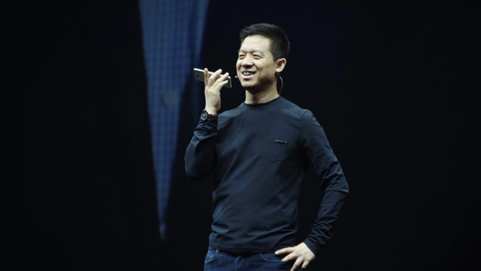
(Image caption) Jia Yueting gives a speech during his LeEco era, confidently holding a mobile phone and describing his "ecosystem" vision. It was an era when people believed that stories could outpace reality. He stood at the center of China's booming internet, both a beacon of glory and the starting point of later cracks.
⸻
The word "ecology" once made everyone willing to believe.
There was a time when China's capital market believed that speed could outpace reality.
Video platforms, smartphones, smart TVs, sports rights, film and television content, financial services, and automobile manufacturing all seem to be reconnected by a larger word: "ecosystem."
Jia Yueting understood how to use this term very early on, and he used it more thoroughly than anyone else. He didn't talk about a single product; he talked about a system. He didn't talk about a company; he talked about an ecosystem. He didn't talk about an industry; he talked about future lifestyles.
This language was real and valid at the time; it wasn't a hoax.
That was an era where people believed a story could outpace financials, and for a considerable period, stories indeed did, generating real valuations, real funding, and real market share. Many investors, entrepreneurs, and users weren't misled; they genuinely believed that as long as the entry point was large enough, the user base was large enough, the scenarios were broad enough, and capital flowed quickly enough, the future would naturally emerge. Jia Yueting was adored not just because he was a good storyteller, but because that era needed someone to tell a story to its fullest potential.
Reuters, in its review of Jia Yueting, summarized his journey from video streaming to electronics manufacturing, and later, founding Faraday Future in an attempt to challenge Tesla. These words encapsulate his typical path: he always jumps from one entry point to a larger industry narrative. This is his talent, and also the starting point for the repeated questioning that followed.
Imagination can drive up valuations, but it cannot replace cash flow. LeEco's story, from the very beginning, was not just the story of a single company, but a mirror reflecting the era of China's internet boom—it revealed the collective desires of that time, and also the void that followed those desires.
Jia Yueting stood in the center of that mirror. That position was both a halo and a target.
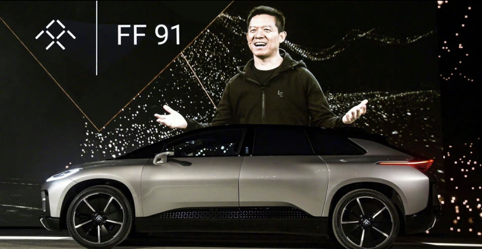
(Image caption) Jia Yueting on stage with the FF 91. From LeEco to Faraday Future , he has always tried to put cars into a larger technological narrative; but in the US public market, imagination must be tested by delivery, governance, and cash flow.
⸻
In 2017 , he went to the United States with his unfulfilled dream.
The story of Jia Yueting leaving China can be viewed from different perspectives and is not the same story at all.
From the perspective of Chinese public opinion, he is someone who left amidst numerous inquiries from creditors. From his own narrative, he is someone who went to pursue his next dream. And neither of these versions is actually lying—they simply chose different focal points.
His dream is Faraday Future: smart electric vehicles, mobile spaces, next-generation mobility, and the integration of automobiles with the internet, entertainment, data, and artificial intelligence.
In hindsight, this judgment was not entirely wrong.
Today's automotive industry is evolving from a mechanical manufacturing sector into a fusion of software, energy, AI, and the user ecosystem. Tesla, Xiaomi Auto, Huawei Smart Selection, NIO, XPeng, and numerous other smart electric vehicle companies are all demonstrating, to varying degrees, that the car is becoming a new computing platform, a mobile space, and potentially an AI terminal. Jia Yueting has been at the forefront of this direction for a long time, and this should be acknowledged.
The problem is that seeing a trend and completing a trend are two different things.
Electric vehicles cannot be built simply through insight. They require engineering capabilities, supply chain management, manufacturing stability, cost control, financing pace, and delivery capabilities, as well as enduring long-term scrutiny from regulators and the market. Tesla is Tesla not just because Musk talks about Mars, AI, and energy, but also because he has consistently built an extremely difficult business loop encompassing factories, supply chains, product iterations, and capital markets.
The metaphor of "China's Elon Musk" is half true and half a trap. It's true in that both are adept at redefining the present with the future, both have cross-disciplinary imagination, and both can transform technological products into cultural narratives. The trap lies in the fact that this metaphor leads the outside world to expect more from Jia Yueting than from Musk's equally dedicated years—years spent working nights in factories, years chased by suppliers for payments, years when the company nearly went bankrupt. Musk's narrative holds true because he ultimately delivers on his promises. The ongoing question facing Jia Yueting is: after the narrative, where is the delivery?
This issue isn't about harsh external criticism, but rather the very nature of the industry. For cars to be on the road, to carry passengers, they must contend with safety regulations, supplier payment terms, production line quality control, battery management, and after-sales insurance. This is an industry that no story can replace in terms of practical realities.
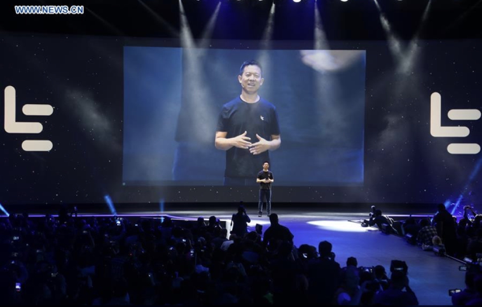
(Image caption) In 2016 , Jia Yueting introduced the LeEco ecosystem at the LeEco San Francisco launch event. It was an era when people believed that speed, access, content, hardware, and capital could be reorganized with the same word, and "ecosystem" was the most alluring language of that time.
⸻
Upon entering the United States, he encountered a completely different set of logic.
In 2019, Jia Yueting filed for Chapter 11 bankruptcy reorganization in the United States.
The Los Angeles Times reported at the time that Jia Yueting planned to use his stake in Faraday Future to establish a creditor trust to repay his personal debts accumulated in China. In 2020, FF announced the completion of Jia Yueting's personal bankruptcy reorganization proceedings, and the creditor trust was formally established.
This point in time has been glossed over as financial news in many reports, but its true significance lies not in finance, but in the system.
This marks Jia Yueting's transition from the logic of Chinese-style business expansion to a different order under American law and the creditor system. From now on, he will no longer only face public opinion, but also the continuous questioning of bankruptcy courts, creditors' committees, boards of directors, information disclosure systems, and the public market. This questioning has a name, a procedure, and legal consequences, and will not stop because of the founder's next dream.
This is the layer that Chinese entrepreneurs most easily underestimate when going global.
In China, many entrepreneurs are accustomed to the combined forces of speed, connections, boldness, fundraising pace, and market access. But in the US public market, things are slower, tougher, and more traceable. Board structure, related-party transactions, information disclosure, SEC investigations, shareholder litigation, creditor rights, accounting standards, audit working papers—these things won't give way just because a founder's dream is grand enough. This system may not be more humane, but one thing is very clear: it will constantly question what you've said, done, promised, disclosed, and delivered in the past.
Jia Yueting was one of the first Chinese entrepreneurs to enter this system in this way. The sense of unfamiliarity, the density of rules, and the feeling that every step was recorded are not easily described by outside observers.
His story thus takes on another layer of meaning. It is not just about one person's fate, but also about the process of a Chinese entrepreneur being redefined after entering the American institutional arena—not destroyed, but reshaped.
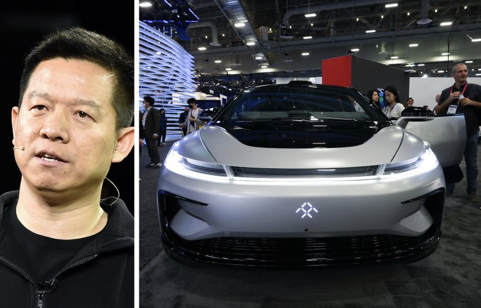
(Image caption) Jia Yueting with a Faraday Future car model. After arriving in the US in 2017 , he faced US public market rules such as Chapter 11 bankruptcy reorganization, SPAC listing, and SEC investigation.
⸻
With its SPAC listing, FF gained access to the public market and faced more rigorous scrutiny.
In 2021, Faraday Future entered the U.S. public market through a SPAC.
SPACs were a fast-track to listing for many startups at the time, faster than traditional IPOs, providing a new capital entry point for high-risk, high-imagination, and high-capital-need companies. For Jia Yueting, this was an attempt to find a second foothold in the United States.
But going public is never the end; it's just a different way of asking questions.
When a company without mature revenue, stable deliveries, or complete market validation enters the public market, it gains not only funding and exposure, but also stricter regulation, more inquiries from investors, and more volatile stock prices. Subsequently, FF has faced prolonged market pressure regarding issues such as corporate governance, financing, disclosure, and investor trust.
In March 2026, Reuters reported that FF stated the U.S. Securities and Exchange Commission (SEC) had concluded its years-long investigation without taking any action. The investigation covered matters including the company's 2021 PIPE financing and SPAC-related transactions. FF's previous internal reviews had also uncovered some inaccurate statements to investors. FF's official announcement confirmed that the SEC investigation had officially ended, and no penalties or enforcement actions were sought against the company, Jia Yueting, or any other team members.
The SEC's conclusion of its investigation and lack of action is a significant relief for FF. However, this does not mean that all of the company's problems have been resolved. Reuters reported in 2024 that FF withdrew its full-year production forecast for that year, citing reasons including market conditions and funding levels; the company was also facing delisting pressure from Nasdaq at the time, and its cash reserves were extremely limited.
Without sufficient funds, it's difficult to stabilize the supply chain; without a stable supply chain, delivery is difficult; without delivery, revenue is hard to generate; without revenue, there's even greater reliance on financing; and the more reliant on financing, the greater the pressure on shareholder dilution and market confidence. Jia Yueting has been navigating this cycle for years. It's not something he can break on his own, but breaking it is still an answer he must give.
The market doesn't need him to explain again how big his dream is. It needs to see evidence of how the dream translates into a viable business model—orders, deliveries, revenue, gross profit, cash flow, and governance structure. These things are more honest than any press conference and harder to fake than any news release.
⸻
Returning as CEO , he once again attempts to redefine FF.
On May 10, 2026, FF officially announced that its board of directors confirmed and appointed Jia Yueting as FF Global CEO and Jerry Wang as Global Executive Chairman; the appointments took effect on May 5, 2026. FF's 8-K filing with the SEC confirmed that the board accepted Matthias Aydt's resignation as Co-Global CEO, and Jia Yueting became the company's sole Global CEO. The company also stated that it will begin a new chapter of growth as a Physical AI company.
It has been almost ten years since he started anew in Los Angeles with the dream of FF.
Over the past decade, he has experienced bankruptcy restructuring, SPAC listing, SEC investigation, delisting pressure, multiple rounds of financing difficulties, and repeated questioning and observation from the outside world. Every time he thought he could move forward, new problems pulled him back to where he started. This situation is a weight that no one can truly understand just by looking at it from the sidelines.
Now he's back at the helm. This brings more than just personnel changes; it's a strategic redefinition.
FF is no longer simply describing itself as a smart electric vehicle company, but has shifted to a new narrative encompassing Physical AI, EAI, embodied intelligence, robotics education, and automotive robotics. In April 2026, FF announced that it had hosted the EAI Developer Ecosystem Forum, launched FF EAI Brain and the Open Developer Platform, and stated that its EAI Robotics educational products are progressing, with home education considered the first growth driver in the consumer-grade EAI robot market.
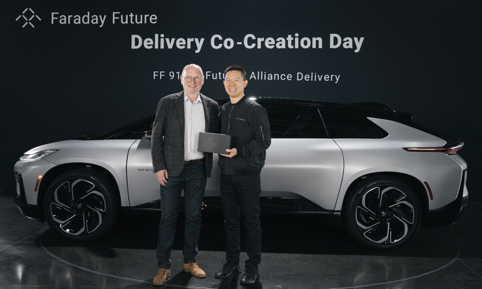
(Image caption) Faraday Future delivered the FF 91 2.0 Futurist Alliance to Jia Yueting at " Delivery Co-Creation Day " . For a company that has long faced market skepticism, delivery is not just a product event, but also a credibility event.
From an industry trend perspective, this judgment has its logic. AI, robotics, smart hardware, and education are indeed likely to form new intersections in the future. Embodied intelligence is becoming an important direction for the AI industry, and robots may gradually move from industrial scenarios into homes, education, and mobile spaces. Jia Yueting's choice of EAI and Physical AI aligns with some of the most active sectors in the current technology capital market, and this is not without reason.
However, from the perspective of company operations, this also raises a more acute question: What exactly is FF's core competency? Is it car manufacturing? Is it intelligent cockpits? Is it AI hardware? Is it educational robots? Or is it Jia Yueting's ability to tell a future story? This is not a denial, but a question that the public market will inevitably ask sooner or later—because every new narrative requires corresponding new products, revenue, customers, channels, and delivery evidence.
FF's Q1 2026 financial report shows that EAI Robotics became a new revenue engine in the first quarter of deliveries, generating approximately $512,000 in revenue, close to the $536,000 in revenue for the entire year of 2025. This is an initial signal worth observing, but the scale is still small and insufficient to indicate that a complete business loop has been formed.
Strategic shifts are not unfamiliar in Jia Yueting's biography. From videos to ecosystems, from ecosystems to mobile phones, from mobile phones to cars, and from cars to AI and embodied intelligence, he has consistently tried to position himself where the next industry buzzword will emerge. This ability is his talent, but this inertia is also his risk—if the EAI shift can generate real revenue and verifiable product capabilities, it could be FF's attempt to find a new path out of the pressure of heavy asset car manufacturing; if it is merely forced to adopt a more imaginative story due to delivery difficulties and financial pressure, then it will once again fall into the cycle of concept-driven but lagging implementation.
Jia Yueting himself knows the answer to this question best.
⸻
The part of him that most resembles Musk is also the part of him that least resembles Musk.
The comparison of Jia Yueting to China's Elon Musk is not without reason.
Neither of them are traditional entrepreneurs; both are adept at linking technology, products, culture, and capital narratives together. Neither is content with a single product, but rather attempts to build a larger system. Both can convince their supporters that current losses and chaos are a necessary price to pay for the future. Both possess a sense of the times rarely seen in ordinary businessmen—they are not merely running companies, but attempting to redefine an industry.
But the biggest difference between the two is not their personalities or their courage, but something more specific: Musk used engineering and delivery to bring the narrative back to reality, while Jia Yueting has long faced the problem of how to shorten the distance between the narrative and reality.
Musk's world also has its delays, losses, controversies, exaggerated statements, and capital market fluctuations. He has been considered crazy, shorted, and questioned. But what he ultimately leaves behind are rocket launches, car deliveries, satellite networks, and continuous revenue. These things allow his narratives, no matter how radical, to be grounded in reality at some point.
The challenge Jia Yueting faces lies precisely here. It's not because his direction is wrong, but because the distance between his direction and its implementation is longer than he anticipated, consumes his resources faster, and takes longer than the patience of outsiders can bear.
The cars that are actually delivered and used are more important than concept launches. Real revenue is more important than a grand ecosystem. A transparent governance structure is more important than passionate speeches. A business loop that can withstand audits and market scrutiny is more important than any title.
This isn't criticism; it's the same requirement that this industry places on all founders. It's just that different people, at different times, are being questioned about this in different ways.
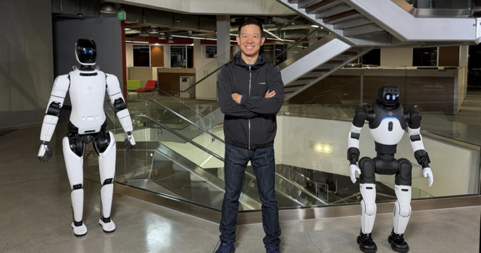
(Image caption) Jia Yueting posing with a humanoid robot from FF EAI Robotics . After resuming his role as Global CEO in 2026 , he will shift the company's focus to Physical AI and educational robots. This signifies his renewed push into the new AI arena, and also tests whether FF can truly establish a closed-loop revenue model .
⸻
Standing in a crack does not necessarily mean you will fall.
Jia Yueting has always stood in the cracks.
Between China and the United States, between the internet and manufacturing, between dreams and debt, between founder's spirit and corporate governance, between old credit and new narratives. Such people are prone to failure and misunderstanding; they are easily deified and easily demonized.
For GFM, the most important thing is not to rush to label him, but to open up the cracks in him layer by layer—because cracks are not conclusions, cracks are entry points for observation.
The problems surrounding Jia Yueting are far greater than his personal situation. The inertia of rapid expansion among Chinese entrepreneurs, the fragility of the internet ecosystem narrative after its capitalization, the institutional weight of debt and personal credit crises, the real barriers to new energy vehicle manufacturing, the gap between SPAC listings and US public market rules, the long-term need to rebuild trust between Chinese companies listed overseas and investors, the structural tension between founder control and corporate governance, and the tug-of-war between new concepts and old trust in the AI era—these problems will not disappear with Jia Yueting's personal success or failure, nor will they automatically find answers with the rise and fall of FF's stock price. They are common challenges for Chinese entrepreneurs going global in this era, but in his case, they are particularly dense and clearly layered.
If Jia Yueting can prove himself again in the future, his story will become a rare example of credit rebuilding for Chinese entrepreneurs going global, and it deserves to be carefully recorded. If he fails again, his story will still be valuable—because it will remind those who follow that industrial imagination cannot replace cash flow, founder charisma cannot replace governance systems, and capital stories cannot replace real delivery.
This is not gloating, nor is it a pessimistic prediction. This is the honesty one should show when observing someone who has earnestly walked this path.
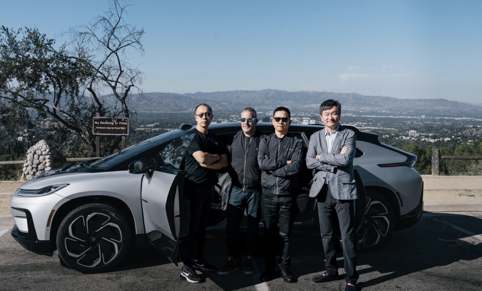
(Image caption) The FF 91 appears on a road scene in Southern California. Los Angeles and California are not only the geographical locations where Jia Yueting restarted his career, but also a completely new institutional environment: automobiles, capital, law, creditors, and the public market are all redefining his car-making story here.
⸻
What he needs most is media that truly understands him.
In Jia Yueting's story, the media is never just a bystander; it is also part of the story.
When LeEco rose to prominence in China, media narratives amplified its voice; its subsequent collapse, fueled by media scrutiny, accelerated its isolation. In the United States, mainstream financial media often framed it as a "Chinese founder fleeing," a framework that may not be entirely wrong, but it omits more than it tells.
A truly institutionalized media outlet doesn't just record what someone says, but also what conditions and limitations the institutional context in which they operate provide. It doesn't just question why they failed, but also tries to understand where their judgments were accurate and where the structure was beyond their individual control.
Jia Yueting needs the media. But what he needs is not media that fawns over him, nor media that judges him, but media that can truly understand his situation—media that is willing to take the time to open up his cracks layer by layer and tell his readers: what this person is facing, not just what he did wrong.
This is one of the reasons why GFM wrote this article.

(Image caption) Jia Yueting poses for a photo with the first owner of the FF 91 2.0 upon delivery. In Los Angeles, he is still "testing" —debt , governance, cash flow, and delivery. Standing between the cracks of Chinese imagination and American institutional rules, this image is both a stage achievement and a reflection of continuous questioning.
⸻
In Los Angeles in 2026 , he was still taking an exam.
In Los Angeles in 2026, Jia Yueting once again took the helm of FF.
He wasn't facing a blank sheet of paper, but a stack of bills, an SEC filing, a company yet to generate stable revenue, and a market still awaiting answers. He brought with him yet another redefinition of the future, and one question—this time, could he truly shorten the gap between narrative and reality?
GFM doesn't know the answer.
But we will continue to observe. Because this answer belongs not only to Jia Yueting, but also to everyone who is still trying to bridge the gaps in the system.
⸻
Disclaimer
This article is a profile of a person from GFM's "People" series, intended solely for public information analysis and media research. It does not constitute any investment advice regarding Faraday Future, Jia Yueting himself, or related securities, nor does it constitute any commercial endorsement. All news reports, company announcements, and public documents cited in this article are based on publicly available sources; GFM makes no guarantee regarding the completeness or timeliness of the information from these sources.