

Beyond the Three Models: A Fourth Possibility for Media Institutions
GFM's "People's Profile" Three-Person Special | General Overview
If we place Murdoch, Chen Ping, and Qiu Liben in the same coordinate system, what we see is not just three paths, but three limits.
One extreme is to completely transform the media into a power machine, allowing it to directly participate in the production and exchange of political influence. Another extreme is to attempt to maintain the media's moral independence, supporting public expression with a sense of mission, even if it means continuous depletion and loss of resources. Yet another extreme is to maintain a minimum space for expression within the numerous constraints of the existing structure, exchanging the long-term wear and tear of the individual for the existence of a crack.
These three paths each solve different problems, but they also expose the insurmountable boundaries of each. 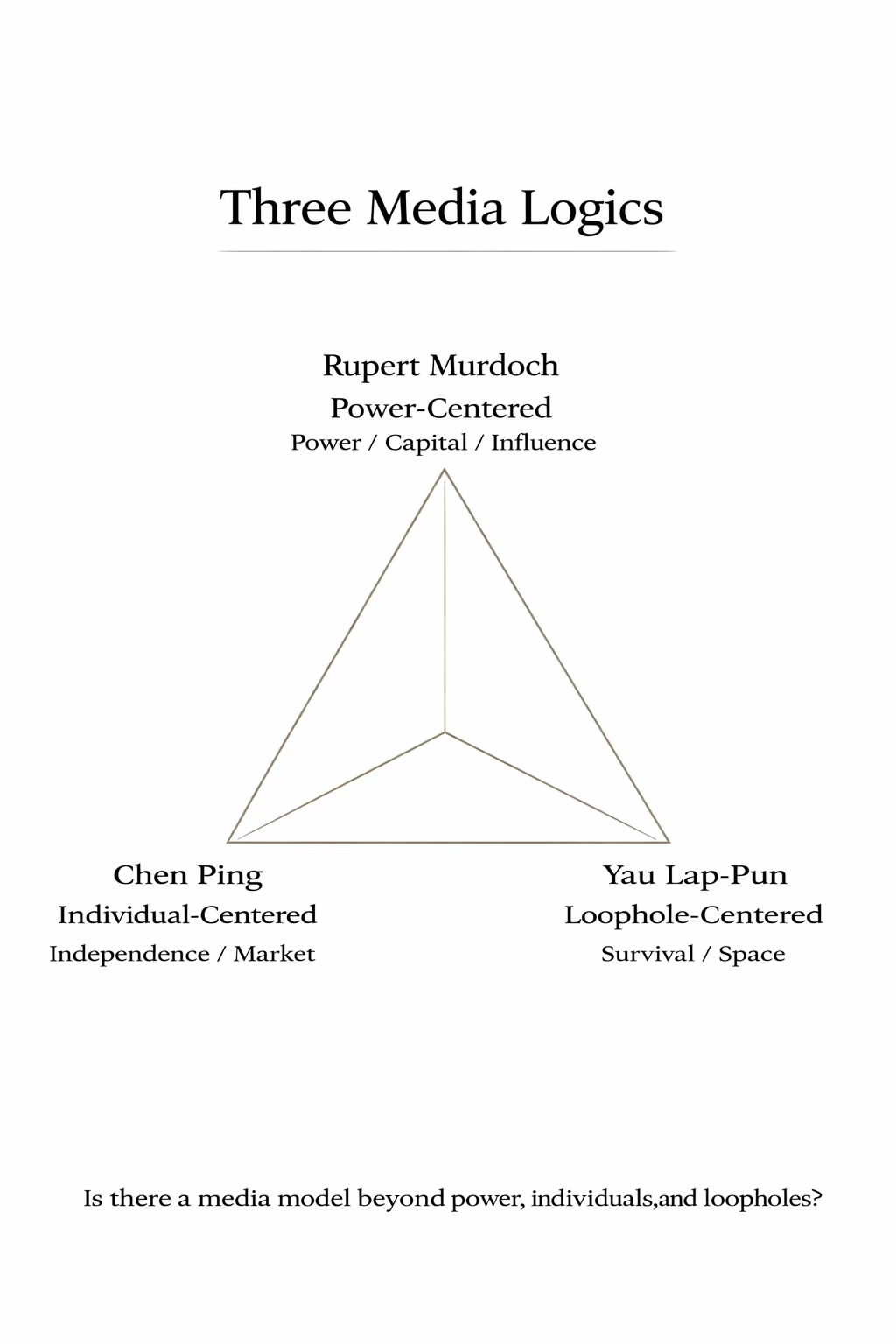 (Image Caption) This diagram presents three continuously operating media logics in a triangular structure: the top represents the "power-oriented" model, represented by Rupert Murdoch, centered on capital and influence; the bottom left represents Chen Ping's "individual-oriented" model, relying on individual ability and market operations; and the bottom right represents Qiu Liben's "niche-oriented" model, seeking survival space within institutional constraints. These three together constitute the contemporary media ecosystem and raise a crucial question: Is there a media model that can transcend power, the individual, and the niche?
I. The Incompleteness of the Three Paths Murdoch's system was effective. It operated continuously for seventy years, undergoing multiple self-renewals through technological advancements, from newspapers to television, and from television to streaming. However, the core logic of this system—traffic generation, stance locking, and political exchange—determined that its credibility ultimately served the power structure it depended on, rather than the public good itself. It could make the media influential, but it couldn't make that influence truly accountable for the public interest. When the media stopped pretending to be neutral, it became more honest; but when the whole world accepted this honesty, the disappearance of publicness no longer needed to be hidden.
Chen Ping's practice was honest. He attempted to exchange commercial interests for resource autonomy, and then use that autonomy to support public expression, providing a real institutional model for addressing the question of "how can media outlets that don't rely on government funding exist?" However, his model repeatedly encountered setbacks in the real world: without stable institutional protection, even the strongest sense of mission from an individual is difficult to withstand the systemic suppression of independent expression by the entire environment. Chen Ping's importance lies not in his success, but in his clear identification of the true boundaries of that path.
Qiu Liben's existence is invaluable. Under conditions of imperfect freedom, he maintained a space for public discussion through thirty-three years of practice. However, this maintenance highly depends on individual sensitivity, precise control of language, and a sustained balance of relationships—it is possible, but difficult to replicate; it exists, but its existence depends on consumption, not on the self-sustaining nature of the system. From Qiu Liben's perspective, we see not only a possibility but also a warning: if the public nature of the media needs to rely entirely on the long-term consumption of individuals to maintain, then this public nature itself will forever remain on a fragile edge.
All three models are real, but all are incomplete. 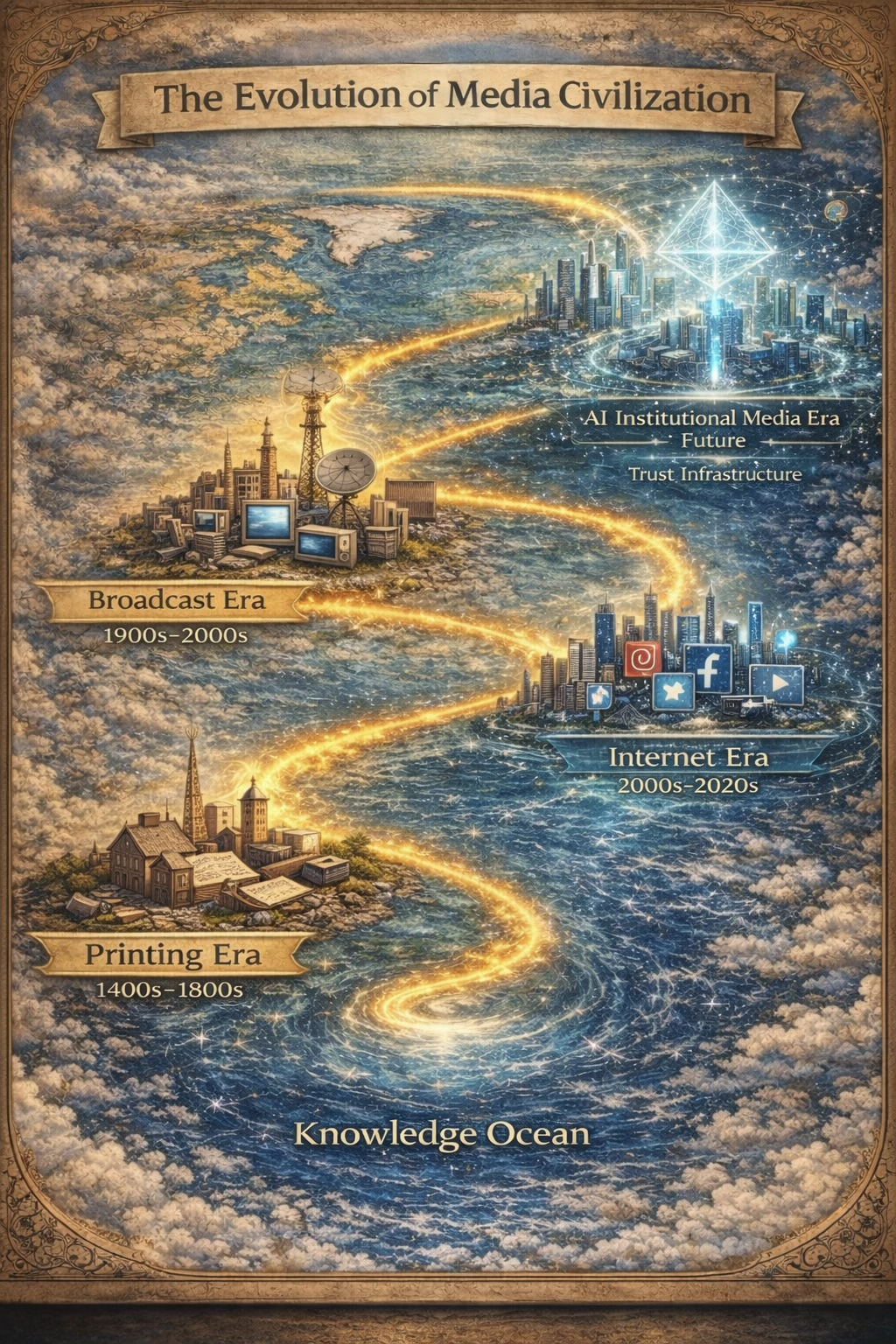 (Image Caption) Media Civilization Evolution Diagram: This diagram illustrates the evolution of media from print, broadcast, and the internet to AI-driven institutional media. Media has gradually transformed from an information carrier into a power structure, and in the AI era, it faces a core shift—no longer content production, but credibility and verifiability. This is a civilizational evolution from "communication efficiency" to "trust mechanisms."
II. Shift of the Problem Therefore, the problem begins to shift.
The media is no longer simply facing the questions of "what to say" or "which side to take," but is beginning to confront a more fundamental structural issue:
When information can be generated infinitely, when distribution is dominated by algorithms, and when the visibility of a voice is determined by the platform—on what can the credibility of the media be built upon?
This question lacks a complete answer within the framework of third-generation media civilization. The internet has lowered the barrier to information production, but it hasn't solved the problem of information credibility; social media amplifies individual voices, but it also amplifies the voices of lies and manipulation; algorithmic recommendations improve the efficiency of information delivery, but they systematically favor content that is more likely to evoke emotions rather than content that requires more understanding.
In this environment, all three traditional models face new challenges. The upgraded version of the Murdoch model—algorithm-driven stance locking—is more effective and harder to detect than Murdoch's own system. The predicament of the Chen Ping model—the dual drain on independent media from both commercial pressure and the political environment—has become more prevalent in the digital age. Qiu Liben's "gap"—maintaining a space to speak amidst varying pressures—is harder to locate and easier to close in the algorithmic environment of platforms.
A reality we must face is that the media predicament of our time is not just a matter of content or stance, but a more fundamental issue of institutional design.
Third, a fourth possible starting point: If the first three models respectively build the credibility of the media on power (influence), morality (sense of mission) and the individual (professionalism and resilience), then their common problem is that they all depend on some structurally unsustainable external conditions.
Power relations change; a sense of mission is worn down by the realities of life; and an individual's resilience has its limits.
This also means that new possibilities can no longer be based on "who," but must be based on "how"—that is, it must be an answer to a systemic problem, not just an answer to a problem involving individuals.
This is precisely the direction that the fourth generation of media civilization is trying to explore.
If the first generation of media civilization belonged to the print era, the second to the radio and television era, and the third to the internet era, then we are standing at a historical juncture today. The near-zero cost of information production has not brought about the ideal of information democratization, but rather unprecedented chaos in the information order. In this environment, what is truly scarce is no longer the quantity of information, but its credibility—a credibility that can be verified, traced, and cited long-term. 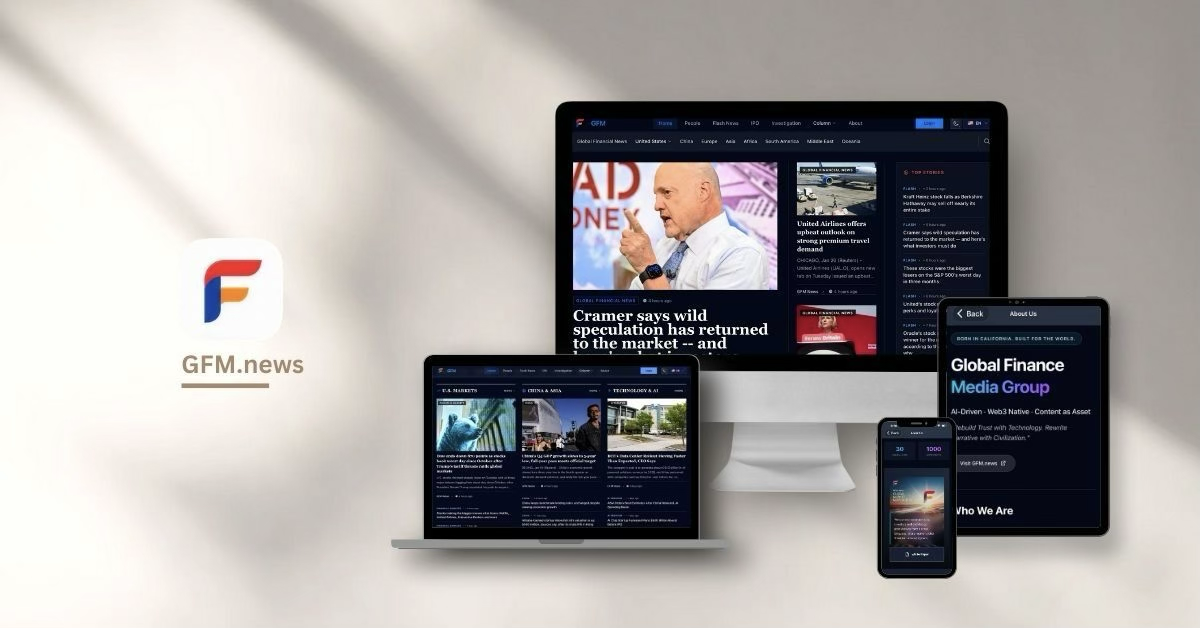 (Image caption) As an explorer of fourth-generation media, GFM creates a "fourth possibility" beyond public resources, power, and gaps. It attempts to break through the reliance of traditional media on personal experience and boundary control, and uses AI-driven intelligent infrastructure as its core to practice the concept of "content as an asset," building a multilingual, traceable, verifiable, asset-based, scalable, and sustainable public discussion space.
IV. Institutions as the Foundation of Media
GFM is trying to explore this very direction:
The credibility of the media should be separated from the relationship between individuals and power, and instead built on a verifiable, traceable, and sustainable system.
Within this framework, a report is not just a conclusion, but a process that can be traced back; an investigation is not just an opinion, but a structure with a chain of evidence; and a media outlet is not just a voice, but a system that can be examined.
CiviNote, as an institutional engine, transforms the generation, verification, and preservation of content from individual capabilities into a sustainable infrastructure—every survey possesses the institutional characteristics of traceable sources, verifiable processes, and preserved results. Its multilingual distribution capabilities allow this credibility to transcend language boundaries and serve global public issues. AI-driven content production ensures that institutional analysis no longer relies on the individual efforts of individual editors, but rather becomes a sustainable systemic capability.
These three layers combine to form an infrastructure logic unlike any previous media form: it does not rely on any specific political relationship, nor on a certain editor's thirty years of personal cultivation, nor on a commercial mission that is destined to bleed under the pressure of reality, but on an institutional structure that can be designed, tested, and continuously improved.
From Qiu Liben's "gaps maintained by people" to Chen Ping's "public instruments supported by commercial self-reliance" and then to GFM's attempt to build "credible infrastructure supported by institutional design"—this is not just an iteration of technology, but an evolution of media civilization. 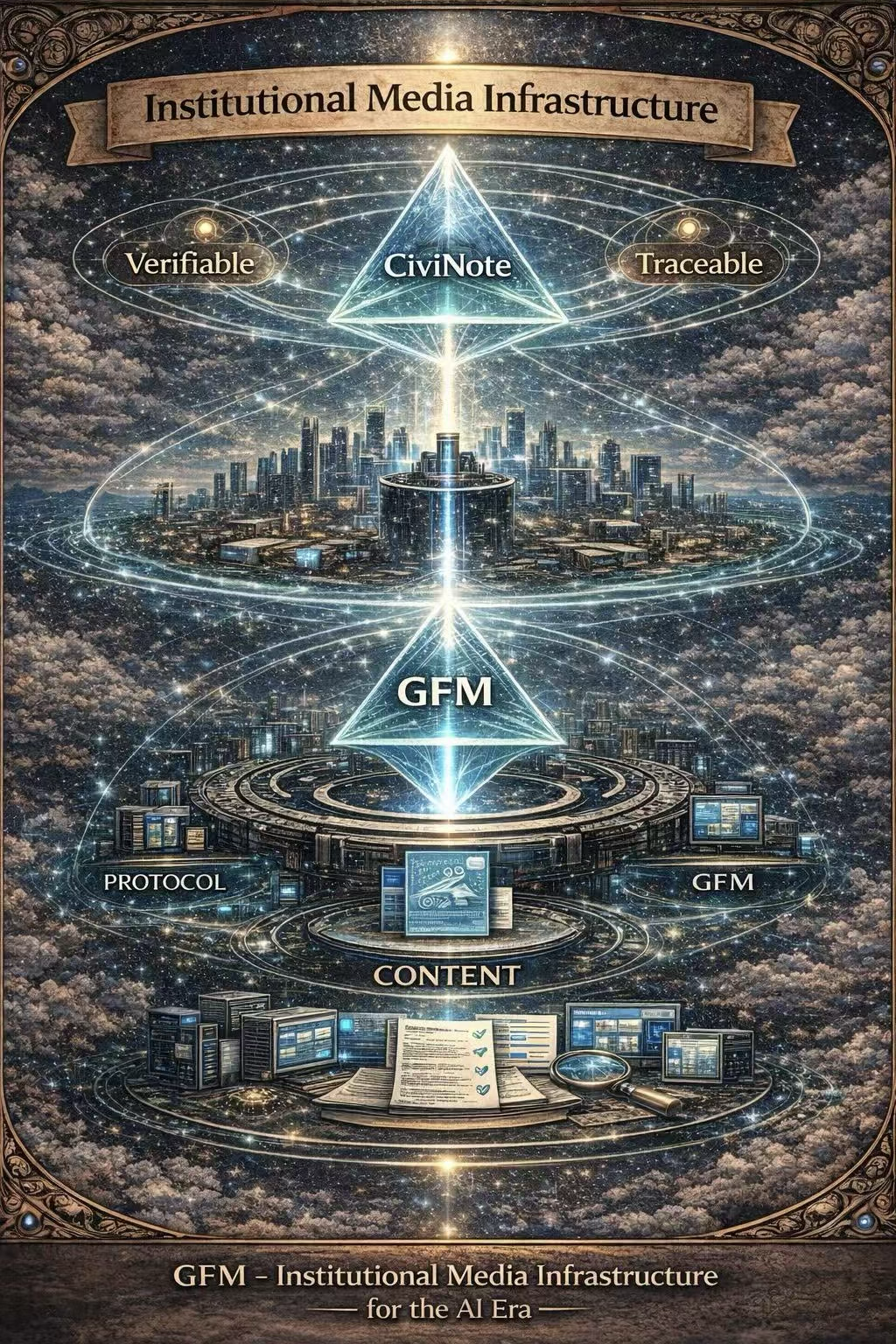 (Image Caption) GFM and the Fourth Generation of Media Civilization: This image depicts an exploratory model of GFM as an institutional media infrastructure. CiviNote serves as the engine, introducing a verifiable, traceable, and multilingual distribution mechanism into GFM, thus decoupling media credibility from individuals and power, and shifting it towards institutional design. GFM does not provide answers, but rather raises questions, exploring new possibilities for media trust.
V. The next real problem of media civilization: In 2026, driven by AI, dominated by platforms, and overloaded with information, the most fundamental problem facing the media will no longer be "how to produce more content", but "how to make credible content be identified, preserved, and used in the long term".
This is no longer just a technical issue, but a matter of institutional design; it's not just a business issue, but a matter of civilizational choice.
Murdoch addressed how to make the media influential. Chen Ping attempted to address how to maintain the media's independence. Qiu Liben addressed how to ensure the media survives within restrictions.
GFM is attempting to answer a question on a different level: how to ensure that the credibility of the media does not depend on any individual's sense of mission or the protection of any political relationship, but is built on a verifiable, traceable, and long-term citation-based institutional foundation.
VI. Returning to the Three Individuals: In this sense, Murdoch, Chen Ping, and Qiu Liben are not historical figures, but rather three ongoing logics. The three media models they represent remain the fundamental structure of today's global media ecosystem—continuing in different forms and with different technological dimensions.
GFM does not attempt to deny the validity of these arguments, nor does it attempt to make simple moral judgments about them. What we are trying to answer is another question:
Beyond these existing paths, is there a form of media that does not rely on power, individuals, or gaps?
This question still has no definitive answer. Any honest media outlet should acknowledge this.
But it constitutes the most important starting point for the media system of this era—not because we have found the answer, but because we are clear enough to understand what the problem is.
In an information environment filled with definitive pronouncements, raising a genuine question is itself a form of institutional contribution.
The exploration of GFM begins here.
This article is the summary of the three-person feature article "Media Is Not Neutral: Between Public Instruments, Power, and Gaps" published in GFM's "People" section. The three profiles, "The Man Who Creates Power—Rupert Murdoch," "A Man Who Does Not Want to Be Subordinate to Power—Chen Ping," and "The Man Who Runs a Newspaper in the Gaps—Qiu Liben," serve as background texts for this article and are recommended for reading consecutively.
Global Finance Media Group — gfm.news