

Andrew Feldman: Architectural Dissident in the AI Computing Order
He's not making a chip; he's challenging the GPU cluster-dominated infrastructure path.
Character ID: PZ-US-01-001
English name: Andrew D. Feldman
Country/Region: United States; City: Sunnyvale, California
Company/Institution: Cerebras Systems
Identity/Position: Co-founder & CEO
People and Fields: AI Infrastructure, Semiconductor Architecture, AI Training and Inference, Computing Power Substitution Path Disruptions Types: AI Productivity Disruptions, Technology Governance Disruptions, Capital Structure Disruptions  (Image caption) Andrew Feldman stands in the shadow of AI computing power, attempting to propose an alternative infrastructure path with wafer-level architecture.
That battle was asymmetrical from the start.
Goliath was never worried about David.
This is where the real cruelty of the story lies. It's not because the giant is evil, but because he simply doesn't need to care—his armor is too thick, his lines too solid, and behind him stands the habitual obedience of the entire Israeli army. David's problem isn't just his size; it's that he's fighting a war that is fundamentally unequal.
Andrew Feldman knew this.
He calls himself "professional David" who fights against giants, speaking with the calmness typical of Silicon Valley entrepreneurs. But behind this statement lies a soberly unsettling judgment: sometimes the best technology doesn't necessarily win, so you have to work hard to make sure it does.
The giant he faced was Nvidia. Not just a company, but an infrastructure empire already embedded in the very fabric of the global AI industry: GPUs, CUDA, developer tools, cloud platform partnerships, customer habits, and the trust of the capital markets—accumulated over two decades, layer upon layer, forming an almost invisible moat.
In the AI era, those who truly hold the underlying power are never just model companies. OpenAI, Anthropic, Google, and Meta stand at the center of the public eye; but at a deeper level, what determines the cost, speed, scale, and national capabilities of AI is the infrastructure system comprised of chips, computing power, data centers, energy, and supply chains. This system is today highly concentrated on the GPU ecosystem dominated by Nvidia.
Feldman's question was simple, fundamental, and made everyone uncomfortable:
Is AI computing power limited to only one path?
This question is the starting point of his entire character story, and also the reason why GFM wrote about him.  (Image caption) Feldman calls himself "professional David" and is not dealing with a single company, but an entire AI computing power empire.
Feldman is not a product of hype, but rather a product of long-term bettors. To understand Feldman, one must first understand who he is not.
He is not an opportunist pushed to the forefront by the generative AI wave, nor is he someone who temporarily switched to "AI computing power entrepreneurship" after ChatGPT became a hit, nor is he a narrative entrepreneur who raised money in Silicon Valley with a white paper and a few slides.
He is a serial entrepreneur who repeatedly bets on the structural bottlenecks of computing infrastructure, and each time he bets on them earlier than the market generally recognizes.
Before Cerebras, he co-founded and served as CEO of SeaMicro. That was in 2009, when cloud computing was just beginning, and data center energy consumption and density issues were not yet public concerns. SeaMicro developed high-efficiency, high-bandwidth microservers and was acquired by AMD for $357 million in 2012. Earlier, he served as Vice President of Product Management and Business Development at Force10 Networks, which was acquired by Dell for $800 million; before that, he participated in the development of RiverStone Networks before its IPO in 2001. He holds a BA and MBA from Stanford University, a resume corroborated by his profile at the University of Chicago's Data Science Institute.
The pattern of this approach is clear: find the next structural contradiction in computing infrastructure and bet on it before the market recognizes it.
SeaMicro addresses the energy consumption and density issues of data centers. Cerebras addresses the problem of organizing computing power in the AI training and inference era: as models grow larger and GPU clusters become more complex, memory walls, communication bottlenecks, power consumption, and system engineering pressures also increase. This contradiction was not a public issue in Cerebras' early days; today, it is one of the most core industry controversies surrounding AI infrastructure.
This is Feldman's first value: he sees problems earlier than the market.  (Image caption) From SeaMicro to Cerebras, Feldman has consistently bet on the next bottleneck in computing infrastructure.
The logic behind a single wafer, and the war on yield.
The core technology of Cerebras needs to be explained by a counterintuitive question.
The chip manufacturing industry has a deeply ingrained production logic: cut a large wafer into many smaller dies, then package, test, and sell them. This logic exists because of the reality of yield. Defects on a wafer are randomly distributed; the smaller the die, the lower the probability of a single die containing defects, resulting in higher yield, lower scrap rate, and more controllable costs. This isn't conservatism; it's the optimal solution accumulated over decades of semiconductor manufacturing.
Cerebras' choice is to completely reverse this logic.
It integrates the entire wafer into a single processor, called a Wafer-Scale Engine (WSE). This means that yield was the biggest engineering challenge from the very beginning: any defect on a WSE cannot be discarded like a traditional die; it must be addressed at the design level. Cerebras engineers invested heavily in redundancy design—allowing certain computing units on the wafer to be bypassed when defects occur, ensuring the entire wafer remains usable. This is the core engineering challenge of wafer-scale computing, and the reason why almost no one before Cerebras could solve it.
What did WSE gain after solving the yield problem?
The third-generation WSE-3 uses TSMC's 5nm process and features 4 megatransistors, 900,000 AI-optimized computing cores, 125 petaflops of peak AI performance, and 44GB of on-chip SRAM. The CS-3 system can support training models with up to 24 megaparameters and can be scaled up to 2048 units.
But numbers are results, not logic. The logic is this: one of the core bottlenecks in AI training is the speed at which data moves between different computing units. GPU clusters connect many GPUs via high-speed networks, allowing data to be continuously transferred between chips. This brings huge communication overhead, latency, power consumption, and system complexity that is difficult to scale linearly.
Cerebras' answer is: make the computation itself large enough so that massive amounts of data never need to leave the chip. With sufficient on-chip computation and wide enough on-chip memory bandwidth, data doesn't need to move frequently between numerous distributed chips. Cerebras officially claims that CS-3 requires 97% less code than GPU clusters for LLM training and can train models with 1B to 24T parameters in pure data-parallel mode. This is the company's official performance narrative; verification in specific scenarios still requires time, but the issue it points to is real: Cerebras is trying to address not just single-point speed, but the complexity and cost of distributed AI engineering.
This is not about optimizing details, but a fundamental difference in architectural philosophy: instead of piling up more and smaller things to increase computing power, we should rewrite the way computing power is organized with a larger and more integrated system.
This philosophy was heretical during the era dominated by Nvidia.
But heresy is not the same as error. 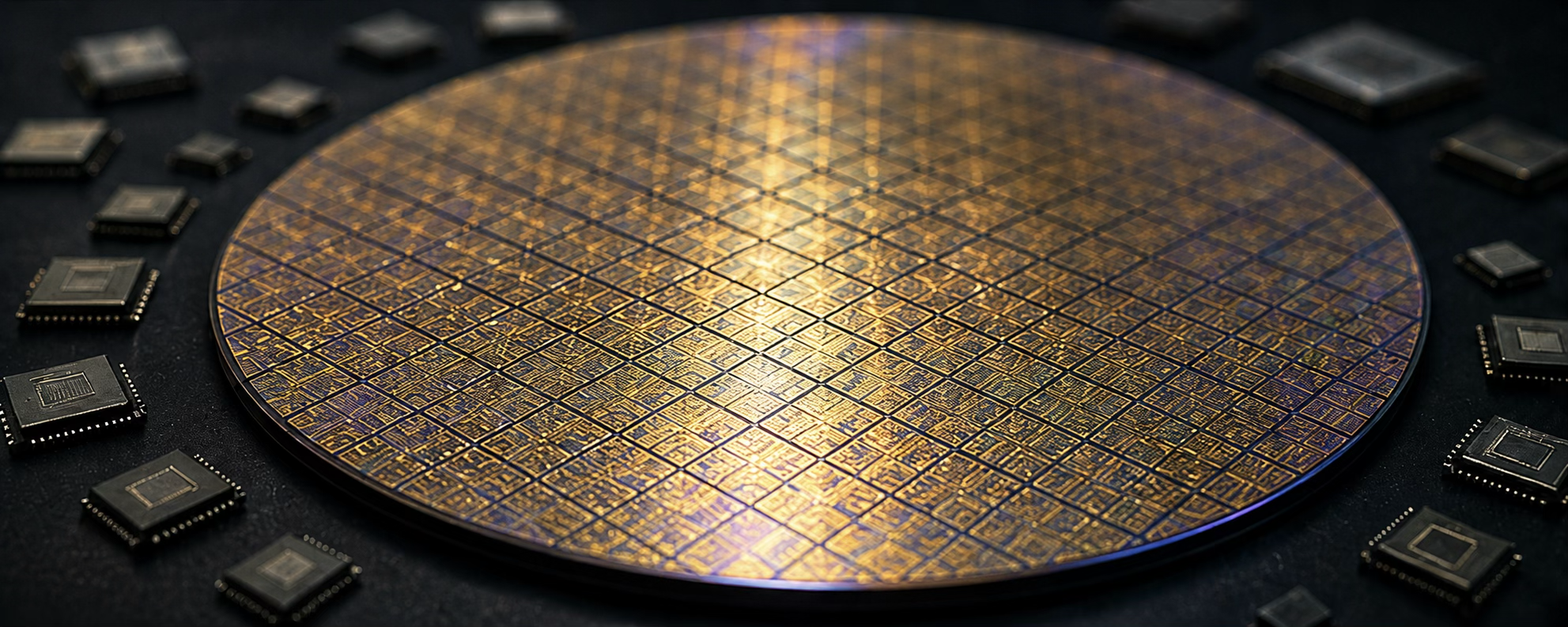 (Image caption) Cerebras' Wafer-Scale Engine does not shred the wafer, but transforms the entire wafer into a super-large processor.
To understand Cerebras' market position, we must first understand what Nvidia's real moat is.
It's not about GPU performance. Performance can be caught up with; AMD is catching up, Intel is catching up, Google has TPUs, Amazon has Trainium, and Cerebras is catching up too. Performance gaps can be narrowed through manufacturing processes, architecture, and R&D investment.
Nvidia's true moat is the world built by CUDA.
In 2006, Nvidia launched CUDA, a parallel computing platform and programming model. For nearly two decades, a large number of AI researchers, engineers, and model trainers worldwide have worked within the CUDA ecosystem. Their frameworks, toolchains, engineering habits, and organizational processes are deeply intertwined with this ecosystem. Migrating from CUDA to another platform is not just about changing hardware; it involves rewriting workflows, retraining engineers, and retesting model behavior—extremely costly and risky. Without a compelling reason, almost no one would choose this path voluntarily.
This is why Feldman's use of the term "professional David" is not just self-deprecation, but a sober assessment of the depth of the problem. He is not fighting against a single chip, but against an infrastructure inertia that has permeated the very fabric of the AI industry.
Cerebras' breakthrough path cannot rely solely on being "faster than GPUs," despite its claimed speed advantage in specific scenarios. What it truly needs to do is identify scenarios where GPU clusters are unsuitable and customers have a strong incentive to change their computing power procurement methods, establish a foothold there, and then gradually expand.
These scenarios may include: applications that are extremely sensitive to inference latency; government and sovereign AI customers that require on-premises deployment rather than cloud-based deployment; environments with special constraints on energy consumption and physical space; and specific scientific computing, medical, and model training workloads.
Not all markets, but probably a large enough market.
This was Feldman's bet. He wasn't betting on "I'm better than Nvidia," but rather on "Nvidia alone simply can't serve everyone."
G42: The most lucrative order, the heaviest political weight. In Cerebras' business history, G42 is an unavoidable and indelible milestone.
It brought the company its most important early revenue, but also institutional risks that the company could hardly solve with engineering capabilities alone.
G42 is an Abu Dhabi-based technology holding group that plays a significant role in the Middle East's AI infrastructure investment landscape. Cerebras' 2024 S-1 prospectus disclosed that G42 contributed $65.1 million in revenue to Cerebras in 2023, accounting for 83% of the company's total revenue that year; in the first half of 2024, G42 contributed $119.1 million in revenue, accounting for 87%.
Imagine that situation.
A company derives over 80% of its revenue from a single client—an AI investment group with ties to the UAE government, currently under scrutiny from US national security authorities. Feldman needs this revenue to demonstrate rapid growth to investors, but it also sends a disturbing signal to regulators: the company's fate is heavily tied to a sovereign capital entity that the US government does not trust.
This is not a matter of financial concentration. This is a geopolitical issue.
Cerebras explicitly disclosed in its S-1 statement that changes in G42 demand, applicable laws and regulations, or negative changes in the strategic relationship between the two parties could harm the company's business; the same paragraph also noted that export licenses may be required when selling products to different jurisdictions. These are legal terms, but behind them lies real political pressure.
As a result, Cerebras' IPO process was previously hampered by a U.S. national security review of its G42-related investments, and it was forced to withdraw its IPO application in 2025.
This is not a business failure. It is an outward manifestation of systemic conflict.
Even after withdrawing his application, Feldman still stated that the company would go public in the future. This statement needs to be read in its context: it is an entrepreneur's determination made under pressure, and also his most important public commitment to himself.
The G42 incident reveals a fundamental question that AI computing power companies inevitably face: whose computing power serves whose national goals? When the answer to this question displeases the US government, even the best technology and the strongest revenue can be shut out of the open market by a regulatory review.  (Image caption) Nvidia's real moat is not just GPU performance, but the ecosystem formed by CUDA, developers, and cloud platforms.
Two attempts in the open market
Cerebras' IPO process is the best example for understanding how the current AI computing power narrative is priced by the capital market.
The first attempt was in 2024. The company filed an S-1 with the SEC, which Feldman signed as CEO and co-founder. The prospectus showed rapid revenue growth, but G42 concentration, national security reviews, and geopolitical risks brought the IPO to a standstill under dual pressure from regulators and the market. In 2025, the company withdrew its application after completing a large private funding round.
This is not a failure, but a costly misjudgment of timing.
The second attempt was in 2026. The market environment had changed, and AI-related IPOs had regained the attention of the capital market. This time, the company presented new financial strength: revenue rose to $510 million in 2025, up from $290.3 million the previous year, and turned from a loss of $9.90 per share to a profit of $1.38 per share; more importantly, the company reached a multi-year agreement with OpenAI, in which OpenAI agreed to deploy 750 megawatts of high-speed AI computing power in Cerebras, an agreement valued at over $20 billion.
In terms of pricing, the company plans to sell 28 million shares at a price range of $115 to $125 per share, raising up to $3.5 billion and targeting a valuation of up to $26.62 billion. Morgan Stanley, Citigroup, Barclays, and UBS are the lead underwriters.
These figures represent more than just the scale of financing.
This means that, for the first time, the public market is seriously pricing in AI computing power paths other than Nvidia. If successful, this valuation will become a benchmark for the entire alternative computing power industry, influencing the financing logic, competitive narratives, and market expectations of latecomers.
But the IPO is not the end. It is the beginning of even more rigorous tests.
After going public, the margin for error in the narrative narrows dramatically. Private companies can use vision to gain patience, while public companies must use quarterly figures to earn trust. Any order delays, customer churn, or profit margin compression will be amplified in the market's immediate pricing. Feldman could previously explain the G42 concentration as a "strategic partnership," but after going public, it will be re-examined by institutional investors in a more scathing way.
OpenAI Contract: Institutional Repositioning, Not Just a Commercial Victory. In Cerebras' 2026 IPO narrative, OpenAI is the most important new variable, but it needs to be carefully interpreted.
A computing power scale of 750 megawatts and a contract value exceeding $20 billion—these figures are impressive enough. But a more important question is: where does this contract stand within OpenAI's overall computing power landscape? OpenAI maintains complex computing power relationships with Microsoft Azure and other vendors. Is Cerebras a complementary player, a distributed provider, or a true core vendor? The pace of revenue recognition and the delivery schedule will determine the true financial implications of this contract.
However, these technical issues cannot overshadow a more important institutional significance.
From Middle Eastern sovereign AI clients dominated by the G42 to top US modeling companies represented by OpenAI, Cerebras' client portfolio is undergoing a structural geopolitical shift. This shift not only affects its finances but also influences how regulators, institutional investors, and industry partners assess Cerebras' overall risk profile.
The essence of the G42 problem is whose national goals computing power serves. The emergence of OpenAI has provided an answer to this question that is more easily accepted by US regulators.
Feldman is well aware of this. The OpenAI contract is not just a commercial victory; it's an institutional anchor reset for the Cerebras IPO narrative.  (Image caption) G42, OpenAI, export controls and sovereign AI bring Cerebras' computing power narrative into the geopolitical arena.
To fully understand Feldman's situation, one must look at maps, not just chips.
AI computing power is no longer just a business issue; it is becoming a national capability issue.
The US export control list determines which chips can be sold to which countries. Middle Eastern sovereign wealth funds are making massive investments in global AI infrastructure. Europe is discussing computing power sovereignty, not wanting to be entirely dependent on US cloud service providers. Southeast Asia, India, Japan, and South Korea are all attempting to build local computing capabilities in different ways.
This landscape presents both opportunities and risks for Cerebras. The opportunity lies in the fact that sovereign AI customers don't want to rely solely on Nvidia; dependence on a single supplier means a loss of negotiating leverage, and on-premises deployment is a potential advantage for Cerebras compared to GPU cloud services. The risk lies in the uncertainty surrounding US export controls, which limits the markets Cerebras can freely access. The G42 incident has already demonstrated that the political affiliation of computing power customers directly impacts a company's regulatory position in the US.
Feldman needs to manage the technology roadmap, product delivery, software ecosystem, and financial structure simultaneously, and also answer a more complex question:
On this map, which clients' money can be taken, which markets' business can be done, and which collaborations will push the company into regulatory sensitive areas?
This isn't an engineering problem; it's a systemic design problem. And this problem can't be solved simply by having better chips.
His five institutional values
GFM wrote about Andrew Feldman not because Cerebras had proven successful, but because he represented a set of institutional propositions worthy of long-term tracking.
He personified the bottleneck of AI computing power. The competition in AI is primarily a competition of systems related to computing power, energy, chip architecture, supply chain, and data center capital expenditure, not just a competition of models. Feldman's existence gives this abstract proposition a concrete face and traceable progress.
He offered an alternative technological vision. Wafer-scale computing is not mainstream, but precisely because it is not mainstream, it has independent value for institutional observation: it shows that GPU clusters are not the only possibility, and that there are deeper architectural philosophical differences behind technology choices, differences that do not disappear automatically.
He stands at the true intersection of technology, capital, and geopolitics. Cerebras's customer structure, sovereign AI scenarios, and CFIUS review make it a valuable case study in the context of export controls, AI deployments in the Middle East, and national security—a case extremely rare in the public market.
This presents a rare opportunity to test the narrative of AI infrastructure alternatives in the public market. If Cerebras successfully goes public, its public pricing of computing power paths other than GPUs will influence the financing logic and valuation expectations of the entire alternative computing power industry.
Cerebras' products are closely intertwined with data center power, cooling engineering, cloud services, sovereign AI policies, model inference costs, and national computing power, providing a complete cross-section for understanding the underlying institutional competition in AI.
Risk: Incomplete proof
Feldman's story must depict ambition, but it must also define boundaries.
The technical narrative is strong, but market adoption remains to be seen. Performance advantages do not automatically translate into large-scale adoption; the success of AI chips also depends on the maturity of the software ecosystem, customer migration costs, depth of cloud integration, supply chain reliability, and long-term cost structure. These are variables that the prospectus narrative cannot address.
Nvidia's moat remains extremely deep. The complex web of hardware, software, developer ecosystem, cloud platform relationships, and capital market trust won't be weakened by a single technical paper or a stellar financial report. Eroding it requires time, customer accumulation, and ecosystem building; lacking any one of these is insufficient.
Customer structure remains a key question. While the successful implementation of the OpenAI protocol could reshape market understanding, delivery schedules, revenue recognition, and the actual execution of contract details will continue to be the core questions institutional investors ask quarterly.
Geopolitics will not disappear. The complex relationship between AI chips, sovereign computing power, export controls, and Middle Eastern capital will shape the market boundaries that Cerebras can access in the long term, and these are structural constraints that engineering capabilities cannot solve.
An IPO is the starting point of a new trial, not the end. Going public brings capital and exposure, but also quarterly performance pressure, public competition, and a much stricter market tolerance than private financing.  (Image caption) Feldman's value lies not in his victory, but in his use of a single wafer to challenge the existing order of AI computing power.
A wafer, a rhetorical question
Andrew Feldman is not the one standing at the center stage of the AI era.
Unlike Sam Altman, who has a mastery of model narratives, or Jensen Huang, who stands at the symbolic pinnacle of a computing empire, he occupies a more austere, lower-level position, is less understood, and has fewer people willing to stay there long-term.
He is attempting to reorganize the way computing power is organized at the infrastructure layer of AI productivity.
This is neither sexy nor has any shortcut.
Cerebras may succeed, or it may simply leave behind an alternative path partially absorbed by the market under the shadow of Nvidia. Wafer-scale computing may become an important branch of AI infrastructure, or it may remain an "interesting technology" rather than a "mainstream infrastructure" due to the combined effects of ecosystem inertia, cost structure, and the speed of customer adoption.
But regardless of the outcome, the questions raised by Feldman can no longer be ignored.
As the future of AI increasingly depends on computing power, can computing power only move forward along one path?
The value of this issue does not depend on Cerebras' stock price, nor on whether the IPO was completed at the expected valuation. Its value lies in the fact that it brought a previously accepted monopolistic structure to the forefront of public scrutiny in the capital market for the first time, subjecting it to systematic questioning.
GFM writes about Andrew Feldman not because he has won, but because he represents one of the most worthy figures to follow in the long run in the world of AI infrastructure: someone who, at a time when the mainstream order has been established and most people have chosen to conform, is still trying to pave a different path for the future.
He's not making a chip.
He is turning a complete wafer into a silent questioning of the order of AI computing power.
The act of asking a question is itself a form of power.
Disclaimer: This article is a research contribution from GFM's "People's Profile" series, based on publicly available information, SEC filings, and verified press releases. It does not constitute investment advice, and copyright belongs to GFM.