

After smartphones, Nokia finally got its AI.
After losing access to mobile devices for twelve years, how patents, networks, and AI-RAN can help this Finnish company regain a key position in AI infrastructure?
More than a decade ago, Nokia handed over its most consumer-familiar mobile phone business to Microsoft, and the market quickly relegated it to the list of losers in the smartphone revolution. Today, NVIDIA has completed a $1 billion equity investment in Nokia; Nokia, on the other hand, has placed AI-RAN, optical networks, IP networks, and patent licensing into the same AI infrastructure landscape. It hasn't gone back to the way it was; the market is reassessing its place in next-generation networks.
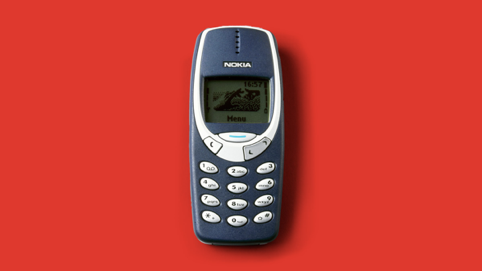 (Image caption) The Nokia 3310 from the feature phone era symbolized the company's brand assets that once dominated the global consumer mobile phone market. After Nokia sold most of its Devices & Services business to Microsoft in 2014, its closest point of contact with consumers disappeared, but its patents, standards, and network engineering capabilities were retained, becoming the starting point for subsequent revaluation.
Mobile phones may leave the market, but the underlying assets remain.
In many people's memories, Nokia's story has long since ended.
It was once the most representative global brand in the feature phone era. Reliability, durability, and wide coverage almost constituted a generation's shared impression of mobile communication. When the iPhone and Android changed the smartphone market, Nokia gradually faded from consumers' view. "Nokia lost the smartphone war" became a simple, and not entirely wrong, conclusion.
The problem is that this conclusion only explains what it lost, but not what it retained.
On April 25, 2014, Nokia completed the sale of the majority of its Devices & Services business to Microsoft. The deal was initially announced in September 2013, with Nokia disclosing a transaction price of €5.44 billion, though the final amount was subject to closing adjustments.
This was an exit from the mobile phone era, and also a restructuring of the company's assets. Nokia sold off the businesses closest to consumers and most easily visible to the market, but retained its communication standards, patent portfolio, wireless access networks, optical networks, IP networks, and engineering capabilities.
These assets won't lose value as quickly as an obsolete mobile phone. They serve operators, enterprise networks, data centers, and critical communication systems, operating within a longer technology and capital cycle that is less influenced by consumer trends.
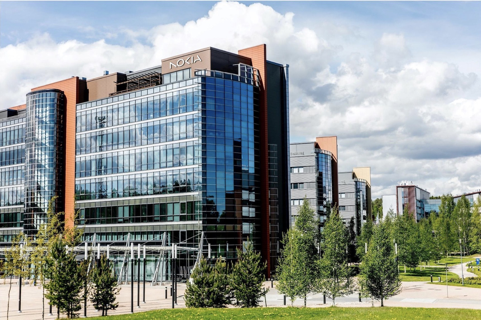 (Image caption) Nokia's headquarters campus in Espoo, Finland. After selling its mobile phone business, the company shifted its focus to wireless access networks, optical networks, IP networks, and technology standards licensing. The headquarters presents itself as a supplier to operators and critical infrastructure, rather than a consumer electronics brand.
The smartphone revolution has changed the distribution of power.
In the era of feature phones, competition among mobile phone companies mainly stemmed from hardware design, supply chain, distribution channels, and brand. Nokia held a significant advantage in this dynamic. It controlled a global distribution network, possessed mature communications engineering capabilities, and had built user trust in product quality and durability.
Smartphones have changed far more than just phone screens, cameras, and the way we access the internet.
Operating systems, app stores, developer ecosystems, cloud services, and user data are gradually replacing hardware itself as the value center of the industry. Apple and Google have established a new order centered on platforms: mobile phones have become the gateway to software, content, payments, advertising, and data services.
Nokia wasn't ignorant of communications, nor was it incapable of manufacturing mobile phones. It faced a shift in industry rules. When the market began pricing based on operating systems, application ecosystems, and data capabilities, hardware manufacturing and brand advantages were no longer sufficient to maintain its position.
The exit from the mobile phone business was therefore both a failure and a forced divestment. Afterward, Nokia had to answer a more difficult question: now that it no longer had a consumer gateway, what was left for the market to re-evaluate?
Patents and standards provide longer cash flow.
Part of the answer lies in the technical standards and patent licenses that are rarely accessible to the average consumer.
Once a communication standard is adopted by global equipment manufacturers, operators, and terminal manufacturers, the related standard-essential patents can generate licensing revenue for a considerable period. The core of this revenue is not whether a particular product sells well, but whether the entire industry continues to use the same technological rules.
Nokia disclosed at its Capital Markets Day 2025 that its Technology Standards business has over €800 million in contracted revenue annually by 2030, with an additional €200 million in annualized revenue from expansion areas. This is the basis for the company's disclosed contractual revenue, and does not equate to realized revenue, nor does it imply that future earnings are free from technological, market, and legal risks; however, it demonstrates that Nokia's standards and patent assets still possess measurable commercial value.
The mobile phone brand was Nokia's most prominent asset, but it may not have been its most enduring.
In the telecommunications industry, technical standards, patent portfolios, and long-term customer relationships may not be showcased at consumer electronics launches, but they play a vital role in the continuous evolution of devices. These are also the reasons why Nokia was able to maintain its presence in the industry after exiting the mobile phone business.
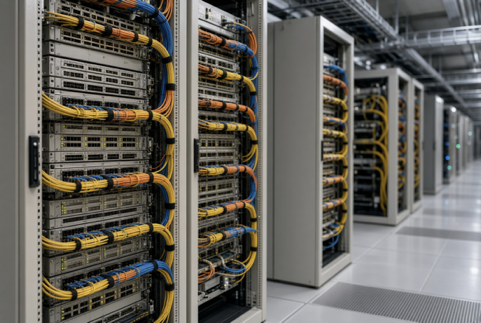 (Image caption) Schematic diagram of optical transmission and data center interconnection equipment room. After Nokia acquired control of Alcatel-Lucent in 2016, its R&D accumulation in fixed networks, IP and optical networks, as well as Bell Labs, was incorporated into the group, enabling the company to enter the transport layer required for data center interconnection and AI infrastructure.
Alcatel-Lucent completes its network infrastructure expansion.
In January 2016, Nokia acquired control of Alcatel-Lucent through a public share swap offer, and the two companies subsequently began operating as a single entity.
This acquisition was significant for Nokia far beyond simply expanding its scale. Alcatel-Lucent brought fixed networks, IP and optical networks, routing, and carrier-grade engineering capabilities, along with Bell Labs' accumulated R&D expertise. This further transformed Nokia from a company once known for its mobile phones into a comprehensive communications infrastructure provider spanning wireless, fixed, optical, and IP networks.
The customers and problems it faces have also changed accordingly.
It's no longer just about which phone consumers choose, but about how operators upgrade their networks, how enterprises deploy private networks, how data centers interconnect, how industrial scenarios ensure low-latency connections, and how different countries maintain critical communication capabilities.
These markets may not be as eye-catching as smartphone launch events, but they determine the stable flow of data, computing power, and services. As AI begins to demand larger-scale, higher-density, and lower-latency connections, the strategic value of these capabilities naturally increases.
AI needs more than just chips; it also needs networks.
The AI boom initially focused on GPUs, models, large data centers, and cloud services. Without computing power and models, AI cannot begin.
However, as AI enters inference, enterprise applications, and edge deployments, new problems begin to emerge. Industrial equipment, robots, connected vehicles, medical terminals, urban sensing systems, and various smart devices all need to bring data and decision-making capabilities closer to the field of use.
Their requirements for networks go beyond speed; they also include latency, reliability, security, predictability, and the ability to continuously upgrade.
For computing power to leave the data center, it must pass through the network.
AI-RAN has gained attention in this context. RAN, or Radio Access Network, is a crucial link in mobile networks connecting terminal devices to the core network. AI-RAN attempts to combine AI computing, radio access networks, and software architecture to allow operators to optimize spectrum usage, network capacity, and service capabilities in a more flexible way.
For Nokia, this is a familiar yet entirely new position: it remains at the core of the communications network, but the network's role has gradually evolved from a transmission channel to a part of carrying intelligent services.
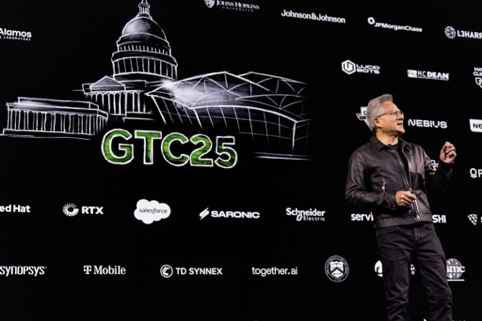 (Image caption) In October 2025, NVIDIA CEO Jensen Huang delivered a speech at GTC in Washington. At the same event, NVIDIA announced a $1 billion investment in Nokia at $6.01 per share, and a collaboration to advance AI-RAN and data center networks. This prompted the market to re-examine Nokia's position in next-generation networks.
NVIDIA's investment has changed the market's perception of Nokia.
In October 2025, NVIDIA announced a $1 billion investment in Nokia, subscribing to new Nokia shares at $6.01 per share. Nokia confirmed the completion of the private placement in November of the same year, with NVIDIA holding approximately 2.90% of the shares.
The collaboration extends beyond AI-RAN to exploring the possibility of incorporating Nokia’s data center switching and optical network technologies into NVIDIA’s future AI infrastructure architecture.
This deal has prompted the market to reconsider whether Nokia was a failed mobile phone company or a network infrastructure company whose history has been overshadowed by mobile phones.
The outcome shouldn't be overly optimistic based on a single investment. NVIDIA's investment doesn't guarantee commercial success, nor does it eliminate the competitive and execution risks Nokia faces. However, this deal reflects the growing trend of computing power, data center networks, wireless access networks, and edge deployments forming a unified industry chain.
The next round of competition in AI will not only take place between models and chips, but also between computing power accessing the network, data flowing between different nodes, and intelligent services reaching end-user scenarios.
AI-RAN has entered the productization stage, but still needs to be validated at large scale.
On July 15, 2026, Nokia announced what it calls the industry's first commercial AI-RAN platform, using its own anyRAN software and the NVIDIA Aerial AI-RAN platform.
Nokia stated that the platform has demonstrated a spectral efficiency gain of over 20%, and set technical targets of reaching 50% by 2027 and exceeding 100% by 2028. The company plans to begin pilot deployments by the end of 2026 and provide commercial solutions in 2027.
These figures must be understood within their original context: they include both the technological achievements the company has demonstrated and the product roadmap that is yet to be validated. Whether AI-RAN can continue to deliver cost reductions, capacity increases, and new revenue in real-world network environments still depends on operator capital expenditures, energy costs, equipment compatibility, spectrum conditions, and the speed of customer adoption.
In the communications industry, a new technology often requires a longer verification period from its release to large-scale commercial use than consumer products. This is especially true in critical infrastructure sectors, where customers are buying not only new features but also stability, maintainability, and long-term returns.
Nokia has entered the productization stage of AI-RAN, but it has not yet achieved large-scale market validation. This is precisely the part of its transformation story that is most worth continuing to follow.
What has been repriced is its location.
Nokia's changes are not a return to its roots in the sense of a consumer brand.
It lost the mobile phone entry point but retained communication standards, patents and engineering capabilities; through the acquisition of Alcatel-Lucent, it strengthened its fixed, optical transmission and IP network capabilities; and at a time when AI is putting new demands on networks, it has entered a new round of competition in the convergence of computing power and communication.
Consumer brands need to constantly strive to capture consumers' attention. Infrastructure companies, on the other hand, rely on technological reliability, standard-setting status, customer relationships, long-term deployment capabilities, and capital expenditure cycles. The former easily generates market buzz, while the latter tends to accumulate value during periods of market quiet.
Nokia's value lies not in recreating the glory of the mobile phone era, but in its continued position at the intersection of next-generation communication rules, network capabilities, and industry investment.
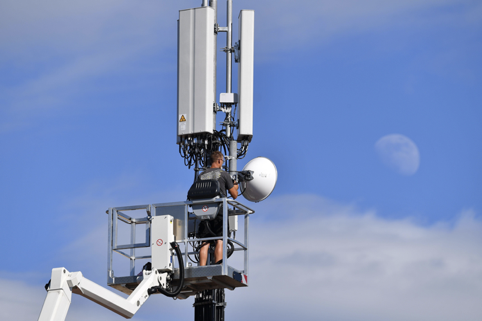 (Image caption) Technicians install radio access network antennas and transmission equipment on a base station tower. RAN is a crucial link connecting terminals and the core network, and it is also the field foundation for Nokia to integrate AI computing into the radio access network; the company released its commercial AI-RAN platform in July 2026, and pilot deployments and large-scale verification are still underway.
Recovery is not yet victory
Nokia still faces multiple challenges. The telecommunications equipment market has long been influenced by operators' capital expenditure cycles, resulting in uneven returns on 5G investments, and the business model for 6G remains undefined. Ericsson, Samsung, Huawei, and other regional equipment vendors also pose competitive pressure at different technology and market levels.
The economic viability of AI-RAN remains to be seen. How GPUs and accelerated computing devices affect deployment costs and energy consumption, whether operators are willing to continue paying for software subscriptions, and whether new network capabilities can be converted into quantifiable revenue are all questions that need to be answered in the next phase.
Geopolitics also has a dual impact on Nokia. Supply chain restructuring and security needs may open up some market opportunities, but market fragmentation, compliance costs, and the complexity of global deployment may also increase.
Therefore, Nokia today is better understood as a company that is repositioning its assets and market position, rather than a story of a complete turnaround.
A company may lose its front office, but it may not lose its future.
Nokia did not revert to the old path of the mobile phone era. Instead, it chose to integrate its patents, standards, wireless access networks, optical networks, IP networks, and R&D capabilities into a new cycle of AI infrastructure expansion.
A company may fade from consumers' minds but retain its influence within the industry system; it may miss a product cycle but may regain its place in the next generation of technological architecture.
Nokia's case reveals more than just the resilience of corporate transformation. It also reminds the market that control in the AI era exists not only in chips and models, but also in the communication networks that carry computing power, data, and intelligent services.
Disclaimer
This article is based on company announcements, regulatory documents, and publicly available information and is for research and informational purposes only. It does not constitute any investment, transaction, or business decision advice. The technical benefits, product roadmaps, and commercialization timelines described herein may contain company objectives or forward-looking statements; actual results may differ from expectations.