

A phone call Trump made to Jensen Huang: Who is stepping on the gas for American AI?
Nvidia's $99 billion equity investment has extended to cutting-edge AI, professional cloud providers, and optical interconnect companies. A phone call from the president put the White House's determination to accelerate AI alongside the ever-expanding power of AI capital in the same frame.
When Jensen Huang answered Trump's call from his stage in Los Angeles, within minutes, the White House's accelerated AI ambitions, Nvidia's $99 billion capital footprint, and the reality of data center expansion simultaneously came to the fore. This race involves not only chips and models, but also power grids, financing, local communities, and public trust. Before the US prepares to loosen the brakes, it must first answer: Who is pressing the accelerator, and who will bear the risks and costs ahead?
 (Image caption) On September 14, 2026, Nvidia CEO Jensen Huang received a phone call from US President Donald Trump on stage at the All-In Summit in Los Angeles and transferred the call to amplified audio. In the image, he is holding a folding phone and sitting on a sofa with the host; this is the same public phone call described at the beginning of the article.
When Huang answered Trump's call, he said, "You're right. We're not going to let that happen, sir."
On September 14, 2026, Jensen Huang stood on the stage of the All-In Summit in Los Angeles, discussing artificial intelligence with the host of the All-In Podcast. The audience included investors, entrepreneurs, and tech executives. Topics covered models, chips, and data centers, but consistently returned to an increasingly unavoidable question: Is cutting-edge AI progressing too fast? Do we have enough time to understand, test, and constrain it?
Huang Renxun's assistant walked to the front of the stage with a constantly ringing phone and handed it to him.
He glanced at the caller ID; it was US President Trump.
Jensen Huang did not leave the stage. He told Trump that he was sitting in front of thousands of people at the summit, then put the phone on speakerphone so that the entire audience could hear the president's voice.
Trump did not announce any deals or release any new executive orders. He spoke about the future direction of AI. He said robots will not take over the world and called recent calls to slow down AI development a "hoax."
"We have to do things, and we have to do them carefully," Trump said. "But that doesn't mean we're going to stop an industry."
He described the data center as a strategic industrial asset for the next few decades and believes that many U.S. projects are being pushed overseas due to licensing barriers.
When Trump stated that the US cannot allow fear to slow down the industry, Jensen Huang gave the most attention-grabbing response of the entire event:
"You're right. We're not going to let that happen, sir."
This call, lasting only a few minutes, suddenly imbued the AI debate with the weight of the White House. It also revealed Jensen Huang's position in the current AI economy: he is no longer just a chip company CEO discussing product performance. Nvidia's GPUs power the training and inference workloads of model companies worldwide; its capital, procurement arrangements, and technological collaborations extend to cutting-edge AI labs, AI cloud service providers, optical interconnect companies, and data center supply chains.
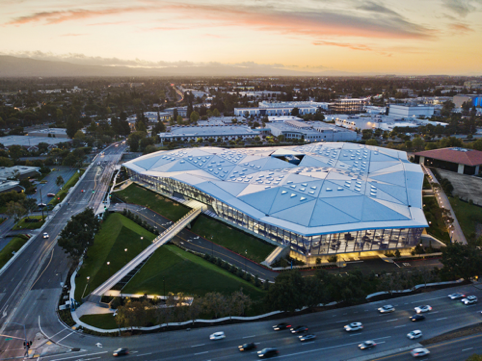 (Image caption) The Voyager Building, Nvidia's headquarters in Santa Clara, California. This corporate headquarters corresponds to the role transformation described in the article: Nvidia is no longer just a chip supplier, but an ecosystem organizer that has penetrated into model companies, professional cloud services, and the supply chain with $99 billion in equity investments, procurement commitments, and financing guarantees.
The $99 billion investment is changing Nvidia's role.
NVIDIA holds a dominant position in the AI industry. Its GPUs support large-scale model training, inference services, cloud computing, robotics, medical research, and defense applications. The CUDA software ecosystem and NVLink interconnect architecture also keep a large number of developers, cloud service providers, and enterprise workloads within its technological orbit.
But Nvidia’s recent actions show that it is no longer simply waiting for market demand to emerge naturally.
According to its quarterly filings ending July 26, 2026, Nvidia disclosed $99 billion in equity investments and an additional $25 billion in equity investment commitments. These figures demonstrate that Nvidia's role extends far beyond chip sales. It is investing capital across the entire AI value chain while building long-term relationships with companies that purchase Nvidia GPUs, deploy Nvidia networking equipment, or rely on its software environment.
Capital, hardware, technology, and market demand are reinforcing each other within the same ecosystem.
Trump's assertion that the US should not slow down AI has very specific industrial implications for Nvidia. More model training means more GPUs; more inference services mean more data centers; more data centers mean more optical interconnects, power, cooling systems, and networking equipment. Technological speed has become an economic force that can translate into revenue, valuation, and the influence of technological standards.
Capital initially flows to model companies and professional AI cloud providers.
Nvidia's investment strategy primarily targets cutting-edge AI developers.
Large modeling companies like OpenAI face challenges far exceeding the funding needs of typical startups. They need more than just capital to develop products; they require long-term access to massive computing power, data center space, power supplies, engineering capabilities, and next-generation equipment. The faster modeling capabilities advance, the sooner these infrastructure commitments must be made.
In February of this year, OpenAI announced it had secured $110 billion in new funding, including $30 billion from Nvidia. This deal deepened Nvidia's relationship with one of the world's most important developers of cutting-edge models. Nvidia wants model companies to have sufficient capital to build computing power and for their expansion to be built on Nvidia systems. For OpenAI, Nvidia's capital and technological influence will help address the enormous costs of building data centers and procuring computing power.
Specialized AI cloud providers are also an important part of NVIDIA's strategy. Companies like CoreWeave and Nebius purchase GPUs in large quantities and then lease the computing power to model companies, enterprise customers, and developers. Unlike traditional hyperscale cloud platforms, they do not simultaneously operate massive e-commerce, advertising, and enterprise software businesses; their core work is to transform AI computing power into sellable services.
Nvidia's investment and business relationships with specialized AI cloud providers should still be examined on a transaction-by-transaction basis. Shareholding ratios, lock-up clauses, procurement obligations, and related-party risks will not be entirely the same. However, Nvidia's direction is clear: it is helping to cultivate more AI computing power providers, so that market supply is not entirely dependent on a few hyperscale platforms.
This approach can create new customers and potentially lead to deeper industry dependence. Once the invested companies acquire capital and equipment, they will need to rely on GPU computing power to generate rental revenue. Nvidia's equipment sales and equity investment value could therefore simultaneously benefit from the expanding demand for AI.
This relationship is not necessarily unhealthy in itself, but investors, regulators, and the market must clearly understand it.
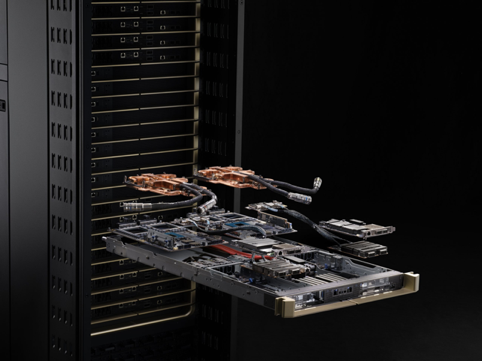 (Image caption) The internal structure of an NVIDIA liquid-cooled AI server rack, showing the cooling plate, high-speed interconnect cables, and computing modules. The image presents the physical form of the GPU cluster as the engine of the "AI factory," echoing the text's mention of more model training and inference services, which implies more data centers, power, and network equipment.
Optical interconnects will determine whether an AI factory can operate at full speed.
If we consider an AI data center as an industrial factory, the GPU is the most prominent engine, and the optical interconnects are like the high-speed rail system within the factory. If data transmission is not fast enough, stable enough, or energy-efficient enough, even the most powerful chip may become idle while waiting for data to arrive.
Nvidia's investments in Lumentum and Coherent are specifically targeting this segment. On March 2nd of this year, Nvidia announced a $2 billion investment in each of the two companies. These transactions are not just equity investments, but also include billions of dollars in procurement commitments and future capacity arrangements for advanced laser and optical networking products.
The collaboration serves two purposes. Photonics gains capital to expand its R&D, manufacturing, and U.S. domestic production capacity; Nvidia, on the other hand, secures key components for next-generation data centers earlier and integrates these technologies more deeply into its own architecture.
On March 31, Nvidia invested another $2 billion in Marvell. The collaboration covers customized AI chips, networking equipment, optical interconnects, and silicon photonics technology. Marvell's products will be compatible with NVLink Fusion, while Nvidia will provide CPUs, network interface cards, and interconnect technologies.
This deal has particularly important implications. As more enterprises look to adopt customized AI chips, Nvidia's response is not necessarily to exclude these chips from its systems, but rather to allow them to continue running within Nvidia-centric data center architectures.
A single GPU can be incredibly fast, but if data can't flow rapidly between chips, the value of the entire cluster diminishes. Optical transmission, photonics, and high-bandwidth networks have become central to the next phase of competition in AI infrastructure. Nvidia is investing in areas less prominent than GPUs, but which could determine the actual operational efficiency of AI factories.
The $105 billion guarantee and the $500 billion framework do not equate to cash investment.
The most important, and most confusing, point in Nvidia Capital's strategy is that different arrangements cannot all be simply called "investments".
Equity investment is the exchange of capital for ownership of a company; a purchase commitment is a promise to buy equipment or services in the future; loans, credit support, lease guarantees, and residual value guarantees each have different triggering conditions, accounting treatments, and risk limits.
In August of this year, Nvidia announced it would provide up to $105 billion in support guarantees for OpenAI's data center arrangement in Ohio. The project, developed by SoftBank's SB Energy, is expected to be used by OpenAI on a long-term lease.
Nvidia's own disclosures make an important distinction: these warranties cover defined lease and electricity payments, not the cost of the entire project, nor do they assume all of the tenant's obligations. As OpenAI fulfills its lease payments, Nvidia's risk exposure will decrease; the related warranties will also terminate under certain conditions.
Therefore, Nvidia's $105 billion cash investment is not a one-time commitment, nor is it an unconditional assumption of all obligations for OpenAI. It is a contingent guarantee arrangement involving leasing, electricity, and residual value of assets. Even so, it is still a massive infrastructure financing commitment, demonstrating Nvidia's willingness to leverage its balance sheet, creditworthiness, and confidence in the long-term value of its equipment to help the AI data center secure financing.
The other set of collaborations is different in nature. Nvidia has established partnerships with Apollo, BlackRock, Blackstone, Brookfield, Goldman Sachs, and KKR to create a dedicated third-party capital pool for data center construction and computing system procurement by Nvidia customers. The goal of this framework is to mobilize more than $500 billion in potential capital investment.
This doesn't mean Nvidia is putting up $500 billion of its own money. It's more like an industrial finance platform: large asset management companies provide external capital; Nvidia provides technology standards, an ecosystem of devices, and visibility into long-term demand, and offers defined support in some transactions to reduce investor concerns.
This structure can accelerate financing for AI infrastructure and allow Nvidia to move into a position previously held primarily by banks, leasing companies, and large project financing institutions.
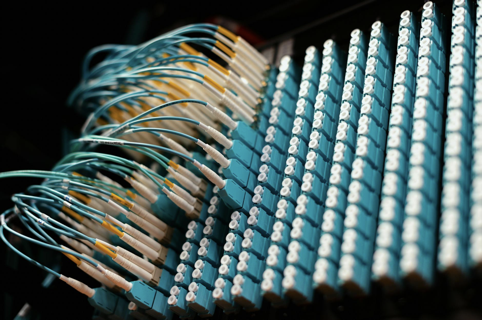 (Image caption) Fiber optic patch panel and high-speed optical connector in a data center. The article likens optical interconnects to a high-speed railway inside an AI factory; Nvidia's investments in Lumentum, Coherent, and Marvell are precisely to enable data to flow between chips at high speed and stably.
A longer growth flywheel is forming.
From an industry perspective, Nvidia is extending the growth trajectory of AI.
It supports model companies, cloud providers, and supply chain enterprises through capital and partnerships; these companies then purchase GPUs, networking equipment, optical interconnect products, and data center services. Once deployed, new model training and inference services enter the market. Increased demand may subsequently boost the valuations and refinancing capabilities of these companies.
CUDA accompanies developers to work on NVIDIA platforms; NVLink strengthens the internal connectivity of large GPU systems; and optical interconnects and supply chain collaborations extend this dependence to the deeper layers of data centers. NVIDIA's competitive advantage is extending from the performance of a single chip to the operational capabilities of an entire AI factory.
Companies choose NVIDIA not just because of investment relationships. Product performance, software maturity, supply reliability, technical support, and the existing developer ecosystem are all substantial factors. However, when NVIDIA simultaneously acts as a supplier, investor, system partner, and ecosystem organizer, the market has reason to demand clearer disclosure.
How much revenue comes from the investee companies? Which investments come with procurement or technology commitments? If data center utilization is lower than expected, whose balance sheet will ultimately bear the risk?
These questions do not presuppose answers, but are fundamental questions that the maturing AI capital market must answer.
Who has the right to decide the pace of AI development?
The conversation between Trump and Jensen Huang represents a viewpoint: the United States must accelerate and compete. Their core argument is that if the US delays AI development due to fear or over-regulation, it risks ceding technological advantages, capital, and industrial capabilities to competitors.
On the other hand, there's Anthropic CEO Dario Amodi. In his September article, "We Must Pace the Frontier," Amodi argued that capability building should not outpace the pace of safety research, alignment efforts, testing capabilities, and incident management. He didn't advocate halting AI research, but rather called for stronger safety safeguards, more substantial independent assessments, and a clearer framework for managing cutting-edge risks.
OpenAI CEO Sam Altman also acknowledged that powerful technologies inevitably come with accidents. The key issue is whether the system can disclose, investigate, learn from, and correct these mistakes; if companies cannot proceed safely, they should be willing to slow down or stop.
This debate, ostensibly about speed, is at a deeper level about power. Can companies assess risk themselves? Can independent assessors obtain meaningful oversight authority? Should the government establish new rules? Will strict rules weaken American competitiveness? Or will insufficient rules leave the cost of major mistakes borne by society?
Nvidia's position complicates these issues. It is not a cutting-edge modeling lab, yet it supplies the computing power needed for modeling labs; it is not a power company, yet it relies on massive new electricity demand and data center construction; it is not a regulator, yet it can influence the speed of AI development through capital, technology, and supply chain decisions.
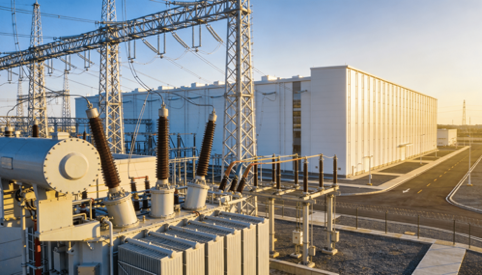 (Image caption) A scene showing substation facilities juxtaposed with a large data center building. The article emphasizes that data centers are ultimately built on the power grid and the community, and that power access, transmission upgrades, local costs, and public trust are institutional issues that the United States must simultaneously address when choosing to accelerate AI infrastructure development.
Data centers are ultimately built upon the power grid and the community.
Trump described data centers as strategic industrial assets, highlighting the physical reality of the AI economy. Each large AI data center requires reliable power, transformers, power grids, cooling systems, land, and a skilled construction workforce. It's not a virtual abstraction hidden behind the word "cloud," but a massive local construction project.
If the U.S. is to accelerate its AI infrastructure development, it must answer some practical questions: Who will pay for grid upgrades? How many long-term jobs and local tax revenues will data centers ultimately create? How will community concerns about water resources, electricity prices, and environmental impact be addressed? Will public subsidies for large-scale projects be linked to measurable returns?
The Ohio project has brought these issues to the forefront. It's important that a data center can be built; equally important are its access to sufficient power, financing, sustainable utilization, and the earning of long-term trust within the community.
For Nvidia, these are not distant public policy issues. Whether GPUs can be converted into sustainable revenue depends on whether data centers can be built, connected to the grid, secured funding, and maintained viable operational efficiency. The larger Nvidia's capital footprint, the more tightly it is tied to energy infrastructure and the local communities that house those facilities.
The systemic problems persisted even after the phone call.
A phone call from Trump to Jensen Huang suddenly gave an AI debate a different kind of immediacy: the president was online, the CEO of the world’s most important AI infrastructure company was on stage, and thousands of listeners witnessed a public statement from the United States on its direction in AI.
The call conveyed a clear stance: the United States should not allow fear to halt an emerging industry; data centers must be built; and the AI race must continue.
The reality beyond the phone call is equally clear. Through equity investments, data center guarantees, equipment supply, optical interconnect investments, and third-party financing partnerships, Nvidia is paving a longer runway for this race.
The United States can choose to accelerate. But speed should not be a reason to obscure financial structures, ignore public costs, or abandon independent oversight. Mature AI competitiveness should be built on an institutional framework where companies can invest, technology can advance, the market can clearly see the risks, and the community can understand what it will bear and what it will gain.
The brakes may have been released, but the steering wheel should not be entrusted to any single force.
Disclaimer
This article is for news, research, and informational purposes only. The content is compiled from publicly available reports and company disclosures and does not constitute investment, securities, legal, tax, energy, or AI security advice. Readers should independently verify the latest company documents, policy information, and professional opinions.